
Sign up to save your podcasts
Or



If I give myself grace, will I lose my edge?
Maybe you’ve wondered that too.
If you built your career on getting everything done without complaint, letting yourself off the hook can feel like opening Pandora’s box. As an Enneagram 3, I’ve wrestled with this one for years. Part of the answer lies in how our culture rewards grit, and in what that’s taught us to call discipline.
This episode explores:
Here’s a question to sit with: what would it feel like to be held by both grace and devotion, instead of choosing between them? And if you know a woman who’s afraid to slow down because she thinks she’ll lose herself, send this episode her way.
Curious where you are in your own work recovery? Take the Work Recovery® Audit at workrecovery.com.
Connect with Bree
After burnout, so many of us start asking when we’ll get back to normal and feel like ourselves again.
In this episode, I give you my honest answer. You may never return to the version of you who existed before burnout... and that might be the best news.
When you look at your patterns with radical honesty, you find things you want to change. That could be how you work, how you show up for your work, or how you separate your worth from your output. Those changes become who you are now. And yet there can be real grief in letting go of the woman who could push through anything, especially when the people around you got used to her.
I also share where I am right now in writing my book, using a ritual of 999 words a day. That excavation has shown me a built-in “governor” I didn’t have in my chief-level years, and I’m learning to trust it.
In this episode
Take the Work Recovery Audit
I worked really hard on this one. The audit helps you slow down and notice what you might be carrying from work, then maps your answers to the Work Recovery Method (Regulate, Rewire, Reclaim). It tells you which phase to start in. Take it at workrecovery.com or find it linked at executiveunschool.com. I’d love to hear what you think.
Share the show
If this episode helped you, follow or subscribe and leave a rating. Then send it to the friend who keeps saying “I’m fine,” with a note that says, “This made me think of you.”
Connect with Bree
I’ve wrestled with this one for years: when do I give myself grace, and when do I push through?
After burnout, your internal alarm system can get out of whack. Some women feel like everything is forcing. Others feel so numb that nothing registers at all. No one can watch you work and tell you whether you’re in flow. You’re the instrument, and this episode helps you tune it so you can feel into what force and flow feel like for you.
This episode explores:
Here’s a question to sit with: pick one task on your list this week. Does it renew your energy, or does it borrow from somewhere you’ll have to pay back later? And if you know a woman who’s trying to find her way back after burnout, send this episode her way.
Connect with Bree
When a woman comes to me after burnout, I ask her what she wants for herself. Most of the time, she can’t answer.
Maybe you can’t either.
She can tell you exactly what her team needs and what her boss expects. Her own desires are much harder to find. That long pause says a lot. Burnout is the work wound our culture has finally named, and underneath it, so often, is self-abandonment.
In this episode, I share how that showed up in my own career, and why rest alone rarely heals it. This episode explores:
Here’s a question to sit with: where did you first learn that your needs could wait when it comes to your work? And if someone you love keeps saying “I’m fine,” send this episode her way.
Connect with Bree
I’ve said “I’m burned out” in the same breath as “I’m tired.”
Maybe you have too.
In the past few episodes, we redefined growth as capacity expansion. This week, I’m looking at what happens when our capacity gets pushed past its edge for too long.
Burnout might be the most overused word in work culture right now, and I think it’s one of the least understood. We use it as a catch-all, then take some PTO and expect a week off to fix something that took years to build.
So in this episode, we get more precise. This episode explores:
Here's a question to sit with: when you say you’re burned out, what do you actually mean? Getting specific is the first step toward finding your way back. And if this episode made you think of someone who’s running on empty, send it her way.
Connect with Bree
Instagram: @breejohnsonofficial x @executiveunschool
I used to believe growth came from pushing harder.
This week, I've been redefining growth as capacity expansion: the capacity to hold more of my own truth and to stay with myself when life gets full. That definition leads to a better question. If growth is capacity, what actually expands it?
In this episode, I share my answer in two parts.
The first is environment. So many of us leave a job that hurt us and then keep living in the conditions that caused the hurt. When the same patterns show up again, we blame ourselves. Changing the conditions around you creates room for growth that willpower alone can't force.
The second is the promises we keep to ourselves. As a former employment attorney, I think of these as the unspoken contracts we have with ourselves. Self-trust gets built one honored term at a time, and every small promise kept tells you that you can count on yourself. That trust is the fuel that lets you hold more.
I also share what these two rules look like in my life right now, as physical health becomes my number one priority after some eye-opening news.
This episode explores:
If your growth looks quiet right now, I see you. This weekend, choose one small promise to yourself that you know you'll keep. Then keep it, and notice what it feels like to be someone you can count on.
Connect with Bree
I'm becoming suspicious of the way I've defined growth for most of my life.
For 20 years, I lived inside reports. As managing partner, COO, and chief strategy officer, I watched revenue, headcount and expense trends, and the "successful" direction of every line was up. Flat meant a problem. A sharp decline meant a crisis.
Somewhere along the way, I started measuring my own life the same way. More clients meant better. A fuller calendar meant I was growing. Anything that slowed down felt like falling behind. I carried that pattern right into my work as founder and Editor in Chief of Executive Unschool.
This week, after so many of you responded to Wednesday's letter, I wanted to keep exploring this in real time. I don't have it all figured out.
What I do have is a new definition that's been coming online for me over the past few months: growth as capacity expansion. Capacity to hold more of my own truth. Capacity to stay with myself when things get hard. Sometimes that means adding something, and sometimes it means clearing space.
This episode explores:
If your growth right now looks quiet or steady, or even like a season of contraction, I hope this gives you another way to measure it.
Ambition is beautiful. Big, audacious goals are the essence of how good it can get. Let's make sure our measures of growth include how we actually feel.
Connect with Bree
I know what it feels like when the thing you built becomes the thing you have to leave.
Ashlei Rolloff got the email on her day off. The million-dollar agency she had built was being divested and spun out to her. On paper, it was a gift. Inside, it showed her how much of her worth had been tied to her VP title and her output.
In this episode, Ashlei shares the grief that came in waves and the very specific ways she has rebuilt since, including a sovereign morning and a last hour of the day that belongs to her alone.
The beauty in her story is this: the exit opened a new door, and the healing work is what let her walk through it.
This episode explores:
Featured: Build Your Personal Life Coach Agent
Join Ashlei live on October 13 to 15, from 11am to 1pm CT each day, and build an AI coach trained on your Human Design and core values. No coding is needed. Pilot pricing is $297, and only four spots remain.
Register: https://nerdherdpro.com/ai-education/
Friend, if you're in that in-between season, I hope this conversation helps you feel less alone. How good can it get?
Connect with Ashlei
Connect with Bree
I signed up for something a few weeks ago that my body was already saying no to... and I said yes anyway.
Fresh off the Growth Day Conference, I've been sitting with the word growth. Somewhere across 20-plus years of work, I started treating growth and more as the same thing. More clients, more partnerships, more posts, more speaking engagements, all stacked on top of what I already carry.
Then a founder archetype survey from my fractional finance advisor stopped me cold. I'm building as three different founder archetypes, running three different businesses at once.
As an Enneagram 3, I believe I'm capable of a lot. Building three startups at the same time is a different question, and it explains why I can cross off half my to-do list and still end the day feeling behind. Here's my reframe: when you choose contraction on purpose, that counts as growth too.
This episode explores:
If you're in a season where everything you're carrying looks good on paper and still feels heavy, take one minute today. Name one area where "more" has been running the show. Then ask what would actually serve your highest good. Letting something go can be the most growth-forward move you make this fall.
Connect with Bree
Website: executiveunschool.com
Instagram: @breejohnsonofficial
I've drafted email replies in my head while someone I love was telling me about the best moment of their day. Guilty.
Maybe you've been there too. You walk through the front door (or up the stairs, if you work from home) and realize you never actually left work. Your body is home, and your mind is still in the 3:00 meeting, rewriting what you should have said. Then the shoes and backpack in the entryway set you off, and deep down you know the shoes were never the point.
Research on how people recover from work shows that heavy workloads make it harder to mentally detach during time off. So the weeks you need a real break the most are the weeks your brain holds on the tightest. And with work living in our pockets, the natural boundary between the workday and the rest of your life has disappeared. We have to build that boundary ourselves.
In this episode, I'm sharing how to recognize the signals that it's time to reset, plus two practices that help: micro-recoveries during the day and a clean break at the end of it.
Listening back, here's my reframe: rest is something you build in before you feel you've earned it.
This episode explores:
Your invitation for today is simple. Pick one signal you know shows up for you, and when you notice it, let it be your cue for a micro-recovery. Then tonight, try one clean break. You've done enough for today, friend.
Connect with Bree
From the publisher's feed
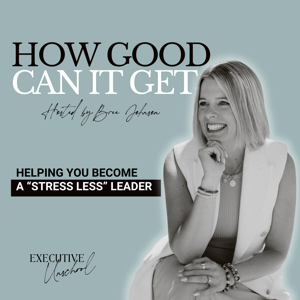
How Good Can It Get is a podcast for ambitious leaders, founders, and creatives who are ready to move beyond burnout, hustle culture, and surface-level success.
Hosted by Bree Johnson — former law firm executive turned leadership thinker and creator — this show explores what it really takes to heal work wounds, reclaim personal power, and build a life where success and fulfillment coexist.
Through thoughtful conversations and solo reflections, each episode examines the intersection of work, wealth, worth, and well-being, offering grounded insights on leadership, identity, nervous system regulation, career transitions, and the hidden emotional costs of modern ambition.
This is not productivity advice or performative self-help.
It’s a deeper inquiry into how we work, why we strive, and what it means to lead with clarity, integrity, and self-trust.
If you’re navigating burnout, redefining success, or questioning the systems you’ve been asked to perform within, this podcast offers a quieter, wiser path forward.
Tune in weekly and subscribe to explore how good life — and leadership — can truly get as you learn to recover your energy.