
Sign up to save your podcasts
Or



The conversation explores the radicalization of Muslim communities in Europe, focusing on the influence of the Palestinian issue and the rise of political Islam. Kobi Michael discusses his research findings on the demographic changes, manifestations of Islam in daily life, and the responses of European politicians to radicalization.
Takeaways
Chapters
The conversation features Phyllis Chesler discussing the evolution of feminism, the Palestinianization of feminist discourse, and the challenges faced by women under oppressive regimes. It highlights the disconnect between mainstream feminism and the realities of women's rights in various cultures, particularly in relation to Islam and the political landscape surrounding Israel. The conversation delves into the complexities of feminist movements, media representation, and the challenges faced by women in various cultural contexts, particularly in relation to Israel and the broader implications for Western civilization. Phyllis Chesler and Richard Landes discuss the failures of feminist organizations to address issues of anti-Semitism and the plight of women in Muslim-majority countries, while also highlighting emerging voices in feminism that challenge the status quo.
Takeaways
Chapters
The conversation with Charles Asher Small delves into the intricate web of foreign funding in Western academia, particularly focusing on the influence of the Muslim Brotherhood and Qatari investments. It highlights the alarming rise of antisemitism and the ideological shifts in education stemming from these financial ties. The conversation delves into the complex interplay of antisemitism, education, and foreign influence in American universities, highlighting the historical roots of antisemitism, the role of the Muslim Brotherhood, and the impact of foreign funding on academic integrity. It emphasizes the need for awareness and action to combat these issues and support Israel as a frontline in a global struggle against extremism.
Takeaways
Chapters
The conversation explores the evolution and current state of the feminist movement, particularly its handling of women's rights in the Muslim world and the intersection with issues of race and representation. Corinne Blackmer discusses the historical context of the feminist movement, critiques of its current trajectory, and the implications for marginalized voices within and outside the movement.
Takeaways
Chapters
The conversation between Elaine Ellinger and Richard Landes explores the fundamental misunderstanding of Islam in the West, emphasizing that it is not merely a religion but a comprehensive system known as 'Deen'. Elaine Ellinger discusses the implications of this misunderstanding, particularly in educational contexts, and highlights the need for a clearer understanding of Islamic teachings and their impact on society. The conversation delves into the complexities of Islamic teachings, the dualistic nature of its laws, and the implications of Islamic jurisprudence on society. It also discusses the phases of Islamic expansion, the situation in Nigeria, and the challenges faced in addressing Islamophobia and promoting awareness of these issues.
Takeaways
Chapters
In this conversation, Khaled Hassan shares his personal experiences growing up in Egypt and the impact of his childhood on his views about faith and identity. He discusses the complexities of ideological change, emphasizing the importance of genuine self-reflection and critical thinking in recognizing true transformations in beliefs.
Takeaways
Chapters
In this conversation, Richard Landes and Andrew Pessin delve into the critical study of antizionism, exploring its historical roots and contemporary implications. They discuss the complexities of addressing antisemitism and the challenges posed by media narratives surrounding the Israeli-Palestinian conflict. The conversation delves into the complexities surrounding the criticism of Islam and the ideological underpinnings that shape contemporary discourse. It highlights the interplay between progressive ideologies, fear of backlash, and the historical context of antisemitism.
Takeaways
Chapters
The conversation between David Patterson and Richard Landes explores the historical and metaphysical roots of antisemitism, drawing connections between past and present forms of hatred towards Jews. David Patterson articulates how antisemitism is not merely a form of prejudice but is deeply intertwined with theological and philosophical challenges posed by Jewish thought. The conversation delves into the historical and cultural significance of Jewish identity, the roots of antisemitism, and the metaphysical implications of these themes. David Patterson and Richard Landes explore the responsibilities of the Jewish people, the nature of hatred, and the importance of embracing one's identity amidst societal challenges.
Takeaways
Chapters
The conversation between Benjamin Kerstein and Richard Landes explores the dynamics of Jewish identity, self-defense, and the ideological conflicts within the Jewish community, particularly in relation to antizionism and the influence of prominent figures like Chomsky and Beinart. It delves into the moral implications of these ideologies and the perceived threats to Jewish existence, especially in the diaspora. The conversation delves into the rise of antisemitism in American politics, particularly focusing on figures like Bernie Sanders and Ben Rhodes, and their perceived roles in this trend. It also explores the dynamics of Jewish identity, privilege, and the challenges faced by the American Jewish community in confronting antisemitism and radical ideologies.
Takeaways
Chapters
The conversation between Rajiv Malhotra and Richard Landes delves into the historical and ongoing struggles of Hindus in India against Islamic invasions and violence, highlighting the need for awareness and dialogue among non-Muslims. Rajiv Malhotra shares insights from his extensive research on the topic, emphasizing the importance of acknowledging historical atrocities and fostering understanding among different faiths. The conversation delves into the historical context of violence against Hindus, particularly during the partition of India, and explores the implications of history centrism in understanding religious narratives. Rajiv Malhotra shares personal anecdotes and broader historical insights, emphasizing the need for a nuanced understanding of these events. The conversation explores the complexities of monotheism, the need for mutual respect among religions, and the historical context of Abrahamic faiths. It emphasizes the importance of understanding Hindu perspectives, the necessity for reform within Islam, and the potential for alliances against radical ideologies.
Takeaways
Chapters
From the publisher's feed
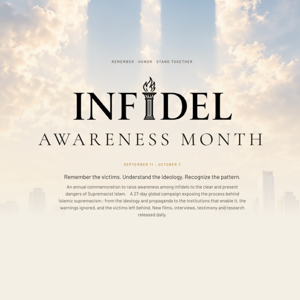
The podcast in support of Infidel Awareness Month.
Remember the victims. Understand the ideology. Recognize the pattern.
An annual commemoration to raise awareness among…
A 27-day global campaign exposing the process behind Islamic supremacism; from the ideology and propaganda to the institutions that enable it, the warnings ignored, and the victims left behind.
New films, interviews, testimony and research released daily.