
Sign up to save your podcasts
Or



This conversation between examines the decline of ancient Christian communities across the Middle East and discusses how religious law, jihad ideology, and Western interpretations may shape that decline. Richard Landes and Robert Spencer focus on Syria, Iraq, Turkey, Armenia, Spain, and Nigeria, exploring why religiously driven conflicts are sometimes framed as nationalism or politics.
Robert Spencer shares his perspective on Islam, jihad, and Islamic history, discussing dhimmi restrictions, caliphal ideology, and the Muslim Brotherhood. The conversation also considers how media, academia, and religious institutions describe persecution and conflict. The views expressed are those of the speakers.
Timestamps
00:00 - Opening the discussion on the disappearing Christians of the Middle East
00:38 - Iraq, Syria, and Turkey: the collapse of ancient Christian populations
01:05 - Robert Spencer’s background and long study of Islam and jihad
02:12 - Spencer’s concerns about the future of Middle Eastern Christian communities
02:39 - Saddam Hussein, Syria, and secular rule
03:59 - Arab nationalism and discrimination in Islamic law
05:30 - The limits of nationalism in the Arab world
06:54 - The global Ummah and national identity
07:22 - Why Spencer rejects a nationalist interpretation of Hamas
08:16 - Palestinian statehood and a broader Islamic project
10:46 - Palestinian identity and its historical and political context
12:57 - The dhimmi system and the legal status of Christians and Jews
13:25 - The continued influence of historical restrictions
14:46 - The Armenian genocide and violence against Christians
15:06 - Spencer’s characterization of Islam’s relationship to political power
16:27 - Lands once ruled by Islam and the idea of driving out non-Muslims
17:15 - Spain, the Balkans, and jihad beyond the Middle East
18:55 - Qur’anic passages cited in discussions of religious conflict
20:24 - Defensive jihad and its use to justify offensive campaigns
21:54 - The Muslim Brotherhood document and internal subversion
22:47 - The document’s language about undermining the West
24:38 - Spencer’s interpretation of Qur’anic language about unbelievers
25:28 - How supremacist interpretations describe non-Muslims
26:52 - Religious claims about moral leadership
27:31 - The discussion of apartheid-like attitudes
28:41 - Neighborly relations and points of tension
29:40 - Historical examples of neighborliness turning to violence
31:47 - Yugoslavia, ethnic identity, and the end of state suppression
33:13 - The Armenian genocide as an escalating process
34:53 - Nationalism and supremacist interpretations of Islam
35:15 - Hamas, civilians, and the speakers’ discussion of jihad
37:04 - Apostasy in Kuwait and constitutional freedom under Sharia
38:13 - Human rights language and the Cairo Declaration
39:37 - Al-wala wa-l-bara and religious loyalty
40:34 - Nigeria, Fulani jihad, and media coverage
42:15 - How institutions describe jihad-related violence
45:38 - “Therapeutic history” and public understanding
46:56 - Campus reactions and debates over Islamophobia
49:14 - Marxism, postcolonial framing, and the victim-oppressor lens
50:34 - Why Western elites may avoid dissent
54:17 - The idea of “invisible dhimmitude” in media and academia
55:05 - Qatar, Saudi influence, and journalistic self-censorship
56:20 - Christian leaders and responses to persecution
57:16 - Dialogue and its limits, as discussed by the speakers
59:14 - Grassroots awareness and advocacy
60:40 - Spencer’s stated solidarity with victims of jihad
61:53 - Where to find Robert Spencer’s writing and research
The conversation between David Deutsch and Richard Landes explores the concept of antisemitism as a moral irrationality and a pattern of distorted moral reasoning. It delves into the historical and contemporary manifestations of this pattern, its transmission, and its impact on society and politics. The conversation delves into the pattern of antisemitism and its impact on Western politics and culture. It explores the unconscious adoption of the pattern, its historical manifestations, and its influence on foreign policy. The discussion also highlights the intersection of the pattern with contemporary movements like woke culture and the challenges of addressing the pattern in journalism.
Takeaways
Chapters
The conversation delves into the historical and contemporary persecution of Christians in the Middle East and Africa, highlighting the systematic assault on indigenous Christian communities. It also explores the silence and indifference of the West, particularly American Christians, towards the plight of persecuted Christians. The impact of the exilic condition on the cultural, spiritual, and mental well-being of Christians in the West is also discussed. The conversation delves into the challenges faced by Western civilization, the loss of framework and discipline, the need for solidarity among Christians and infidels, and the potential role of Israel in providing refuge for persecuted minorities. It also touches on the issue of supremacist Islam and the need for a reformation within the Muslim world.
Takeaways
Chapters
The conversation between Andrew Pessin and Richard Landes delves into the academic capture by antizionist ideology, the ironies of Arab modernization, and the willful blindness of Western elites to Islamic supremacy. It explores the red-green alliance that tore through academia in the 21st century and the impact of supremacist Islam on academic fields. The conversation delves into the prevalence of anti-Zionism in academic circles and its impact on Jewish studies. It also explores the historical origins of antizionism and its connection to the Protocols of the Elders of Zion. The discussion highlights the need for scholarly examination and critique of antizionist ideology.
Takeaways
Chapters
The conversation between Danny Burmawi and Prof Richard Landes delves into the concept of Islamophobia and Islam's phobia, highlighting the intolerance of Islam to criticism and its impact on society. It explores the nature of Islam and its influence on societal norms and behaviors. The conversation delves into the Islamic sentiment, the supremacist reading of Islam, the otherness of people in Islam, the best story in Islam, and the challenge of being a good neighbor to infidels. It explores the Islamic sentiment and its impact on the perception of otherness, as well as the challenges of interpreting and practicing Islam in a diverse society.
Takeaways
Chapters
The conversation between Prof Richard Landes and Dr Andy Bostom delves into the concept of Islamophobia as a tool used to suppress criticism of Islam and the importation of anti-Semitic attitudes into Western societies. It explores the power of the Islamophobia accusation and its impact on public discourse, as well as the prevalence of extreme antisemitism in Muslim societies and its influence on Western populations. The conversation methodically explores the reluctance to discuss Islam's historical record of hostility, the impact of Islamic institutions on the persecution of Christians and Jews, and the role of Western intellectuals in dealing with Islamic supremacism. It delves into the clash of civilizations, the concept of supremacist Islam, and the need for Muslims to acknowledge the historical doctrine of jihad. The discussion highlights the battle of open society and dispute, as well as the impact of Al Azhar University's influence.
Takeaways
Chapters
The podcast 'Infidels' features a discussion on the rise of oikophobia and its convergence with Islamic movements in the US.
This first episode is hosted by Juliana Taimoorazy and features Benedict Beckeld and Prof Richard Landes in conversation.
The conversation delves into the aftermath of 9/11, the celebration of the attack, and the emergence of self-hate within Western civilization. It also explores the influence of Marxist ideology and the Frankfurt School on the development of oikophobia, as well as the role of apocalyptic expectations in shaping societal attitudes. The conversation delves into the concept of aggressive naivete and the impact of supremacist Islam on Western civilization. It also explores the genesis of Islamophobia and the need for reformation from within. The discussion concludes with a focus on the importance of awareness and action to safeguard Western civilization.
Takeaways
Chapters
From the publisher's feed
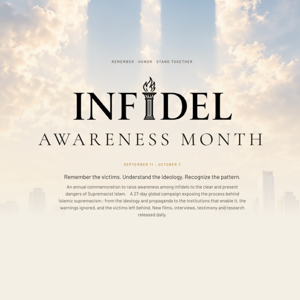
The podcast in support of Infidel Awareness Month.
Remember the victims. Understand the ideology. Recognize the pattern.
An annual commemoration to raise awareness among…
A 27-day global campaign exposing the process behind Islamic supremacism; from the ideology and propaganda to the institutions that enable it, the warnings ignored, and the victims left behind.
New films, interviews, testimony and research released daily.