
Sign up to save your podcasts
Or



There is a moment in leadership that doesn’t get talked about very often.
It’s not the moment when a decision is made. It comes earlier—when something starts to become clear, but not yet to everyone else.
In this short video, Dr. Melissa Morriss-Olson introduces her latest reflection on this often-overlooked phase of leadership: the space between recognizing a shift and bringing others along.
Drawing on conversations with university presidents, she explores what it means to:
• see something before others do
• navigate the timing of action
• communicate through uncertainty
• and “hold” an institution through change
This is the part of leadership that can feel isolating—and yet, it’s often where the most important work begins.
🎥 Watch the video for a brief introduction
📖 Read the full essay here: https://ingeniousu.wpcomstaging.com/
We’d love to hear what resonates with your own leadership experience.
In this episode of IngenioUs, I sit down with President Krista L.Newkirk J.D.of the University of Redlands—an extraordinary leader whose journey to the presidency is as compelling as her approach to leadership.
From her early years growing up on a cattle ranch in Missouri, to her career as an attorney, to leading complex institutional transformation, Krista’s story is one of resilience, adaptability, and purpose. What stands out most is her ability to navigate high-stakes decisions with both analytical rigor and deep humanity.
At the heart of her leadership is a powerful—and often overlooked—skill: listening. As Krista shares, truly listening means understanding not just what people say, but what they feel—and that insight shapes how she leads, makesdecisions, and builds trust across her institution.
In our conversation, we explore:
If you’re a leader in higher education—or aspire to be—this is an episode you won’t want to miss.
About Our Guest
Dr. Krista Newkirk is President of the University of Redlands. With a background in law and higher education leadership, she has led significant institutional transformation, including mergers and strategic growth initiatives, while remaining deeply committed to student success andmission-driven leadership.
What makes a university—and its surrounding city—sticky?
In this episode, David J. Staley explores a powerful concept shaping the future of higher education: stickiness—the ability of a college or university not only to attract students, but to inspire them to stay, build careers, and contribute to the region after graduation.
Drawing on a recent consulting experience at a Midwestern university, Staley reflects on a familiar challenge: institutions successfully bring students in, only to watch them leave for opportunities elsewhere. He contrasts this with “sticky” ecosystems like Ohio State and Columbus, where a dynamic interplay between university strengths and regional opportunities encourages graduates to remain and thrive.
The episode introduces the idea of a “stickiness index”—a framework for assessing how well institutions and cities retain talent. Factors include:
Staley argues that stickiness is not accidental—it requires a deliberate, collaborative strategy between universities, civic leaders, and employers. It also calls for a reimagining of alumni engagement, shifting from long-term connection-building to immediate post-graduation retention efforts.
Importantly, he reframes the common narrative of “brain drain” as something more subtle: “brain leakage”—where talent is developed locally but gradually seeps away due to lack of opportunity or connection.
For institutions facing enrollment pressures and questions about value, a focus on stickiness offers a compelling path forward—one that integrates enrollment, student experience, workforce development, and regional vitality into a unified strategy.
🔑 Key Takeaways
🎯 Why This Matters
As higher education faces increasing disruption—from demographic shifts to economic pressures—institutions must think beyond traditional metrics. “Stickiness” reframes success in terms of long-term impact, regional contribution, and human connection.
👤 About the Author
David J. Staley is a historian, author, and thought leader on the future of higher education. His University Design column explores innovative ideas shaping institutions and their role in society.
In a time when higher education is facing profound questions about its value, purpose, and future, what does it take to lead with both clarity and conviction?
In this episode of IngenioUs, I sit down with Dr. Summer McGee,president of Lenoir-Rhyne University—a dynamic and forward-thinking leader whose career has been defined by building: building programs, building strategy, and building institutions that grow and thrive.
From her earliest days as a faculty member launching a new academic program to her leadership today as a two-time college president, Summer has consistently approached leadership with a builder’s mindset. In our conversation, she shares what she has learned across her leadership journey and how she is navigating one of the most complex moments in higher education.We explore:
Throughout the conversation, Summer offers a powerful reminder that leadership is both deeply strategic and deeply human—and that the future of higher education will be shaped by those who can do both well.About the Guest
Dr. Summer McGee is the president of Lenoir-Rhyne University. A two-time college president and former founding dean, she is known for her expertise in academic innovation, enrollment growth, and institutional transformation. Her leadership is grounded in a commitment to student success, strategic clarity,and building organizations that are positioned to thrive in a rapidly changing higher education landscape.
Key Takeaways
Connect & Learn More
Follow IngenioUs for more conversations with innovative leaders shaping the future of higher education.
In this episode of IngenioUs, Melissa Morriss-Olson explores a dimension of leadership that doesn’t often get named—but is deeply felt by those in leadership roles.
We talk a lot about transparency in leadership. We encourage it. We expect it. And in many cases, we equate it with effective leadership.
But what happens when leaders can’t fully share what they know?
Drawing from recent conversations with college and university presidents, Melissa reflects on a different kind of tension—one that sits at the intersection of responsibility, judgment, and trust.
This is not about what leaders avoid saying.
It’s about what they cannot fully say—even when they want to.
In this episode, Melissa explores:
This conversation is grounded in real leadership stories and reflects a broader pattern Melissa is seeing across higher education today.
She expands on these ideas in more depth in her latest blog:
👉 What Leaders Know—but Cannot Fully Say
As you think about your own leadership:
How do you navigate the tension between being transparent and being responsible?
If this resonates with you, we'd love to hear your thoughts.
Feel free to connect or share your perspective.
IngenioUs explores leadership in higher education through candid conversations with presidents and changemakers who are navigating complexity, driving innovation, and leading with purpose.
In this episode, David J. Staley reads from his latest University Design blog entry, Educable, where he explores a provocative new concept drawn from Leslie Valiant’s recent work: that what truly distinguishes humans is not intelligence—but educability.
What if education is not simply about acquiring knowledge or skills, but about undergoing a fundamental “state change”—a transformation in how we think, act, and understand the world? And what if this idea reshaped how we assess learning, design degrees, and even imagine the future of artificial intelligence?
Staley challenges us to reconsider long-standing assumptions about education versus training, the purpose of higher education, and what it really means to be “educated” in a rapidly evolving world.
Key Ideas Explored
Why This Matters
At a time when higher education is under pressure to demonstrate value and relevance, this episode invites us to think more expansively. If education is truly about transformation—about changing who we are—then our current systems of grading, credentialing, and ranking may be missing the point.
Staley’s reflections open the door to a more ambitious vision of higher education—one centered on human development, adaptability, and lifelong learning.
📖 Read the Full Blog
👉 Educable by David J. Staley
🎙️ About the Author
David J. Staley is a higher education philosopher, strategist, futurist, and designer. He serves as an Honorary Faculty Fellow in Innovation at CHELIP and is the author of Alternative Universities, The AI Symposium, and other works exploring the future of higher education and knowledge systems.
🔗 About the Series
This episode is part of the University Design series, published under the IngenioUs blog label, which explores bold, forward-thinking ideas about the future of higher education.
In this episode of IngenioUs, Melissa Morriss-Olson speaks with Rachelle Keck PhD, JD, president of Grandview University, about leadership, agency, and the evolving future of higher education.
Rachelle’s path to the university presidency is far from traditional. After more than two decades practicing law, she transitioned into higher education leadership and eventually became the president of Grandview University in Des Moines, Iowa. In this conversation, she shares how her experiences as a first-generation college student, a woman leader inhigher education, and one of nine siblings growing up in rural Missouri shaped her leadership philosophy.
Rachelle discusses the leadership lessons she learned moving from law into higher education administration, the realities of leading a university today, and how institutions can prepare students for a rapidly changing workforce.
She also shares the four pillars that guide her leadership every day: love, logic, listening, and learning—a framework that blends analytical decision-making with empathy and collaboration.
Throughout the conversation, one powerful question keeps resurfacing—one that Rachelle first heard as a child and now shares with students and emerging leaders:
What are you going to do about it?
This episode will resonate with anyone interested in women’s leadership, university leadership, higher education innovation, and the future of college leadership.
Topics Discussed in This Episode
About the Guest
Rachelle Keck is president of Grandview University, a private university in Des Moines, Iowa. Before entering higher education leadership, she spent more than twenty years practicing law. Her leadership focuses on student opportunity,institutional sustainability, and preparing graduates for meaningful careers and lives of purpose.
About the Podcast
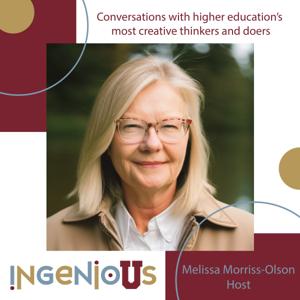
IngenioUs is a higher education leadership podcast hosted by Melissa Morriss-Olson, Distinguished Professor of Higher Education Leadership at Bay Path University and author of IngenioUs Leadership: Creating Solutions to Wicked Problems in Higher Education.
Each episode features conversations with innovative leaders who are shaping the future of higher education.
In this episode of the IngenioUs Leadership Podcast, Melissa Morriss-Olson sits down with historian and higher education leader Carol Quillen, former president of Davidson College and now President and CEO of the National Trust for Historic Preservation.
Carol brings a historian’s lens to leadership—one grounded in humility, courage, and a deep respect for the power of community and place. Over the course of the conversation, she reflects on her leadership journey from growingup in a small historic town in Delaware to leading one of the nation’s most respected liberal arts colleges.
Carol shares insights about what leadership really means, why she believes it is fundamentally about helping communities create the conditions for change, and what she learned about guiding an institution through moments of uncertainty, including the challenges of the COVID-19 pandemic.
The conversation also explores her current work with the National Trust for Historic Preservation, where she is thinking deeply about how historic places can help Americans reconnect with the complexity of their shared history. At a time when public conversations often feel abstract and polarized, Carol argues that standing in the places where history actuallyhappened can open the door to more thoughtful dialogue and renewed civic understanding.
This episode is a thoughtful reflection on leadership, community, and the enduring importance of place in shaping how we understand ourselves and one another.
Key Themes from the Conversation
Leadership as Context Building
Carol describes leadership not as a title or position but as the work of helping a community create the conditions it needs to live up to its highest aspirations.
Courage and Humility in Leadership
Two qualities she believes are essential for leaders navigating complexity and uncertainty.
Listening and Trust Building
How leaders create environments where people can speak honestly, disagree respectfully, and work together toward shared goals.
Leading Through Crisis
Reflections on guiding Davidson College through the COVID-19 pandemic and the importance of transparency when decisions must be made with incomplete information.
The Power of Institutional Culture
Why understanding the history and identity of an organization is critical when leading change.
The Power of Place in Civic Life
How historic sites—from Gettysburg to Monticello to immigrant tenements—help us confront the complexity of American history and foster deeper conversations about our shared future.
Advice for Emerging Leaders
Carol encourages young leaders to focus less on career planning and more on doing the work that is right in front of them.
About Carol Quillen
Carol Quillen is President and CEO of the National Trust for Historic Preservation and the former president of Davidson College, where she served for eleven years.
A historian by training, Carol previously spent many years on the faculty at Rice University and held several administrative leadership roles there. She is widely respected for her thoughtful approach to leadership, institutional change, and civic engagement.
Her current work focuses on the role historic places can play in strengthening communities and fostering dialogue about the nation’s shared past and future.
About the IngenioUs Leadership Podcast
The IngenioUs Leadership Podcast explores how leaders createsolutions to complex challenges in higher education and beyond. Through conversations with innovative and thoughtful leaders, the podcast highlights ideas, experiences, and perspectives that help listeners think differently aboutleadership today.
Where does innovation really begin? After interviewingdozens of college presidents, one surprising leadership habit kept appearing: listening.
When we talk about innovation in higher education, theconversation often centers on bold ideas, new programs, or visionary strategies. But insights from leaders across the field suggest that meaningful innovation often begins somewhere much quieter.
It begins with listening.
Through the IngenioUs podcast, Dr. Melissa Morriss-Olson has spoken with dozens of college and university presidents about leading change in complex institutions. One lessonconsistently emerges from those conversations: before introducing new initiatives, successful leaders take time to understand the people and contexts they serve. They listen to faculty, staff, and students, learning how their institutions really work and what challenges people are experiencing.
Why does this matter? Because when leaders move tooquickly to solutions, they sometimes end up solving the wrong problem.
Listening helps uncover the deeper issues—and the real opportunities for meaningful change.
In Dr. Morriss-Olson’s newest blog article, “TheFirst Leadership Habit of Innovation,” she explores this ideaand shares insights drawn from these leadership conversations.
You can watch the video and read the full article here:
Higher Education Leadership | Innovation | ChangeLeadership | Academic Leadership | Organizational Change
In this episode, David J. Staley reads his latest CHELIP: University Design column, “Interestingness,” inspired by Kenneth O. Stanley and Joel Lehman’s Why Greatness Cannot Be Planned: The Myth of the Objective.
What if the pursuit of clearly defined objectives is actually the enemy of breakthrough innovation?
Drawing on the intellectual journey of urban theorist Jane Jacobs, insights from computer science, and examples from the history of invention, Staley challenges one of higher education’s most sacred assumptions: that learning must always be guided by predetermined goals and measurable outcomes.
Instead, he explores a radical idea — that interestingness, not objectives, may be the true engine of discovery.
In This Episode
Why Jane Jacobs’ “directionless” intellectual wandering shaped one of the most influential urban thinkers of the 20th century
How experiments in artificial intelligence reveal the limits of goal-driven design
The paradox of innovation: why the stepping stones to major breakthroughs rarely resemble the final outcome
The hidden cost of learning objectives and overly structured curricula
Why students who feel “undecided” may actually be operating from a deeper intellectual instinct
The case for reimagining Liberal Studies as a major in “interestingness”
Key Ideas
1. Greatness Cannot Be Planned
Many transformative discoveries — from microwave ovens to airplanes to early computers — emerged not from direct goal pursuit, but from exploratory work aimed at entirely different problems.
2. The Danger of Objective Thinking
Ambitious goals can create tunnel vision. When we fixate on outcomes, we may overlook the very stepping stones that would lead us there.
3. Interestingness as a Compass
Novelty acts as a detector of possibility. Interesting ideas open new pathways — even when their ultimate purpose is unclear.
4. Are Universities Designed for Discovery?
With tightly defined learning objectives and structured degree pathways, are we unintentionally suppressing intellectual exploration?
5. Not Having a Plan Can Be a Very Good Plan
For students drawn to curiosity rather than credentials, exploration may not be aimless — it may be the most innovative strategy of all.
About David J. Staley
David J. Staley is an Associate Professor in the Departments of History, Design, and Educational Studies at The Ohio State University and serves as an Honorary Faculty Fellow in Innovation with CHELIP. His research explores digital history, historical methodology, and the intersection of technology, scholarship, and the future of higher education. A prolific author and curator of digital and physical exhibits, Dr. Staley brings a deep interdisciplinary perspective to conversations about innovation and institutional transformation.
A Question for Listeners
Are our institutions designed to produce graduates with objectives — or graduates with curiosity?
What might change if we structured higher education around interesting questions instead of predetermined outcomes?
From the publisher's feed