
Sign up to save your podcasts
Or



Send us Fan Mail
On Inside Geneva this week: part four of our series marking the 75th anniversary of the Universal Declaration of Human Rights. Imogen Foulkes talks to Navi Pillay, she served as UN Human Rights Commissioner from 2008 to 2014, she started life in racially segregated South Africa.
"We grew up under apartheid and we’re realised there’s something very unfair here. Our teachers were afraid to talk about…you know they would teach us democracy in Greece, but not why don’t we have democracy in South Africa."
She became the first woman of colour to have her own legal practice in South Africa.
"It was so lonely, and so scary. I had very little choice, because I went looking for jobs after I’d qualified, at law firms, they were mainly white law firms, and they would say ‘we can’t – you’re a black person, so we can’t have our white secretaries taking instructions from you.’’
She served on the international tribunal for the Rwandan genocide – but hesitated when Ban Ki Moon asked her to become UN Human Rights Commissioner.
"You have to respond to a call that’s made to you, a trust that people place in you. So if you ask me what moved me from where I wanted to go to this, it was the secretary general saying ‘we need you now’.’
Today, she believes the universal declaration on human rights is as relevant as ever – as long as we use it.
"No state has distanced itself from that treaty. So I see hope in that and I feel these are the tools that civil society has. You have the law, now push for implementation."
Join Imogen Foulkes on the Inside Geneva podcast to find out more.
For more insights and discussions from Switzerland's international city, subscribe to Inside Geneva wherever you get your podcasts.
Get in touch!
Thank you for listening! If you like what we do, please leave a review or subscribe to our newsletter.
For more stories on the international Geneva please visit www.swissinfo.ch/
Host: Imogen Foulkes
Production assitant: Claire-Marie Germain
Distribution: Sara Pasino
Marketing: Xin Zhang
Send us Fan Mail
August marks two important days in the humanitarian calendar
First, the International day of the disappeared.
Fabrizio Carboni, ICRC: ‘I look at my kids, I look at my family, and I say ‘imagine now there is a frontline between us and my son, my brother, my mother, my father, are captured and I can't see them for a year, two, three, four.’’
Inside Geneva hears how the ICRC reunites those divided by conflict, and visits the Red Cross Central Tracing Agency.
Anastasia Kushleyko, Central Tracing Agency: ‘I’m calling from the ICRC, I’m calling from Geneva: As of last week he was a POW, he was safe and well. It's always always people are so grateful and mothers, you know especially mothers.’
Second, the UN marks World Humanitarian Day on August 30. 20 years after the Baghdad bombing which killed 22 UN staff, Inside Geneva talks to an aid worker deeply affected by that day.
Laura Dolci, UN Human Rights: ‘So I had taken him to the airport, together with our child, and the yes it took me in fact many years to be able to use the same elevator in the airport where I last kissed him.’
Laura Dolci, UN Human Rights: ‘The aid worker, the humanitarian worker, the peacekeeper; ultimately it's a human being that decides to put its own being also to the service of humanity.’
Join host Imogen Foulkes on Inside Geneva
Get in touch!
Thank you for listening! If you like what we do, please leave a review or subscribe to our newsletter.
For more stories on the international Geneva please visit www.swissinfo.ch/
Host: Imogen Foulkes
Production assitant: Claire-Marie Germain
Distribution: Sara Pasino
Marketing: Xin Zhang
Send us Fan Mail
On Inside Geneva this week: part three of our series marking the 75th anniversary of the Universal Declaration of Human Rights.
Host Imogen Foulkes talks to Louise Arbour, who served as UN Human Rights Commissioner from 2004 to 2008. She arrived in Geneva with a formidable track record.
As a prosecutor for the former Yugoslavia, she had indicted Slobodan Milosevic for war crimes. In Rwanda, she secured convictions of rape as crimes against humanity.
"The work I did both with the tribunal for the former Yugoslavia and for Rwanda were if anything a vindication for me of the significance of law, of the rule of law, as an organising principle in modern society," explains Arbour.
Leading the UN’s human rights work was a new challenge.
"These were very challenging times. 2004, you know, this was in the backyard of 9/11. It was, a new, dangerous, unknown world was starting to unfold with a lot of uncertainties, including on the human rights front."
New strategies were needed.
"When you arrive in the role of high commissioner for human rights, I think that’s part of the dilemma; how do you use your voice? Because I think to be the megaphone for the denunciation of injustices at some point becomes counterproductive, because it just illuminates how impotent the system is. It’s like you scream in the wilderness," she said.
That’s why this dedicated lawyer still tells us to follow the laws, treaties, and conventions we have.
"If you came from another planet and you just looked at the human rights framework; the universal declaration of human rights, all the treaties, the conventions, the work of the treaty bodies, you’d think you’d arrived in heaven. So why is it not the case?"
Join Imogen Foulkes on Inside Geneva podcast to find out more.
Get in touch!
Thank you for listening! If you like what we do, please leave a review or subscribe to our newsletter.
For more stories on the international Geneva please visit www.swissinfo.ch/
Host: Imogen Foulkes
Production assitant: Claire-Marie Germain
Distribution: Sara Pasino
Marketing: Xin Zhang
Send us Fan Mail
On Inside Geneva this week we take a deep dive into the pros and cons of artificial intelligence. Should the United Nations (UN) help to regulate it? Could it even do that? Across the UN there are different views.
Tomas Lamanauskas, deputy secretary general of the International Telecommunications Union (ITU) says that "the technology in itself has a huge potential to help us resolve a lot of challenges of today, from climate change, to helping education to, helping in the health sector. It’s just that the question is that as with every technology, this technology has risks."
"There are real problems with its ability to accelerate disinformation, and enhance bias. We also have to look at those longer term consequences, in areas like lethal weapons and things where there really are real important, almost existential risks to some of these technologies," adds Peggy Hicks from the UN Human Rights Office (OHCHR).
But what about the tech industry?
Lila Ibrahim, chief operation officer at Google DeepMind says that "from the very start of DeepMind, since 2010, we've been working on AI and thinking about how do we build this responsibly? It's not something we just tag on at the end of all the research we've been doing."
Is goodwill from the tech giants enough?
"The malicious use of AI systems for terrorists, criminal, or state purposes could cause horrific levels of death and destruction, widespread trauma, and deep psychological damage on an unimaginable scale," concludes Antonio Guterres, UN Secretary-General.
Join host Imogen Foulkes on Inside Geneva
Join host Imogen Foulkes for a new episode of the Inside Geneva podcast and gear up for a journey into the world of AI to discover how we can responsibly leverage its power for a better tomorrow.
Get in touch!
Thank you for listening! If you like what we do, please leave a review or subscribe to our newsletter.
For more stories on the international Geneva please visit www.swissinfo.ch/
Host: Imogen Foulkes
Production assitant: Claire-Marie Germain
Distribution: Sara Pasino
Marketing: Xin Zhang
Send us Fan Mail
On Inside Geneva this week: part two of our series marking the 75th anniversary of the Universal Declaration of Human Rights. Imogen Foulkes talks to Mary Robinson, the second person to serve as UN Human Rights Commissioner. Even as a schoolgirl in Ireland, she was already passionate about human rights.
‘I was a bit of a bookworm, and I found a book with a photograph of Eleanor Roosevelt holding the Universal Declaration of Human Rights. That iconic photo.’
She became a campaigning lawyer, and then Ireland’s first female president, but still wanted to do more.
‘There was this office of High Commissioner which I was aware of. In fact, I'd seen some of its work in Rwanda, which had been very difficult work. All my knowledgeable friends said ‘you know Mary I wouldn't take that job’.’
Her time as Human Rights Commissioner was challenging.
‘I remember feeling to myself, I'm going to get on top of this somehow. This job is impossible, everything is very very difficult, it's extremely hard work but somehow I’m going to get on top of it. And it got better.’
‘Some governments were critical…’
‘Over and over again, I kept saying to myself ‘I represent the first three words of the charter of the United Nations: we the peoples. That's what I represent. Not the states.’
Today, her commitment is undimmed..
‘Human rights is the answer. We need to understand that everyone has these core human rights, that all human beings are born free and equal in dignity and rights. That this is who we are.’
Get in touch!
Thank you for listening! If you like what we do, please leave a review or subscribe to our newsletter.
For more stories on the international Geneva please visit www.swissinfo.ch/
Host: Imogen Foulkes
Production assitant: Claire-Marie Germain
Distribution: Sara Pasino
Marketing: Xin Zhang
Send us Fan Mail
On Inside Geneva this week, host Imogen Foulkes asks if the United Nations (UN) should still work in Afghanistan, now the Taliban are banning women from work, and girls from secondary school?
Karima Bennoune, professor of International Law: ‘Anyone who believed in something called Taliban 2.0, had never actually spoken to an Afghan woman human rights defender. Because the Afghan women human rights defenders, they knew what was going to happen. They did their best without a loud microphone to tell governments, to tell international organisations, what was going to happen.’
Is the UN becoming complicit in what some call gender apartheid?
Fiona Frazer, UN human rights, Kabul: Despite the fact that it does seem, every month, or three months or so on a new decree comes out that pushes women further back into their homes, we have to keep being here. That's what women and girls tell us: they want us to be here. They feel the need to have the UN be here, to be present, and to keep going back.
It’s now almost two years since the Taliban seized power again. What do Afghan women think?
Fereshta Abbasi, Human Rights Watch: If there is a resistance in Afghanistan, it’s definitely coming from the women of Afghanistan. That 12-year-old girl who's still attending an underground school in Helmand is the resistance of Afghanistan. The Taliban will never be able to erase their minds and erase the knowledge that they have already gained.
Join Imogen Foulkes on Inside Geneva
Get in touch!
Thank you for listening! If you like what we do, please leave a review or subscribe to our newsletter.
For more stories on the international Geneva please visit www.swissinfo.ch/
Host: Imogen Foulkes
Production assitant: Claire-Marie Germain
Distribution: Sara Pasino
Marketing: Xin Zhang
Send us Fan Mail
This week Inside Geneva starts a new series marking the 75th anniversary of the Universal Declaration of Human Rights. Born out of the terrible cruelty of World War II, millions hoped the declaration would prevent atrocities.
"This Universal Declaration of human rights may well become the international Magna Carta of all men everywhere," said Eleanor Roosevelt.
But there was no UN human rights chief until the cold war ended in the 1990s.
José Ayala Lasso, first UN human rights commissioner says: "Yes, it is an impossible mission to try to guarantee the effectiveness of all human rights: social economic and political cultural, even the right to development of the whole people of the world."
UN member states still differ on what the universal declaration even means.
José Ayala Lasso continues: "If you see human rights through the lens of communism, probably you see them in a different manner when you see them through the eyes of democratic governments. I do not think that we should be permissive in order to accept violations. But we should try to understand the reasons of the other: why the regime, the totalitarian regimes act in a way. Why?"
But some principles are non-negotiable.
"The basic principle is the human being. Human beings are to be respected, they are equal in dignity and in rights as the declaration says in the first article. We should believe, we should not lose our faith in the capacity of human beings to act correctly," concludes José Ayala Lasso.
Join Imogen Foulkes for an in-depth interview with the first ever UN human rights chief.
Get in touch!
Thank you for listening! If you like what we do, please leave a review or subscribe to our newsletter.
For more stories on the international Geneva please visit www.swissinfo.ch/
Host: Imogen Foulkes
Production assitant: Claire-Marie Germain
Distribution: Sara Pasino
Marketing: Xin Zhang
Send us Fan Mail
Inside Geneva was at the World Health Assembly over the last week, finding out what lessons are being learned from Covid-19 now that the WHO says the global health emergency is over – even if the pandemic isn’t.
Suerie Moon, co-director, Global Health Centre, Geneva Graduate Institute said: "Every single country is vulnerable to pandemics. Every single country can have its economy, its society fundamentally undermined by a pandemic. We know this."
Member states are supposed to be working on a pandemic treaty – so we cope with the next one better. Fair access to medicines is a key issue.
Barbara Stocking, chair of panel for a global public health convention added: "On medicines and so on, I think this is the most difficult issue to be handling. I hope most countries are signed up to the view that there should be equity. I don’t think the developing countries will sign up to any treaty, when they don’t see that there are plans to get much nearer to equity."
Can medicine producers be persuaded to be generous?
Thomas Cueni, Director General, International Federation of Pharmaceutical Manufacturers (IFPMA) said: "You cannot coerce know-how sharing, because either you’re willing to share your wisdom with me or you’re not. IP waivers, which means ignoring patents, would actually be a huge barrier."
Transparency and rapid information sharing are on the agenda too:
Imogen Foulkes, Inside Geneva host asked: "We still don’t know exactly how and where and from what Covid-19 came. Will we find that out do you think? Is investigation still going on?"
Maria van Kerkhove, World Health Organisation concluded: "We’re certainly going to do everything we can to figure out how this pandemic began. And it does depend on collaboration, scientific collaboration, collaboration from member states, sharing of information, sharing data, and we need more collaboration from China, we’ve been very vocal about that.’
Listen and subscribe to the podcast to find out more.
Get in touch!
Thank you for listening! If you like what we do, please leave a review or subscribe to our newsletter.
For more stories on the international Geneva please visit www.swissinfo.ch/
Host: Imogen Foulkes
Production assitant: Claire-Marie Germain
Distribution: Sara Pasino
Marketing: Xin Zhang
Send us Fan Mail
The Sudan conflict began over a month ago, and the consequences for the population are getting more and more serious.
In this episode we take a long hard look at the conflict in Sudan, and what the UN and humanitarian agencies here in Geneva – the ones whose very purpose is to either prevent such conflicts happening, or at the very least help ease the suffering – can actually do.
Doctors Without Borders (MSF) have been operating in Sudan for decades and Vittorio Oppizzi, the project coordinator in Sudan, says that this conflict "adds on a situation that was already critical."
Another member of MSF, Melat Haile, says that "it's the poor, the innocent, the medical people who will suffer from this." She explains that in 2022 alone, they conducted more than half a million medical consultations, "and now the need is going to be much more."
Then what can be done about this situation? Paula Gaviria, Special Rapporteur on the human rights of internally displaced persons, thinks that "the first responsibility we have as a nation is to stop violence, suffering and targeting the civil population."
Listen to this episode to find out more about the conflict in Sudan and why Mohamed Osman, from Human Rights Watch, said they had already warned about this dangerous situation escalating.
Get in touch!
Thank you for listening! If you like what we do, please leave a review or subscribe to our newsletter.
For more stories on the international Geneva please visit www.swissinfo.ch/
Host: Imogen Foulkes
Production assitant: Claire-Marie Germain
Distribution: Sara Pasino
Marketing: Xin Zhang
Send us Fan Mail
This week, Inside Geneva goes behind the scenes with the ICRC’s prisoner exchange in Yemen.
Fabrizio Carboni, ICRC: "I look at my kids, I look at my family, and I say ‘imagine now there is a frontline between us, and my son, my brother, my mother, my father are captured and I can't see them for a year, or two, three, four".
Can the move help bring peace to Yemen?
Daniel Warner, analyst: "Confidence building is the most important thing in all negotiations, and in any kind of situation, such as prisoner exchange, but in any development of finding peace".
And we look at Switzerland’s tricky position over Ukraine, neutrality, and the arms trade.
Keith Krause, Geneva Graduate Institute: "German officials have expressed their dismay that Switzerland would not allow re-export of munitions that Germany had bought several years ago, so Switzerland finds itself in a very delicate position".
Daniel Warner, analyst: "A Russian diplomat said that Switzerland is no longer considered a neutral country. When you think of the summits: Reagan Gorbachev, Biden Putin, it's difficult to imagine in the future Geneva or Switzerland will be a centre for negotiations".
Get in touch!
Thank you for listening! If you like what we do, please leave a review or subscribe to our newsletter.
For more stories on the international Geneva please visit www.swissinfo.ch/
Host: Imogen Foulkes
Production assitant: Claire-Marie Germain
Distribution: Sara Pasino
Marketing: Xin Zhang
From the publisher's feed
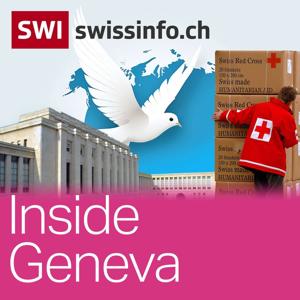
Inside Geneva is a podcast about global politics, humanitarian issues, and international aid, hosted by journalist Imogen Foulkes. It is produced by SWI swissinfo.ch, a multilingual international…

6,774 Listeners

7,585 Listeners

5,735 Listeners

1,798 Listeners

13 Listeners

974 Listeners

719 Listeners

136 Listeners

15,584 Listeners

15,904 Listeners

3,070 Listeners

1,131 Listeners

905 Listeners

2,277 Listeners
1,418 Listeners

0 Listeners

1,094 Listeners
3 Listeners

0 Listeners

7 Listeners

0 Listeners
0 Listeners