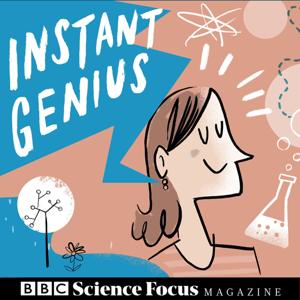
Instant Genius

Instant Genius

By Our MediaScienceTechnology
Download on the App Store
  • Favorites

    164

    Followers

  • Typical duration

    31 min

    per episode

Based on Podcast App listening data

Instant Genius episodes

  • Why do humans make music?

    Our lives are full of music, from the songs we sing along to on the radio to the orchestral scores that bring a film to life. But why is it that humans love to make music, and how did it evolve in the first place?

    Musicologist Prof Michael Spitzer, author of the new book The Musical Human (£30, Bloomsbury), joins BBC Science Focus online assistant Sara Rigby on this week’s episode to explain.

    Let us know what you think of the Science Focus Podcast by filling out our survey. By submitting it, you enter the prize draw to win one of seven £100 Voucher Express Gift Cards. It should take no more than 5 minutes. UK residents only. Full T&Cs.

    • Take part in the survey
    • Subscribe to the Science Focus Podcast on these services: Acast, iTunes, Sticher, RSS, Overcast

      Listen to more episodes of the Science Focus Podcast:

      • The psychology of the sea shanty: Why work songs are such earworms
      • Could these gloves be the future of music? – Imogen Heap
      • The neuroscience of happiness – Dean Burnett
      • Dr Pete Etchells: Do video games encourage gambling behaviour?
      • Why you can’t multitask (and why that’s a good thing)
      • Phobias, paranoia and PTSD: Why virtual reality therapy is the frontier of mental health treatment


      • Hosted on Acast. See acast.com/privacy for more information.

        Learn more about your ad choices. Visit podcastchoices.com/adchoices

        28 min
      • The future of human flight, with real-life Iron Man Richard Browning

        In this week's episode of the Science Focus Podcast, we talk to the "real-life Iron Man" – not Marvel's Tony Stark, but inventor Richard Browning.

        He’s the creator of the ‘Jet Suit’, which can fly one person through the air at speeds of 135km/h. He’s also founder and chief test pilot of Gravity Industries and author of new book Taking on Gravity (£20, Bantam Press).

        He explains his quite literal rise to success – and the future of human flight.

        Let us know what you think of the episode with a review or a comment wherever you listen to your podcasts.

        Subscribe to the Science Focus Podcast on these services: Acast, iTunes, Sticher, RSS, Overcast

        Listen to more episodes of the Science Focus Podcast:

        • Podcast: Why realistic humanoid robots need to learn to lip-sync
        • Ritu Raman: Can you build with biology?
        • Dr Erin Macdonald: Is there science in Star Trek?
        • Meet the computer scientist teaching an AI to play Dungeons and Dragons
        • How virtual reality is helping patients with phobias, anxiety disorders and more
        • Dr Pete Etchells: Do video games encourage gambling behaviour?

        • Hosted on Acast. See acast.com/privacy for more information.

          Learn more about your ad choices. Visit podcastchoices.com/adchoices

          28 min
        • Why realistic humanoid robots need to learn to lip-sync

          In this week's episode of the Science Focus Podcast, commissioning editor Jason Goodyer speaks to Dr Carl Strathearn, a research fellow at the School of Computing at Edinburgh Napier University.

          He's currently conducting research on realistic humanoid robots, specifically on more realistically synchronising their speech and mouth movements.

          He tells us about how to get robots out of the Uncanny Valley, why the way a robot looks is so important, and why Data from Star Trek is an inspiration for his work.

          • Read an edited excerpt from this interview

          Let us know what you think of the episode with a review or a comment wherever you listen to your podcasts.

          • Subscribe to the Science Focus Podcast on these services: Acast, iTunes, Stitcher, RSS, Overcast
          • Read the full transcription of this episode [this will open in a new window]

            Listen to more episodes of the Science Focus Podcast:

            • How virtual reality is helping patients with phobias, anxiety disorders and more
            • Dr Pete Etchells: Do video games encourage gambling behaviour?
            • Rana el Kaliouby: What if computers could read our emotions?
            • Ritu Raman: Can you build with biology?
            • Dr Erin Macdonald: Is there science in Star Trek?
            • Robert Elliott Smith: Are algorithms inherently biased?

            • Hosted on Acast. See acast.com/privacy for more information.

              Learn more about your ad choices. Visit podcastchoices.com/adchoices

              30 min
            • How to understand statistics in the news and when to trust them

              In this week's episode of the Science Focus Podcast, editor Daniel Bennett speaks to Tom Chivers and David Chivers.

              Tom is a veteran science journalist and author and David is lecturer in economics at the University of Durham. As well as a surname, they share a passion for statistics, or more precisely for the way that numbers are used and presented in the media. Together they’ve written a new book: How to Read Numbers: A Guide to Statistics in the News and Knowing When to Trust Them.

              They talk to Daniel about how to understand the sometimes confusing stats surrounding health and risk, how to spot a suspicious claim when you see one, and how to think about the current concerns surrounding the Oxford/AstraZeneca vaccine.

              Let us know what you think of the episode with a review or a comment wherever you listen to your podcasts.

              • Subscribe to the Science Focus Podcast on these services: Acast, iTunes, Stitcher, RSS, Overcast
              • Read the full transcription of this episode [this will open in a new window]

                Listen to more episodes of the Science Focus Podcast:

                • Sir David Spiegelhalter: There's no such thing as Blue Monday
                • Matt Parker: What happens when maths goes horribly, horribly wrong?
                • Hannah Fry: How much of our lives is secretly underpinned by maths?
                • Prof Linda Scott: Why is there still economic inequality between men and women?
                • Hannah Fry: What's the deal with algorithms?
                • Robert Elliott Smith: Are algorithms inherently biased?

                • Hosted on Acast. See acast.com/privacy for more information.

                  Learn more about your ad choices. Visit podcastchoices.com/adchoices

                  1 hr 6 min
                • The bizarre biology of the mantis shrimp

                  What is your favourite animal? If you know anything about the mantis shrimp, it might well be your top pick. Dwelling in shallow tropical waters, these mysterious predators not only wield one of the strongest punches in nature, but also a one-of-a-kind visual system that scientists are only just making sense of.

                  One of these scientists is Dr Martin How from the University of Bristol. He joins us on this week's episode of the Science Focus Podcast to reveal more about mantis shrimp and their remarkable abilities.

                  Let us know what you think of the episode with a review or a comment wherever you listen to your podcasts.

                  • Subscribe to the Science Focus Podcast on these services: Acast, iTunes, Stitcher, RSS, Overcast
                  • Read the full transcription of this episode [this will open in a new window]

                    Listen to more episodes of the Science Focus Podcast:

                    • Everything you ever wanted to know about… the deep sea with Dr Jon Copley
                    • Andrew Hunter Murray and Dan Schreiber: Is there really no such thing as a fish?
                    • Brad Lister: Are we facing an insect apocalypse?
                    • Neil Gemmell: The genetic hunt for the Loch Ness Monster
                    • Neil Shubin: How do big changes in evolution happen?
                    • Mark Lynas: Could leaving nature to its own devices be the key to meeting the UK’s climate goals?

                    • Hosted on Acast. See acast.com/privacy for more information.

                      Learn more about your ad choices. Visit podcastchoices.com/adchoices

                      23 min
                    • The creator of Bellingcat on using the internet to investigate global affairs

                      In this episode of the Science Focus Podcast, we speak to Elliot Higgins, the founder of Bellingcat. If you haven’t heard that name before, then you might be surprised to know that Bellingcat is behind some of the biggest news revelations of the decade.

                      They use social media and information freely available online to carry out what they call open source investigation.

                      Their work has uncovered the use of chemical weapons in Syria, identified suspects in the Skripal poisoning in Salisbury and identified the people responsible for downing flight MH17 over Ukraine.

                      Eliot speaks to editor Dan Bennett about his new book, We Are Bellingcat (£20, Bloomsbury), which tells the story of how a group of amateur hobbyists ended up taking on Russian spies.

                      • Read an edited excerpt of this interview

                      Let us know what you think of the episode with a review or a comment wherever you listen to your podcasts.

                      • Subscribe to the Science Focus Podcast on these services: Acast, iTunes, Stitcher, RSS, Overcast
                      • Read the full transcription of this episode [this will open in a new window]

                        Listen to more episodes of the Science Focus Podcast:

                        • Dr Julia Shaw: Why do we do bad things?
                        • Marcel Danesi: Why do we want to believe lies?
                        • Project Discovery: Could computer games help find a cure for COVID-19?
                        • Chris Lintott: Can members of the public do real science?
                        • Lara Martin: Meet the computer scientist teaching an AI to play Dungeons and Dragons
                        • Rana el Kaliouby: What if computers could read our emotions?

                        • Hosted on Acast. See acast.com/privacy for more information.

                          Learn more about your ad choices. Visit podcastchoices.com/adchoices

                          45 min
                        • Prof Avi Loeb on what 'Oumuamua tells us about the problem with modern physics

                          In 2017, the Pan-STARRS telescope in Hawaii spotted an interstellar object passing by Earth for the first time. Shortly after, Harvard’s Prof Avi Loeb was met with a backlash from the scientific community for suggesting it could be of alien origin.

                          Now, several years on, he has written a book, Extraterrestrial: The First Sign of Intelligent Life Beyond Earth, outlining why we still can’t out rule the possibility, and why scientists should always keep an open mind.

                          We speak to Avi on this week's episode of the Science Focus Podcast. He tells us why he believes the object, 'Oumuamua, was of alien origin, and what problems this reveals about the way modern physics is conducted.

                          • Read an edited excerpt of this interview

                          Let us know what you think of the episode with a review or a comment wherever you listen to your podcasts.

                          • Subscribe to the Science Focus Podcast on these services: Acast, iTunes, Stitcher, RSS, Overcast
                          • Read the full transcription of this episode [this will open in a new window]

                            Listen to more episodes of the Science Focus Podcast:

                            • Dr Douglas Vakoch: Should we try to contact aliens?
                            • Bergur Finnbogason: Project Discovery and its search for exoplanets
                            • Dr Erin Macdonald: Is there science in Star Trek?
                            • What if the Earth’s magnetic field died? – Jim Al-Khalili
                            • Building a base on the Moon, and crafting believable sci-fi – Andy Weir
                            • Dr Becky Smethurst: How do you actually find a black hole?

                            • Hosted on Acast. See acast.com/privacy for more information.

                              Learn more about your ad choices. Visit podcastchoices.com/adchoices

                              45 min
                            • Meet the computer scientist teaching an AI to play Dungeons and Dragons

                              Many of us have had a one-to-one interaction with artificial intelligence. Whether that’s through an automated chat service for customer service, or trying our hand at beating an AI built to play chess. But these experiences aren’t flawless, they’re not as smooth as our interactions with other human beings.

                              One researcher trying to improve the language abilities of AI is Lara Martin, a postdoc at the University of Pennsylvania. More specifically, Lara is trying teach AI to tell stories.

                              Let us know what you think of the episode with a review or a comment wherever you listen to your podcasts.

                              • Subscribe to the Science Focus Podcast on these services: Acast, iTunes, Stitcher, RSS, Overcast
                              • Read the full transcription of this episode [this will open in a new window]

                                Listen to more episodes of the Science Focus Podcast:

                                • Rana el Kaliouby: What if computers could read our emotions?
                                • Aleks Krotoski: What happens to your data when you die?
                                • Robert Elliott Smith: Are algorithms inherently biased?
                                • Pete Etchells: Are video games good for us?
                                • Jamie Susskind: How technology is changing politics
                                • Jim Al-Khalili: Why AI is not the enemy


                                • Hosted on Acast. See acast.com/privacy for more information.

                                  Learn more about your ad choices. Visit podcastchoices.com/adchoices

                                  39 min
                                • International Women’s Day: The forgotten female scientists of history

                                  Today is International Women’s Day, and in this episode of the Science Focus Podcast, online assistant Sara Rigby talks to science historians Anna Reser and Leila McNeill, authors of Forces of Nature: The Women who Changed Science (£20, Frances Lincoln).

                                  They tell us about the women who engaged in science throughout history but don’t always get remembered – the midwives, the astronomers, and the wives and sisters.

                                  • Read an edited excerpt from the interview

                                  Let us know what you think of the episode with a review or a comment wherever you listen to your podcasts.

                                  • Subscribe to the Science Focus Podcast on these services: Acast, iTunes, Stitcher, RSS, Overcast
                                  • Read the full transcription of this episode [this will open in a new window]

                                    Listen to more episodes of the Science Focus Podcast:

                                    • Why aren't there more women in science?
                                    • Angela Saini: Inequality in science
                                    • Caroline Criado Perez: Does data discriminate against women?
                                    • Kathryn D. Sullivan: What is it really like to walk in space?
                                    • Subhadra Das: What part has science played in racism?
                                    • Kevin Fong: What happened to Apollo 13?

                                    • Hosted on Acast. See acast.com/privacy for more information.

                                      Learn more about your ad choices. Visit podcastchoices.com/adchoices

                                      40 min
                                    • How to maximise your motivation, according to a neuroscientist

                                      As the UK enters its 13th month of lockdown restrictions and home-working, many surveys cite a slump in mental wellbeing and general productivity.

                                      But are there any scientific ways we can maximise our motivation and prevent procrastination?

                                      In this episode of the Science Focus Podcast, neuroscientist Dr Gabija Toleikyte, author of Why the F*ck Can't I Change, tells us all about it.

                                      Let us know what you think of the episode with a review or a comment wherever you listen to your podcasts.

                                      • Subscribe to the Science Focus Podcast on these services: Acast, iTunes, Stitcher, RSS, Overcast
                                      • Read the full transcription of this episode [this will open in a new window]

                                        Listen to more episodes of the Science Focus Podcast:

                                        • Why you can’t multitask (and why that’s a good thing)
                                        • Dean Burnett: The neuroscience of happiness
                                        • Daniel Freeman: How virtual reality is helping patients with phobias, anxiety disorders and more
                                        • Anthony David: Why is there still such stigma around mental health?
                                        • Pete Etchells: Are video games good for us?
                                        • Sandro Galea: What is the difference between health and medicine?
                                        • Helen Russell: What does it mean to be happy?

                                        • Hosted on Acast. See acast.com/privacy for more information.

                                          Learn more about your ad choices. Visit podcastchoices.com/adchoices

                                          29 min

                                        About Instant Genius

                                        From the publisher's feed

                                        Whether you’re curious about getting healthy, the Big Bang or the science of cooking, find out everything you need to know with Instant Genius. The team behind BBC Science Focus Magazine talk to world-leading experts to bring you two bite-sized masterclasses on a new subject each week.

                                        Best of Instant Genius

                                        Ranked by our users in the last 21 days

                                        More shows like Instant Genius

                                        More or Less by BBC Radio 4

                                        More or Less

                                        873 Listeners

                                        The Naked Scientists Podcast by The Naked Scientists

                                        The Naked Scientists Podcast

                                        607 Listeners

                                        Nature Podcast by Springer Nature Limited

                                        Nature Podcast

                                        766 Listeners

                                        Health Check by BBC World Service

                                        Health Check

                                        92 Listeners

                                        The Food Programme by BBC Radio 4

                                        The Food Programme

                                        264 Listeners

                                        The Food Chain by BBC World Service

                                        The Food Chain

                                        347 Listeners

                                        Discovery by BBC World Service

                                        Discovery

                                        964 Listeners

                                        BBC Inside Science by BBC Radio 4

                                        BBC Inside Science

                                        394 Listeners

                                        Science Weekly by The Guardian

                                        Science Weekly

                                        420 Listeners

                                        The Life Scientific by BBC Radio 4

                                        The Life Scientific

                                        220 Listeners

                                        The Audio Long Read by The Guardian

                                        The Audio Long Read

                                        836 Listeners

                                        Unexpected Elements by BBC World Service

                                        Unexpected Elements

                                        359 Listeners

                                        All in the Mind by BBC Radio 4

                                        All in the Mind

                                        82 Listeners

                                        CrowdScience by BBC World Service

                                        CrowdScience

                                        474 Listeners

                                        The World, the Universe and Us by New Scientist

                                        The World, the Universe and Us

                                        112 Listeners