Intentional Growth

Intentional Growth

By Arkona - Intentional GrowthBusinessEntrepreneurshipInvestingManagement
Download on the App Store

Intentional Growth episodes

  • #343: The Decision-Making Process of Selling TXI to an ESOP with Josh Golden
    On today’s show I have Josh Golden on to share his story about how he started, grew, and sold his company Table XI (now TXI) to an ESOP on December 31, 2022.
     
    My favorite part of this interview? Josh focuses most of the interview about what went into his decision-making and why he sold the company to an ESOP. 
     
    I was super excited to finally interview Josh because I have been watching his journey for over five years. It was fun to hear Josh reflect on the recent exit, especially because of how intentional he was over the last five years. 
     
    Josh starts the interview by telling the story about how we met on a chairlift and struck up a conversation about him feeling “stuck” because he didn’t know what to do next with this business: continue growing it, sell it to a strategic buyer, do an ESOP, hire a CEO, etc. 
     
    As Josh shares his journey from the origin story through the exit, he does an amazing job articulating what he was trying to accomplish at each stage, what was important to him at that point in the journey, why he made the decision he did, and how that decision played out based on what he wanted.
     
    I hope you enjoy listening to this conversation with Josh!
     
    // WATCH THE INTERVIEW ON YOUTUBE: Intentional Growth™ Podcast
     
    What You Will Learn
    Why Josh was feeling “stuck” and what questions were on his mind that he needed answers to.
    Why Josh decided to become an entrepreneur instead of following the academic route his parents took.
    The origin story of Table XI, early partnership buyouts, and how Josh feels about it today.
    Why it’s important to listen to the market and continue to evolve the business.
    What client requests you should say “yes” to based on how your company infrastructure is built and where you want to take the business.
    Josh's story of parting ways with high-ticket clients because values were not aligned. 
    What “distracted visionaries” need to do when bringing people on.
    What it was like for Josh to take a back seat after hiring a CEO.
    What hiring a CFO did for the company’s performance and valuation.
    What led Josh to take his company the ESOP route.
    Why Josh didn’t convert to an ESOP when he first decided that was the exit he wanted and what he did in between that time in order to almost double the value of the business.
     
    // USE YOUR FINANCIALS TO CLARIFY A PATH TOWARDS A MORE VALUABLE BUSINES
    1 hr 34 min
  • #342: Quarterly Economic and M&A Market Update with ITR Economics, ButcherJoseph, and the NCMM
    QUARTERLY ECONOMIC AND M&A MARKET UPDATE
     
    Making real-time decisions–while staying on track toward long-term goals–is much more difficult today compared to only a few years ago. There are no shortages of headwinds to deal with: inflation, interest rates, labor issues, supply chain disruptions, returning to the office, and on and on.
     
    Sure, things are harder, but we entrepreneurs and leaders don’t have the luxury to stop and take a break to collect our thoughts and make peaceful decisions in a vacuum. We have to make crucial decisions–fast. This puts enormous pressure on our long-term plan and our real-time data. 
     
    Our goal with this Quarterly Economic and M&A update is to provide you with relevant information (that is often much harder to find than it should be) so you can use it to enhance your decision-making and stay on track toward your future equity valuation targets.
     
    ITR Economics // Brian Beaulieu 
     
    In the first segment, our sponsor and CEO of ITR Economics, Brian Beaulieu, brings us his thoughts about the macroeconomic picture. Brian and I talk about the potential for a 2023/2024 recession (and what’s causing it), what’s going on in the labor market, interest rates, inflation, and which industries will have no problem getting through the next two years. 
     
    My favorite part of the interview is toward the end when I asked Brian what data to pay attention to. He nails the answer. Since this interview, I picked up their book How to Make Your Move again and it is SUCH a breath of fresh air. It makes all the sense in the world why their forecasting accuracy is 94.9 percent. Since 1948, ITR Economics has provided business leaders with economic information, insight, analysis, and strategy. ITR Economics is the oldest privately held, continuously operating economic research and consulting firm in the United States.
     
    ButcherJoseph // Jeff Buettner 
     
    In the second segment, I have Jeff Buettner on from ButcherJoseph, an M&A advisory firm, to discuss what is going on in the deal space. Jeff and his firm are in the weeds every day doing deals, whether that is selling a company to a third party, converting a business to an ESOP, raising debt, or helping facilitate an internal buyout. With this experience, Jeff gives us his update on how the current environment–and all the challenges with it–are impacting valuations, deal structures, deal volume, and perspective of different buyers. I loved my conversation with Jeff. He had practical and actionable insights that give us a view into the privately held deal market that is hard to come by. 
     
    The National Center for the Middle Market // Doug Farren 
     
    In our last segment, Doug Farren, director of The Center for the Middle Markets, comes on the show to share the results of their semi-annual Middle Market Indicator (MMI) where they surveyed 1,000 middle-market companies. I loved this addition because we got
    1 hr 43 min
  • #341: What it Means to Be "On-Purpose" with Kevin W. McCarthy
    Ep.#2 [THEME EIGHT]
     
    The question “what is my purpose?” is searched over 5,000 times on Google globally each month.
     
    It seems like every media source has done a piece on “how important it is to find your purpose” in the past couple of years. I don’t think anyone argues how important it is, however, the bigger issue is HOW to find your purpose, and more importantly, how to do it in a way that makes sense without feeling guilty or anxious that you are not there yet.
     
    I find it super interesting how “having a purpose now” is almost becoming a fad similar to “being authentic.” However, I find the act of “trying to be authentic” an oxymoron. How do you try to be authentic? I think it’s similar to finding your purpose. It doesn’t just land in your lap, and the more you try, sometimes the further away you get.
     
    But that still leaves us all with the big question, “how do we find our purpose?”
     
    On today’s show I have entrepreneur and author Kevin W. McCarthy (not the speaker of the house ;-) who is the founder of consulting company On-Purpose and the author of The On-Purpose Person, The On-Purpose Business Person, Chief Executive Leadership Officer, and his new book Tough Shift. Kevin has been on the journey of helping entrepreneurs, owners, and leaders find their purpose since the late 1980s. I think he was a bit ahead of his time! 
     
    If you find your purpose–your true purpose–you will feel a sense of alignment with the world, yourself, and the immediate environment around you. It feels like the things you are working on matter, you are progressing toward something bigger than yourself, and your skills are being used in a way that bring value to the world while you get rewarded for it. 
     
    In this episode Kevin shares what the definition of purpose really is and his thoughts on the importance of the process of finding your purpose vs. getting to it as fast as possible and the iterating over time. Because of how long Kevin has been at this, he has very practical ways to think about what it means to “find your purpose” and “live your purpose.”
     
    This is a very practical and actionable conversation that should hopefully leave you encouraged that it is possible for everyone to find their purpose, but more importantly, why it shouldn't be overengineered and how to approach the journey in a way that gives you grace and not anxiety that you are “missing something important in life” but have no playbook on how to fill the gap.
     
    This conversation is an attempt to bring this topic–that most people agree is super important–down to earth so you can start making progress toward the purpose you have and how you can integrate it into your life and business.
     
    // WATCH THE INTERVIEW ON YOUTUBE:
    1 hr 7 min
  • #340: Designing Your Ideal Life on Purpose: A Conversation About Life, Business, Money, and Intention with Spencer Hilligoss
    Ep.#1 [THEME EIGHT]
     
    “Money can’t buy a calm mind, a fit body, a house full of love” - The Naval Podcast. 
     
    In the episode where I heard this quote, Naval points out how Bezos, one of the wealthiest people on the planet, can’t use any of his money to buy these things. Does this resonate with you? It hit me like a ton of bricks. It made me think of all the people who have been on this podcast after selling their companies, have a huge portfolio of assets, and are still not happy because they have endless amounts of time and no purpose. 
     
    Are you confident you are spending your time, energy, and capital each day in areas that will get you closer to where you want to be? In order to confidently answer yes, you need to peel back the onion and first figure out where you are today and then clarify your ideal vision for the future.
     
    I have found this to be a tough question for people to answer when I ask them “why” five times. Typically, when asking a business owner or entrepreneur what their goal is, I get an answer like revenue, net income, units, subscribers, employee count, or some other metric that–to me–is more of a vanity metric than an indicator of what that person truly values in life. 
     
    On today’s show, I interviewed Spencer Hilligoss, the CEO of Madison Investing, a real estate investment club that has completed $2.3 billion in acquisitions with over 20,000 units. Spencer founded Madison Investing after sitting down with his wife–and now business partner –after hitting a breaking point while grinding away in their W2 jobs. They sat down and created a 15-year vision that included the annual income they needed to decouple their income from their labor, how they wanted to spend their time each day, and how they were going to achieve it. Spencer and Jennifer accomplished their 15-year plan within half the time and are now rethinking again what they want their life experiences and purpose to be.
     
    I really enjoyed the conversation with Spencer because of how clearly he describes the evolution to his approach and views on life, business, money, and time. He explains why he protects what he values and how he wants to spend the time he has each week, and why, regardless of the level of “success” he achieves. 
     
    Do you want to be confident you are spending your time, money, and energy on the right things?  
     
    The best way to answer this question is to think about what you want beyond just the vanity metrics. Regardless of how much money you make–or how big your company is–you will still be stuck with yourself, your mind, your body, and the people around you. 
     
    On today’s show you will learn how to start thinking about your future goals in a new way.
     
    // WATCH THE INTERVIEW ON YOUTUBE: Intentional Growth™ Podcast
     
    What You Will Learn
    Why identifying the amount of annual income you need that is not tied to your labor–and how you will achieve it–is a crucial step to a
    1 hr 5 min
  • #339: Making Sense of us "Visionary" Types with Justin Breen
    Do you ever get frustrated because you feel like the vision you have for the future is perfectly clear - almost obvious -  and all you have to do is connect the dots, wait, and get other people on board? 
     
    Wouldn’t it be nice if it was that easy?
     
    I have always been passionate about this topic of a “Visionary” and what it truly means. Does it really mean something special, or is it just a term used to self diagnose a passionate entrepreneur who doesn't know how to explain why they see the world the way they do while conveniently explaining away our weaknesses?
     
    I tend to find that I (and many visionaries I know) have the gift of foresight, but it comes with pitfalls if not managed correctly - going too fast, leaving projects unfinished, getting distracted, hiring or partnering with the wrong people, or whatever else you can think of!
     
    The worst punishment of all? Not reaching your vision.
     
    This is why I really enjoyed today’s interview with Justin Breen. Justin is an entrepreneur and best selling author of “Epic Business” and “Epic Life.” Justin spent 20 years in the media business before starting BrEpic Communications, a premium PR firm specifically for Visionary entrepreneurs.
     
    I wanted to have Justin on the show because of his unique ability to completely understand Visionaries (strengths and weaknesses alike) and how to leverage the world changing ideas Visionaries come up with by putting them into action. 
     
    Whether you are a Visionary - or work with one - this episode is worth the listen. Hopefully, you learn a few insights about yourself or the people you work with!
     
    // WATCH THE INTERVIEW ON YOUTUBE: Intentional Growth™ Podcast
     
    What You Will Learn
    Justin's definition of entrepreneurs vs. business owners vs. humans.
    The four common characteristics successful entrepreneurs share.
    What the KOLBE assessment is and how it is used to identify Visionaries, Integrators, and more.
    Why the KOLBE assessment is different than other assessments like Myers-Briggs or the DiSC assessment.
    Why most Visionaries are “quick starts”.
    What the best complimentary profile is for a Visionary and why.
    How to figure out which type of visionary you are so you can hire the right people to keep you focused.
    The types of people Visionaries need to avoid.
    The correlation between an entrepreneur's high IQ and happiness. 
    // USE YOUR FINANCIALS TO CLARIFY A PATH TOWARDS A MORE VALUABLE BUSINESS:
    59 min
  • #338: [SUCCESS STORY] A-Player Tells Story About Getting Hired, Scaling, & Selling a Company for 11x EBITDA with Jon Thielen
    Ep. #4 [THEME SEVEN]
     
    I am very excited to republish my interview with Jon Thielen as a way to wrap up our miniseries. Jon is an awesome example of the A-players we’ve been talking about. What better way to understand how to find, pay, and incorporate an A-player than hearing it from one of them!
     
    Today’s show is a replay of a conversation I had with Jon, who was hired on to a software company, grew it, and helped the owner sell it just a few years later for 11x EBITDA. 
     
    In this interview, Jon tells us the story about the process he went through and why the core values of not only the business, but also the owner and founder, are one of the main driving factors that attract A-players. Jon explains why recruiting and building out teams was one of the first things Jon did once being brought on (and his dating approach to this), plus how Jon tied his marketing KPIs to his sales KPIs every single week.
     
    To wrap up the interview, Jon tells the story of how the owner approached selling and how Jon executed the plan by selling the company for 11x EBITDA while only staying on for five months after the sale.
     
    To hire A-players, you need to know how they think and how they approach the businesses they are working in. Jon does a great job! Enjoy!
     
    // WATCH THE INTERVIEW ON YOUTUBE: Intentional Growth™ Podcast
     
    What You Will Learn
    How Jon was sought out by the owner of a software company because of his growth mindset and business philosophy.
    Why Jon thinks EBITDA is the most important metric.
    Why Jon always wants to know the owner's core values before accepting a position.
    Jon’s dating mindset toward onboarding and building teams.
    How Jon tied his marketing KPIs to his sales KPIs.
    How Jon structured his bonus compensation plan.
    Jon’s approach to getting the company ready to sell since the owner wanted to be hands-off with the process.
     
    // USE YOUR FINANCIALS TO CLARIFY A PATH TOWARDS A MORE VALUABLE BUSINESS: Intentional Growth Financial Assessment
     
    Bio:
    Jon Thielen is a growth leader who has leveraged the principles of leadership to create accountable teams, operational discipline, and strategic growth strategies. As president, he sold a shareholder’s company for 11x in 2019. Jon Thielen builds scalable SaaS B2B and B2C sales growth strategies, driving revenues, profits, and engaging customer experiences. He has had leadership roles with media, start-ups, and data screening companies such as Trusted Employees, AOL/Patch.com, Internet Marketing, Inc, SanDiego.com and Citysearch.com. His focus is in the sales process, operational discipline, employee engagement, LEAN principles, continuous improvement, accountability, brand strategy, a proven process, and most importantly improving the on-boarding (CX) customer experience.
     
    Interview Quotes:
    10:02  - “Primarily, I am a revenue-driving executive.” - JT
    18:42  - “You can accomplish anything if you put it in front of you.” - JT
    23:49  - “If you put incentive plans to change behavior, well, put the right behavior in.” -

    1 hr 12 min
  • #337: How to Recruit, Onboard, and Integrate Key Executives with Mike Frommelt from Keystone Search
    Ep.#3 [THEME SEVEN]
     
    If you have been following along in this mini-series, we’ve been tackling one of the hardest topics an owner/leader typically faces: how to find, hire, and pay A-players. Today is part three of four, and we’re tackling how to engage an executive recruiter in case you want to go that route to find your next A-player.
     
    Hiring a recruiter to find your replacement can be a daunting task, not only financially but also emotionally. My goal with this interview is to demystify the process and services of an executive recruiter and give you the information you need before making a decision to hire within, recruit organically, or engage a firm to do it for you.
     
    Today on the show I interviewed Mike Frommelt, CEO of KeyStone Search, an executive recruiting firm based in Minneapolis, Minnesota. Mike shares–with full transparency–how he sources, hires, and integrates high-level executives into companies with business owners who want to separate themselves from the management role. 
     
    The reason I chose to have Mike on the show (again) was because of who he is and the approach his firm takes. Mike is one of the most genuine people I have met, and his firm specializes in EOS© founder-led companies as well as ESOPs.
     
    In this episode, you will learn how an executive recruiting firm finds key executives (especially since most of them already have jobs), how they can help you decide whether your internal candidates are an option, what assessments and vetting processes should be used to make sure these executives are the right fit for your company culture, how to effectively and efficiently go through the hiring process with these executives, and finally, what results you should expect, as the business owner, after these people are onboarded. 
     
    Hiring a high-level person to fill your shoes on the leadership role (W2) side of your business is a huge milestone to getting back your freedom, creating value, and future choices about when and how you want to monetize your asset. 
     
    Hopefully this episode gives you the confidence you need to know it is possible to find your replacement so you can enjoy work, create wealth, and have an impact.
     
    // WATCH THE INTERVIEW ON YOUTUBE: Intentional Growth™ Podcast
     
    What You Will Learn
    What you should expect when hiring an executive recruiter.
    How to determine whether you should hire within or go outside your company.
    The three phases an executive recruiter takes when placing someone in a company.
    How Mike assesses key executives to make sure they fit the company culture.
    What a culture blueprint is and how it’s part of recruiting and onboarding
    1 hr 21 min
  • #336: How to Create the Best Executive Compensation Plan with Craig Rutledge from VisionLink
    Ep.#2 [THEME SEVEN]
     
    Do you dream of being a “passive” owner while a team of A-Player executives scale your company to new heights? 
     
    Today’s episode is devoted to breaking down HOW to make this dream a reality by creating “Value Growth Partners” out of your A-Players via an executive compensation plan that aligns ownership and leadership’s short- and long-term goals. 
     
    Today, I have Craig Rutledge, Managing Director of VisionLink, back on the show to break down in crazy detail the various ways to design a compensation package for your A-Players that you don’t regret, actually works, and pays for itself.
     
    Craig covers the spectrum of compensation plans from traditional wages/benefits, to short-term cash bonuses, to long-term value growth plans. He explains when and where each strategy is appropriate and the pros and cons of that particular strategy. One of my favorite parts of this episode is how much clarity is brought to the different types of compensation plans and the best ways to design them in order to align ownership and key executives’ goals.
     
    Craig makes it very clear–if the plan is designed correctly–that it should not only pay for itself, it should magnify your value growth strategies by tying the plan to your desired business model, target customers, good profit (as opposed to bad profit…yes, there is such a thing), and company culture. 
     
    If the plan is designed right, it should increase your opportunity to decouple your leadership role from your ownership role, give you more time to actually work ON the business instead of IN the business, reduce your stress and anxiety, increase the value of your business, and give you options when you want to exit while simultaneously reducing the need to stay on after the sale.  
     
    After having Craig on the show for a second time, I truly believe that it is possible to build a financial roadmap to your target equity valuation and hire A-Players that are tied to a plan that is 100 percent aligned with the business. The right plan, clean numbers, and the right A-Player should actually allow you to manage the business from an island via an executive scorecard… the dream EOS© is constantly preaching.
     
    // WATCH THE INTERVIEW ON YOUTUBE: Intentional Growth™ Podcast
     
    What You Will Learn
    The difference between short-term incentives versus long-term value creation.
    How to design a plan that pays for itself.
    How to turn your A-Players into “Value Growth Partners.”
    The difference between good profit and bad profit.
    Why it is not necessary to use insurance in a good executive plan.
    A ton of different ideas on how to vest the key executive.
    Why the r
    1 hr 24 min
  • #335: How to Hire the Best: The Entrepreneur's Ultimate Guide to Attracting Top Performers with Dr. Sabrina
    Ep.#1 [THEME SEVEN]
     
    Do you feel burned out in your leadership role (job) because you’re working too much or because you can’t find anyone who can do what you can do? If you’re thinking what I’ve heard dozens of times, it’s something similar to: “I’ll never find someone who can replace me.” 
     
    In today’s episode, I interviewed Dr. Sabrina Starling, and our goal is to give you hope that it is possible. We break down why it is possible to find A-players, what entrepreneurs are doing who have “figured it out,” and how an owner can afford A-players if cash is tight. 
     
    Dr. Sabrina, The Business Psychologist and author of the How To Hire The Best series and The 4 Week Vacation®, is the founder of Tap the Potential. Dr. Sabrina became a coach because she realized that most of the entrepreneurs she was working with did not have the high quality of life they set out to have due to the lack of talent next to them at the top. 
     
    She made it her mission to help business owners find, assess, and choose the right A-players because it was core to her purpose of helping entrepreneurs design their best life and “make it all worth it.”
     
    The takeaway—build a repeatable process for finding, assessing, and keeping  A-players in order to get your life back and build a more valuable business…at the same time!
     
    Today you will learn the secret to attracting A-players (and why it’s not Indeed), how to build a company culture where A-players want to work, and how to build a high quality of life through A-players and leveraging your financial roadmap.
     
    // WATCH THE INTERVIEW ON YOUTUBE: Intentional Growth™ Podcast
     
    What You Will Learn
    The difference between A players and quiet quitters.
    How to bring out an A players intrinsic motivation that will help you reach your small business goals
    How to find A players (only 10% of the population are classified as A players
    Why your network is the best channel to find A players
    The secret ninja tactic you can use with you A players to create a vision more A players will buy into
    Why allowing your employees to have headspace will increase productivity
    How to afford A players using the 80/20 rule with your clients
    Why it’s important to hire with the lower level people so you can learn how to hire the right people
    Why Dr. Sabrina believes in giving out salary ranges with a job ad
    How to manage A players
     
    // USE YOUR FINANCIALS TO CLARIFY A PATH TOWARDS A MORE VALUABLE BUSINESS: Intentional Growth Financial Assessment
     
    Bio:
    Sabrina Starling, PhD, PCC, BCC, The Business Psychologist, is the bestselling author of The How to Hire the Best
    1 hr 9 min
  • #334: Organize Your Chaos, Get Your Business Out of Your Brain, and Increase Equity Value with Chris Ronzio from Trainual
    Ep.#6 [THEME SIX]
     
    In order to turn your business into a machine that has sustainable, predictable, and transferable cash flow, you have to get your business out of your brain. I know–easier said than done. 
     
    Most business owners don’t want to do the same thing twice, let alone sit down for long periods of time documenting their SOPs or writing out step-by-step how-to’s. That’s the problem today’s guest set out to fix. 
     
    For the last episode of our equity growth miniseries, I speak with Chris Rozio, the founder and CEO of Trainual. Trainual is The Business Playbook–it helps you organize your chaos by systematizing onboarding, training, and knowledge transfer in a way that people will actually like and continue to use. 
     
    Chris created Trainual to allow business owners to quickly take time out of their day to create, update, or share the playbook that runs their company. The best part–Chris and his team built a training system that wants you to spend less time…training. 
     
    Chris started Trainual after successfully scaling and exiting his video production company. The idea behind Trainual started because Chris attributed a lot of the success behind his exit to the playbook he had for his business, which most people would argue couldn’t be scaled or sold–a video production company. His playbook allowed any new hire to come in and quickly carry out a successful client assignment, and he was able to show any potential buyer exactly how his company worked. 
     
    The goal of a business playbook is to help you build a company that gives you the flexibility to reduce your hours, replace your leadership role, or exit the business when and how you please.
     
    // WATCH THE INTERVIEW ON YOUTUBE: Intentional Growth™ Podcast
     
    What You Will Learn
    What helps business owners turn the repeatable day-to-day tasks of their business into a how-to playbook. 
    How Trainual can help business owners transform their business into a financial asset.
    How creating processes and procedures will help you exit your role OR ownership.
    The four sections a company is divided into when it comes to making a playbook.
    The first steps to creating your business’s playbook.
    Why you don’t need to know everything about your business when you start with processes–and how you can create the cadence of documenting everything.
    How to balance taking the time to design the systems versus executing them.
    How Chris creates his goals and puts them into action.
    Real-life sto
    50 min

About Intentional Growth

From the publisher's feed

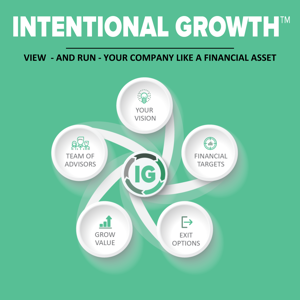
Intentional Growth™ is a podcast is a podcast for entrepreneurs and business owners wanting to view - and run - their company like a financial asset so they can have fun, create wealth, and make an impact. Truly make the entire journey of owning and running a company "worth it".