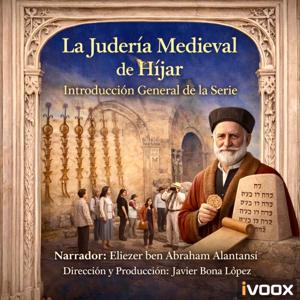
EPISODE 12: THE ETERNAL JOURNEY - LEGACY AND DIASPORA
Series: The Medieval Jewish Community of Híjar
Narrator: Eliezer ben Abraham Alantansí
EXECUTIVE SUMMARY
The final episode of the series narrates the fate of the Jewish community of Híjar after the expulsion of 1492, the legacy they left behind, and the modern rediscovery of their history. Eliezer ben Abraham Alantansí recounts the last day in Híjar (July 25, 1492), the dispersion of the community across the world (Portugal, Italy, North Africa, Ottoman Empire), the journey of the printed books that survived more than 500 years, his own life as a printer in Constantinople, the fate of the converts who stayed, the transformation of the synagogue into a hermitage (1517), the archaeological rediscovery (2017-2018), modern academic research (including the documentary "Books: The Legacy of Alantansí"), and the lessons that the history of Híjar teaches us about memory, coexistence, knowledge, and resilience.
MAIN CONTENT
1. THE LAST DAY: JULY 25, 1492
• Last morning: Empty houses, families loading carts, children crying, elderly in silence
• Last visit to synagogue: Torah scrolls packed, candles extinguished, ark empty, final prayer
• Gathering in square: ~150 people, entire families
• Rabbi's words: "We carry with us the Torah, our tradition, the memory. Am Israel Chai"
• Departure: Caravan leaving Híjar, looking back, final goodbye
• Eliezer carries: Torah scroll, father's manuscript, copy of Pentateuch with Targum and Rashi
2. THE DIASPORA: DIVERGING PATHS
Community destinations:
• Portugal: Closest country still accepting Jews (temporarily)
• Italy: Naples, Venice, Ferrara (established Sephardic communities)
• North Africa: Morocco, Algeria, Tunisia (dhimmis under Islam)
• Ottoman Empire: Constantinople, Thessaloniki, Smyrna (Sultan Bayezid II opened doors)
Eliezer's journey:
• Destination: Ottoman Empire (Constantinople)
• Reason: Peace for Jews, sultan valued knowledge, community of printers
• Duration: Weeks/months, crossing mountains and rivers
• Difficulties: Illnesses, deaths along the way (e.g., Sara Abenforna)
• Loss: Connection with ancestors' graves
3. THE TRAVELING BOOKS: THE PRINTING PRESS LEGACY
Five books printed in Híjar (1485-1490):
1 Tur Orah Hayyim (1485)
2 Nevi'ím Aharoním (1486-1487)
3 Pentateuch with Megillot and Haftarot (1487-1488)
4 Tur Yoré De'á (1487)
5 Pentateuch with Targum and Rashi (July 1490)
Worldwide dispersion:
• ~58 surviving copies preserved in international libraries
• National Library of Spain (Madrid): Pentateuch with Targum and Rashi
• National Library of France (Paris): Tur Orah Hayyim
• British Library (London): Nevi'ím Aharoním
• New York Public Library: Pentateuch
• Hebrew University of Jerusalem Library (Israel): Tur Yoré De'á
Significance:
• Testimony that the Jewish community of Híjar existed
• Memory, identity, tangible legacy
• Connection between generations across centuries
4. MY LIFE IN CONSTANTINOPLE: CONTINUING THE TRADITION
Workshop establishment:
• Jewish quarter of Balat
• From scratch: press, types, paper, ink
• Advantage: 5 years experience in Híjar, learning from Alfonso Fernández de Córdoba
Production:
• Prayer books, biblical commentaries, Talmud treatises, Halakha codes
• Printer's mark: "Printed by Eliezer ben Abraham Alantansí, from Híjar"
• Goal: Keep memory of Híjar alive
Personal legacy:
• Decades of work, dozens of books printed
• Teaching young printers
• Sephardic community in Constantinople grew and prospered
• Never forgot Híjar: synagogue, Rabbi's House, workshop, streets
5. THE CONVERTS: THOSE WHO STAYED
Reasons for conversion:
• Fear of journey and unknown
• Protect children's future
• Genuine belief (some)
• Necessity (majority)
Life as "New Christians":
• Change from Jewish to Christian names
• Church attendance, eating pork, working on Shabbat
• Crypto-Jews: Many remained Jews in secret
◦ Lighting Shabbat candles in private
◦ Abstaining from certain foods
◦ Teaching tradition to children in secret
Inquisition:
• Surveillance, investigations, interrogations, condemnations
• Persecution in Híjar less intense than other cities (small town, duke not as hostile)
Integration and memory:
• Over time, descendants forgot Jewish roots
• Some maintained memory, transmitted stories
• Today: People in Híjar know they have Jewish roots, part of the legacy
6. THE TRANSFORMED SYNAGOGUE: FROM HOUSE OF PRAYER TO HERMITAGE
After 1492:
• Empty synagogue: Torah scrolls to exile, candles extinguished, ark empty
• Duke owner of building
Conversion (1517):
• Duke Luis of Híjar (first Count of Belchite)
• Will February 7, 1517: Perpetual mass in "church of Saint Anthony of Padua, located in house that was formerly the synagogue of the Jews"
• Hermitage of San Antón
Physical transformation:
• Whitewashed walls, Hebrew inscriptions covered
• Christian altar, images of saints
• Tevá dismantled, hejal sealed, matroneum converted to storage
Centuries of oblivion:
• Functioned as Christian hermitage for centuries
• No one remembered it had been a synagogue
• Memory erased, history forgotten
7. THE REDISCOVERY: 2017-2018
Archaeological excavations (2017):
• Team: Antonio Hernández Pardos and Jesús G. Franco Calvo
• Motivation: Duke Luis's will 1517 ("was formerly the synagogue of the Jews")
• Method: Excavations, removing plaster layers, structural analysis
Astonishing findings:
6 Tevá: Base of elevated square platform (~6 m²), iron pillar holes
7 Hejal: Niche in south wall (oriented toward Jerusalem), extraordinary plasterwork (Mudéjar, flamboyant Gothic + Islamic composition)
8 Matroneum: Vestiges of women's gallery, window communicating with upper floor
9 Mural paintings: Menorah (7-branched candelabrum) + Hebrew inscriptions
Recognition:
• 2018: Government of Aragon declared Property of Cultural Interest (BIC)
• One of the best-preserved medieval synagogues in Europe
• Restoration work: Structures consolidated, paintings cleaned, preparation for visits
Today:
• Synagogue open to public
• Visitors can see tevá, hejal with plasterwork, menorah
• Imagine life in Jewish quarter 500+ years ago
• Memory recovered, history rediscovered, legacy preserved
8. THE LIVING LEGACY: MODERN RESEARCH
Resurgence of academic interest (recent decades):
Main researchers:
• Asunción Blasco Martínez: Studies on Eliezer Alantansí, demonstrated Huesca origin, genealogy, reasons for arrival in Híjar
• Miguel Ángel Motis Dolader: Synagogue and aljama, 472 pp. study with notarial documents, prosopographic list of families, record transcriptions
• Antonio Hernández Pardos: Archaeologist, 2017 excavations, detailed reports on findings, architecture/paintings analysis
• Lucía Conte Aguilar: Doctor in Medieval History (native of Híjar), heritage enhancement projects, international dissemination, documentary "Books: The Legacy of Alantansí"
◦ Documentary "Books: The Legacy of Alantansí": Follows the trail of unique books, reconstructs fascinating history of author, combines historical research, academic testimonies, evocative images, shows how printing workshops transmitted customs, knowledge, ways of thinking still inspiring today
◦ Director and producer: José Ángel Guimerá
◦ Featured: Professor Asunción Blasco (University of Zaragoza, specialist in Alantansí)
• Local historians: Florencio Jardiel, Gregorio Lasala (19th century, first references)
• Bibliologists: Miguel Ángel Pallarés Jiménez (printing workshop production)
• Epigraphists: Jordi Casanovas (Hebrew inscriptions)
Current knowledge:
• 236 people and 71 Jewish families identified
• Occupations, commercial networks, life circumstances
• Synagogue, printing press, festivities
• How we lived, loved, suffered, resisted
Value:
• Connection with past
• Understanding of present
• Inspiration for future
9. THE MEANING TODAY: LESSONS FROM HÍJAR
First lesson: The importance of memory
• History forgotten for centuries (synagogue → hermitage, names erased, stories silenced)
• Memory survived: Books, documents, stones, traditions
• Today recovered thanks to historians and archaeologists
• Teaching: Don't forget past, preserve ancestors' stories, honor legacy
• When we forget past, we lose identity
Second lesson: The fragility of coexistence
• Centuries of coexistence Jews-Mudejars-Christians in Híjar (functional coexistence)
• Fragile coexistence: Depended on lords' protection, authorities' tolerance, absence of crisis
• Crisis (Inquisition, Edict of Expulsion) → Coexistence broken → Expulsion
• Teaching: Coexistence must be built, protected, valued
• Hatred, intolerance, fanaticism destroy coexistence
Third lesson: The power of knowledge
• Híjar Jewish community small (~150 people) but cultured
• Valued study and knowledge: Synagogue, Rabbi's House with library, printing press
• Knowledge allowed survival, adaptation, rebuilding lives in exile
• Books traveled world, knowledge preserved, tradition continued
• Teaching: Knowledge is power, education fundamental, culture defines human beings
• Even in dark moments, knowledge is light, hope, reason to continue
Fourth lesson: The resilience of the human spirit
• Expulsion 1492 = Tragedy (lost homes, lands, graves, community)
• But did NOT lose identity, faith, tradition
• Scattered across world, but remained Jews
• Today (500+ years later): Jewish people alive, strong, connected to tradition
• Teaching: Human spirit resilient, survive tragedies, rebuild lives, maintain identity/culture/tradition
• As long as people remember, study, transmit, tradition will never die
10. FINAL REFLECTION: THE JOURNEY CONTINUES
The journey has not ended:
• Began 500+ years ago, continues today
Where it continues:
• Printed books (preserved in world libraries)
• Synagogue (rediscovered and restored)
• Stories (researched and documented)
• Descendant families (Israel, USA, Latin America, Europe)
• Descendants of Sephardic Jews expelled from Spain
• All who study Torah, observe festivities, connect with tradition
• All who value memory, coexistence, knowledge, resilience
Significance:
• Not only story of past, also present and future
• Small community in small town left legacy transcending time and space
• Books travel world and connect people across centuries
• Memory can be recovered even after centuries of oblivion
• Human spirit can resist, survive, prosper in adverse circumstances
• Although Híjar Jewish community disappeared 1492, legacy lives on
Final message:
• Am Israel Chai: The people of Israel lives
• The memory of the Jewish community of Híjar lives
• Shalom
CREDITS
Narrator: Eliezer ben Abraham Alantansí
Direction and Production: Javier Bona López
DOCUMENTARY SOURCES
Historical archives:
• Provincial Historical Archive of Zaragoza (Notarial Protocols, 15th century)
• Archive of the Crown of Aragon
• Archive of the House of Alba (Ducal House of Híjar)
• Diocesan Archive of Zaragoza (1410 license, post-1492 records)
Incunabula and Hebrew manuscripts:
• ~58 preserved copies (5 books printed in Híjar 1485-1490)
• Libraries: Madrid, Paris, London, New York, Jerusalem
Academic studies:
• Blasco Martínez, A. (2002, 2021)
• Motis Dolader, M. A. (2019, 2020) - 472 pp.
• Hernández Pardos, A. and Franco Calvo, J. G. (2017-2019)
• Conte Aguilar, L. (2017, 2023) - Documentary "Books: The Legacy of Alantansí"
• Pallarés Jiménez, M. A. (2008, 2009)
• París Marqués, A. (2019)
• Jardiel, F. / Lasala, G. (19th-20th centuries)
• Baer, Y. (1945/1981)
Specialized journals:
• Sefarad (CSIC)
• Rujiar (Centro de Estudios del Bajo Martín)
• Argensola (Instituto de Estudios Altoaragoneses)
• Hispania Judaica Bulletin
• Revue des Études Juives
Heritage declaration:
• B.O.A. nº 51 of March 13, 2018 (BIC Híjar synagogue)
FINAL NOTE
Six centuries ago, in the Aragonese town of Híjar (Teruel), worked Alantansí, a Jewish printer whose work would mark a milestone in the cultural history of the Iberian Peninsula. He was responsible for printing some of the first incunabula in the Hebrew language, becoming a reference of the Jewish typographic tradition and leaving a legacy that is still alive today. His copies, preserved in libraries and universities of great international prestige, are valuable not only for their rarity and antiquity, but also for the testimony they offer about the life of the Jewish community in the 15th century.