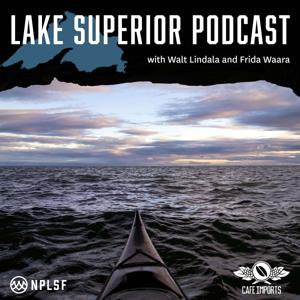
Lake Superior Podcast

Lake Superior Podcast

By National Parks of Lake Superior FoundationSociety & CultureSciencePlaces & TravelNatureEarth Sciences
Download on the App Store

Lake Superior Podcast episodes

  • S6 E5: Isle Royale in Winter: Survival, Science, and Secrets in the Snow – An Interview with Jonathan Pauli

    Winter Study at Isle Royale National Park has a decades long history, but just a few scientists ever get the chance to spend time on this isolated archipelago in Lake Superior. In this episode of the Lake Superior Podcast, Walt Lindala and Frida Waara talk with one of those fortunate ones, Johnathan Pauli, Professor in the Department of Forest & Wildlife Ecology at the University of Wisconsin Madison. From tracking foxes and martens to unraveling a centuries-old survival story, Johnathan shares how studying this wilderness in winter reveals secrets a summer visitor would never experience. Join us for a conversation about science, survival, and what makes Isle Royale National Park a critical refuge for wildlife.


    Key Takeaways:

    • Winter Study at Isle Royale has been going on for over 60 years, originally launched to monitor moose and wolf populations and now expanded to include other animals such as martens, foxes, and snowshoe hares.

    • Winter presents extreme challenges and rich insights, including long days in deep snow, cold exposure, and tracking animals over miles of off-trail terrain.

    • Snowshoe hares follow a 10-year boom-and-bust cycle, which helped explain the survival story of Angelique Mott in 1845, when she struggled to trap hares during a population crash.

    • Isle Royale functions as a modern-day “refugium,” because it is more buffered from human development and invasive species, making it an ideal site for long-term conservation and research.


    Notable Quotes:

    • “Winter is a period of nutritional and resource deficits.  It’s a really important time to study these winter-adapted organisms.”

    • “I love to say that there’s no anonymity in winter.”

    • “Refugia is something near and dear to my heart. These islands, Isle Royale and the Apostle Islands, really represent these interesting test beds for the concept of refugia.”

    • “It’s really important work. It’s really hard work. But it’s also really exciting. There’s a lot of complexity of emotions you have while you’re skiing these trails.”

    • “Sometimes what you see in the tracks can be almost as exciting as seeing some of these critters in person.”


    Resources:

    • Jonathan Pauli’s Research Group – Learn more about his work at UW–Madison:
      https://pauli.russell.wisc.edu/
    • Isle Royale National Park – Explore the park and its natural history:
       https://www.nps.gov/isro/index.htm

    • Apostle Islands National Lakeshore – Discover another key research site:
       https://www.nps.gov/apis/index.htm

    Connect With Us:

    • Website: https://nplsf.org/podcast

    • Facebook: https://www.facebook.com/NationalParksOfLakeSuperiorFoundation

    • LinkedIn: https://www.linkedin.com/company/national-parks-of-lake-superior-foundation


    Sponsors:

    • Cafe Imports – Supporting environmental sustainability in coffee-growing regions since 1993.  Learn more at https://cafeimports.com.
    • National Parks of Lake Superior Foundation – Support vital projects by donating at:
       https://nplsf.org/donate

    Be sure to tune in to this episode of the Lake Superior Podcast to hear Jonathan Pauli’s firsthand stories of survival, science, and what Isle Royale reveals in the silence of winter.


    38 min
  • S6 E4: Tourism, Economic Growth, and the Magic of Munising - An Interview with Kathy Reynolds

    Our National Parks are important places, not just for their preservation of natural beauty and resources, but also for the economic impact they bring to gateway communities. Pictured Rocks National Lakeshore in Michigan’s Upper Peninsula sees nearly a million visitors, year round. For the anchor cities of Munising and Grand Marais, hosting those folks has become their chief industry. With a population of less than 2,000, how do they do it? In this episode of the Lake Superior Podcast, Walt Lindala and Frida Waara talk with Kathy Reynolds, the CEO of the Greater Munising Bay Partnership as well as Director of the Alger County Chamber of Commerce to learn more.

    Key Takeaways:

    • Munising, Michigan, has transformed into a premier tourism destination, with Pictured Rocks National Lakeshore playing a central role in attracting visitors.
    • Tourism is now the leading industry in Alger County, supporting local businesses, entrepreneurs, and the community year-round.
    • Despite Munising's small population of under 2,000 residents, the area welcomes nearly one million visitors annually, requiring careful planning and infrastructure management.
    • The Michigan Ice Fest, the oldest ice climbing festival in North America, draws climbers from around the world and highlights Munising's appeal as a winter recreation destination.
    • Even though Munising has a strong tourism sector, it also has a diverse economy that includes manufacturing and public services, making it more resilient to seasonal fluctuations.

    Notable Quotes:

    • "I also tell people you should live where you want to vacation. Why just say, ‘Oh, I get to spend a week. Every once in a while I go someplace’? I wanted to live in a place that I wanted to vacation."
    • "I would say, and maybe I’m a little biased, that it is probably one of, if the most beautiful places in the whole Midwest. It’s easy to market the area and get people to come."
    • “Winter season can be extremely beautiful, and this year we are living in a snow globe all over the area of Munising.”
    • “Preservation of the park and our natural resources - that’s why people come up to the Upper Peninsula. Protecting those and making sure they stay nice is critical to our economy.”
    • "The people that come to Munising and visit our national park, they not only help us in our community, but they help all the communities outside of us in the U.P."

    Resources:

    • Greater Munising Bay Partnership: munising.org – Learn more about Munising and its economic development initiatives.
    • Alger County Chamber of Commerce: algercountychamber.com – Discover local businesses and visitor information.
    • Pictured Rocks National Lakeshore: www.nps.gov/piro/index.htm – Explore the stunning landscapes and recreational opportunities in the park.
    • Michigan Ice Fest: michiganicefest.com – Learn about the premier ice climbing event in Munising.

    Connect With Us:

    • Website: nplsf.org/podcast
    • Facebook: www.facebook.com/NationalParksOfLakeSuperiorFoundation
    • LinkedIn: linkedin.com/company/national-parks-of-lake-superior-foundation

    Sponsors:

    • Cafe Imports: Supporting environmental sustainability in coffee-growing regions since 1993. Learn more at https://cafeimports.com.
    • National Parks of Lake Superior Foundation: Support vital projects by donating at https://nplsf.org/donate.
    35 min
  • S6 E3: The Lake Trout Resurgence In Lake Superior: A Conservation Success Story - An Interview with Shawn Sitar

    Since the 1940’s, Lake Trout have been extinct in all of the Great Lakes except Lake Superior. Pressure from commercial fishing as well as the invasion of sea lamprey devastated this native species, and the population in Lake Superior also suffered. For three generations an international team of scientists has been working to restore healthy Lake Trout populations in all the Great Lakes. In this episode of the Lake Superior Podcast, Walt Lindala and Frida Waara talk with Shawn Sitar, Fisheries Research Biologist with the Michigan Department of Natural Resources to update the status of Lake Trout in Lake Superior.

    Key Takeaways:

    • Shawn Sitar explains his deep connection to Lake Superior, describing it as his hometown and emphasizing its pristine, natural state.
    • He outlines how Lake Superior stands out among the Great Lakes - not only as the largest by surface area but also as the deepest - making it a unique ecosystem.
    • The episode details the historical collapse of lake trout populations due to overfishing and invasive species, and highlights the international recovery efforts led by the Great Lakes Fishery Commission.
    • Shawn discusses the three-prong approach to lake trout recovery: suppression of sea lampreys, controlled fishing, and hatchery stocking.
    • He also addresses the challenges posed by climate change and evolving research techniques, emphasizing the need for long-term monitoring and adaptive management.

    Notable Quotes:

    • "I realized I look at Lake Superior as my hometown. I love that."
    • "It is the largest lake on the earth in terms of surface area. So that's the statistics there. Lake Superior is also the deepest among the Great Lakes."
    • "In fact, lake trout were extinct in all the Great Lakes except Lake Superior."
    • “By the 1960s, if we look at Lake Michigan, Lake Huron, Lake Erie, and Lake Ontario, the absence of lake trout, the top boss in the system, created a lot of havoc. And during that time period in the late 50s and 60s and 70s, there was another invasive called the alewife, which is a small oily fish from the Atlantic Ocean that came up. And it just basically boomed in the Great Lakes."
    • "During my career working on Lake Superior and the Great Lakes, I've already seen surface temperatures increase from when I started till now. There's a lot of variation around it. And I think there's already research ongoing to assess the impact."

    Resources:

    • Michigan Department of Natural Resources Website: https://www.michigan.gov/dnr
    • Great Lakes Fishery Commission Website: http://www.glfc.org
    • National Parks of Lake Superior Foundation Website: https://nplsf.org
    • Documentary “Fish Thief”: https://www.thefishthief.com/ 

    Connect With Us:

    • Website: https://nplsf.org/podcast
    • Facebook: https://facebook.com/NPLSF

    Sponsors:

    • Cafe Imports: Supporting environmental sustainability in coffee-growing regions since 1993. Learn more: https://cafeimports.com/
    • National Parks of Lake Superior Foundation: Support vital projects by donating at https://nplsf.org

    Be sure to tune in to this episode of the Lake Superior Podcast to hear Shawn Sitar’s in-depth insights on the lake trout recovery efforts, the unique characteristics of Lake Superior, and the ongoing challenges and innovations in Great Lakes fisheries research.


    29 min
  • S6 E2: Michigan Ice Fest – Where Adventure Meets Community – An Interview with Bill Thompson

    Winter can be a sleepy time at the National Parks on Lake Superior, but at Pictured Rocks National Lakeshore near Munising, Michigan, visitors come to snowmobile, mush dogs, snowshoe, fish and cross-country ski. But the biggest event to bring folks into the park is the Michigan Ice Fest. In this episode of the Lake Superior Podcast, Walt Lindala and Frida Waara talk with Ice Fest organizer Bill Thompson about the event and what makes Pictured Rocks such a Mecca for the sport. 

    Key Takeaways:

    • The Michigan Ice Fest has grown from a small gathering in 1991 to an internationally recognized event, drawing over 1,100 participants from 38 states and seven countries.
    • Ice climbing at Pictured Rocks National Lakeshore offers a one-of-a-kind experience, with ice formations over open water that can’t be found anywhere else in the world.
    • Ice Fest caters to all skill levels, from beginners as young as eight to seasoned climbers, with professional athletes providing instruction and inspiration at the event.
    • Even in warmer winters with limited ice, the festival continues as an educational and community event, showcasing presentations and fostering camaraderie.
    • The event’s unique location, accessibility, and passionate community make it a cornerstone of adventure tourism in Munising, Michigan.

    Notable Quotes:

    • “With the advent of social media and a few professional athletes spreading the word, there’s nowhere in the world that you can go ice climbing over open water, with crashing waves and the beauty of Lake Superior.”
    • “Ice climbing is a sport for anyone looking to go out, have an adventure, and try something new.”
    • “Ice climbing takes you places that not a lot of people in this world can get to.”
    • “Our safety system is really thought out. Instead of focusing on, ‘Oh man, I’m high,’ I’m focusing on the ice in front of me. You have all of these interesting patterns of ice, you can hear the water trickling behind it, so the sounds are very unique. It’s just really, really special."

    Resources:

    • Michigan Ice Fest Website (michiganicefest.com) – Learn more about the event, clinics, and presentations.
    • Pictured Rocks National Lakeshore (www.nps.gov/piro/index.htm) – Explore the beauty of this unique park.
    • Ice Climbing Safety and Equipment (michiganicefest.com/information/festival-planning/safety/) – Better nderstand the gear and precautions used at the festival.

    Connect With Us:

    • Website: (nplsf.org/podcast)
    • Facebook: (facebook.com/NPLSF)
    • LinkedIn: (linkedin.com/company/national-parks-of-lake-superior-foundation)

    Sponsors:

    • Cafe Imports: Supporting environmental sustainability in coffee-growing regions since 1993. (cafeimports.com).
    • National Parks of Lake Superior Foundation: Support vital projects by donating at (nplsf.org).

    Be sure to tune in to this episode of the Lake Superior Podcast to hear Bill Thompson’s incredible stories of adventure, community, and ice climbing at one of the most unique national parks in the world.


    32 min
  • S6 E1: Chasing Sunrise On Lake Superior: An Interview with Bugsy Sailor

    New Year Resolutions, if you don’t make them, chances are you thought about it. But do those promises keep? In this episode of the Lake Superior Podcast Walt Lindala and Frida Waara talk with Bugsy Sailor, the Official Unofficial Ambassador of Michigan’s Upper Peninsula. Bugsy shares how a resolution he made on January 1, 2019, changed his life.

    Key Takeaways:

    • Bugsy Sailor captures daily sunrises around Lake Superior, embracing nature’s raw beauty and the unpredictability of the seasons.
    • His commitment to photographing every sunrise since 2019 highlights the power of routine, resilience, and creative passion in overcoming challenges.
    • Bugsy emphasizes the importance of embracing inclement weather, breaking stereotypes that sunrises must always be "beautiful and majestic."
    • Through his Sunrise Gallery and community engagement, Bugsy fosters a deeper connection between people and nature, inspiring others to watch more sunrises.
    • His solo adventures and reflections on accountability demonstrate how setting measurable goals can cultivate positive habits and a mindful approach to life.

    Notable Quotes:

    • “It always keeps things fresh. There's a ton of variety within our seasons and on the shores of Lake Superior.”
    • “I think if you start with sunrise and you get up and out the door to watch sunrise, it makes the day attainable. You at least started it on the right foot and can give yourself that potential to live that day to the fullest.”
    • “It's just getting up to that water and that, that impact of being connected with nature every day.”

    Resources:

    • Bugsy Sailor on Year of the Sunrise: yearofthesunrise.com
    • Upper Peninsula Supply Company: upsupply.co 
    • National Parks of Lake Superior Foundation: nplsf.org

    Be sure to tune in to this inspiring episode of the Lake Superior Podcast to hear Bugsy Sailor’s incredible journey of capturing sunrises, his resilience in the face of challenges, and his passion for connecting with nature on a daily basis.

    Connect With Us:

    • Website: Lake Superior Podcast
    • Facebook: National Parks of Lake Superior Foundation
    • LinkedIn: NPLSF on LinkedIn
    35 min
  • S5 E14: The Estivant Pines Story - 50 Years of Conservation with Charles Eshbach

    The forests that ring Lake Superior are some of the most magical on the continent. At the tip of Michigan’s Keweenaw Peninsula, in Copper Harbor, you’ll find the Estivant Pines. This 570 acres of old-growth pine has lured hikers for decades. But saving this stand of ancient timber was no small feat.

    It started over 50 years ago and in this episode of the Lake Superior Podcast, Walt Lindala and Frida Waara talk with photographer and forester Charles Esshbach from Houghton, Michigan, about his work to protect one of the Upper Peninsula’s most remarkable natural treasures.

    Tune in to learn how his story of conservation--from skiing in deep snow with his camera to the cooperation of classrooms around the region--has inspired generations.

    Key Takeaways:

    • The Estivant Pines are one of the last contiguous stands of old-growth white pines in Michigan’s Upper Peninsula, with some trees towering over 150 feet and dating back 500 years.
    •  Grassroots efforts, including a committee of 17 citizens and even fundraising by schoolchildren, were critical to saving the sanctuary from logging in the 1970s.
    •  Photography played a pivotal role in raising awareness, with Charles documenting the pines’ beauty and the destruction they faced, galvanizing public support.
    •  The sanctuary’s preservation has inspired generations, creating a deeper understanding of the value of conserving natural habitats for future generations.
    •  Conservation efforts have not only saved the forest but also educated the public, fostering a culture of environmental responsibility in the region.

    Notable Quotes:

    •  “You always know your backyard the best, and the Keweenaw is my backyard.”
    •  “The kids led the way. School children raised money, from quarters dropped in buckets to can drives, to save these trees.”
    •  “These trees are four to five hundred years old. It’s amazing that they’re still there.”
    •  “Our little committee of seventeen people persevered through countless setbacks.”
    •  “This is a piece of history - a legacy of what we’ve preserved and achieved.”

    Resources:

    • Estivant Pines Sanctuary Information: Estivant Pines (https://www.michigannature.org/index.cfm?fuseaction=locationgallery&action=listing&listing=110) 
    • National Parks of Lake Superior Foundation: NPLSF Website (https://www.nplsf.org/)

    Be sure to tune in to this inspiring episode of the Lake Superior Podcast to hear Charles’s incredible story of conservation and community dedication.

    Connect With Us:

    • Website: Lake Superior Podcast
    • Facebook: National Parks of Lake Superior Foundation
    • LinkedIn: NPLSF on LinkedIn
    38 min
  • S5 E13: Foraging - Rediscover and Reconnect With Nature - An Interview with Tim Clemens

    Since time began humans have been foragers. Survival depended on connecting to the natural world. Today, when most of our food comes from a grocery store or is eaten in a restaurant, that link has been lost. But not for Tim Clemens. In this episode of the Lake Superior Podcast, Walt Lindala and Frida Waara talk with Tim, a professional forager and founder of Ironwood Foraging about how he’s helping people connect with nature; and not in the middle of the forest or farm country, but near his urban home of Minneapolis.

    Key Takeaways: 

    •  Foraging is not limited to rural or wilderness areas—urban environments, like the parks and green spaces in Minneapolis, offer surprising edible treasures.
    •  Learning to identify wild edibles is key to safe foraging, and local foraging groups or societies can be invaluable resources for beginners.
    •  Tim emphasizes the importance of indigenous traditions and thinking long-term, such as planting trees for future generations, in the practice of foraging.
    •  Foraging creates a deeper connection to the natural world, making people more mindful stewards of the environment by seeing it not just as scenery, but as a source of sustenance.
    •  Foraging is becoming increasingly popular, moving beyond farm-to-table into forest-to-table, and gaining recognition in both local communities and top-tier restaurants.

    Notable Quotes:

    •  "Foraging has gotten so much more popular, and just like the farm-to-table movement, the next iteration of that is the forest-to-table movement or the prairie-to-table movement."
    •  "You need to identify the species you're trying to eat before you eat it. You really should identify something first because there are things that can hurt you."
    •  "When you’re foraging, suddenly it's your blueberry patch... it's not just a backdrop for human activity anymore. You’re going to be attached to individual trees...and you're just going to be a better naturalist for that."
    •  "For most of the year, I don't buy rice because I harvest my own. There are things I never buy anymore. I don't buy fruit, I don't buy greens, I don't buy mushrooms, and I don't buy nuts."
    •  "We have folks who have backgrounds in biology like myself and folks who have backgrounds in graphic design. There's room for all those people and a need for all those people because we need people to balance our budgets, fix our computers, design our graphics."

    Resources:

    •  Ironwood Foraging Website: https://ironwoodforaging.com/ 
    •  Minnesota Mycological Society: https://minnesotamycologicalsociety.org/ 
    •  National Parks of Lake Superior Foundation: https://www.nplsf.org/ 

    Be sure to tune in to this insightful episode of the Lake Superior Podcast to learn more about the art of foraging and how you can reconnect with the environment through this ancient practice.

    You can also learn more about foraging and the interview here: https://www.nplsf.org/foraging-podcast-interview

    Connect With Us:

    • Website: https://www.nplsf.org/lake-superior-podcast 
    • Facebook: https://www.facebook.com/NationalParksOfLakeSuperiorFoundation/ 
    • LinkedIn: https://www.linkedin.com/company/national-parks-of-lake-superior-foundation/  
    34 min
  • S5 E12: Capturing the Magic of The Northern Lights: An Interview with Ogetay Kayali

    Witnessing the Northern Lights checks a bucket-list for many. The first time you see the sky erupt in waves of pulsing white, green, red, or even blue light makes lifelong memories. In this episode of the Lake Superior Podcast, Walt Lindala and Frida Waara talk with Astrophysics Graduate Student Ogetay Kayali from Michigan Technological University in Houghton, Michigan. Ogetay shares not only why we seem to be experiencing the Northern Lights more frequently, but also how to better take advantage of the experience with our cameras.

    Key Takeaways:

    •  The northern lights are at their peak due to the solar maximum, a phenomenon that happens every 11 years, increasing the likelihood of bright auroras.
    •  The colors in the northern lights, ranging from green to red and purple, are caused by the interaction of solar particles with oxygen and nitrogen in the Earth's atmosphere.
    •  With advances in technology, it's easier than ever to capture the auroras on cameras, even smartphones, though understanding camera settings like ISO and exposure can enhance the quality of your photos.
    •  Dark skies are critical for viewing the northern lights, and the Lake Superior region offers excellent vantage points for experiencing this natural wonder away from city lights.
    •  The best time to see the lights is during winter months with longer nights, and checking the moon's phase can also help—new moons provide the darkest skies for optimal viewing.

    Quotes:

    •  "We are currently at solar maximum, so we are expecting lots of solar storms that hit the Earth and cause northern lights. That's pretty normal. Every 11 years that happens" – Ogetay Kayali
    •  "If you have a camera, first try to learn using it. If you have a mobile camera, go to the darkest place you can and use long exposures to collect more light." – Ogetay Kayali
    •  "Take that chance, even when the forecast looks cloudy...you've got to try it." – Ogetay Kayali


    Resources:

    •  For daily astronomical insights and stunning celestial images, visit NASA’s Astronomy Picture of the Day (apod.nasa.gov/apod/astropix.html).
    •  To learn more about designated dark sky parks and optimal stargazing locations, visit Dark Sky Parks near Lake Superior (https://darksky.org/places/keweenaw-michigan-dark-sky-park/).
    •  For more information about NPLSF, visit National Parks of Lake Superior Foundation (nplsf.org)

    Don’t miss this captivating episode as Ogatai Kayali, an astrophysics graduate student, explains the science behind the Northern Lights and why we’ve been seeing them more frequently along Lake Superior. Tune in for an in-depth look at the solar cycles, photography tips, and how Lake Superior’s dark skies provide some of the best stargazing opportunities in the world.


    32 min
  • S5 E11: Pictured Rocks: Where Conservation Meets Recreation - An Interview with Hannah Bradburn

    Nearly a million visitors came to Pictured Rocks National Lakeshore in Michigan’s Upper Peninsula in 2023, contributing over $45 million dollars to the nearby economies. For Alger County--with a population of less than nine thousand people—the park also supports 544 jobs. But hosting that many visitors and generating that much revenue does present unique challenges.  In this episode of the Lake Superior Podcast, Walt Lindala and Frida Waara talk with Hannah Bradburn, Visual Information Specialist at Pictured Rocks, to explore the park’s delicate balance between conservation and recreation.

    Key Takeaways:

    •  Visitor Growth: Pictured Rocks sees nearly a million visitors annually, nearly double from a decade ago, showcasing its growing popularity as a travel destination.
    •  Invasive Species Management: Efforts to keep zebra mussels and other invasive species out of the park’s waterways are ongoing, with education and prevention playing key roles.
    •  Seasonal Operations: The park operates year-round, with winter activities like skiing and ice climbing providing a draw for visitors, while summer months focus on hikes, kayaking, and camping.
    •  Local Economic Impact: Visitor spending contributes millions of dollars to nearby communities like Munising and Grand Marais, supporting local businesses and fostering economic growth.
    •  Historical and Cultural Preservation: Pictured Rocks plays a significant role in preserving both natural and historical landmarks, such as the Au Sable Light Station, offering visitors a chance to connect with the region’s past.


    Quotes:

    •  "Pictured Rocks is one of those parks that is best experienced from the water if you're trying to see the cliff - either taking a Pictured Rocks cruise or getting on a kayak tour."
    •  “It’s super important for folks who are transferring their boats or their gear from different bodies of water that they clean, drain, and dry their equipment to make sure that Pictured Rocks waterways stay pristine.”
    •  "If you're interested in working with the park service, reach out to a park, and there's probably room for your skill at a park, and many of us are more than happy to share our experiences."


    Resources:

    •  For more information on visiting or working at Pictured Rocks National Lakeshore, visit Pictured Rocks National Lakeshore (NPS.gov/PIRO). 
    •  For more information about NPLSF, visit the National Parks of Lake Superior Foundation website (nplsf.org).


    Don’t miss this insightful episode as Hannah Bradburn takes us behind the scenes of Pictured Rocks National Lakeshore, revealing how this beloved park balances growing visitation with vital conservation efforts. Tune in for an in-depth look at the stewardship behind one of the Great Lakes' most treasured landscapes.

    32 min
  • S5 E10: Isle Royale Through The Lens - An Interview with Tom Haas, Photographer and Author

    For those who have backpacked Isle Royale, you know it’s a rugged place. Imagine carrying a 20 pound camera and wooden tripod around, along with a stash of 4x5 black and white film. In 1967, Tom Haas, a 19 year old college student from Connecticut was on a mission with the National Park Service to photograph the island. Most of his travel was done by kayak and over the course of 20 years he captured 3,000 black and white images.

    Now, nearly 5 decades later and with help from his wife Jeannie Thoren, the couple have published a book, “Isle Royale, A Photographer’s Circumnavigation 1967-1987.” In this episode of the Lake Superior Podcast, Walt Lindala and Frida Waara talk with Tom about his book and the people and places he captured leaving lasting memories at Isle Royale.

    Key Takeaways:

    •  Tom Haas' passion for Isle Royale shines through in his meticulously captured black and white photographs, showcasing the island's timeless beauty.
    •  The book Isle Royale: A Photographer's Circumnavigation, 1967 to 1987 offers a glimpse into the rich history and captivating landscapes of Isle Royale.
    •  Tom's unique perspective as a longtime visitor and photographer provides a deep understanding of the island's evolution and the enduring spirit of its inhabitants.
    •  The intimate portraits of fishing communities and natural landscapes captured by Tom Haas offer a poignant reflection on the vibrant history of Isle Royale.
    •  Through his work, Tom Haas encourages visitors to slow down, immerse themselves in the island's splendor, and embrace the beauty of Isle Royale at a leisurely pace.

    Notable Quotes:

    •  "You don't have to be in a rush or cover a lot of ground to see a lot." - Tom Haas
    •  "Isle Royale is a place where time seems to stand still, allowing visitors to truly connect with nature and history in a unique way." - Tom Haas
    •  "Photography is not just about capturing images; it's about building trust, forming connections, and telling stories that resonate with the soul." - Tom Haas
    •  "Each photograph in the book reflects a moment frozen in time, preserving the essence of Isle Royale for future generations to cherish." - Tom Haas
    •  "The beauty of Isle Royale lies not just in its landscapes, but in the resilient spirit of its inhabitants and the timeless stories woven into its fabric." - Tom Haas

    Resources:

    •  Tom Haas Photography Website: Tom Haas Photography

    Don't miss the opportunity to delve into the enchanting world of Isle Royale through the lens of photographer and author Tom Haas. Listen to the full episode for a profound exploration of the park's history, beauty, and enduring legacy

    28 min

About Lake Superior Podcast

From the publisher's feed

We are made stronger by story and there’s no better source than the continent's largest body of freshwater, Lake Superior. Join hosts Walt Lindala and Frida Waara as they highlight the five…

Best of Lake Superior Podcast

Ranked by our users in the last 21 days
More shows like Lake Superior Podcast

Fresh Air by NPR

Fresh Air

38,012 Listeners

Hidden Brain by Hidden Brain, Shankar Vedantam

Hidden Brain

43,362 Listeners

Wait Wait... Don't Tell Me! by NPR

Wait Wait... Don't Tell Me!

38,702 Listeners

99% Invisible by Roman Mars

99% Invisible

26,160 Listeners

Travel with Rick Steves by Rick Steves

Travel with Rick Steves

2,509 Listeners

Gastropod by Cynthia Graber and Nicola Twilley

Gastropod

3,644 Listeners

What Trump Can Teach Us About Con Law by Roman Mars

What Trump Can Teach Us About Con Law

4,005 Listeners

The Last Word with Lawrence O’Donnell by Lawrence O'Donnell, MS NOW

The Last Word with Lawrence O’Donnell

7,165 Listeners

Parkography by RV Miles Network

Parkography

896 Listeners

Points North | Great Lakes. Great Stories. by A Great Lakes Podcast

Points North | Great Lakes. Great Stories.

295 Listeners

The Wild with Chris Morgan by KUOW News and Information

The Wild with Chris Morgan

3,418 Listeners

The Al Franken Podcast by The Al Franken Podcast

The Al Franken Podcast

8,029 Listeners

Chasing Life with Dr. Sanjay Gupta by CNN Podcasts

Chasing Life with Dr. Sanjay Gupta

8,098 Listeners

Wiser Than Me with Julia Louis-Dreyfus by Lemonada Media

Wiser Than Me with Julia Louis-Dreyfus

10,666 Listeners

Edmund Fitzgerald: 50 Years Below by Duluth News Tribune

Edmund Fitzgerald: 50 Years Below

155 Listeners