
Sign up to save your podcasts
Or

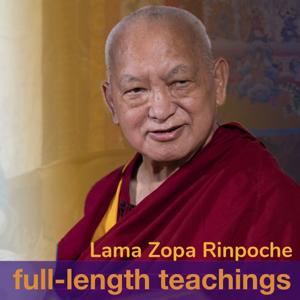


Lama Zopa Rinpoche says that the reason to have meetings is to help with wisdom. Many people have different ideas, so that helps generate a broader view.
Rinpoche talks about the importance of Sangha as role models. He says learning the words is incredible, but without practice, it’s like a tape-recorder. When someone has meditated on lamrim, they can teach with experience.
Rinpoche introduces the main topic of discussion about caring for aged Sangha by suggesting that there should be several places organized in different countries rather than only one place. He then invites people to express their ideas. Eecie Hursthouse (director of Amitabha Hospice Service) discusses the three different needs of elderly Sangha (spiritual, physical, and social needs). Mary, a district nurse, talks about her experiences and the aged care support services available in Australia. Ven. Roger Kunsang talks about his preference to die alone. Ven. Tardo expresses her agreement with Ven. Roger. Ven. Yeshe Khadro gives some examples of people who have died and their experiences. Ven. Chonyi talks about the enormous variation in what people want when they’re dying and the need for financial support. Ven. Lhundrup agrees with Ven. Roger and talks about the building facilities that older Sangha may require. Ven. Pende discusses the building facilities at Nalanda Monastery for the purpose of supporting aged Sangha. Several other speakers contribute to the discussion by sharing their personal experiences and suggestions.
Following this, Rinpoche gives a presentation about how to have a peaceful death. He illustrates the importance of Dharma practice for a peaceful death by sharing several personal stories, including stories about Gen Jampa Wangdu and his realizations. Rinpoche says that protecting our karma during our lifetime is what makes death peaceful and fearless. Protecting our karma means not harming other sentient beings. Thus, the best preparation for death is to practice the good heart in everyday life.
Rinpoche concludes by reminding students to meditate on how everything comes from the mind. This understanding will then lead to knowledge of what is a false view and what is a correct view. Rinpoche emphasizes that this is an extremely important meditation for both old and new students.
From April 10 to May 10, 2004, Lama Zopa Rinpoche gave extensive teachings during the Mahamudra Retreat at Buddha House in Australia. While the retreat focused on Mahamudra, Rinpoche also taught on a wide range of Lamrim topics. This retreat marked the beginning of a series of month-long retreats in Australia. Subsequent retreats were held in 2011, 2014, and 2018, hosted by the Great Stupa of Universal Compassion in Bendigo.
Find out more about Lama Zopa Rinpoche, his teachings and projects at https://fpmt.org/
Lama Zopa Rinpoche discusses the seven attributes of a perfect human body and clarifies the points relating to caste and gender. He also discusses the eight ripening aspects that Lama Tsongkhapa emphasized in the Hymns of the Experience of the Path to Enlightenment.
Rinpoche highlights the preciousness of this perfect human body. He says that it is more precious than the whole sky filled with wish-granting jewels. So, if we don’t get to practice Dharma for even a second, this would be a great loss. Thus, we must bear hardships to practice Dharma. If you don’t bear the hardships, you cannot practice Dharma, and then you will become lazy and waste your precious human body.
Rinpoche reminds us that we experience hardships because we are in samsara. Our body and mind came from karma and delusion, so they are in the nature of suffering. If we don’t practice Dharma because of the hardships, then we’ll be in samsara forever. We’ll never get free from the oceans of samsaric suffering.
The duration of this perfect human rebirth is very short, and it can stop at any moment. Therefore, we need to develop our mind in the stages of the path to enlightenment.
Rinpoche gives a clear description of how to meditate on the lamrim through daily meditations of the lower capable being. He stresses that it’s important to meditate on several points (guru devotion, perfect human rebirth, impermanence-death, renunciation), as if you only meditate on one aspect throughout your life, you may not achieve even that realization. He also stresses that bodhicitta can only be attained after realizing renunciation.
From April 10 to May 10, 2004, Lama Zopa Rinpoche gave extensive teachings during the Mahamudra Retreat at Buddha House in Australia. While the retreat focused on Mahamudra, Rinpoche also taught on a wide range of Lamrim topics. This retreat marked the beginning of a series of month-long retreats in Australia. Subsequent retreats were held in 2011, 2014, and 2018, hosted by the Great Stupa of Universal Compassion in Bendigo.
Find out more about Lama Zopa Rinpoche, his teachings and projects at https://fpmt.org/
Lama Zopa Rinpoche explains how to do the meditation with the requesting prayer. The way to meditate is to realize Guru Vajradhara, the Dharmakaya Buddha, as the root virtuous friend that embodies and pervades all the manifested billions of mandalas or deities.
Rinpoche highlights that the purpose of our life is to free all sentient beings from suffering and cause them happiness. He says that working for others accomplishes two purposes: others’ happiness and our own happiness. Thus, working for others’ happiness has limitless skies of benefit. To illustrate this, Rinpoche gives an example from the Avatamsaka Sutra, which describes how one person with bodhicitta offering a tiny flower to the Buddha collects far greater merit than if all sentient beings living in the great three thousand universes built stupas made of jewels that covered the entire universe. From this example, you can understand how bodhicitta is the treasure of merit.
Rinpoche says that all the infinite qualities of Buddha’s holy body, speech, and mind came from bodhicitta. The Buddha came from a bodhisattva, and bodhisattvas come from bodhicitta. Thus, all one’s past, present, and future happiness come from bodhicitta.
Rinpoche also explains how the development of bodhicitta depends on suffering sentient beings. He says that bodhicitta came from great compassion and great compassion is generated by depending on the existence of suffering beings. Therefore, these sentient beings are unbelievably precious.
From April 10 to May 10, 2004, Lama Zopa Rinpoche gave extensive teachings during the Mahamudra Retreat at Buddha House in Australia. While the retreat focused on Mahamudra, Rinpoche also taught on a wide range of Lamrim topics. This retreat marked the beginning of a series of month-long retreats in Australia. Subsequent retreats were held in 2011, 2014, and 2018, hosted by the Great Stupa of Universal Compassion in Bendigo.
Find out more about Lama Zopa Rinpoche, his teachings and projects at https://fpmt.org/
Lama Zopa Rinpoche says that if you are only seeking the happiness of this life, then you haven’t reached any of the three capacities of the lamrim. The attitude of just seeking the power, reputation, and wealth of this life is an ordinary capable being, not a special capable being. This is not different from the animals and insects.
Rinpoche emphasizes that the meditations for the graduate path of the lower capable being (the eight freedoms and ten richnesses, the great meaning and difficulty to find again, impermanence and death, the lower realm sufferings, karma) are very important for the success of actualizing the whole path. Without these foundations, you can’t have the next realizations, renunciation and bodhicitta. Without bodhicitta, you have no door to enter the Mahayana path to enlightenment, so you can’t complete the tantric path. Therefore, these meditations are the foundation for all those other paths.
Rinpoche describes the eight freedoms and ten richnesses. He urges us to reflect on these points. By doing so, we will realize that we must practice Dharma immediately. Rinpoche says that these meditations will give us hope and courage to defeat the eight worldly dharmas.
Rinpoche bestows the lung of the mahamudra root text and ends the session with an extensive dedication prayer and multiplying mantras.
From April 10 to May 10, 2004, Lama Zopa Rinpoche gave extensive teachings during the Mahamudra Retreat at Buddha House in Australia. While the retreat focused on Mahamudra, Rinpoche also taught on a wide range of Lamrim topics. This retreat marked the beginning of a series of month-long retreats in Australia. Subsequent retreats were held in 2011, 2014, and 2018, hosted by the Great Stupa of Universal Compassion in Bendigo.
Find out more about Lama Zopa Rinpoche, his teachings and projects at https://fpmt.org/
Lama Zopa Rinpoche emphasizes the importance of first becoming clear about the extremely subtle dependent arising view that things exist merely in name (the Middle Way view). If this view is clear in your mind, then the rest becomes easy. If not, then you may get confused or fall into nihilism.
Rinpoche gives instructions on how to meditate on this view. He explains the meaning of “form is empty” and “emptiness is form.” He shows how these lines present the Middle Way view: “form is empty” eliminates the extreme of eternalism; “emptiness is form” eliminates the extreme of nihilism.
Rinpoche also describes how to remove obstacles by meditating on emptiness. Whatever problems you have—sickness, relationship problems, business difficulties—look at them as empty. He mentions Kunkyen Jamyang Shepa, who wrote a text about removing obstacles to travel by understanding how these obstacles are dependently arisen. Meditating on the emptiness of the obstacles dispels them, as it purifies the cause of the problem. Thus, meditating on emptiness is very powerful; it is the best protection.
For those who missed the morning session, Rinpoche gives the lung of Lama Chöpa. He also gives the oral transmissions of the Eight Verses of Thought Transformation, the Maitreya Buddha mantra, the auspicious prayer, and his name mantra.
From April 10 to May 10, 2004, Lama Zopa Rinpoche gave extensive teachings during the Mahamudra Retreat at Buddha House in Australia. While the retreat focused on Mahamudra, Rinpoche also taught on a wide range of Lamrim topics. This retreat marked the beginning of a series of month-long retreats in Australia. Subsequent retreats were held in 2011, 2014, and 2018, hosted by the Great Stupa of Universal Compassion in Bendigo.
Find out more about Lama Zopa Rinpoche, his teachings and projects at https://fpmt.org/
Lama Zopa Rinpoche gives the oral transmission (lung) of the Guru Puja. He explains that taking the oral transmission is important because it has the continuity of blessings from Panchen Losang Chökyi Gyaltsen, who completed the path to enlightenment.
Rinpoche says that he received the transmission from a few lamas—His Holiness, of course, and also Trijang Rinpoche and Ling Rinpoche.
Rinpoche explains the many benefits of having received the transmission. It makes our recitations and explanations to others more powerful and beneficial to the mind. Rinpoche gives an example of the Arya Sanghata Sutra. Reciting this sutra just once after having received the lung has the same benefits as reciting it a hundred times without the lung. Also, when we reach a certain level on the path to enlightenment, there’s a point at which you remember all the teachings for which you received the oral transmissions. All these teachings come to your heart instantly. Thus, there are huge differences between having received the lung and not having received the lung. For any prayer we recite, receiving the lung has a great effect.
From April 10 to May 10, 2004, Lama Zopa Rinpoche gave extensive teachings during the Mahamudra Retreat at Buddha House in Australia. While the retreat focused on Mahamudra, Rinpoche also taught on a wide range of Lamrim topics. This retreat marked the beginning of a series of month-long retreats in Australia. Subsequent retreats were held in 2011, 2014, and 2018, hosted by the Great Stupa of Universal Compassion in Bendigo.
Find out more about Lama Zopa Rinpoche, his teachings and projects at https://fpmt.org/
Lama Zopa Rinpoche begins with a recap of the previous session’s topic: to always live life with a bodhicitta motivation. He cites the Kadampa geshes, who say that if we don’t do this, life will be a never-ending confession. This is because without bodhicitta, our mind will be self-centered and this causes other negative emotional thoughts (anger, attachment, jealousy, etc.) to arise. Then, we will engage in negative karmas, and our vows will degenerate.
Rinpoche says that keeping the mind in the motivation of bodhicitta is like the sun shining in our life. It makes our life beneficial, satisfying, and fulfilling.
He urges us to practice Dharma as much as possible with our body, speech, and mind. He gives examples of how to do this by reciting mantras while travelling and playing the Arya Sanghata Sutra CD.
Rinpoche says that the first freedom (not being born in the hells) is so precious; similarly, all the rest and each of the richnesses are so precious, so we should not waste our life.
He then talks about the second freedom: the freedom to practice Dharma by not being born as a preta. He describes the sufferings of the preta realm and how impossible it is to practice Dharma in this realm. With this freedom, we can achieve the happiness of future lives. Therefore, this second freedom (like the first one) is more precious than mountains of gold.
Following this, Rinpoche describes the third freedom: the freedom to practice Dharma by not being born as an animal. He describes how animals cannot understand Dharma even if we tried to explain it to them. In comparison, for us as humans, it is so easy to communicate and understand Dharma. This makes our human life incredibly precious, and we must not waste even a second of it. We must learn and practice Dharma.
This session ends with a discussion of the five lay vows and the bestowing of the refuge ceremony.
From April 10 to May 10, 2004, Lama Zopa Rinpoche gave extensive teachings during the Mahamudra Retreat at Buddha House in Australia. While the retreat focused on Mahamudra, Rinpoche also taught on a wide range of Lamrim topics. This retreat marked the beginning of a series of month-long retreats in Australia. Subsequent retreats were held in 2011, 2014, and 2018, hosted by the Great Stupa of Universal Compassion in Bendigo.
Find out more about Lama Zopa Rinpoche, his teachings and projects at https://fpmt.org/
Lama Zopa Rinpoche begins with a reminder about the previous session’s discussion of how beneficial it is to recite the Buddha’s past bodhisattva life stories. He also talks about Lupa Rinpoche, a Nepalese lama who inspired many people to do nyung-näs and made a Dharma law that people could not kill animals in his past life.
Regarding the Buddha’s past bodhisattva life stories, Lama Zopa Rinpoche suggests that they need good chanting. In that way, it would appear in the public’s view like singing a song and become even more inspiring. Rinpoche also suggests reading The King of Prayers and The Eight Verses of Thought Transformation for those occasions (birthdays, weddings, etc.). It’s also good to set up extensive offerings, with many light offerings.
Rinpoche briefly discusses the six preparatory practices and then gives a detailed description of the preciousness of this human life, with eight freedoms and ten richnesses. He states that this perfect human rebirth is more precious than mountains of gold.
The first of these eight freedoms—the very beginning of the path to enlightenment—is freedom to practice Dharma by not being born in the hells. He explains the sufferings in each of the hell realms and highlights that freedom from these realms relies on two solutions: purifying past negative karma and vowing not to commit negative karma again. If you only practice purification without taking vows, then the purification practice becomes endless. With these two solutions, you can avoid the suffering of the lower realms and solve the difficulties of this life.
Rinpoche advises that right now, with this freedom to practice Dharma by not being born in a hell realm, you can achieve any happiness you want. If you wish to achieve liberation from samsara and full enlightenment for sentient beings, you can obtain that. Rinpoche says this freedom is more precious than mountains of gold because it allows you to achieve the happiness of future lives. However, it doesn’t last long; it can stop at any time; so, there’s no time for meaningless activities —there’s only time to practice Dharma.
Rinpoche explains that there are many ways to practice Dharma. However, what makes life most meaningful is bodhicitta, which depends on guru devotion. Continuously practicing bodhicitta transforms your life, like transforming iron into gold.
From April 10 to May 10, 2004, Lama Zopa Rinpoche gave extensive teachings during the Mahamudra Retreat at Buddha House in Australia. While the retreat focused on Mahamudra, Rinpoche also taught on a wide range of Lamrim topics. This retreat marked the beginning of a series of month-long retreats in Australia. Subsequent retreats were held in 2011, 2014, and 2018, hosted by the Great Stupa of Universal Compassion in Bendigo.
Find out more about Lama Zopa Rinpoche, his teachings and projects at https://fpmt.org/
This session begins with the Guru Puja offering practice, prayers, and mantras. During the recitation of the tong-len prayer, Lama Zopa Rinpoche advises us to pause and go over the outline of the bodhicitta techniques (either the seven-point cause and effect method or equalizing and exchanging the self with others). Rinpoche says that since bodhicitta is the most precious wish-fulfilling thought for oneself and others, it’s important to briefly meditate on bodhicitta in this way.
Rinpoche also recommends reciting the Buddha’s past bodhisattva life stories after doing the Guru Shakyamuni Buddha mantra and meditation. Rinpoche then elaborates on how these life stories can be recited at birthdays, weddings, and New Year celebrations. He says that it can be very inspiring for others, including non-Buddhists. There’s no contradiction for Christians or those of other faiths, as the stories are basically about compassion, benefiting others, and sacrificing your life for others. This is in harmony with Christianity; it’s not an opposing philosophy. So, everyone can recite it together, in the family or in a public place where there are all kinds of different faiths. In this way, people can hear the heart of Mahayana Buddhism.
From April 10 to May 10, 2004, Lama Zopa Rinpoche gave extensive teachings during the Mahamudra Retreat at Buddha House in Australia. While the retreat focused on Mahamudra, Rinpoche also taught on a wide range of Lamrim topics. This retreat marked the beginning of a series of month-long retreats in Australia. Subsequent retreats were held in 2011, 2014, and 2018, hosted by the Great Stupa of Universal Compassion in Bendigo.
Find out more about Lama Zopa Rinpoche, his teachings and projects at https://fpmt.org/
Lama Zopa Rinpoche defines each of the three capacities of lamrim practitioners: lower, middling, and upper capacity beings. He advises that if we are only seeking happiness for this life, then we haven’t even reached the first capacity. Rinpoche stresses that such a person is not different from animals. Even animals are expert at seeking the happiness of this life by killing or cheating to get food. So, now, in this very lifetime, we must attempt to be in this group of capable lamrim practitioners.
Rinpoche reminds us that this doesn’t happen without causes and conditions. It depends on actualizing the path, which removes the gross and subtle defilements. He further illustrates that this path must be a complete path, from beginning to end. We cannot achieve enlightenment by only meditating on some part of the path. We have to learn and practice the whole path to enlightenment, which needs to be actualized step by step. Therefore, we need to follow the steps on the path to enlightenment as Lama Atisha presented. This lamrim teaching contains all the essence of the 84,000 teachings of the Buddha without anything missing. It is set up for graduated practice for one person to achieve enlightenment.
Rinpoche goes through the lamrim outlines and explains how correctly relying on the virtuous friend and the actual training are of equal value. He cites Kyabje Choden Rinpoche who said it is like the two saddle bags you put on a horse; the weight needs to be equal. Lama Zopa Rinpoche says that people normally mistakenly think that the second outline (training the mind) is more important than the first outline (devoting to the virtuous friend), but they are equally important.
From April 10 to May 10, 2004, Lama Zopa Rinpoche gave extensive teachings during the Mahamudra Retreat at Buddha House in Australia. While the retreat focused on Mahamudra, Rinpoche also taught on a wide range of Lamrim topics. This retreat marked the beginning of a series of month-long retreats in Australia. Subsequent retreats were held in 2011, 2014, and 2018, hosted by the Great Stupa of Universal Compassion in Bendigo.
Find out more about Lama Zopa Rinpoche, his teachings and projects at https://fpmt.org/
From the publisher's feed
162 Listeners