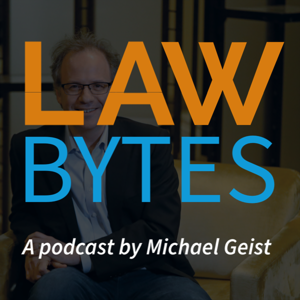
Law Bytes

Law Bytes

By Michael GeistTechnologyArts
Download on the App Store

Law Bytes episodes

  • Episode 268: Sara Grimes on the Moral Panic Behind Banning Kids from Social Media and AI Chatbots
    The question of children’s social media and AI chatbot ban has emerged as one of the most talked-about digital policy issues in recent memory. Premiers, the Liberal convention, and the media have all jumped on board. But has the debate been driven by misinformation, leading to a moral panic? Dr. Sara Grimes has been working on children’s rights and digital policy for over twenty years. As the Wolfe Chair in Scientific and Technological Literacy and a Full Professor in the Department of Art History and Communication Studies at McGill University, she brings a unique perspective to the issue, having applied a children’s rights lens to areas such as social media regulation and age verification technologies. She joins the Law Bytes podcast to discuss her work and perspectives on the hot digital issue of the moment.
    48 min
  • Episode 267: Peter Nowak on Rogers, the Shaw Merger Aftermath, and the Limits of Canadian Telecom Policy
    The recent announcement that Rogers is offering buyouts to half of its workforce is just the tip of the iceberg in a series of developments involving one of Canada’s dominant communications companies. It has seen rising consumer complaints, is cutting capital expenditures, increasingly pivoting towards sports and media, and is now looking to cut its workforce dramatically. Three years after the Rogers-Shaw merger, is this simply the predicted outcome of allowing that merger to go through? To help assess what is happening, Peter Nowak, a veteran telecom journalist, joins the Law Bytes podcast. Peter has covered the industry, worked in the industry and now publishes “Do Not Pass Go”, a regular newsletter and a podcast focused on competition, monopoly, and corporate concentration in Canada.
    36 min
  • Episode 266: Justin Safayeni on the Ontario Government's Overnight Evisceration of Access to Information
    Just over a month ago, the Ford government tabled Bill 97, an omnibus bill with provisions fundamentally restructuring Ontario's access to information system. Information and Privacy Commissioner Patricia Kosseim responded with alarm, but the government rushed ahead with no hearings or public debate. The most significant rewrite of Ontario's access to information regime in nearly forty years became law within weeks. Justin Safayeni, a partner at Stockwoods LLP in Toronto, is one of Canada's leading practitioners in access to information and media law. He joins me on the Law Bytes podcast to make sense of what just happened and what comes next.
    43 min
  • Ep. 265 - Jason Millar on Claude Mythos, Project Glasswing, and the Governance Crisis in Frontier AI
    In a year in which AI has truly dominated much of the news cycle, the story of Anthropic’s Mythos may be the biggest story of them all. A version of the popular Claude AI service is reportedly so powerful that the company can’t release it to the public yet. As governments race to meet with company officials, there are serious cybersecurity risks, prompting many leading software companies to join a new working group to get ahead of the issue before the AI model is publicly released.
    Jason Millar is a colleague at the University of Ottawa, where he holds the Canada Research Chair in the Ethical Engineering of Robotics and Artificial Intelligence. He joins the Law Bytes podcast to talk about Anthropic’s Mythos, the AI governance challenges, the importance of distinguishing between AI security and AI safety, and what governments should be doing to address this latest AI challenge.
    Show Notes:
    ABC News, Cybersecurity Concerns About Anthropic’s ‘Claude Mythos’ Explained, April 9, 2026

    35 min
  • Episode 264: Jon Penney on Chilling Effects in the Digital Age
    “Chilling effects” is a term people hear all the time: in court rulings, in debates over content moderation, in dealing with online harms, or in news coverage of surveillance and legal reforms. The focus is typically on how legal rules may make speaking out more challenging, risky, or even dangerous. But what if our understanding of chilling effects actually understates the issue? Jon Penney is a law professor at Osgoode Hall Law School in Toronto and the author of a new book from Cambridge University Press titled Chilling Effects: Repression, Conformity, and Power in the Digital Age. The book forces us to rethink chilling effects with significant implications for a wide range of digital public policies. Jon joins the Law Bytes podcast to discuss the book and what his findings mean for future legal and regulatory reforms.
    42 min
  • Episode 263: The Lawful Access Act Roundtable With David Fraser and Robert Diab
    Lawful access is back. The decades-long battle has entered a new phase with the introduction of Bill C-22, the Lawful Access Act. This bill follows last spring’s attempt to bury lawful access provisions in Bill C-2, a border measures bill. The latest bill covers the two main aspects of lawful access: law enforcement access to personal information held by communication service providers such as ISPs and wireless providers, and the development of surveillance and monitoring capabilities within Canadian networks.
    To discuss the latest iteration of lawful access, I’m joined on the Law Bytes podcast by David Fraser and Robert Diab for a roundtable discussion of the key elements of the proposed legislation. David is one of Canada’s leading privacy lawyers and a partner with McInness Cooper in Halifax, and Robert is a law professor at Thompson Rivers University in BC and the co-author of a book on search and seizure law.
    59 min
  • Episode 262: Zack Shapiro on the Claude AI Native Law Firm
    What are the limits of using AI to help run a legal practice? There is much discussion about what an AI future might look like, but with the rapid development of AI tools, the future may be now. The hot AI service of the moment is Claude AI, which targets various verticals, including software development and legal services. Zack Shapiro is a New York lawyer and the founder of the Rains law firm. He is a Yale Law School grad who clerked in the U.S. federal courts and practiced at Davis Polk in New York. In a trio of recent articles, he draws on his own experience to argue that the general-purpose AI service is already sufficiently powerful to have a transformative effect on legal practice. He joins the Law Bytes podcast to discuss how he did it and what it might mean for the future of legal services.
    This episode is part of a series of Law Bytes episodes accredited by the Law Society of Ontario for continuing legal education Professionalism Hours. The program contains 45 minutes of Professionalism Content.
    43 min
  • Episode 261: Ian Goldberg on the Privacy Risks of Age Assurance Technologies
    Age verification, estimation or inference is seemingly all the rage right now. Vendors are promoting it as the solution to thorny challenges to limit access to certain sites and services and politicians are eager to legislate in that direction, including in Canada with Bill S-209. Hundreds of scientists and technology experts from around the world have taken note of the trend and come together to issue a public letter warning about the privacy, safety and discrimination risks associated with these technologies. Ian Goldberg, who holds the Canada Research Chair in Privacy Enhancing Technologies at the University of Waterloo, was one of the signatories. Ian has long been engaged at the intersection between technology and privacy and joins the Law Bytes podcast to discuss the age assurance technologies, how privacy enhancing technologies could address some of the concerns, and the risks with current legislative approaches.
    33 min
  • Episode 260: What the Government Didn’t Want You To Hear About Bill C-4 And Its Weak Political Party Privacy Rules
    Last spring, the government quietly inserted provisions that exempt political parties from the application of privacy protections in Bill C-4, an “affordability measures” bill. The government barely acknowledged the provision in its the study of the bill at the House of Commons and refused to even hear witnesses on the issue. The Senate didn’t play along however. It conducted hearings on the privacy rules and the Senators didn’t like what they heard, amending the bill by including a sunset clause on the privacy provisions that gives that the government three years to come up with something better. The bill heads back to the House of Commons, where the government can either accept the change and have the bill pass or reject the change and send it back again to the Senate. This Law Bytes podcast episode tells the story of what the Senate heard on Bill C-4. It is what the government did not want Canadians to hear and would prefer to ignore altogether. There were witnesses from advocacy groups, but the episode focuses on testimony from privacy commissioners (current and former) along with Elections Canada leadership.
    45 min
  • Episode 259: The Privacy and Surveillance Risks of AI Chatbot Reporting to Police
    Over the past ten days, Canada has witnessed one of the fastest-moving technology policy debates in recent memory. What began as reporting about a tragic act of violence – the shootings in Tumbler Ridge, BC -  quickly evolved into questions about AI safety, corporate responsibility, police reporting obligations, and now potential AI regulation. This week’s Law Bytes podcast is a bit different from the norm. Building off my Globe and Mail op-ed, I walk through what has happened thus far, examine the potential policy responses, and explain why both the Online Harms Act and current AI legislative models are poorly suited to this problem, and argue that Canada instead needs to start thinking seriously instead about an AI Transparency Act.
    22 min

About Law Bytes

From the publisher's feed

In recent years the intersection between law, technology, and policy has exploded as digital policy has become a mainstream concern in Canada and around the world. This podcast explores digital policies in conversations with people studying the legal and policy challenges, set the rules, or are experts in the field. It provides a Canadian perspective, but since the internet is global, examining international developments and Canada’s role in shaping global digital policy is be an important part of the story.

More shows like Law Bytes

99% Invisible by Roman Mars

99% Invisible

26,165 Listeners

Making Sense with Sam Harris by Sam Harris

Making Sense with Sam Harris

26,260 Listeners

CANADALAND by CANADALAND

CANADALAND

210 Listeners

The House by CBC

The House

76 Listeners

At Issue by CBC

At Issue

106 Listeners

#onpoli, a TVO podcast by TVO

#onpoli, a TVO podcast

8 Listeners

The Herle Burly by Air Quotes Media

The Herle Burly

50 Listeners

Cautionary Tales with Tim Harford by Pushkin Industries

Cautionary Tales with Tim Harford

5,082 Listeners

The Munk Debates Podcast by Munk Foundation / iHeartRadio

The Munk Debates Podcast

36 Listeners

Tech Won't Save Us by Paris Marx

Tech Won't Save Us

575 Listeners

Hard Fork by The New York Times

Hard Fork

5,554 Listeners

The Ezra Klein Show by New York Times Opinion

The Ezra Klein Show

15,918 Listeners

Curse of Politics by Air Quotes Media

Curse of Politics

39 Listeners

It's Political with Althia Raj by Toronto Star

It's Political with Althia Raj

4 Listeners

Hub Podcasts by Hub Canada Media

Hub Podcasts

34 Listeners