Law Bytes

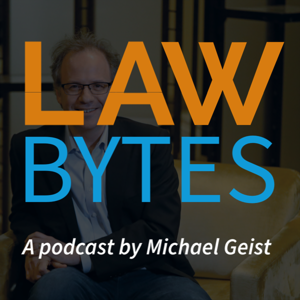
Law Bytes

By Michael GeistTechnologyArts
Download on the App Store

Law Bytes episodes

  • Episode 208: Will Page on Why the CRTC’s Bill C-11 Ruling is Discriminatory and May Ultimately Hurt the Canadian Music Market
    The recent CRTC Bill C-11 decision mandating that streaming services pay 5 percent of their revenues has left seemingly everyone unhappy and sparked multiple legal challenges. While much of the focus has been on video streaming, music was a core part of Bill C-11 and the implications for music streaming services may be the most pronounced.   Will Page is the perfect person to unpack these issues. He is the author of the critically acclaimed book Tarzan Economics, the former Chief Economist of Spotify and PRS for Music, the co-host the Bubble Trouble podcast and a regular contributor to BBC, Financial Times, and The Economist. He joins the Law Bytes podcast to provide new data on what the CRTC’s numbers mean and why the decision could ultimately move the Canadian market backwards rather than forward.
    45 min
  • Episode 207: The State of Digital Law and Policy in Canada as Parliament Breaks for the Summer
    Parliament adjourned for the summer last week, meaning both the House of Commons and Senate are largely on hold until mid-September. The Law Bytes podcast focuses intensively on Canadian legislative and digital policy developments and with another Parliamentary year in the books, this week’s episode takes a look back and take stock of where things stand. It features discussion on the implementation of the Internet streaming and news bills (C-11 and C-18) as well as an analysis of the current state of privacy, AI, online harms, and digital tax as found in Bills C-27, C-63, C-69, S-210 and C-27.
    38 min
  • Episode 206: James Plotkin and David Fewer on Canada’s Landmark Copyright Ruling on Fair Dealing and Digital Locks
    The question of copyright and digital locks – technically referred to as anti-circumvention legislation – dates back more than 25 years with creation of the World Intellectual Property Organization’s Internet Treaties and later in Canada with the enactment of the Copyright Modernization Act. The full scope and application of those digital lock rules has been the subject of considerable debate, particularly over how fair dealing fits into the equation. The Federal Court of Canada recently issued a landmark decision on the issue which concludes that digital locks should not trump fair dealing. CIPPIC, the University of Ottawa’s public interest technology law clinic, raised the key arguments on the issue in an intervention in the case led by James Plotkin, a partner with the law firm Gowlings, and David Fewer, CIPPIC’s Director and General Counsel. They join the Law Bytes podcast to talk about the ruling and to clear up some of the misinformation that has been circulating since its release.
    33 min
  • Episode 205: Len St-Aubin on What the CRTC’s Internet Streaming Ruling Means For Creators, Competition and Consumer Costs
    Last week, the CRTC released its much-anticipated Bill C-11 ruling on the initial mandated contributions from Internet streaming services. While the government focused on the requirement to contribute 5% of Canadian revenues, a closer look revealed the CRTC largely ignored industry data and the actual contributions from Internet streaming services and seemed entirely unconcerned by the effects on competition and consumer costs.   Len St-Aubin is the former Director General of Telecommunications Policy at Industry Canada and played a role in the development of both the Broadcasting Act and Telecommunications Act. He provided consulting services to Netflix until 2020 and has since been an active participant in the debate on Internet policy. He joins the Law Bytes podcast to talk about the CRTC ruling, the state of TV and film production in Canada, and what may lie ahead for the streamers, creators, and consumers.
    30 min
  • Episode 204: What Could Have Been for the Bill S-210 Hearings
    Bill S-210, the mandated age verification bill for pornography sites that in reality targets everything from Google Search to Netflix, was expected to be the subject of extensive hearings by the Standing Committee on Public Safety and National Security. But after a Conservative filibuster, it appears that there will be only one hearing and that the bill will be reported back to the House unamended. Before that vote, this week’s Law Bytes podcast offers up a “what could have been” hearing on the bill. It features my mock opening statement alongside responses to some of the actual questions raised by MPs on issues such as privacy, website blocking, and poorly defined terms in the bill.
    32 min
  • Episode 203: Andrew Clement on Calls to Separate Privacy Reform and Artificial Intelligence Regulation in Bill C-27

    Bill C-27, Canada’s proposed privacy reform and AI regulation bill, continues to slowly work its way through the committee process at the House of Commons with the clause-by-clause review of the AI portion of the bill still weeks or even months away. Recently a group of nearly 60 leading civil society organizations, corporations, experts and academics released an open letter calling on the government to separate the bill into two.

     Andrew Clement has been an important voice in that group as he tracked not only the committee hearings but also dug into the consultation process surrounding the bill. Clement is a Professor Emeritus in the Faculty of Information at the University of Toronto, where he coordinates the Information Policy Research Program and co-founded the Identity Privacy and Security Institute (IPSI). He joins the Law Bytes podcast to talk about AI regulation in Canada, concerns with the bill, and offers insights into the legislative and consultative process.

    35 min
  • Episode 202: David Soberman on the Reality Behind Claims Canadian Wireless Prices Have Been Cut in Half
    Prime Minister Justin Trudeau recently claimed that “we’ve cut the cost of cell phone plans in half since 2019 - in part by increasing competition.” Is that true? What is the real state of Canadian wireless competition and how does pricing compare with other countries? To help answer those questions, this week David Soberman, a Professor of Marketing at the Rotman School of Management at the University of Toronto and the Canadian National Chair of Strategic Marketing joins the Law Bytes podcast. Professor Soberman’s research is focused on understanding how the operation of markets is affected by the exchange of information between organizations and customers, relationships within the distribution channel and the introduction of innovations to markets.
    27 min
  • Episode 201: Robert Diab on the Billion Dollar Lawsuits Launched By Ontario School Boards Against Social Media Giants
    Concerns about the impact of social media on youth have been brewing for a long time, but in recent months a new battleground has emerged: the courts, who are home to lawsuits launched by school boards seeking billions in compensation and demands that the social media giants change their products to better protect kids. Those lawsuits have now come to Canada with four Ontario school boards recently filing claims. Robert Diab is a professor of law at Thompson Rivers University in Kamloops, British Columbia. He writes about constitutional and human rights, as well as topics in law and technology. He joins the Law Bytes podcast to provide a comparison between the Canadian and US developments, a deep dive into alleged harms and legal arguments behind the claims, and an assessment of the likelihood of success.
    42 min
  • Episode 200: Colin Bennett on the EU’s Surprising Adequacy Finding on Canadian Privacy Law
    A little over five years ago, I launched the Law Bytes podcast with an episode featuring Elizabeth Denham, then the UK’s Information and Privacy Commissioner, who provided her perspective on Canadian privacy law. I must admit that I didn’t know what the future would hold for the podcast, but I certainly did not envision reaching 200 episodes. I think it’s been a fun, entertaining, and educational ride. I’m grateful to the incredible array of guests, to Gerardo Lebron Laboy, who has been there to help produce every episode, and to the listeners who regularly provide great feedback.  The podcast this week goes back to where it started with a look at Canadian privacy through the eyes of Europe. It flew under the radar screen for many, but earlier this year the EU concluded that Canada’s privacy law still provides an adequate level of protection for personal information. The decision comes as a bit of surprise to many given that Bill C-27 is currently at clause-by-clause review and there has been years of criticism that the law is outdated.  To help understand the importance of the EU adequacy finding and its application to Canada, Colin Bennett, one of the world’s leading authorities on privacy and privacy governance, joins the podcast.
    29 min
  • Episode 199: Boris Bytensky on the Criminal Code Reforms in the Online Harms Act
    The Online Harms Act – otherwise known as Bill C-63 – is really at least three bills in one. The Law Bytes podcast tackled the Internet platform portion of the bill last month in an episode with Vivek Krishnamurthy and then last week Professor Richard Moon joined to talk about the return of Section 13 of the Canada Human Rights Act. Part three may the most controversial: the inclusion of Criminal Code changes that have left even supporters of the bill uncomfortable.   Boris Bytensky of the firm Bytensky Shikhman has been a leading Canadian criminal law lawyer for decades and currently serves as President of the Criminal Lawyers’ Association. He joins the podcast to discuss the bill’s Criminal Code reforms as he identifies some of the practical implications that have thus far been largely overlooked in the public debate.
    34 min

About Law Bytes

From the publisher's feed

In recent years the intersection between law, technology, and policy has exploded as digital policy has become a mainstream concern in Canada and around the world. This podcast explores digital policies in conversations with people studying the legal and policy challenges, set the rules, or are experts in the field. It provides a Canadian perspective, but since the internet is global, examining international developments and Canada’s role in shaping global digital policy is be an important part of the story.

More shows like Law Bytes

99% Invisible by Roman Mars

99% Invisible

26,165 Listeners

Making Sense with Sam Harris by Sam Harris

Making Sense with Sam Harris

26,260 Listeners

CANADALAND by CANADALAND

CANADALAND

210 Listeners

The House by CBC

The House

76 Listeners

At Issue by CBC

At Issue

106 Listeners

#onpoli, a TVO podcast by TVO

#onpoli, a TVO podcast

8 Listeners

The Herle Burly by Air Quotes Media

The Herle Burly

50 Listeners

Cautionary Tales with Tim Harford by Pushkin Industries

Cautionary Tales with Tim Harford

5,082 Listeners

The Munk Debates Podcast by Munk Foundation / iHeartRadio

The Munk Debates Podcast

36 Listeners

Tech Won't Save Us by Paris Marx

Tech Won't Save Us

575 Listeners

Hard Fork by The New York Times

Hard Fork

5,554 Listeners

The Ezra Klein Show by New York Times Opinion

The Ezra Klein Show

15,918 Listeners

Curse of Politics by Air Quotes Media

Curse of Politics

39 Listeners

It's Political with Althia Raj by Toronto Star

It's Political with Althia Raj

4 Listeners

Hub Podcasts by Hub Canada Media

Hub Podcasts

34 Listeners