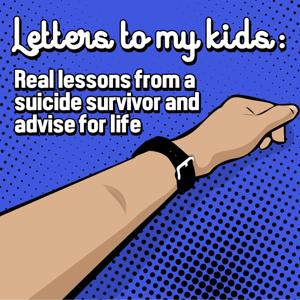
Letters to my kids: A suicide survivor's lessons and advice for life

Letters to my kids: A suicide survivor's lessons and advice for life

By Letters to my kids: A 2-time suicide survivor and advocate for realistic optimism.
Download on the App Store

Letters to my kids: A suicide survivor's lessons and advice for life episodes

  • Episode 14: Breaking the rules; and getting away with it
    Breaking the rules; and getting away with it
    Music: “Just A Blip” by Andy G. CohenFrom the Free Music ArchiveReleased under a Creative Commons Attribution International License
    "Ethical behavior is doing the right thing when no one else is watching- even when doing the wrong thing is legal." - Aldo Leopold
    - Everybody loves a good "bad-boy" story about the person who broke rules and did well with it. - On the last episode on honesty, I talked about my gambling story and how I repaid my large debt. I'm not proud of what i did or why I had to do it but the point of that story was 2-fold; to illustrate that we all make mistakes and no one's perfect, and there are points in life where you have to make exceptions for what you believe in.- Life's never as simple as black-and-white. There's no one "final" or "one-size-fits-all" approach to everything. Which is both a good thing and bad. Good that because we know none of us are perfect; we will never be able to attain some kind of standard that needs to be met or applied. - Despite what it sounds like, people break the rules quite normally and on a daily basis. People cut queues, run through red lights; and while most of the times perfectly valid reasons, sometimes it can be mundane. - Every person who came to be regarded as a visionary had at some point or another, or even still continue to; break the rules. While that should not be used as an excuse, it's a good reminder that the people who set the rules themselves are failable and not perfect. - Talk about my own career and how I came to constitute a rule-breaker.
    - However, it's always good to consider some "rules" when you're thinking about breaking the rules.- Knowledge; you know how to differentiate a situation from the norm that requires a difference in the treatment that constitutes a breaking of the rules. You know enough to realize that the rules don’t make sense or they're wrong and you know what EXACTLY is required to make it right. - You've calculated the risk. Breaking the rule shouldn't be a decision to be made in the heat of a moment or done emotionally. Make sure you've done all the research and expanded ALL the effort necessary to ensure you ABIDE to the rules. - You're prepared for the consequences. It's interesting to talk about rules in the United States because here is a country and government that was founded on precisely the concepts of rule breaking when it decided to revolt against England. It's been regarded as "cool" to break the rules; in fact the whole concept of disruption in business is to challenge and break the status quo. However, you need to be ready to face consequences. - There's a fine line between being reckless and breaking rules for the greater good. Common sense needs to be the rule of the day. We need to be able to develop good common sense to know when to follow the rules and when to violate them? When to preserve beautiful order and when to flirt with anarchy?- If all of this sounds complicated; that's because it is. There is NO hard-and-fast rule as well, pardon the pun. So; be prepared to break the rules ONLY IF you have thought hard about it.
    12 min
  • Episode 13: Honesty, the only policy?
    Honesty, the only policy?
    Music: “Just A Blip” by Andy G. CohenFrom the Free Music ArchiveReleased under a Creative Commons Attribution International License
    https://www.huffingtonpost.com/karen-ann-kennedy/is-honesty-really-the-bes_b_6171242.html
    "Honesty without kindness, humor and goodheartedness can be just mean" - Pema Chodron
    - Talk about introduction and how advise needs to be properly applied. Like would you want someone to tell you that you're ugly; although beauty is in the eye of the beholder. - Talk about balance and how it's practical not just as a star wars movie plot. Extremes are never good because you're over-doing something. Most of us are taught from young to be honest. - It's worth to understand why people lie. FEAR – The world tells us that if you don't know something, you're worthless. As such, most people choose the easy way out, which is to pretend to know something. After all; con- sultants make a living out of this. Almost all of us practice this to some degree, making "fake it till you make it" something real. MANIPULATE – Now, a personal agenda is almost always a reason for lying; to influence the decisions of other people to do what the person lying wants. For example, the word "love" is probably the most over-used in lies in order to get the other person emotionally vested to serve the lying person's agenda. PRIDE – Most of us would think that we are above lying for the sake of it. But think about how often we have lied to people we love about the reality of a situation. For example, people who are not doing well normally try to project a different picture and even spend money they can't afford to spread that image. - Talk about how gambling debt was repaid- Everyone knows it's wrong to lie; we have been told about the consequences since we were young. However, all of us have tried honesty at some point or another. However, probably our approach should have been better because we misunderstood how to apply honesty. - The truth is honesty that when misused; honesty is often a veiled form of self- indulgence. This means that in a nutshell, when feelings build up, it’s frustrating to hold them in and keeping them to yourself. And, of course, it feels damn good to release them. That feel good sensation is a form of gratification. -It’s sad that our education at home and in school doesn’t include teaching us how to manage and handle our angry feelings in a safe and non-threatening manner. Since intimate relationships trigger negative feelings, this means most of us are mistreating the people we love most by lashing out and even verbally hurting those we love; all in the name of being honest.- Honesty isn’t a policy, it’s a value! Honesty needs to co-exist with other values. Values such as compassion, kindness, being positive, etc. It would definitely be honest of you to put down someone's lack of talent at something, for example your kid's drawing; but is it kind and helpful? How about being honest that your wife's put on some weight over the years and that she would look huge in that dress? Is it compassionate? Is your comment useful? - Honesty is a sought-after value, but so is common sense. And just like everything else, common sense needs to be applied when deciding when and where to be honest. Just like there are people who lie to advance their own agenda, so too are there people who apply honesty, truth, fairness, and equality on their terms. There's a right time for everything, so it is the same with honesty.- If there's a need to be honest, take some time off away to evaluate whether or not it'll be kind and useful for the other person. Do not be honest in anger and make sure that there are no unresolved issues that could feed the fire and trigger the honest outburst.- Also; honesty needs to go hand-in-hand with communication. You need to build up the relationship, then apply honesty as a value you use to express your thoughts but not at the expense of the other person's feelings.
    14 min
  • Episode 12 - Part 2: Money and Finances, practical steps and a word on crypto
    Money and Finances, advise and lessons from an ex-gambler and suicide survivor
    Music: “Just A Blip” by Andy G. CohenFrom the Free Music ArchiveReleased under a Creative Commons Attribution International License
    "Do not save what is left after spending, but spend what is left after saving." - Warren Buffett
    - Be positive about money; money should be your friend rather than your foe. So, don't write it off as something you'll never be able to do. - Talk about how there are only 2 ways to increase the amount of money available; either increase your income/income sources, or reduce your outflows. It's not rocket science. Amount of money available = Incomes - outflows- Trim your outflows by reviewing them comprehensively. 15-dollar coffee, reduce if you can't eliminate. 15-dollar lunch, try to trim it to 10 first. Be realistic about what you're doing; remember, they need to be do-able and you need to understand/believe in why you're doing all of this.- The best way to plan your outflows is by setting a budget. If you're not a person comfortable with strict and rigid planning, consider dealing ONLY in cash. In fact, until you get your finances in a comfortable state, make it your ONLY option. Keep your cards at home and only set yourself a fixed amount of cash each week to use. From this amount of money; set aside 2 "Expenses"; one for fixed savings, and one for some kind of charity/donation. - If your finances are in a rough state, start setting specific financial plans to get out of it. Set aside a % of your income to settle your debts or consider structuring your debts into fixed-term repayments or installments to reduce interests. If re-structuring is not possible, be creative; but DON'T get into MORE trouble. - Keep your financial plans/goals as realistic as possible. You need to be honest with yourself on this.- Automate your major expenses (rent/mortgage, fixed expenses, savings, investment fund) so that these are the 1st items that get paid to reflect the actual amount you have left as balance each month.- Depending on where you are financially, set a reasonable amount of % for spending on yourself; on meals, a good time. But be disciplined with the amount, and keep it as low as possible while not compromising your own happiness, because working and/or earning money without spending it is not happiness. So splurge, but only once in a blue moon. Talk about my parents and money.- Talk about planning, again; fail to plan is planning to fail. Put savings into a separate fund you don't have direct control over. You need a min. of 3-6 months' worth of salary as emergency funds. Keep your savings funds as far away from your regular funds as possible. Increase your savings when you get raises.- Always have backup plans and backup funding sources. Build those; they don't come to you without work; or tell me where I can get some as well! Talk about my planning for kid's education in the future and how they've been placed in long-term investment/insurance funds.- NEVER co-sign or be a guarantor for someone else's loans. It doesn't matter WHO; family, fried, etc. It WILL destroy your relationship. If you're ever going to loan money to close persons; consider it a donation in order not to take it personally and to ruin the relationship.- DON'T RUSH into purchases, if something seems too good to be true; it probably is. So take your time to do research, honest evaluation and a calm mind to review, review and review. - "We buy things we don't need with money we don't have to impress people we don't like." - Dave Ramsey. While some jobs/fields may require some spending in order to fit in/socialize, that doesn't mean you HAVE to get the most expensive options. Be creative in how you source it as well. - For money and finance matters, the buck stops with you. So, listen; evaluate, but do your own research and ultimately only let yourself decide and make the decisions. You will have to pay for it in any case.- If you're going to in
    18 min
  • Episode 12 - Part 1: Money and Finances, advice and lessons from an ex-gambler and suicide survivor
    Episode 12 - Part 1: Money and Finances, advice and lessons from an ex-gambler and suicide survivor
    Music: “Just A Blip” by Andy G. CohenFrom the Free Music ArchiveReleased under a Creative Commons Attribution International License
    "Money can't buy you happiness, but it does bring you a more pleasant form of misery" - Spike Milligan
    - not a coincidence we talk about it after forgiveness, which probably was too gloomy and somber for it's own good. But it was a topic close to my heart, for obvious reasons. All of us take money very seriously; and we ought to, because it's a serious topic. But like everything else in life; we can't take it TOO seriously. Talk about family and relationship with money due to poverty upbringing.- In life, like it or not; but our finances will affect us. When we have good finances, we tend to be more secure, more confident, etc. There are plenty of opinions about how to make money, how to get rich, the unjustness of people being wealthy and hoarding their wealth, what people should do with their money, what the responsibilities of wealthy people are, what the responsibilities of poor people are, luck vs. hard work, silver spoon and entitlement vs. worked my way up from the bottom, etc.Everyone has an opinion on money because it has such a profound impact on our lives.- It's important to note here that; money is not the be all and end all in life. However; money is like the oil in our vehicles. It's there to smoothen out the cracks, enable a smoother journey as well as being able to get you where you need to go. Having it is definitely an advantage vs. not having it. But how you use it; is ultimately what matters.- Talk about gambling habit, how it started off with good intentions.- Love/hate relationship with money. But money, like most things in life; isn't very complicated, it's us who make it such. Like, I would love to be able to eat truffle- flavoured everything; but my wallet (not to mention my wife who doesnt' like truffles) doesn't allow it. - We all make mistakes, whether with money/finances or not. So don't beat yourself too hard about it but rather, practise forgiveness and move on.
    12 min
  • Episode 10 - Part 2: Living life without regrets
    Living life without regrets Part 2
    Music: “Just A Blip” by Andy G. CohenFrom the Free Music ArchiveReleased under a Creative Commons Attribution International License
    - Personal story- Let Go of the Victim Mentality. The longer time spent complaining, the longer the amount of time required to formulate solutions and to get out of the issues encountered/experienced. “You don’t make progress by standing on the sidelines, whimpering and complaining. You make progress by implementing ideas.” ~ Shirley Hufstedler- Be grateful for what you have; and tell your closest loved relations how much they mean to you, and how you love them. The experience of love is one of the best things in life. - Practice kindness, because intentional kindness is life-giving. When you give and you practise kindness, you actually exercise your own ability to let go and receive the kind words of others.- Follow your dream and don't waste time. But start with small practical steps. So often, we are so busy trying to live up to the expectations of others that we do not allow ourselves to follow our own dream. “Take the first step in faith. You don’t have to see the whole staircase, just take the first step.” ~ Dr. Martin Luther King Jr.- Start small and be consistent; but be bold and take risks. Staying within our comfort zone may be safe, but it is impossible to achieve greatness by living cautiously. - Talk about how podcast came to be, because didn't want to have any regrets. - Earning a living is important and is a major part of life, but not to the exclusion of other things. To fully participate in all aspects of life, such as spending time with loved ones and enjoying meaningful activities, we should leave work time at work. - Take Advantage – Each Day Offers a New Beginning and a clean slate. - Be yourself. We have our own values, beliefs, personality traits, and desires. When we deny any part of our authentic self, we deny our identity and self. Our uniqueness makes us who we are.- Don’t Give up on Yourself. Have faith in yourself and know that, “Most of the important things in the world have been accomplished by people who have kept on trying when there seemed to be no hope at all.” - Dale Carnegie
    10 min
  • Episode 10 - Part 1: Living life without regrets
    Living life without regrets
    Music: “Just A Blip” by Andy G. CohenFrom the Free Music ArchiveReleased under a Creative Commons Attribution International License
    - From wikipedia: "Regret is a negative conscious and emotional emotion to one's personal decision-making, a choice resulting in action or inaction. Regret is related to perceived opportunity."
    - Seeing all of this growing up had a profound impact on me as it made me resolve never to have regrets. Obviously, saying is easier than doing it; but over time and years, this has now changed to "if ever there is a doubt in doing something that could cause regret, don't do it and re-think."
    - As per episode 6; "don't sweat the small stuffs"; Life is far too short to be spent worrying about things that are beyond our control. Also on the previous episode on Happiness, being able to enjoy both the happiness as well as happy memories together with the unhappiness and unhappy memories in our life's journey is the key to being able to fully experience life.
    - Stop comparing yourself, especially to people whom are better of. If you want to compare, compare to people whom are worse off in order to be grateful and thankful. No matter what you do, no matter who you are or where you are, all of us have to walk on our own journeys.
    -We've covered failures in general, but to avoid regrets; you should only give up once you've exhausted all options and possibilities. You should not leave any stone unturned that could turn into a "what if" question with regards to missed opportunities and/or actions. 
    - Practice forgiveness and letting go. It's a given that there'll be points in our lives that we'll be hurt either by events and/or by the people around us. However; how we deal with that hurt is up to us. Some people stay stuck in bitterness their entire lives and never move beyond the pain. 
    - Give up looking and thinking about the “what Ifs”“Remembering that you are going to die is the best way I know to avoid the trap of thinking you have something to lose. You are already naked. There is no reason not to follow your heart.”- Steve Jobs"No one wants to die. And yet, death is the destination we all share. No one has ever escaped it, and that is how it should be, because death is very likely the single best invention of life. It's life's change agent. It clears out the old to make way for the new.” -Steve Jobs

    11 min
  • Episode 9: Be present for today, tomorrow will come soon enough
    Be present for today, tomorrow will come soon enough
    Music: “Just A Blip” by Andy G. CohenFrom the Free Music ArchiveReleased under a Creative Commons Attribution International License
    "Remember then: there is only one time that is important-- Now! It is the most important time because it is the only time when we have any power." - Leo Tolstoy
    "Living in the moment means letting go of the past and not waiting for the future. It means living your life consciously, aware that each moment you breathe is a gift." - Oprah Winfrey
    - Today is an important day; you may not think it as such but it is. Why? Because today is the one day you can control in your life.- As covered in the previous episode "Don't sweat the small stuff"; we need to be able to prioritize and organize your thoughts and concerns. - Always focus on today because it’s the one day that you have. You can learn the lessons from yesterday, apologize and move on. But you can't undo what has already been done. This doesn't mean that you are not accountable for your past actions though. - Life is constantly unfolding in the present today. - We need to be conscious that we live in a world and age where everything moves at light- speed. That has allowed us to be easily distracted, and this leads to us not being able to focus, constantly thinking and pondering about the next action. - Therefore, we need to focus more on the present; being here and fully participative in all the events around you. Do not allow yourself to be distracted most of all by your thoughts about the future/past. - In her memoir Eat, Pray, Love, Elizabeth Gilbert writes about a friend who, whenever she sees a beautiful place, exclaims in a near panic, "It's so beautiful here! I want to come back here someday!" "It takes all my persuasive powers," writes Gilbert, "to try to convince her that she is already here."- The mind's natural tendency when faced with pain is to attempt to avoid it—by trying to resist unpleasant thoughts, feelings, and sensations. As we get older, we work feverishly to recapture our youth. - It doesn't have to be this way. We talked about acceptance previously as part of the grieving process—letting the emotion be there. - In conclusion, one-day-at-a-time living is the only way to go. And to live each day without regrets, by not thinking too much when you've already decided and committed; if there is even a shadow of regret, perhaps you need to take some time out to think and not to rush things.
    11 min
  • Episode 8: Happiness, Overrated or just misunderstood?
    Happiness, Overrated or just misunderstood?
    Music: “Just A Blip” by Andy G. CohenFrom the Free Music ArchiveReleased under a Creative Commons Attribution International License
    https://www.huffingtonpost.com/dr-judith-rich/happiness-its-overrated_b_685851.html
    - The world puts alot of emphasis on living a "happy" life. There is a huge industry towards "finding happiness" that proposes that if you don’t have ongoing happiness then you need to pursue it. You need to find your purpose, change your job, get a new partner, move locations—do something, anything, to find the happiness that you are missing. - A never-ending happy life is unattainable because it doesn't exist. Happiness is a state of mind that doesn't stay constant. It is an enigma. It means different things to different people. We cannot achieve a state of happiness without understanding what it looks like. - Ironically, it is in the heaviest and most ardent pursuit of happiness that we become depressed and disappointed. Which kind of makes the pursuit of it counter-productive. But why are so many people still so insistent on finding "it"?- It is therefore, in the heaviest pursuit of happiness, that you turn this into a self-fulfilling prophecy. That when you identify with not having enough, you reinforce and create the very unhappiness and/or emptiness that you want to fill up. Thus, creating your unhappiness dillema.- To seek happiness as a permanent state derives from two primitive evolutionary impulses: avoiding pain; which is part of the need to avoid harm and eventually death; and seeking gratification as well as to leave a legacy."The brighter the light, the darker the shadow" - Carl Jung- The height of personal happiness can only be measured by the depth of personal sadness.Happiness is not a stand-alone feeling. Happiness is a comparative emotion. - Happiness is elusive, like some rare and captivating insect that lights up when it lands on your shoulder. It’s there for a moment and then gone. - Instead, refuse to give into the feelings of emptiness and not being good enough. You are who you are, no one else can be you. So embrace yourself instead; and embrace your life. Make the most of the fleeting experience of the roller coaster of life; treasure all the feelings and experiences that only living your life can offer.- The Stockdale Paradox talks about James Stockdale and his words- Let go of the pursuit of happiness. It’s wasting your time and will disappoint you in the end. Express your full range of emotions that you will go through in life.
    13 min
  • Episode 7: Moving on and letting go - Part 2
    Moving on and letting go: Part 2
    Music: “Just A Blip” by Andy G. CohenFrom the Free Music ArchiveReleased under a Creative Commons Attribution International License
    -Summary and recap from the 1st Episode.
    - No one is saying that this process is easy, but there is no denying that it's important in order to ensure that you don't become mentally affected by what has happened, and also to allow moving on with one's life.- Talk about 2nd Suicide attempt as an example of the stages.- Also equally important is being able to forgive. Forgiveness doesn't mean that you forget, but it does mean that you let go of all anger/bitterness that you may have over what that has happened. - At the end of the day, time waits for no-one. We should not be defined by our past as we move on in life.
    9 min
  • Episode 7: Moving on and letting go - Part 1
    Moving on and letting go: Part 1
    Music: “Just A Blip” by Andy G. CohenFrom the Free Music ArchiveReleased under a Creative Commons Attribution International License
    Attitude is more important than the past, than education, than money, than circumstances, than what people do or say. It is more important than appearance, giftedness, or skill. Charles R. Swindoll
    5 stages of grief:https://grief.com/the-five-stages-of-grief/
    - The phrase letting go tends to be more associated with relationships and associations with other people, but it actually applies to everything in life.- People start off idealistic and energetic. However, the more they go through in life, the more they get weighted down by the disappointments and failures that inevitably comes with life. - Previous episodes have talked about the need to go through challenges, face changes and generally; overcome obstacles that life places in front of us. One of the key lessons that have to be learnt is how do we deal with situations without causing harm to ourselves. The key to that is in moving on and letting go.- We tend to put to much emphasis on our situations without care/concern for our own self. Which is ironic because we believe that we need something; even though it could cause more hurt/grief to your own self, because we believe we will lose more without it. - You need to treat what has happened as a loss, introduction to the 5 stages of grief.People often think of the stages as lasting weeks or months. The stages are responses to feelings that can last for minutes or hours as we flip in and out of one and then another. We do not enter and leave each individual stage in a linear fashion. We may feel one, then another and back again to the first one. Some phases also have the possibility of being repeated. - You can't truly move on in life without letting go. You can however, pretend to move on; but it'll just suck you back in eventually. - It's important to use the steps mentioned to deal with grief, as it ends with acceptance. This is important to prevent bitterness, which has the ability to eat you inside and consume you; if you don't have acceptance.
    13 min

About Letters to my kids: A suicide survivor's lessons and advice for life

From the publisher's feed

Real lessons from a suicide survivor and advice for life. From a 2-time suicide survivor and advocate for realistic optimism