
Sign up to save your podcasts
Or

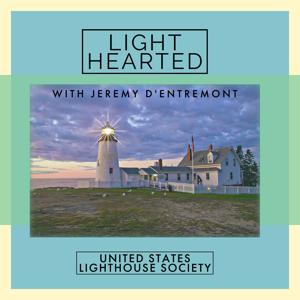


This is an edited version of an interview that was featured in Light Hearted episode 44 in January 2020. Joseph Smith has been a theatrical performer based in New York City since 1995. His passion is to create excitement and curiosity about history by giving voice to stories that celebrate the human spirit.
He has written and performed a portrayal of Augustin Fresnel, the inventor of the Fresnel lens that revolutionized lighthouse lighting. It is a portrayal of one man’s fascination with “finding the solution to the many questions in the inexhaustible range of science.” He has performed the program at the National Lighthouse Museum and many other venues.
Hereford Inlet, a break in the barrier islands along the east side of Cape May, New Jersey, was used by whalers as far back as the 17th century. Shifting sands and a strong current made the inlet dangerous for mariners. As coastal shipping and the use of the inlet increased, funds for a lighthouse were appropriated in 1872. A wood frame combined keeper’s house and lighthouse began service in 1874. The beautiful Victorian design was the work of the Lighthouse Board’s chief draftsman, architect Paul J. Pelz.
After automation, the building was neglected and boarded up for nearly 20 years. Then, in 1982, the lighthouse property was leased to the City of North Wildwood, and it was restored in the years that followed. Today the lighthouse is managed by the City of North Wildwood’s Historical Commission. Our guest today, W. Scott Jett, is the city historian and the city clerk for the city of North Wildwood, and he’s the chairman of the Historical Commission.
We’ve produced almost 300 episodes of the podcast Light Hearted in the past five years. Most of the interviews we’ve done have been a half hour to an hour. We realize that listening to an hour-long podcast is not something everyone wants to do, so we’re introducing something we call Light Hearted Lite. In this new series, some favorite interviews from the past five years have been edited down to around 10 to 20 minutes. We’ll still keep posting the longer episodes as well.
For this first edition of Light Hearted Lite, we’re going back to episode one from June 2019. The person interviewed is the award winning writer and illustrator of children’s books Sophie Blackall. Her books have won many awards, and her children’s book Hello Lighthouse, which she wrote and illustrated, won the 2019 Caldecott medal.
There are three segments in this episode. First, 11-year-old Guinevere Porter and her best friend Dani, Kentucky residents, talk about their visits to some beautiful and very tall lighthouses in Georgia, Florida, and elsewhere. As they correctly point out, we need kids to get interested in lighthouses. They will be the ones caring for them in the future, and also, visiting and climbing them is fun!
In the second segment, we speak with Patrick Mont, a clockmaker for the famous Chelsea Clock company of Massachusetts. Starting in the early 1900s, Chelsea clocks were used to keep the time at many light stations, lightships, and lighthouse tenders. The company is also famous for its ship’s bell clocks. Lighthouse Service clocks made by Chelsea Clock are now highly prized antiques. In this interview, Patrick talks about what makes the clocks so special.
Guin Porter returns for the third segment. She interviews Light Hearted co-hosts Michelle Jewell Shaw and Cindy Johnson, along with host Jeremy D’Entremont. The subject is Portsmouth Harbor Lighthouse in New Hampshire, a place that is near and dear to all three of them. Included in the discussion is the damage sustained in recent storms.
The seas off the northern California coast are notoriously rough, and no area is more treacherous than St. George Reef, which is the tip of a submerged volcanic mountain about six miles offshore. Construction of a lighthouse on the reef began in 1883. It took nine years to complete the massive 90-foot-tall granite tower on top of a 50-foot-tall base. A powerful first-order Fresnel lens was installed, and the lighthouse began service on October 20, 1892.
After a large navigational buoy was positioned nearby in 1975, the light station was discontinued, and the crew was removed. The St. George Reef Preservation Society was formed in 1988 for the purpose of restoring and maintaining the lighthouse. The organization has also provided public tours via helicopter.
Interviewed in this episode is John Zimmerman, president of the St. George Reef Preservation Society. Also taking part in the interview is Jen Lewis, outreach manager for the Point Cabrillo Lighthouse. Jen also cohosts the episode.
Whale Rock Light, a typical cast-iron “spark plug” type lighthouse, was constructed at the entrance to the west passage of Rhode Island’s Narragansett Bay in 1882 to help mariners past a treacherous reef. Isolated Whale Rock was not a desirable location for keepers, and 16 different men served as head keeper between 1882 and 1909. A 1924 storm sent waves over the top of the tower and did some damage to the structure, but that storm was nothing compared to what was to come in 1938.
Walter Barge Eberle, assistant keeper at Whale Rock Light in 1938, was the father of six children. On September 21, 1938, with practically no advance warning, a devastating hurricane was bearing down on New England’s south facing coast. At about 5:30 the next morning, Keeper Daniel Sullivan phoned the Eberle family in Newport. His words were to the point: “The light is gone.” The lighthouse tower was completely gone, and Walter Eberle was never found. He was 40 years old.
There are two interviews in this episode. The first, recorded in 2001, is with the surviving children of Walter Eberle. The woman who did most of the talking in the interview was Dorothy Roach, Eberle’s oldest daughter. Also featured is David Robinson, the State Underwater Archaeologist for the state of Massachusetts and Director of the Massachusetts Board of Underwater Archaeological Resources. When he was based in Rhode Island, he was the first person to study the underwater remains of Whale Rock Lighthouse.
The area in Southern California known as San Pedro saw Spanish use dating back to the 1540s. Once a separate township, it’s now part of Los Angeles. After the Mexican-American War, San Pedro’s harbor was expanded and improved. Congress appropriated funds for a lighthouse at Point Fermin, San Pedro’s southernmost point, in 1854. The light began service on December 15, 1874.
Point Fermin had the distinction of having two women –sisters Mary and Ella Smith — serve as the first keeper and assistant. The light was converted to electricity in 1924. The City of Los Angeles took over the property, with a city employee living in the lighthouse as caretaker. The light was darkened after the attack on Pearl Harbor in December 1941, and it was never reactivated as an aid to navigation.
The lighthouse is now the centerpiece of 37-acre Point Fermin Park. The facility is managed by the Department of Recreation and Parks for the City of Los Angeles. The Point Fermin Lighthouse Society serves to assist with fundraising, tours, events, and volunteers. There are two guests in this episode. Kristen Heather is the historic site curator, and Jeanette Rodriquez is a museum guide at the lighthouse.
On the east side of Washington’s Puget Sound, Mukilteo grew as a port in the late 1800s, with salmon canning and lumber as leading industries. Funds were appropriated by Congress for a lighthouse at Mukilteo in 1903, and construction began in 1905. A 30-foot tower was built, attached to a fog signal building, with two large, separate dwellings for the keepers and their families. The station began service on March 1, 1906. The light and fog signal were automated in 1979.
The Mukilteo Historical Society now manages the light station. The grounds are open all year, while the lighthouse is typically open on weekends and holidays, from the end of April to the end of September. There are two guests in this episode. Joanne Mulloy is the president of the Mukilteo Historical Society, and Jerry Arnold is on the Society’s board of directors.
Congress authorized lighthouses at several California locations in 1850, including San Diego. Construction began in 1854 on a lighthouse on a high bluff at the end of Point Loma, more than 400 feet above the sea. The lighthouse began service in November 1855. Its active life was fairly short, as it turned out. The great height of the light station was a handicap when low clouds and fog surrounded the bluff, so a new lighthouse was built on the low tip of the peninsula. Darkened for good on March 23, 1891, the original lighthouse ultimately became known as the Old Point Loma Lighthouse.
Old Point Loma Lighthouse is now a popular attraction within the National Park Service’s Cabrillo National Monument. There are three guests in this episode. Amanda Gossard is program manager for the Cabrillo National Monument. Karen Scanlon and Kim Fahlen are longtime volunteers for the Cabrillo National Monument, and they’re also the co-authors of the book Lighthouses of San Diego. Kim and Karen also happen to be identical twin sisters. Jen Lewis of Point Cabrillo Lighthouse in northern California cohosts this episode.
Maine’s Baker Island is about four miles southeast of the much larger Mount Desert Island. A lighthouse was established on the highest point of the island in 1828. The early history of the light station is very much tied into the history of the family of William and Hannah Gilley. The Gilleys had taken possession of the island in the early 1800s, and William was appointed as the island’s first lighthouse keeper. The original tower was replaced in 1855 by the 43-foot-tall cylindrical brick tower that still stands today. The keeper’s house has been unoccupied since the light was automated in 1957.
Baker Island Light Station is now owned by the National Park Service as part of Acadia National Park, while the Coast Guard maintains the navigational light. There are Acadia National Park ranger-led tours of the island from Bar Harbor in the summer. Keepers of Baker Island is a nonprofit that was formed to support the National Park Service with the care and upkeep of the island’s natural and cultural landscape. Cornelia Cesari, our guest in this episode, is an island resident and the president of the board of directors of Keepers of Baker Island. Cornelia is also the author of the book Baker Island, released in 2018 by Arcadia Publishing.
From the publisher's feed

23,731 Listeners
26,151 Listeners

1,565 Listeners
4,759 Listeners

111,799 Listeners
1,343 Listeners

896 Listeners

295 Listeners
3,415 Listeners
18,041 Listeners
18,955 Listeners
10,863 Listeners
1,175 Listeners