
Sign up to save your podcasts
Or



Send us Fan Mail
The collection of DNA from Airman and Guardians accused of committing an offense under the UCMJ; and the crediting step of the impeachment by prior inconsistent statement.
Send us Fan Mail
In this out-of-order episode, I discuss two CAAF cases (US v. McPherson and US v Adams) that both apply the literal wording of Article 43, UCMJ, to find that a five-year statute of limitations applies to some pretty egregious offenses. The cases demonstrate how following the law can be challenging when you would prefer a different result. Those cases are relevant to the Air Force's mandatory COVID-19 vaccine where some commanders appear to be ignoring the law to achieve the desired ends: a fully vaccinated force.
Send us Fan Mail
Is it lawful to include a mandatory punitive discharge in a Plea Agreement, even when Congress hasn't determined that a punitive discharge is required for that offense? The second chapter addresses the "confirm" step in the impeachment of a witness using a prior inconsistent statement.
Send us Fan Mail
In United States v. Steen, the appellant was charged with introduction and distribution of marijuana. At trial, the government sought to admit text messages wherein the appellant sought to acquire marijuana for personal use. The text messages were created after the alleged offense but the government argued it was, under MRE 404(b), admissible to show the appellant had a plan to maintain a certain amount of marijuana and the fact that he wanted some demonstrated that he must have distributed his stock to the informant and needed to replenish. The case is interesting because it involves several rules of evidence, "opening the door" to excluded evidence, and the risk of broad assertions. At about 14:19, the episode changes gears slightly to discuss using text messages on cross-examination.
Send us Fan Mail
This is the first episode! (So allow some grace.) The episode discusses United States v. Tyler, Crim. App. No. 29572, C.A.A.F., April 26, 2021, which held that the unsworn victim impact statement is not evidence but it may, nonetheless, be commented on by trial counsel in sentencing argument. The court also stressed the role of the military judge as gatekeeper to ensure that the statement contains only proper victim impact. At 11:08 the episode shifts gears and discusses the concept of "depth" on cross-examination. I hope you find it helpful!
From the publisher's feed
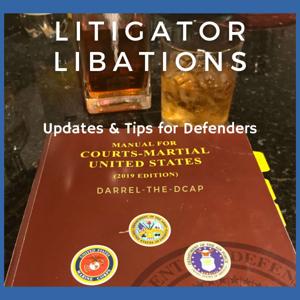
Updates and tips on defensive litigation in military justice including discussing recent appellate decisions and providing advocacy tips.

112,173 Listeners

56,556 Listeners
14,189 Listeners

15,500 Listeners

28,936 Listeners

16,184 Listeners