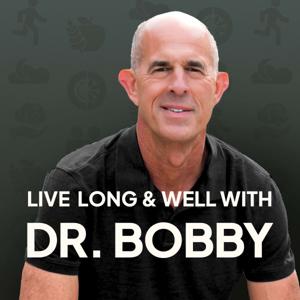
Live Long and Well with Dr. Bobby

Live Long and Well with Dr. Bobby

By Dr. Bobby DuboisHealth & Fitness
Download on the App Store
  • Favorites

    50

    Followers

  • Typical duration

    33 min

    per episode

Based on Podcast App listening data

Live Long and Well with Dr. Bobby episodes

  • #67 Stress Reduction: What Actually Works—and What’s Just Wellness Hype

    Stress is everywhere and so is the marketing. Nearly half of US adults say they feel stressed often, and the wellness world is ready with a supplement, a lab panel, or a pricey device for every symptom. We wanted a cleaner answer: what is stress, what can we measure at home, and what actually reduces stress in a way that’s grounded in real studies rather than hype.

    We start by defining stress in a practical way: stress rises when the demands you perceive exceed the resources you think you have. That helps explain why stress can feel so intense even when there’s no single “stress blood test” to prove it. From there, we walk through simple, objective tracking tools you can use right away, led by the Perceived Stress Scale (PSS-10). We also talk about supportive signals like resting heart rate and heart rate variability (HRV), and why cortisol testing often creates more confusion than clarity in day-to-day life.

    Then we get into what works. The strongest evidence supports unsexy basics like better sleep and regular exercise, plus approachable mind-body tools like breathwork and mindfulness meditation. We also cover two surprising areas with research behind them: music therapy and aromatherapy (often lavender). Finally, we call out common red flags and popular myths, including “adrenal fatigue,” questionable supplement stacks, and consumer vagus nerve stimulation gadgets that borrow credibility from real implantable medical devices without delivering real proof.

    If you want a plan you can trust, we outline an N of 1 stress reduction experiment: measure your baseline, test one change for a week or two, re-measure, and keep only what moves your numbers and your life. Subscribe, share this with a stressed-out friend, and leave a review on Apple or Spotify, then send us a note with what you tried and what actually worked for you.

    Send us Fan Mail

    Support the show

    📥 Tap to join my free newsletter & get the 1-page episode checklists: drbobbylivelongandwell.com


    33 min
  • #66: A big coffee study won't change what I do....

    Visit my website


    Bold claims make great headlines; clear evidence makes better habits. We take a hard look at the widely shared study suggesting two to three cups of coffee cut dementia risk by 20 percent and unpack what those numbers really mean for your brain and your daily routine.

    First, we break down the Harvard JAMA research: massive cohorts of nurses and physicians, decades of follow-up, and self-reported diet data that carry real strengths and built-in limits. We explore why observational studies can’t prove causation, how confounders like sleep, exercise, and income can bend results, and why tea showing similar benefits while decaf shows none points to caffeine yet refuses a tidy explanation. Then we translate relative risk into absolute terms to show how a big percentage drop can still be a small difference in real life, and we discuss the publication bias that comes from testing many hypotheses and promoting only the eye-catching hits.

    Next, we turn to trials where the science gets sharper. The CRAVE study randomized coffee days in healthy adults with continuous heart monitoring and found no rise in atrial abnormalities that lead to atrial fibrillation, though there was a bump in benign PVCs. For those with a history of AF, the DCAF trial offers a surprise: participants who kept drinking coffee had almost half the recurrence rate compared with those who quit, suggesting caffeine didn’t worsen outcomes and might even help. The message for most people is reassuring—coffee isn’t the arrhythmia trigger it’s often made out to be.

    Our bottom line is practical and personal. If coffee fits your life and doesn’t wreck your sleep, enjoy one or two cups without expecting miracles. Protect your rest first, because sleep debt is a far clearer risk to cognition than a second espresso is a remedy. Stay curious, ask how a study was designed, and look for consistent results across methods before changing routines. If you learned something helpful, tap follow, share this episode with a friend who loves their morning brew, and leave a quick review to help others find the show.

    Send us Fan Mail

    Support the show

    📥 Tap to join my free newsletter & get the 1-page episode checklists: drbobbylivelongandwell.com


    19 min
  • #65: Can I Eat All the Salt That I Want?

    You read everywhere that you “should” cut salt—especially if your blood pressure is up. But salt also makes food enjoyable. In this episode, I walk through the human evidence (not animal studies) and frame salt as a risk–benefit tradeoff: when does sodium meaningfully matter, for whom, and how can you test your sensitivity?

    Big questions we answer

    • If you have high blood pressure: does lowering salt always help?
    • If your BP is normal but you have heart/kidney risk: does salt matter?
    • If you’re basically healthy: how worried should you be?

    Key takeaways

    • Sodium is essential (nerves, muscles, fluid balance)—the issue is dose and individual response.
    • Most sodium comes from packaged/restaurant foods (not your salt shaker).
    • Salt restriction lowers BP, but the average effect is modest compared with typical BP meds (context matters).
    • Salt sensitivity varies: roughly ~30% of healthy people and ~40–50% of people with hypertension may be “salt-sensitive” (with higher rates in older adults, women, and some ancestry groups).
    • If you’re salt-sensitive—especially with hypertension—being mindful of sodium is likely worth it. If you’re not, the “must be low-salt for everyone” story is less clear.

    Practical: Do an N-of-1 salt sensitivity test

    1. Measure home BP daily (or a few times/day) for a week
    2. Go lower-sodium for 1–2+ weeks (at least within guidelines, possibly lower)
    3. Track BP change
    4. Add salt back and watch what happens
    5. Optional: repeat the low-salt phase for confirmation
       If BP shifts meaningfully (often ~3–5 mmHg+), you may be salt-sensitive.

    Food reality check (why sodium adds up fast)

    • ~10% of a 2,300 mg/day sodium “budget”: 2 slices bread, 1 Tbsp ketchup, or a pinch of salt
    • ~1/3: 1 cup canned soup, 1 slice pizza, or a Big Mac
    • ~1/2: frozen lasagna, a few deli slices, or a 6” cold-cut sub
       Cooking mostly from whole foods makes staying lower-sodium much easier.

    Studies & resources mentioned (links embedded)

    • CDC hypertension awareness/treatment/control stats: https://www.cdc.gov/nchs/products/databriefs/db511.htm

    • Hypertension outcomes review (risk of events/death): https://pmc.ncbi.nlm.nih.gov/articles/PMC8292050/

    • Population sodium/BP overview (JACC): https://www.jacc.org/doi/10.1016/j.jacc.2019.11.055

    • DASH-Sodium trial (NEJM): https://www.nejm.org/doi/full/10.1056/NEJM200101043440101

    • Sodium restriction meta-analysis (BP/outcomes): https://pmc.ncbi.nlm.nih.gov/articles/PMC12624901/

    • Salt sensitivity overview (AHA/Hypertension): https://www.ahajournals.org/doi/10.1161/HYPERTENSIONAHA.123.17959

    • Heart failure trials/meta (salt restriction): https://www.ahajournals.org/doi/10.1161/CIRCHEARTFAILURE.122.009879

    • Salt substitute trial (NEJM): https://www.nejm.org/doi/full/10.1056/NEJMoa2105675


    Call to action
    Are you going to run your own N-of-1 salt test? If you do, I’d love to hear what you learn.

    Reminder: I’m an educational resource, not your physician—use this to guide a conversation with your clinician.

    Send us Fan Mail

    Support the show

    📥 Tap to join my free newsletter & get the 1-page episode checklists: drbobbylivelongandwell.com


    31 min
  • #63 The Million Dollar Question: Which Health Predictions Actually Help You Live Longer?

    Can you predict when “bad things” will happen to your health—and more importantly, can you do anything about it? In this episode, I break down which prediction tools actually help you live long and well (because you can act on them), and which ones are mostly expensive fortune-telling. Joined by cardiologist Dr. Anthony Pearson (author of The Skeptical Cardiologist), we dig into heart-risk calculators, dementia genetics, and why biological age clocks aren’t ready for prime time.

    Guest: Dr. Anthony Pearson, cardiologist and writer of The Skeptical Cardiologist (Substack)

    Key topics & takeaways

    • Why “prediction” only matters if it changes what you do—and improves real outcomes.
    • A red flag to watch for: is the person promoting the tool also selling the test, supplements, or “hacks” to fix it?
    • A sobering reality check: even doctors’ YouTube claims often lack strong evidence (and the least evidence-based content gets more views).
    • Heart disease risk equations: the gold standard in prediction because we can reduce risk factors (BP, LDL/ApoB, smoking, diabetes) and clinical trials show outcomes improve.
    • But even good tools miss people: a study of <65-year-olds who had heart attacks found many were labeled “low risk” beforehand.
    • Dementia genetics (ApoE): ApoE4 raises risk (especially E4/E4), but it’s not destiny. You can’t change genes—so the value of testing depends on whether it motivates healthy behaviors or creates anxiety.
    • Biological age clocks: fascinating research, messy consumer product. Different tests disagree, repeat testing can vary wildly, and most importantly—no proof that “lowering” a clock improves health outcomes or longevity. My advice: save your money (for now).

    Links & resources mentioned

    • Wall Street Journal: longevity calculators for retirement planning: https://www.wsj.com/personal-finance/retirement/i-tried-answering-a-big-unknown-in-retirement-planning-how-long-will-i-live-9ef468df

    • Evidence behind doctors’ YouTube claims (JAMA Network Open): https://jamanetwork.com/journals/jamanetworkopen/fullarticle/2844038

    • Example of strong claims vs broader evidence debate (Substack): https://substack.com/@drjasonfung1/p-182794806

    • Framingham Heart Study overview (risk factors history): https://pmc.ncbi.nlm.nih.gov/articles/PMC4159698/

    • Heart-attack patients labeled “low risk” by calculators (JACC Advances): https://www.jacc.org/doi/10.1016/j.jacadv.2025.102361

    • Biological age clock reliability issues (comparison across clocks): https://pmc.ncbi.nlm.nih.gov/articles/PMC9586209/

    Call to action
    If you found this useful, please share the episode with a friend and leave a quick review on Apple Podcasts or Spotify. Want my newsletter on practical, evidence-supported ways to improve longevity? Visit drbobbylivelongandwell.com.

    And don’t forget to vote on what we should call this community: N of One Nation, Outcome Optimizers, Health Warriors, or something better.

    Send us Fan Mail

    Support the show

    📥 Tap to join my free newsletter & get the 1-page episode checklists: drbobbylivelongandwell.com


    34 min
  • #62: GLP-1s: Life-Changing Results… at What Cost?

    A medicine that quiets food noise, trims 15 to 20 percent of body weight, and even lowers the risk of heart events sounds like a fantasy—until you meet GLP-1 drugs. We dig into what makes semaglutide and tirzepatide so different, how they rewire satiety signals, and why their impact extends beyond the scale to blood sugar, blood pressure, and cardiovascular outcomes. Along the way, we get candid about the trade-offs: GI side effects, lean mass loss, and the reality that stopping often means regaining much of the weight.

    To go deeper, we’re joined by Dr. David Rind, chief medical officer at the Institute for Clinical and Economic Review (ICER), to decode how “value” gets measured in health care. Together we explore how these medications can be a strong value for individuals at today’s negotiated prices, yet still strain the entire system when millions qualify. You’ll hear why real-world discontinuation is high, why strength training and adequate protein are non-negotiable, and how benefits like fewer heart attacks, fewer joint surgeries, and improved quality of life factor into the equation.

    We also tackle the hard question: how do we pay for a breakthrough at population scale without crowding out everything else? From Netflix-style subscription models and dedicated funding to competitive pricing and rethinking our hyperpalatable food environment, we outline pragmatic paths that could expand access while protecting budgets. If you’ve wondered whether GLP-1s are miracle drugs or money pits, this conversation offers a grounded, evidence-based guide to the science, the economics, and the choices ahead.

    Enjoyed the show? Follow, share with a friend, and leave a quick review so more people can find it. Have thoughts or questions we should cover next? Send them our way and join the conversation.

    Send us Fan Mail

    Support the show

    📥 Tap to join my free newsletter & get the 1-page episode checklists: drbobbylivelongandwell.com


    51 min
  • #61 The Doctor Won't See You Now

    More of us are being seen by nurse practitioners (NPs) and physician associates/assistants (PAs); for routine care outcomes look similar to physician visits, but for complex, new, or worsening problems you should push to see the doctor and ask for clear oversight.

    Key topics

    • Why this is happening: Longer waits and rising demand meet a physician shortfall, so systems lean on NPs/PAs to expand access. New-patient waits average ~31 days, varying widely by city and specialty (AMN
      ). Fewer people have a usual source of care, pushing visits to urgent care/ER (Milbank Scorecard
      ).
    • The scope shift: NP involvement in Medicare outpatient visits rose from 14% in 2013 to ~26% in 2019 (Harvard/Tradeoffs summary). Projections show rapid growth in NP and PA roles through 2030 (ValuePenguin analysis
      ).
    • Training differences (at a glance): NPs typically complete a master’s/DNP with ~500–700 supervised clinical hours and, in many states, can practice independently; PAs complete a master’s with ~2,000 supervised hours and practice with physician collaboration; physicians complete medical school plus 3–5+ years of residency (~10,000+ hours) and broad rotations—critical for complex differential diagnosis (AJMC overview
      ).
    • Quality of care, by the evidence: For common, protocol-driven issues, outcomes are generally similar. A Cochrane-summarized evidence base finds comparable results for blood pressure control, mortality, and patient satisfaction, with longer counseling time in NP visits (AJMC summary of RCTs
      ). Patients often feel PAs spend more time with them (JAAPA survey
      ). Diabetes care quality appears similar across clinicians (PubMed
      ); NPs tend to deliver more smoking-cessation counseling (AANP brief
      ).
    • Where this works well: Routine follow-ups (blood pressure, cholesterol, diabetes), protocol-based care, minor acute concerns (UTI, simple URI), post-op checks when all is going well—especially with clear physician involvement.
    • When to push for the doctor: New, unclear, or non-resolving problems (e.g., complex headaches, persistent back pain, ongoing fatigue or depression), multiple chronic conditions, many medications, or when a serious alternative diagnosis must be ruled out (e.g., “heartburn” vs. cardiac disease).
    • Advocate for transparency: Ask in advance who you’ll see, whether your case will be reviewed with a physician, and how escalation works if you’re not improving.

    Takeaways

    • Access will keep driving NP/PA growth; use it to be seen sooner.
    • For routine care, NPs/PAs are often a solid choice with similar outcomes and more counseling time.
    • For complexity, insist on physician evaluation or documented oversight.
    • You have the power to ask questions, confirm the plan, and request escalation when needed.

    Links mentioned in this episode
    AMN wait-time trends → amnhealthcare.com

    Access gaps → 

    Send us Fan Mail

    Support the show

    📥 Tap to join my free newsletter & get the 1-page episode checklists: drbobbylivelongandwell.com


    12 min
  • #60: From Point A to Point B: How I Built a Life I Never Planned!

    Madrone Springs Ranch and Bed and Breakfast Website


    Summary:
    I share five lessons that shaped an unexpected path—from physician-scientist to entrepreneur, Ironman triathlete, podcaster, and ranch/inn owner—and how you can use the same principles to build a life you didn’t plan but absolutely love.

    What you’ll learn:

    • Why it’s smart to seek counsel—but essential to trust your own judgment.
    • How pairing medicine and business created a career at the intersection of evidence, incentives, and impact.
    • A simple way to identify your superpower (and your kryptonite) so you can build the right team around you.
    • The “big picture → incremental steps” approach that carried me from daily core work to marathons to Ironman.
    • How to move forward when you don’t have a master plan—just take the next best step.
    • The power of focusing on strengths and designing work (and life) around what you do best.
    • Why my podcast exists: translating rigorous evidence into accessible, agenda-free guidance.

    Key moments:

    • Choosing medicine vs. business—and discovering it was never either/or.
    • Reframing a PhD: deliver peer-reviewed papers, not a door-stop dissertation.
    • From “don’t look old” to four full Ironmans and 15 70.3s—one step at a time.
    • Building Madrone Springs Ranch by following curiosity, not a 10-year plan.
    • Accepting getting "older": prioritize durability and finishing over speed.
    • The “Chief Beauty Officer” principle—surround yourself with complementary strengths.
    • Why I launched Live Long & Well: evidence first, no hype, no conflicts.

    Takeaways:

    • Ask for advice, but trust yourself.
    • Know your superpower—and your kryptonite.
    • If you have a vision, work backward into small, consistent steps.
    • If you don’t, take the next best step and let the path reveal itself.
    • Build your life around what you’re genuinely good at.

    Try this this week:

    • Write down one decision where your gut disagrees with the chorus—what is it telling you?
    • Make two columns: strengths and weaknesses. Identify one task to delegate or drop.
    • Pick one small step that moves your long-term vision—or your curiosity—forward.

    If this episode helped you, share it with a friend who’s between Point A and Point B. And if you’re new here, follow the show so you don’t miss what’s next.

    Send us Fan Mail

    Support the show

    📥 Tap to join my free newsletter & get the 1-page episode checklists: drbobbylivelongandwell.com


    26 min
  • #59: The Great Cold Remedy Audit: What Actually Works

    Summary: I separate cold-season fact from folklore so you know what truly prevents colds, what (slightly) shortens them, what eases symptoms—and what to skip. Save money, feel better, and keep it simple.

    What we cover

    • How common colds are and how long they last (2–3 per year on average; usually 5–7 days; cough can linger).

    Prevention audit: 

    • Vitamin C doesn’t prevent colds in the general population (Cochrane), though it helped in physically stressed groups; 
    • handwashing probably helps (Cochrane) 
    • echinacea doesn’t pan out (Cochrane) 
    • garlic didn’t reduce colds but modestly reduced severity in one RCT (trial)
    •  gargling showed a very small signal (trial)

    Grandma’s wisdom check: 

    • Short sleep (<6 hours) quadrupled cold risk in a viral-challenge study (study) 
    • cold exposure might matter (foot-chilling RCT: more colds in the chilled group, study
    • lab data suggest colder noses weaken first-line defenses (mechanism)

    Shortening a cold: 

    • Vitamin C doesn’t shorten it when started after symptoms (Cochrane
    • zinc lozenges can trim 1–2 days if started within 24 hours (≈100 mg/day elemental zinc in trials, meta-analysis
    • chicken soup has plausible lab effects on white blood cells (study

    Symptom relief: 

    • Oral phenylephrine doesn’t work; the FDA voted 16–0 that it’s ineffective (FDA review
    • Pseudoephedrine (the “real” Sudafed, behind the pharmacy counter) reduces congestion with meaningful effect sizes (evidence
    • Honey 30 minutes before bed improved cough and sleep in kids (not for <1 year) and is supported by a broader review (RCTsystematic review 
    • Humidifiers didn’t show clear benefit in trials (Cochrane
    • Voice myth: Whispering actually stresses the vocal cords more for many people—so speak softly instead (study
    • Flu vs. cold: Tamiflu is only for influenza and must be started within ~48 hours.

    Takeaways

    • To avoid colds: prioritize sleep and handwashing; keeping warm may help.
    • To shorten a cold: consider zinc (start early). Chicken soup is reasonable and comforting.
    • To treat symp

    Send us Fan Mail

    Support the show

    📥 Tap to join my free newsletter & get the 1-page episode checklists: drbobbylivelongandwell.com


    16 min
  • #58 The Great Hepatitis B Vaccine Controversy: What Does A Balanced View Reveal?

    Sign up for free newsletter here

    Summary: I walk you through the proposed shift away from universal newborn hepatitis B vaccination at birth, why it matters, what the evidence shows, and how parents can make a calm, informed choice—without reigniting every vaccine debate.

    Episode highlights

    • I explain why hepatitis B is uniquely risky for babies: if infected early, up to 90% develop lifelong infection with later risks of cirrhosis and liver cancer. I also clarify that exposures aren’t only from mom at delivery—household contact and tiny blood exposures matter.
    • We review what happened after the U.S. moved to a universal newborn dose in 1991: childhood hepatitis B plunged dramatically, with no new safety concerns emerging from hundreds of millions of doses.
    • I outline the new proposal: keep the birth dose for babies of mothers who are positive or whose status is unknown; consider delaying to two months when mom tests negative—via shared decision-making with the pediatrician.
    • I describe why many pediatric and public health experts still favor the birth dose: it protects against documentation errors and early exposures, and it avoids added “friction” that can reduce on-time vaccination.
    • I address autism concerns with empathy and evidence: large studies and reviews have not found a link between vaccines—including hepatitis B—and autism.
    • My take: I would keep the universal birth dose because it’s safe, simple, and highly effective. But if parents delay, they should commit to the 2-month visit and rely on their clinician—not social media.

    Key takeaways

    • The risk window is small but meaningful. Early-life infection can have lifelong consequences; the birth dose is a safety net.
    • Process vs. evidence matters. Policy shifts should be driven by strong data, not ideology or committee turnover.
    • If you delay, have a plan. Put the two-month appointment on the calendar now and follow through.
    • Know your status. Make sure maternal hepatitis B testing is done and documented correctly.

    Resources mentioned (for deeper reading)

    • Hepatitis B clinical overview and long-term risks (CDC): cdc.gov/hepatitis-b/hcp/clinical-overview

    • U.S. policy history and early childhood burden pre-1991: PubMed 11694691

    • Impact of infant hepatitis B vaccination (MMWR): mmwrhtml/mm5125a3.htm

    CTA: If this episode helped, share it with an expecting parent or grandparent. To get my weekly note on practical, evidence-supported longevity and preventive health, join me at DrBobbyLiveLongAndWell.com.

    Send us Fan Mail

    Support the show

    📥 Tap to join my free newsletter & get the 1-page episode checklists: drbobbylivelongandwell.com


    16 min

About Live Long and Well with Dr. Bobby

From the publisher's feed

Let's explore how you can Live Long and Well with six evidence based pillars:  exercise, good sleep, proper nutrition, mind-body activities, exposure to heat/cold, and social…

Best of Live Long and Well with Dr. Bobby

Ranked by our users in the last 21 days
More shows like Live Long and Well with Dr. Bobby

Afford Anything | Get Smarter With Money by Paula Pant, Personal Finance Expert

Afford Anything | Get Smarter With Money

3,566 Listeners

The Stacking Benjamins Show by Joe Saul-Sehy and Josh ‘OG’ Bannerman, CFP

The Stacking Benjamins Show

1,979 Listeners

Sound Retirement Radio by Jason Parker

Sound Retirement Radio

450 Listeners

Retirement Answer Man by Roger Whitney, CFP®, CIMA®, RMA, CPWA®

Retirement Answer Man

1,309 Listeners

Retirement Starts Today by Benjamin Brandt CFP®, RICP®

Retirement Starts Today

542 Listeners

ChooseFI | Financial Independence Podcast by ChooseFI

ChooseFI | Financial Independence Podcast

5,138 Listeners

The Retirement and IRA Show by Jim Saulnier, CFP® & Chris Stein, CFP®

The Retirement and IRA Show

754 Listeners

Stay Wealthy Retirement Podcast by Taylor Schulte, CFP®

Stay Wealthy Retirement Podcast

695 Listeners

BiggerPockets Money by BiggerPockets Money

BiggerPockets Money

3,064 Listeners

Earn & Invest by Jordan Grumet (Doc G)

Earn & Invest

447 Listeners

Ready For Retirement by James Conole, CFP®

Ready For Retirement

827 Listeners

All the Hacks: Money, Points & Life by Chris Hutchins

All the Hacks: Money, Points & Life

1,609 Listeners

Mile High FI Podcast by Doug Cunnington, Mr. Money Mustache, & Carl Jensen

Mile High FI Podcast

200 Listeners

Retirement Planning Education, with Andy Panko by Andy Panko

Retirement Planning Education, with Andy Panko

1,069 Listeners

Catching Up to FI by Bill Yount & Jackie Cummings Koski

Catching Up to FI

354 Listeners