
Sign up to save your podcasts
Or



Based on Podcast App listening data
In high school, Isabella Karle had to take a science class to fulfill a prerequisite. She chose chemistry at random. Karle would go on to become one of the most important chemists of her time, doing groundbreaking research in the field of X-ray crystallography. Her discoveries in the mid 1950s are a key reason many modern-day pharmaceuticals are available on pharmacy shelves. But Karle’s collaborator–her husband, Jerome–would eventually receive the Nobel Prize in Chemistry for work Isabella also achieved.
In this episode of Lost Women of Science Conversations, host Elah Feder explores the remarkable resurgence of I Who Have Never Known Men, Jacqueline Harpman’s 1995 novel that went largely unnoticed for decades before becoming an international sensation. Harpman was a psychoanalyst and her training informed the book’s speculative fiction, dystopian, and science fiction genres.
Elah first speaks with award-winning translator Ros Schwartz, who translated the novel into English twice –once in 1997 and again in 2022, when a new edition helped introduce Harpman’s work to a new generation of readers.
Later, Elah is joined by Susan Watkins, Professor of Women’s Writing at Leeds Beckett University, to discuss the novel’s themes of resilience, isolation, and survival, and why this once-overlooked book is resonating so strongly with readers today.
En 1856, décadas antes de que se acuñara el término “gas de efecto invernadero”, Eunice Newton Foote demostró el efecto invernadero en su laboratorio casero. Colocó un cilindro de vidrio lleno de dióxido de carbono al sol y observó que se calentaba mucho más rápido que un cilindro con aire común. Su conclusión: más dióxido de carbono en la atmósfera da lugar a un planeta más cálido. Años más tarde, un científico británico llamado John Tyndall realizó un experimento mucho más complejo que demostró el mismo efecto y explicó su funcionamiento. Hoy en día, Tyndall es ampliamente reconocido como el hombre que descubrió el efecto invernadero. ¡Incluso hay un cráter en la luna que lleva su nombre! Mientras que Eunice Newton Foote fue olvidada por la historia… hasta que un historiador aficionado redescubrió su legado.
In 1856, decades before the term “greenhouse gas” was coined, Eunice Newton Foote demonstrated the greenhouse effect in her home laboratory. She placed a glass cylinder full of carbon dioxide in the sun, and found that it heated up much faster than a cylinder of ordinary air. Her conclusion: more carbon dioxide in the atmosphere results in a warmer planet. Several years later, a British scientist named John Tyndall conducted a far more complicated experiment that demonstrated the same effect and revealed how it worked. Today, he’s widely known as the man who discovered the greenhouse gas effect. There’s even a crater on the moon named for him! Eunice Newton Foote, meanwhile, was lost to history—until an amateur historian stumbled on her story.
How much can you understand about a brain when that brain is long gone? Tilly Edinger, a Jewish paleontologist, used fossilized skulls to study the evolution of brains. That research allowed her to escape Nazi Germany in 1939, and create a new subdivision of paleontology, paleoneurology.
In 1930s India, Kamala Baghvat dreamed of working alongside the world's greatest scientific minds. But she was repeatedly told “no” when she tried to work in the then male dominated field. Inspired by Gandhi, she used nonviolent protest to pry her way into some of India’s top laboratories. She became the first Indian woman to earn a PhD in biochemistry, and eventually, the first woman to lead India's Royal Institute of Science. Baghvat’s career centered around a topic she was passionate about: solving India’s malnutrition crisis.
Sharla Boehm earned a teaching degree from UCLA before channeling her talent for math into computer programming. While working at the Rand Corporation, she built a ground-breaking simulation, originally conceived to strengthen military communications during the Cold War. The simulation –and her work– would ultimately lay the foundation for the modern internet.
“La única vez que vi algo que me pareció anormal… había un brazo humano en el refrigerador”, dijo J. Peter Willard sobre su tía, Mary Louisa Willard. Por lo demás, insistió, era “muy normal.” Pero Mary Louisa Willard, profesora de química en la Universidad Estatal de Pensilvania a finales de la década de 1920, dejó una fuerte impresión en la mayoría de las personas. Su ciudad natal, State College (Pensilvania), la conocía por detener el tráfico en su Cadillac rosa para saludar a sus amistades, y por organizar fiestas de cumpleaños para sus queridos perritos cocker spaniels. La policía la conocía por su oficio secundario: usar la química para resolver crímenes.
“The only time I ever saw something that I thought was abnormal…there was a human arm in the refrigerator,” said J. Peter Willard about his aunt, Mary Louisa Willard. Otherwise, he insisted, she was “very normal.” But Mary Louisa Willard, a chemistry professor at Pennsylvania State University in the late 1920s, left a strong impression on most people, to say the least. Her hometown of State College, Pennsylvania, knew her for stopping traffic in her pink Cadillac to chat with friends, and for throwing birthday bashes for her beloved cocker spaniels. Police around the world knew her for her side hustle: using chemistry to help solve crimes.
Elizabeth Roboz Einstein’s life was shaped by the forces of history. She studied bioorganic chemistry at the University of Vienna in the 1920s and then left her home country of Hungary during World War II, before German troops invaded — practically a miracle for a single, Jewish woman. In the U.S., she blazed a trail in the brand new field of neurochemistry; her seminal research into multiple sclerosis (MS) unlocked key findings that would make effective medical treatments for MS possible.
From the publisher's feed
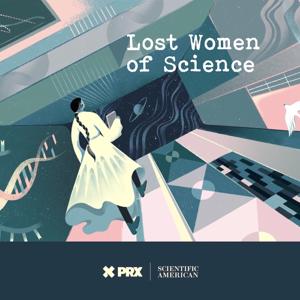
For every Marie Curie or Rosalind Franklin whose story has been told, hundreds of female scientists remain unknown to the public at large. In this series, we illuminate the lives and work of a…
Ranked by our users in the last 21 days

43,840 Listeners

43,332 Listeners

26,165 Listeners

6,871 Listeners

1,254 Listeners

3,643 Listeners

6,445 Listeners

2,229 Listeners

4,208 Listeners

24,541 Listeners
2,178 Listeners

16,337 Listeners

5,084 Listeners

2,319 Listeners
1,734 Listeners