
Sign up to save your podcasts
Or



Based on Podcast App listening data
How does the National Trust for Scotland care for the many objects in its collections? Lesley Scott is one of the conservators constantly battling against environmental factors to preserve artefacts, furniture and artworks for future generations.
Jackie meets her at the House of the Binns to get a sneak peek at a major renovation project which is currently being carried out there. The 17th century home has been closed to the public since the start of the pandemic, but work is now being done to prepare it for reopening.
In their conversation, they discuss how conservation work is done and what challenges must be overcome. How does modern science help a conservator? What does a renovation project involve? And what can visitors expect to see when the House of the Binns opens its doors once more?
For the latest information on the House of the Binns’ reopening, visit www.nts.org.uk/visit/places/house-of-binns.
What does the future of the National Trust for Scotland look like? To mark the launch of the Trust’s new strategy – Nature, Beauty and Heritage for Everyone – we united young eco reps with Chief Executive Phil Long.
In a special episode of Love Scotland, three primary school pupils from Glasgow meet up with Phil to discuss the environment, and what can be done to protect it. Their conversation, in the city that hosted COP26 less than six months ago, touches on sustainability and what role the Trust can play in preserving Scotland’s climate and natural spaces.
How will the Trust take on the challenges of climate change? What is already being done? And what can be achieved before the Trust’s centenary in 10 years’ time?
To find out more about the new strategy, visit the website.
Take a listen…
The witch trials of the sixteenth, seventeenth and early eighteenth centuries form one of the darkest chapters in Scotland’s history. More than 2,500 people – the vast majority of them women – were executed and more than 4,000 accused of witchcraft during this time, and yet their stories have largely gone untold.
Recently, though, that has started to change. Earlier this year, on International Women’s Day, First Minister Nicola Sturgeon issued an apology to all those who had been persecuted. And last year, the National Trust for Scotland published a report detailing the links between its properties and the witch trials.
Dr Ciaran Jones, the lead researcher and author of the report, joins Jackie Bird to discuss his findings and what they say about Scotland’s wider cultural and societal issues at the time.
In an exciting and invigorating year for Glasgow’s art scene, Jackie heads to Pollok House to find out more about one of the city’s most prominent artists of the late 19th century. Edward Atkinson Hornel was a Glasgow Boy – a group of radical young painters who transformed the city’s art and planted the seed of modernism. Inspired by the work of Dutch and French realism, the Boys found both commercial and critical success with landscapes and portraits that displayed everyday life.
A new exhibition at Pollok House tells the story of Hornel’s two visits to Japan and the work he created there.
How did these visits shape his point of view? What do they tell us of western views of Asian nations at the time? And what fuelled Glasgow’s close artistic links to Japan? Take a listen…
For more information about Love Scotland, go to: www.thebiglight.com/lovescotland
As wildfires take their toll on Scottish mountainsides, it's more important than ever that we all take care of our wonderful wilderness. Jackie heads to Glencoe to meet ranger Scott McCombie and hear how the National Trust for Scotland’s dedicated staff can help you learn about – and look after – the great outdoors.
Hear about how you can see everything from native forests to golden eagles on a trip to Glencoe and take part in a guided walk or even a Land Rover safari to get as close as possible to Scotland’s outstanding natural heritage. Ranger Scott McCombie also talks us through the steps he and his team are making to help ensure the great outdoors stays great, as more of us take the time to enjoy what Scotland has to offer. There’s so much to see and do at Glencoe and at all of the Trust’s wild places. Head to their website at nts.org.uk to find out more (and even book a slot on that Land Rover tour…).
Violet Jacob (1863-1946), born Violet Augusta Mary Frederica Kennedy-Erskine at the House of Dun, in Angus, was a poet and writer whose contributions to the Scottish literary canon are too often overlooked. In this second episode of our Women’s History Month specials, Jackie Bird speaks to academic and writer, Dr Carol Anderson about the unsung heroine of Scottish literature.
We hear how Jacob’s upper-class childhood in the House of Dun affected her later work, and how she broke with conformity to deeply examine the role of society at the turn of the century. With readings from some of her best-known poems – including ‘Wild Geese’, and a thorough look at her travels and private writings, Anderson reveals why Jacob deserves better recognition.
How did Jacob’s intercontinental travel influence her? Why did she adopt Scots in her writing, despite not speaking it herself? And what was it about the House of Dun and the surrounding area that captured her imagination long after she left?
Take a listen…and if you’d like to visit the birthplace of this fascinating poet, head to the House of Dun page on the Trust’s website.
To mark International Women’s Day, our host Jackie Bird hears how Scotland’s leading suffragettes plotted to bomb Burns Cottage, the birthplace of the national bard.
We hear about Ethel Moorhead, the first woman to be force fed in a Scottish jail, and her co-conspirator Frances Parker, on how they led the fight for women’s votes north of the border. Professor Pederson tells how the women cycled in dead of night with home-made bombs, to the birthplace of Robert Burns.
What happened to the two women? How did their struggle win and lose support in society at the time? And how did the poetry of Robert Burns play a part in their defence?
Take a listen…
Call us inquisitive, curious or just plain old nosy, but there’s nothing more thrilling than uncovering a detail that’s often overlooked. And it’s this spirit of discovery that’s the driving force behind today’s special bonus episode, where we’re placing the spotlight on our favourite Hidden Secrets from Love Scotland so far.
From a ticket to Lord Lovat’s grisly execution on display at Culloden Visitor Centre and signs of beaver activity along the banks of the River Tay, to Brodie Castle’s two ancient Egyptian mummies, which pre-date Christ by 300 years, each fascinating secret is safeguarded by National Trust for Scotland staff and volunteers.
Ready to unearth our most-loved hidden secrets? Let’s dive in!
Jackie Bird heads to Glencoe with the National Trust for Scotland’s Derek Alexander and Lucy Doogan.
To mark 330 years since the massacre of the MacDonald clan at Glencoe, Jackie Bird heads north to see how work on a recreated turf house will help to tell the full story of one of the most harrowing moments in Scottish history.
On 13 February 1692 38 men, women and children were murdered in cold Scottish army companies of Argyll’s Foot Regiment. For two weeks prior to the bloodshed, clan members had played host to the soldiers in their modest turf-dwellings on the slopes of the glen.
As the Trust opens its faithfully restored turf house at the site, we hear how a better insight into the way the clans of Glencoe lived will bring the history of the massacre to new generations of visitors.
Also in this episode, Cameron hears about a wonderful plaything on show at Helensburgh’s Hill House.
Located just outside of Glasgow’s Southside, Greenbank Garden is an urban oasis with woodland walks and more than 3600 species of beautiful plants – including over 500 varieties of daffodil.
Our host Jackie Bird heads to Greenbank to talk daffodils and see the first signs of spring. Jackie chats to the property’s Head Gardener, Andrew Hinson, about the highlights and challenges of caring for Greenbank’s impressive horticultural collection, why the yearly arrival of this bright yellow flower never gets any less exciting, and the signs we should look out at Trust properties across the country that tell us spring is well and truly springing.
Find out more about Greenbank Garden at: www.nts.org.uk/visit/places/greenbank-garden
Also in this episode – Cameron hears about the traces of beavers living along the banks of the River Tay, as part of our regular slot, Hidden Secrets.
From the publisher's feed
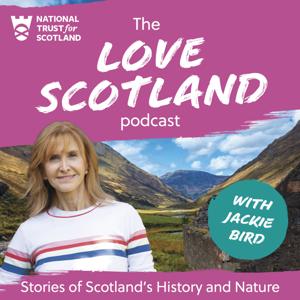
Love Scotland is a fortnightly podcast series from the National Trust for Scotland.
Hosted by TV star, expert broadcaster and National Trust for Scotland president Jackie Bird, Love Scotland features big names, experts and enthusiasts from all walks of life. Each episode delves deep into the detail of Scotland’s history, its wildlife and its landscapes.
Ranked by our users in the last 21 days

3,178 Listeners

2,100 Listeners

491 Listeners

1,992 Listeners

247 Listeners
109 Listeners

381 Listeners

4,764 Listeners
104 Listeners
233 Listeners
41 Listeners
471 Listeners

3,223 Listeners

25 Listeners

894 Listeners