
Sign up to save your podcasts
Or

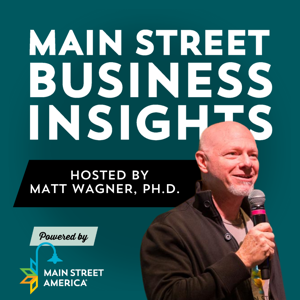


The Main Street Business Insights podcast is back! Recorded live at our 2026 national conference in Tulsa, host Matt Wagner sits down with Brandi Hines-Lee, owner of Agitsi Stained Glass in the Route 66 Main Street District.
A third-generation stained glass artist, Brandi learned the craft by watching her mother and grandmother work. After her mother passed away, she left her job and opened the studio the two of them had planned to run together, naming it Agitsi — “my mother” in Cherokee.
Losing the person she turned to with every technical question shaped how she runs the shop: no one through her door gets stuck without someone to ask.
That instinct built the business. Custom commissions led to teaching, teaching created demand for supplies, and a wholesale account required a brick-and-mortar storefront — one she found because another artist she had met while volunteering as a mentor invited her to join the artists working in Red Fork. She signed that first lease just before COVID closed the state, then redesigned her teaching studio into a layout other studios now follow, a survival story that later brought Good Morning America to Tulsa.
Brandi and Matt also talk through the pressures on the shop: rising freight and material costs, and big-box retailers selling supplies at her wholesale price. Her answer isn’t price. It’s the relationships a supplier can’t stock — answering a student’s question whether or not they buy a class, and asking what her community needs when sales go quiet, which is how hand-beaded graduation feathers for Indian Education seniors came to cover a month’s rent.
Being Cherokee, Brandi says, is about being one with the community: understanding, resilient, and always teaching. It is why everyone through the door is treated as somebody’s daughter, mother, brother or uncle, and why her students are anything but competition.
Plus: Matt shares why the podcast went quiet for a few months, and what's coming next!
Connect:
Join us next time for more insights into the evolving landscape of Main Street business.
What trends will shape Main Street businesses in 2026? And how can you prepare now?
In this annual predictions episode, host Matt Wagner analyzes the intersection of society, technology, and economic trends to forecast what's ahead for small businesses and Main Streets. Drawing from consumer data, industry reports, and Main Street America's latest research, Matt identifies eight key trends that will impact everything from retail strategies to food and beverage concepts to financing models.
Before looking ahead, Matt reviews his 2025 predictions — scoring a win on retail growth projections (flat to stagnant when adjusted for inflation), a loss on GPL-1 drug impacts (a year too early), and a draw on AI adoption by nonprofits (usage is there, but not in the predicted areas).
Here are the eight predictions for 2026:
Bonus Prediction: 2026 is the Year of Small Business! Our yet-to-be-released 2026 Directors' Survey shows "supporting businesses and entrepreneurs" as the #1 programming priority, and small business programming had the greatest community impact. With new resources including the Small Business Hub, Made Originals, grant programs, and the Hartford Small Business Accelerator, Main Street programs will cement their support for the small business sector.
Whether you're a Main Street director planning 2026 programming, a business owner adapting your strategy, or an entrepreneur considering launch, these predictions provide a roadmap for navigating the year ahead.
Note: At the end of February, we’ll pause new episodes of the podcast as we shift focus to the Small Business Hub and Made Originals programming. Explore our extensive back catalog here for insights on succession planning, disaster recovery, scaling businesses, and more.
Connect:
Episode Links:
Join us next time for more insights into the evolving landscape of Main Street business.
In this episode, host Matt Wagner sits down with Kim Redeker, owner of The Sweet Granada Chocolate Shop in Emporia, Kansas.
Over 21 years, Kim has grown from a 500-square-foot storefront with two employees (herself and her mom) to a 3,200-square-foot production facility employing 21-28 people depending on the season, plus two retail locations. In 2025, The Sweet Granada was also voted the #2 best candy shop by USA Today Readers!
Kim's journey reveals the strategic advantages small-scale manufacturers have on Main Street: the ability to jump on viral trends (Dubai bars, cocoa bombs) before mass market catches up, the capacity to create custom products quickly using local technology, and how community connection keeps dollars and talent local.
Discover Kim's approach to:
Whether you're a small-scale producer considering expansion, a Main Street director supporting makers and manufacturers, or a business owner wondering how to compete with mass market, this conversation offers practical insights on building a manufacturing business without leaving downtown.
Join us as Kim shares why her only regret is not starting sooner, how small makers make communities more interesting, and what it means to stay "light on your feet" as an entrepreneur.
This episode also previews Main Street America's new Made Originals initiative, a soon-to-come program supporting small-scale manufacturers and brand creators in the Main Street network through giving access to national markets, education, certification, and access to capital.
Get a limited edition box of Made Originals chocolates from Main Street maker, The Sweet Granada Chocolate Shop! Use code MSA26 for 30% off through 2/14.
Connect:
Learn about The Sweet Granada Chocolate Shop
Get a special Made Originals chocolate bar set!
Learn about Emporia Main Street
Learn about Made Originals
Join MSA’s Small Biz Hub
Episode Links:
Join us next time for more insights into the evolving landscape of Main Street business.
How do you build a scalable business without losing its origins; what makes it truly special? In this episode, host Matt Wagner sits down with Angela Mallett, founder of Honeybee Sage Wellness & Apothecary in Milwaukee, Wisconsin.
In their conversation, Angela shares her intentional approach to growth, one that prioritizes community care and cultural healing over rapid expansion. Angela's journey began with massage therapy and a calling to bring ancestral herbal wisdom back to underserved communities. Starting in 2018 in the heart of Milwaukee's 53206 zip code — one of the city's most challenging areas — Honeybee Sage has become more than a tea shop. It's an apothecary rooted in the healing traditions of her great-great uncle, a root doctor from Mississippi, offering herbal remedies as medicine.
Discover Angela's approach to:
Whether you're an entrepreneur considering expansion, a Main Street director supporting mission-driven businesses, or a business owner wondering how to scale without sacrificing values, this conversation offers a refreshing perspective on intentional growth. Join us as Angela shares why she works "like she doesn't need the money," how herbal tea serves as accessible medicine, and what it means to be a professional "space creator" for community healing.
About the Episode
What happens after a natural disaster hits your Main Street? This episode provides insights on how Main Street leaders and business owners can learn how to be better prepared for disaster from others who have recently gone through recovery efforts.
In this special roundtable episode, host Matt Wagner sits down with community leaders from Spruce Pine, North Carolina, one year after Hurricane Helene devastated their downtown. Featuring Mayor Philip Hise, owners of DT’s Blue Ridge Java David Niven and Zan Sistare, Main Street Director Spencer Bost, and Town Manager Daniel Stines, this conversation goes beyond the immediate aftermath to address the complex realities of long-term recovery.
Located in the Appalachian Mountains with a population of approximately 2,300, Spruce Pine faced complete loss of water, power, and communication for 17-21 days. The town is now managing an estimated $50 million in municipal damages while supporting the recovery of downtown businesses like DT's Blue Ridge Java.
DT’s Blue Ridge Java was a recipient of Main Street America's Backing Small Businesses Disaster Recovery Grant supported by American Express – in the episode, you’ll hear a bit about how the grant helped their recovery efforts.
Discover the critical lessons they learned about:
Why communication infrastructure failure was more devastating than physical damage
What volunteer organizations made the difference in the first critical weeks
The reality of 15+ day delays in federal emergency response
Building improvements and infrastructure planning that matter for future mitigation
Whether your community faces hurricanes, floods, tornadoes, or wildfires, these lessons apply. Learn what actually helps, what doesn't, and ways to prepare your Main Street before disaster strikes.
Join us as we hear directly from this resilient community about their experiences with loss, recovery, and rebuilding—and what other Main Street leaders and business owners can learn from their story.
Looking for more disaster resilience resources? Download Main Street America’s Disaster Recovery & Resilience Toolkit here.
Connect:
Learn about Downtown Spruce Pine
Learn about the Town of Spruce Pine
Learn about North Carolina Main Street & Rural Planning Center
Learn about Main Street America's Backing Small Businesses Disaster Recovery Grant
Learn about DT’s Blue Ridge Java
Episode Links:
About the Episode
In this data-driven conversation, host Matt Wagner sits down with Mike Powe, Senior Director of Research at Main Street America, to break down findings from their Fall 2025 Small Business Survey. The survey of 1,295 businesses reveals that small business owners are experiencing persistent revenue and profitability challenges, broad societal instability impacting operations, and the measurable advantage of Main Street program support (nearly a full point higher confidence and 11% better revenue stability).
Takeaways
Episode Links:
Amex Shop Small Grants Program
We have some super exciting news to share with you all! Main Street America and American Express are teaming up to launch a new grant program for small business owners. The Amex Shop Small Grants Program will provide an initial $5 million to fund 250 grants of $20,000 each to eligible small business owners across the U.S. The application will open on this Small Business Saturday, November 29, 2025.
And get this. Every time an American Express Card Member shops with their eligible Card at a qualifying U.S. small business on November 29, American Express will donate an additional $1 to fund additional grants. So, there’s an extra incentive to get out there and support local businesses on Small Business Saturday! You can find eligible small businesses in your community on the Shop Small Map. American Express Debit Cards are not eligible.”
Find more information on our website at mainstreet.org/shopsmallgrant.
About the Episode
How can you maximize holiday revenue when you're facing tariff uncertainty, shifting consumer confidence, and limited time to prepare for the holiday season?
Takeaways
Episode Links:
Amex Shop Small Grants Program
We have some super exciting news to share with you all! Main Street America and American Express are teaming up to launch a new grant program for small business owners. The Amex Shop Small Grants Program will provide an initial $5 million to fund 250 grants of $20,000 each to eligible small business owners across the U.S. The application will open on this Small Business Saturday, November 29, 2025.
And get this. Every time an American Express Card Member shops with their eligible Card at a qualifying U.S. small business on November 29, American Express will donate an additional $1 to fund additional grants. So, there’s an extra incentive to get out there and support local businesses on Small Business Saturday! You can find eligible small businesses in your community on the Shop Small Map. American Express Debit Cards are not eligible.”
Find more information on our website at mainstreet.org/shopsmallgrant.
About the Episode
How do you successfully transition a business across five generations without creating resentment or burning out the next generation? This episode tackles the complex realities of family business succession planning through the story of Tiger's General Store in Hayesville, North Carolina — a business that has operated continuously since 1875.
In this three-generation conversation, host Matt Wagner sits down with Rob Tiger (fourth generation), Holly Tiger (married into the business), and Lauren Tiger (fifth generation) to explore the intentional decisions that have kept this 150-year-old business thriving. From Rob's initial reluctance ("I'll give you a year") to Lauren's carefully structured path that required building her own career first, this family reveals the honest conversations and strategic choices behind successful succession.
Discover practical strategies for:
Whether you're planning a business transition, considering buying a family business, or wondering how to stay relevant in a small market for decades, this episode provides a candid look at what actually works — and what doesn't — in multi-generational business ownership.
Join us as we hear directly from three generations about losing money in the early years, evolving from groceries to gifts, resisting pressure to go fully online, and why consistency matters more than perfection in small business success.
Special thanks to Sherry Adams, North Carolina Main Street Program, for coordinating this episode.
Connect:
Episode Links:
When investors and banks say "no," how do you prove your business concept can work? This episode explores a strategic approach to launching a business that up-and-coming entrepreneurs could consider: launching a beta facility to prove market viability before scaling.
In this episode, host Matt Wagner sits down with Megan Peterson, social innovator and founder of Mendo LEAP in Ukiah, California. Located in Mendocino County, Mendo LEAP is an adaptive play center providing an inclusive space for children of all abilities to Learn, Explore, Adapt, and Play (LEAP).
Discover how Megan turned funding rejection into an opportunity to build a stronger, more sustainable business model by:
Whether you're facing funding challenges, launching in an underserved market, or looking to validate your business concept before going all-in, this episode provides a practical framework for de-risking your venture while building community support.
Join us as we hear directly from Megan about her journey from new mom to driven entrepreneur, the many lessons learned, and what other small business owners frankly can take from her story.
Connect:
Episode Links:
- Watch video interview
- Listen on Apple Podcasts
- Listen on Spotify
- Subscribe for updates
Show Notes:
Join host Matt Wagner for his conversation with Rachael Kehler, owner of The Peppermint Stick Candy Store in downtown Boyertown, Pennsylvania. In this episode, Matt and Rachael discuss her journey to entrepreneurship, leveraging nostalgia as a marketing tool, small town tourism, and more.
In this episode, we dive deep into:
- Rachael’s Journey to Entrepreneurship: Rachael explains her beginnings as a business owner. The idea for a candy store was sparked while watching visitors explore downtown Boyertown after riding a newly installed tourist train. With Rachael’s entrepreneurial spirit matched with her husband’s historic renovation skills, they created an old-fashioned candy shop and ice cream parlor as a feel-good destination for tourists and residents alike.
- Harnessing Nostalgia in Your Business: As both a business owner and history lover, Rachael has learned that everything – even candy – has a story. Leveraging the feelings and memories associated with your products can endear customers to your business – and invite new people to walk through your door.
- Keeping Up Modern Technology: If you walk into Peppermint Stick Candy, you’ll feel like you were transported back in time to the 1940s. But the marketing tools and techniques that made you want to visit in the first place are firmly planted in the age of AI. Rachael uses modern marketing tools like Grammarly, Google Gemini, and more to form creative marketing campaigns and stay hyper-productive as a busy small business owner.
Connect:
Episode Links:
Join us next week for more insights into the evolving landscape of Main Street business.
From the publisher's feed

90,949 Listeners

31,973 Listeners

43,320 Listeners

421 Listeners

28,681 Listeners

111,852 Listeners

56,432 Listeners

9,528 Listeners

5,115 Listeners

16,349 Listeners

6,057 Listeners

6,378 Listeners

19,223 Listeners
33 Listeners

804 Listeners