
Sign up to save your podcasts
Or

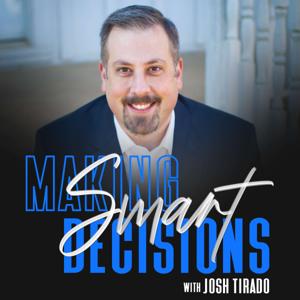


Josh Tirado: [00:00:20] Welcome to making smart decisions podcast. I'm your host, Josh Tirado, and today we are discussing a very fun topic. The topic of what do clients like the most? In a recent survey of my clients, the number one and number two items they liked the most and why one was the educational aspect. Where we take complex things, make them simple, actionable, relatable, and explain how this will benefit them or discuss those two or three options and let them make an educated decision on which route they want to take that they're most comfortable with. So the educational aspect was big.
[00:01:37]The second component was constantly looking for something new to add value, whether it's an investment strategy, whether it's a product that's out there, whether it's a change of philosophy, whatever it is staying current. And I really think that's one of the main advantages of working with an advisor, and I'm biased, but working with a fee-based advisor.
[00:01:54]Who is working off of a plan with you? Not just managing assets because we're having serious discussions. For my average client, three times a year, and we're going over different things. And each year, we try to bring some additional value. I might not have a brand new topic. Every three or four months.
[00:02:07] We might not need one, but we're constantly searching for something. So one finding unique. Things that can add value to the client and then to being able to translate those unique opportunities or products to the client to make an informed decision. And I want to touch on the product side a little bit of it.
[00:02:23]Because again, this comes up time and again, and I make this comment jokingly to many clients, but I often referenced the old golden rule. And I slight twist on it. So I would say, the golden rule. He who has the gold makes the rules. And I know that it's not the true golden rule, but it's very applicable while investing as your money grows.
[00:02:41] And as you put more aside and reach different levels of wealth, more opportunities pop up. I can offer clients who have an account balance of over a hundred thousand dollars that I can't offer to someone with an account balance of 25,000. I can offer things to someone with an account balance over 500, over a million, or at different income levels.
[00:02:58] There are different things out there. And everyone grows and gets access to these things eventually if the money keeps growing. But what I want to say that there are certain things that we can offer to most people, Almost everyone. It depends on your situation, but there's a lot of value out of things.
[00:03:11] And I want to touch on a few of them very quickly. One of them is 401k management. The vast majority of people out there that are still working have a 401k. It doesn't apply to everybody. It's currently about a third of the client, a third of the companies out there offering 401ks, but it's growing dramatically every single month is the ability for the advisor.
[00:03:28]Working with a money management firm to have a contract with the 401k company and your employer to be able to go in there and manage your 401k on your behalf. So if you have a self-directed option inside your 401k, which allows you to create a little brokerage account, that is the window we were allowed to use, and then we have a signed agreement.
[00:03:45]what we do is we go in through that brokerage window. And we're then able to put new investments in your 401k and actively manage those investments. So it used to be that this was all on you. And in a lot of cases, it still is. Like I said, only about a third of the companies out there offer this, but for the ones that do it, it's a tremendous way to have more choice in your 401k and someone watching it for you in real-time.
[00:04:06]for my clients have been using it over the past two years, results have been. Very good across the board. So I'm quite pleased with it, but either you have an advisor helping with the 401k or an advisor helped me with the 401k and can directly access the 401k through a money management firm.
[00:04:21] And help you manage it. Now, when I say directly access it, we're not asking for a username. We're not asking for a password. We're not taking control. We're assigning all the appropriate forms as though you're opening up a brokerage account. That account is within your 401k, and we're using an amen money management company.
[00:04:36]Just like we may be using a third-party money management firm to help manage some of your money outside of your 401k. We're using a similar firm to help manage it within your 401k. That's a great advantage. And another thing is alternative investments. Now you do need to have a minimum net worth and a minimum household income.
[00:04:51]Either both or one of the other has to be even higher, but as long as you have, as long as you reach the minimums, you have access to alternative and investments. Now, so alternate investments are great. Some are not. Some have received a bad rap in recent years. Some have been a real advantage.
[00:05:03]Two people, but they're often in things such as currency, real estate, several oil and gas partnerships. Sometimes I know a lot of those. Were used heavily in the eighties, and I had a lot of trouble. But there are several different things out there. Some of these alternative investments are restrictive because they're privately held. Some are in mutual fund form.
[00:05:20] So they're very illiquid and publicly held. So there are a number, different ways to do it. But what I suggest is it's not the same old as some stocks have some bonds. Even at a more modest level of money invested, you can have access to stocks to bonds. Still, also if you're interested the real estate and some of the other alternative investments. New ones are coming out all the time now. It takes a while for them to get, be regulated, and be approved on different platforms to be sold or used in your portfolio.
[00:05:44]But there's a lot of options out there, and new ones are coming to market all the time. Recent events or the past year with COVID and the economy, different things have really limited some of the alternate investments for folks. And some have just made the very liquid ones available and the illiquid ones not as available now. I don't want to paint anything with too broad of a brush.
[00:06:02]Some of the liquid ones have many advantages and are great, but there's no one size fits all. Each thing is on a case-by-case basis, but the alternatives are great. So far, we've already touched on helping you manage your 401k, some alternative investments that are not as correlated to the rest of the market and get your returns from a different type of asset.
[00:06:17]That's really great. I want to mention some, there are some annuity products out there, and they're becoming so popular. I think they'll eventually end up with their own asset—class their own category. Many people refer to them as buffered products, and essentially you have an annuity where you're still offered upside potential where you're tracking an index for the market.
[00:06:33]But if the market goes down, the insurance company issuing the annuity has a clause in there where they will absorb the first certain percentage of loss. So if your account, a lot of them that I've used are, is 10%. So if the account goes down 10%, they absorbed the first 10% of loss over the first year.
[00:06:49] there's a trade-off there. You're also not receiving a hundred percent of the index. So you're tracking the SME...
Josh Tirado: [00:00:20] Welcome to the making smart decisions podcast. I'm your host, Josh Toronto. And today, we are discussing pensions. Is it a sheep, or is it the Wolf? Or is it just a Wolf in sheep's clothing? Let me jump into the pension thing here and try to delineate a little bit.
[00:01:19] When I am talking about pensions. I am talking about pensions from companies, not from the government, and quasi I mostly pension from smaller branches of government. So not necessarily federal pensions, but maybe something along the lines of that, of a state pension.
[00:01:35]The vast majority of people no longer have a pension 40 years ago, the vast majority of people. I had a pension, and that was a big push on retirement. Pensions became very expensive. They were hard to manage. They went away. The 1980s saw the rise of the 401k, and that really replaced the pension.
[00:01:49] So it used to be that, Hey, I had a pension, the company put so much money aside. Maybe I contributed to it. Maybe I didn't, depending on what setup you had. And when you retired, you got a certain amount of money, which was guaranteed for all these years in your retirement. And it was awesome. And everyone worked towards their pension fund people for years joked about the gold watch, and I got a pension.
[00:02:05]When I retired, the pension became hard to manage. It went away. And the onus of retirement transferred from the company you worked for over to you with the rise of the 401k. Because now you're consuming your money. You're getting a match from the company. But now you have to manage the investments that are in their project.
[00:02:21] How much is going to be in there? So it's no longer the company during a pension taking care of you. It's you taking care of your own money? Pensions used to be far and wide, very accepted, very common pensions are not that anymore—several large companies over the past 10 years.
[00:02:35]Have eliminated their pensions for people under a certain amount of time, say employees are there for less than five years, less than 10 years. And new hires, no pension people that have been there longer than that, the pension's there, but it's frozen. And then you have some older people that they know will be retiring out or taking a package in the next five years.
[00:02:50]And their pensions remained fairly unchanged, but the companies had moved away from pensions. Let me discuss that for the few of you out there that still have pensions. Let me touch on that from a private company. Again, I see this left and right with my clients. The pensions are being frozen.
[00:03:02]The pensions are going away. They might give you a lump sum, payout of some money towards your 401k, but then the pension is going away. So when I am doing retirement planning for my clients and have a pension, what is becoming increasingly popular as a stress test is. We don't count their pension at all.
[00:03:17]It used to be that we would say, what if something happens? You don't get the projected pension cause it's 20 years out. And maybe the company doesn't do as well, or maybe they freeze it, and we would show them a reduced pension. My clients are savvy.
[00:03:28]They're smart people. And not just smart because they choose to work with me. But because they are smart, savvy people. We're looking at the associated risks with the pension and the companies' health, they're working for. Even the healthiest companies are getting rid of them.
[00:03:40] So we've actually started just eliminating the pension from their retirement planning projections. And we want to make sure that they can afford to retire on their own. And if they get the pension, great, it's gravy, but they're not relying on it. So I caution you if you are not doing.
[00:03:54] a
[00:03:54] Josh Tirado: [00:03:54] separate IRA or Roth IRA or 401k, and you're just relying on a pension.
[00:03:59] And you're not within five years of retiring. That will probably not work out for you as well as you initially thought. That is the overwhelming trend in the United States today. So please be very careful again, we don't even consider their pension. If they're more than five years out from retirement or dramatically reduce the pension projection, the federal government will do everything in their power to stay.
[00:04:20] And I'm jokingly saying, stay in business. But the government can raise taxes, collect more money and continue to govern the people, and make their pensions work. They make the pensions happen now—several government pensions of receiving the pension. You're not receiving social security, so you are not able to quote-unquote double dip there.
[00:04:35] So please bear in mind that, Hey, if I'm getting this pension, you're not getting social security again. The pension there is more reliable, but we don't know how much you're going to receive from that pension, or could it be changed in the future? So please, once again, take a little control, take some more of the money into your own hands and do some other outside investing, just online, a pension.
[00:04:53]Then we have this kind of strange hybrid scenario called smaller pensions where it's state-run. Some states have done a very good job of managing their pension fund. And the ones that pop into mind first are just the States that are managing the pension fund for teachers, police, firefighters, state workers, that sort of thing.
[00:05:11] some other States have horribly mismanaged it and even passed rules where they were allowed to borrow money out of the pension plan, to cover expenses and nothing to do with the pension, with no requirement to pay it back and no requirement to pay themselves any interest. So now, not only is that money has not been returned to the pension plan.
[00:05:25]But that money was not invested. Earning return for the pension plan during that same period of time. And now you have a woefully underfunded pension, which will result down the road in people receiving a reduced pension. Potentially, the States could even default. There are some States that when COVID hit, and they were running this so much economic, no grant, they had already been in economic trouble for the previous 10, 15, 20 plus years.
[00:05:46] But COVID hitting amplified it to the point where there are some States considering, and they publicly announced this, the governors publicly announced it, that the States would consider bankruptcy as a way to restructure the debt and what the obligations of the state were. It would be interesting to see if those pensions were going to, depending on the bankruptcy court, if those pensions would be protected.
[00:06:07] Or if they only had a fund the pension with some minimum amount of money or who knows what was going to happen. But all I know is that if I was relying on a pension and I plan to receive a pension from the state for my years of hard work, and that state was in such bad financial straits, it was considering going bankrupt.
[00:06:25]And the pension fund is massively underfunded. I'm not going to feel too comfortable about that pension. And I know a lot of people that are working on getting their 25 years, so they can get out and get their pension, but there are talks repeatedly about what's going to happen with that pension.
[00:06:38]I know some teachers in that position. I noticed some police officers in that position and some firefighters in that position. It's scary because, in many instances, they don't have separate money...
Josh Tirado: [00:00:20] Welcome to the making smart decisions podcast. I'm your host, Josh Tirado, and today we're going to discuss sequence risk or sequence of return risk or something that sounds really boring and dumb and not useful to you. But in reality, it is actually a major major risk to your retirement and your investments.
[00:01:26]That's what we're gonna jump into today. So let me give you the definition of what sequence risk is. According to Investopedia, sequence risk is the danger that the timing of withdrawals from your retirement account will have a negative impact on the overall rate of return available to the investor.
[00:01:40] Let me boil that down for you. Timing is everything. When you pull your money out of your retirement accounts can affect how much it is their long-term. Now that makes sense to me, but in reality, it's just math. Okay. It's math. It's boring, but it can really affect you. Obviously, the stock market and your investments, whether it's stocks, bonds, real estate, what have you? It does not go up in a straight line. It can go up and go down. It can go sideways, different things. You can have several bad years in a row followed by several good.
[00:02:11] You have several good years followed by several bad. You can have interspersed and in differing magnitudes. Whenever you hear people talk about the market, you often hear, Oh, over any 10 year period, the market has returned X or Oh. Since people start investing in the market, it has averaged this sort of return and gone up.
[00:02:28] Yeah. That's an average. That is not what you're getting every year. It can be more. It can be less. I'm amazed that people jump in, and they're like, after so many years, Hey, the market's supposed to average this. I don't have that. I have this. It could be more, it could be less, but that's based on timing. And that's based on the sequence of returns within the investment.
[00:02:47]Now that gets magnified. When you go to retire, and you're going to pull your money out. Let me take this a step further. In my world, you see many things to say, sequence risk sequence of return risk That sort of thing. When I do a financial plan for someone, and we're focused on the retirement and the withdrawal, there are two main things in this sort of realm that we stress test for one is called bad timing.
[00:03:07] And I think bad timing is the most practical implementation of sequence risk. Bad timing says, statistically, the worst time to lose money. Or have poor returns is in the first two years of retirement because it's at that point that you have simultaneously stopped, contributing, started withdrawing. Now your seed money, which needs to grow like a snowball rolling downhill, has been reduced by less than optimal returns.
[00:03:33] Okay. Maybe you were planning on 8%, you only got 4% of your planning on something positive, and you actually went down and lost money. So those first two years are imperative that you really protect them because you can't dig yourself into a hole there. After all, there's no more money coming in to fill in the hole, and that money needs to grow to protect you.
[00:03:49] Long-term. One of the main things that we stress test against is bad timing, where we take a look at what you're invested in and the likelihood that you'll lose money. And, those first two years of retirement, when I say lose money, It's not guaranteed. Still, historically we can look at how the investments you're holding have fared in different years and how much on average they'll go down, and we can look at, okay, here's the likelihood that they will go down in this first two years.
[00:04:11] And here's the percentage they could go down. One way you get rid of sequence risk or the bad timing risk is to diversify properly. Because rarely does everything go down or go up at the same time. So we start to reduce the overall amount of risk, and we properly diversify. And by doing that, we can dramatically reduce the chances that you will lose money in those first two years of retirement, which is the most important, but secondarily and almost as important is we run a Monte Carlo simulation.
[00:04:40]When I say the chance of you making a certain amount of money for a certain number of years, you're not living your money, is based on this Monte Carlo simulation. What do you mean? The money? Carlos simulation in my world with planning takes a look at.
[00:04:51]Not just your overall portfolio, not just the average you're holding, but it takes a look at the different types of stocks, the different types of bonds, the different types of real estate, whether it's large-cap, small company, international, whatever it is, it looks at all. And then it takes a look at historical what they've done as far as when they've gone up when they've gone down.
[00:05:09]And what is the likelihood of that happening? And the Monte Carlo simulation runs a thousand plus sometimes depending on what you're running a couple of thousand different scenarios with different sequences of returns. So a lot of good returns in the beginning followed by bad, a lot of bad followed by good, and vice versa.
[00:05:24] And it does it for every asset category that you're currently invested in. And then, we'll run a scenario showing that for all the asset categories that we plan on you being invested in. At the time of retirement, you will give you your probability of your money lasting and how much is in there. A lot of the free planning software that's out there takes a look at what average returns are and says to you, here's the number you need to have when you go to retire.
[00:05:46]But that number is really a moving target because that number might be there on the day. You retire. But your life expectancy after you retire may be 30 years. So that number is one snapshot. One day, we need to take a look at what you are invested in overall, how much you need to pull out of there, what sources you're pulling it from.
[00:06:02]And this sequence of return risk over five, 10, 20, 30 years. In fact, we look at the sequence of return risk. As to your proper asset allocation while you're still accumulating money leading up to retirement because in what order you get, your returns or losses in the market affect you even leading up to retirement.
[00:06:19]It's amplified in retirement. But it's all-important. So when you deal with the professional, we'll stress test for bad timing at the beginning of retirement. We will run a Monte Carlo simulation to stress, test you for the sequence of return risk during your accumulation phase. And we'll rerun it for the projection when you retire in your withdrawal phase to make sure that money will last.
[00:06:40] And then, on top of that, we still make sure that at the proposed end of your plan, there is still extra money there. There is still a buffer because you need more money. It would be best if you had that safety net when you're just trying to figure out a number or look at some free software to give you a number of some projections.
[00:06:56]I have never seen it where it considers all of these different variables and stress tests it for you. And that's really what you get with the professional. And that's really important. So sequence risk sequence of return risk may sound really boring. But if you don't address it, it could be one of the number one detriments to you having a successful retirement.
[00:07:13]
Joe: Hello, and welcome to the show. My name is Joe Woolworth. I produce the making smart decisions podcast with Josh Tirado. I'm here today with Josh Tirado and David Morgan. The founders of the Amplify program that we are going to learn about today.
[00:00:31] So let's get started, guys. Josh, tell me a little bit about Amplify.
[00:00:35]Josh: So amplify as a program that we created, and our slogan is your immediate and sustainable giving strategy.
[00:00:40]Joe: Great. So you guys are going to work with individuals to help nonprofits by helping individuals give more money to nonprofits, basically.
[00:00:48] Josh: That is correct. Our end goal is to get more money to the nonprofits for today and in the future, hence our immediate and sustainable giving strategy.
[00:00:57]Joe: how did you guys come up with this idea?
[00:00:58] Like, what was the logic behind partnering up on this?
[00:01:01] David: . I've been in the nonprofit space for a while, and one of the problems I think this solves is. Everyone's going after more followers, and it's really about quantity. And that can make you look good, but a lot of nonprofits have a problem getting to the depth, and connecting to givers is how they'd like.
[00:01:18] And so I think this can do that. It offers a tool to say, yeah, we'd love for you to, for example, buy our coffee. But what if you can connect with us more deeply, even in a generational way. And so I think this removes an obstacle in being able to do that.
[00:01:33] Joe: And David, you have experienced in the nonprofit world.
[00:01:36] David: Yeah. Around 2013, my wife and I founded love abounds and just really briefly. So we do village development in Zambia that looks like clean water. Right now. We have two homes for abandoned children, and we have a women's empowerment project that teaches women to be entrepreneurs themselves by farming chickens.
[00:01:55]That, and then. Also, really quick to Condi coffee is a coffee company that we started that funds all of that or helps fund all of that. So we've been in the space for a while, and we really enjoy it. I love entrepreneurship in all its forms, and I liked that you.
[00:02:09] Joe: guys, obviously. Are passionate about people giving to nonprofits because it can make on people's, and now you're forming this amplify program to help people be better-equipped givers.
[00:02:20] So tell me about the strategies on how you guys are going to help people amplify their giving.
[00:02:29] Josh: So I'd like to touch on just two examples of two topics of two strategies we can use. And these strategies really came to light because, as David mentioned, he's been in this space or working.
[00:02:38]As director of a nonprofit and working with nonprofits for a long period of time, I've been working with nonprofits and specifically several churches for the past 22 years to help with giving. And the same problem came up repeatedly; where there's some legacy giving where people wanted to give a family gift when someone passed away. However, all nonprofits need operating capital.
[00:03:00] Now they need money. Now it helps them for their mission, not just necessarily in 20 or 30 years. Over the past 20 years, we see the same problems over and over again. And Dave and I thought you know what? There has to be a better way. And what if we came up with a formalized program to help the nonprofits and put together a nice structure for their giving.
[00:03:18] And that's where we originally came up with amplify. So two examples I want to discuss one helps to amplify the current gifts. The other one helps to amplify future gifts, and there are several different planning strategies we can utilize. But here are two prevalent ones. The first one is called the donor-advised fund.
[00:03:35] What this allows the person to do. This is the person donating the money. They can donate virtually an unlimited amount of money into a donor-advised fund. Now, the donor-advised fund sounds technical sounds nice. The platform I use, they have actually branded it as the giving fund. I think that's a more accurate description.
[00:03:52] The donor can donate a virtually unlimited amount of money into the fund. And they receive a tax break on the entire amount that they contribute to the fund. Now, it says the fund, and it's not one mutual fund. It's actually set up as a brokerage account. They have control over managing and working with the professional to manage the brokerage account's investments and grow it.
[00:04:13] And from there, they determine. Which qualified five Oh one C3 charities will receive some of that money. And if they're having a great year, they can donate more. If they're having a down year, they can donate less and donate to one charity. They can donate to multiple charities. You have total control over it, but the donor receives Benefits cause he had a huge tax break.
[00:04:31] They can manage the money. And we also encouraged them to turn it into a legacy. Play, involve the children. If they're older, involved, the grandchildren, get them involved. So that way, they're getting in the habit of donating and enriches their souls. And it's a great family thing as well as the actual dollars.
[00:04:48] And then when the original people pass away, they can even leave it to the family, and the family can continue to manage it and donate to the charities, and you can create a great legacy. But what's great is you're managing the money. You're growing the money, but you're giving it now. So you can see what's happening.
[00:05:03] You can see the fruits of your labor and the fruits of your donations with the nonprofit and the nonprofit benefits because instead of waiting for the person to pass away to receive the gift, eventually, you're getting more money now. And if that person was going to donate a set amount of money, now they're getting a tax break on that money, which allows them to donate even more money if they want to kick in some of those tax savings and it's invested.
[00:05:24] So that gift can really start to snowball year after year and create a perpetual gift. So the donor advice fund slash giving fund is a great strategy where everyone benefits now, instead of necessarily in the future,
[00:05:37] David: from a non-profit perspective, I think many times, donors can feel like it's really risky to give a big gift.
[00:05:46] And that makes sense. So what you want is somebody who has the expertise of having done this before the financial aspect, the estate planning aspect. To be able to say, yeah, you're in safe hands. This is what we can do in a very predictable way. It's not giving the non-profit a large some, and we're not sure what will happen with it.
[00:06:07]I think nonprofits are really leaving a lot of money on the table just because. There's no program to guide and answer questions from this perspective.
[00:06:18] Non-profits are just—overworked, underpaid. And I think what's daunting to them is doing a whole nother campaign to raise more money from the same people who usually give them money. So that's an obstacle they're trying to overcome. What's beautiful about this is we don't have to be a part of some giant campaign tha...
Josh: Hi, I'm Josh Tirado. And on this episode of Making Smart Decisions Podcast, we are going to touch on the emergency fund. What is it in? Do you need one? Most financial advice starts with the basis of you should have an emergency fund. And a lot of people just view that as a savings type account and yes, you should absolutely have that it might seem pretty simple, but let's dive down into that a little bit deeper when it comes to the emergency fund, the old rule of thumb was you should have put aside three months worth of living expenses.
[00:02:12] Not three months worth of your salary, the three months worth of your bills, and your living expenses to get you through something tough
[00:02:19] Over time, what I tell my clients is that has evolved and I recommend a good starting point is three months' worth of living expenses. Ideally, you want to get up to about six months worth of living expenses. The reason being if you suffer a sickness or an injury or some other sort of serious issue, and you cannot work, studies show that most people are back to work within six months. If you could have six months' worth of living expenses, put aside most illnesses and injuries that you'll be able to recover from them within six months and get back to them.
[00:02:51]So I think the emergency fund is important. I think you should shoot for three months' worth of living expenses, build up to six months worth of living expenses. And then depending on your situation, take it from there. More is not bad in that sort of situation. But also bear in mind. It doesn't just have to be sitting there in a savings account.
[00:03:08] It could be invested in something very conservative, earning you more money than a savings account, and still be relatively liquid where we can get a transferred back into your bank account or into your hands within. 24 48, 36 hours. So if there really is an emergency, you can still have your hands on the money within a day or two.
[00:03:29] It doesn't have to be where you need that money that day. So for many of my more conservative clients, when their emergency fund continues to grow, we will keep a portion of it in savings or checking as cash. And the rest of it, we do start to siphon it off into an investment account where they can earn something on it, and it is still.
[00:03:48]Very accessible and relatively liquid. do think the emergency fund is a basis for very many people. I think you just start with that. And I think the three to six months of living expenses is also a good rule of thumb.
From the publisher's feed
26 Listeners
42 Listeners

29 Listeners
24 Listeners

6 Listeners
4 Listeners

0 Listeners

7 Listeners
19 Listeners

7 Listeners

5 Listeners

0 Listeners

0 Listeners
0 Listeners

0 Listeners

0 Listeners

8 Listeners
3 Listeners

5 Listeners
0 Listeners