
Sign up to save your podcasts
Or



Based on Podcast App listening data
Lionel Barber and Alan Rusbridger are joined by Maurizio Molinari, editor of Italian daily newspaper La Repubblica to explore exactly what Prime Minister Giorgia Meloni is doing with Italian state media.
Renowned historian Antonio Scurati was booked to deliver a monologue on a talk show on Italian broadcaster RAI 3 on 25th April, Italy’s Liberation Day, when it commemorates victory over fascism. In this speech, he was planning to accuse Meloni’s government of sticking to ideologies of neo-fascist culture. But then his appearance was cancelled—leading to allegations that the Italian PM is trying to turn state broadcasters into her own “megaphone”.
She wouldn’t be the first European leader exert control over their country’s media. There are concerns that Meloni is planning to take the Italian media down a similar road to that of Viktor Orbán’s Hungary, where independent journalists operate in a climate of fear and intimidation.
Hosted on Acast. See acast.com/privacy for more information.
Tensions in the Middle East ramped up at the weekend with the massive drone and missile attack launched by Iran on Israel. The eyes of the world refocused on the region, particularly Gaza—but what about the other occupied Palestinian territory, the West Bank?
Gideon Levy is an award-winning journalist who has been writing a column in Haaretz called “The Twilight Zone” for many years. On the podcast, he discusses his current view of life in the West Bank with Alan Rusbridger and Lionel Barber.
Gideon has been visiting Gaza and the West Bank on a weekly basis for over 30 years now, reporting the stories of Palestinians living in the occupied territories. Gaza was closed to all Israelis after the second Intifada, but Gideon has continued his weekly visits to the West Bank since. The people he has met have told him many moving stories, which he has relayed as part of what he says is his mission to tell the truth. Behind it all, Gideon sees himself as a journalist and a human first, and then an Israeli— and believes this should be a message for all journalists.
‘I’ve crossed some lines’ he says, because he walks a difficult path. He’s been shot by Israeli soldiers, too. But he insists that someone must tell the story of the people living in the occupied territories, currently living through hell in the West Bank and in Gaza.
Hosted on Acast. See acast.com/privacy for more information.
The war in Ukraine has been grinding on for over two years now, and the media spotlight on the region has dimmed over the last few months. But Anne Applebaum, a Pulitzer Prize-winning historian and writer for the Atlantic, has been following the conflict closely.
Because much of the world’s media has turned attention away from Ukraine, with editors focusing time and money instead on the war in Gaza, Anne explains that the innovation of Ukrainians in the war is being under-reported. So is there more going on than meets the eye? Despite not having a navy, Ukraine has been able to destroy much of the Russian Black Sea Fleet—but that hasn’t been widely covered, as no journalists are present to witness successful missions. As the war enters a crucial new phase, Anne, Lionel and Alan discuss the challenges of covering the conflict—and what the media can do better.
Also on the podcast, Celia Richardson from the National Trust joins Alan and Lionel to talk about the accusations made by the Daily Mail that the scones sold in its tea rooms and made with no butter were “woke”. A storm in a teacup?
Hosted on Acast. See acast.com/privacy for more information.
Israel’s Prime Minister Netanyahu has passed a law that will ban foreign media from operating within the country. Al Jazeera is one of the main outlets on the ground providing reportage, and the most watched network in the region—so what impact will the closure of their operations in Israel have on the ability to get news out of the war zone? Alan Rusbridger and Lionel Barber are joined by journalist and humanitarian Khaled Mansour to discuss where genuine news reporting from the conflict will come from with the ban in place.
Also this week: in the past, UK political parties have relied on backing from Murdoch-run news media to ensure victory in general elections. Journalist and author Tom Baldwin discusses with Alan and Lionel whether that will be the case in the next election too. With the media landscape vastly different to previous elections, do the Times and the Sun still hold the power to sway the population?
Hosted on Acast. See acast.com/privacy for more information.
This week, Alan Rusbridger and Lionel Barber are joined by Gavin Esler and Michael Crick as they get stuck into GB News, broadcaster bias—and what it’s like to watch and appear on the channel.
Previously, Alan had tasked Gavin with watching GB News’s output for a month. The outcome? Tory MPs interviewing Tory MPs, “shallow” reporting, and a lack of balance not just about politics but about the reality of issues such as housing in UK society. Michael Crick is a contributor to GB News—albeit a combative one—and explains why he continues appearing on the channel, despite repeatedly calling for it to be shut down.
With such a lack of impartiality, how does the channel dodge being challenged by the regulator, Ofcom? Plus, ahead of the looming general election, tighter rules apply to broadcasters. How will GB News be able to report on the poll with so many politicians involved as presenters?
This episode of Media Confidential was recorded in front of an audience.
Hosted on Acast. See acast.com/privacy for more information.
In any war, counting the number of people killed is challenging. So, too, is understanding how they died. In Gaza, where the still-rising death toll already includes 13,450 children, these figures can be obscured by biases, allegations—and the realities on the ground. In this week’s episode, Lionel Barber and Alan Rusbridger are joined by leading statistician David Spiegelhalter to discuss how to shed light on casualty numbers in a war situation.
Also this week, George Brock joins Alan and Lionel to discuss a small yet significant development in the future of local news. George is a professor of journalism at City, University of London and has previously worked at the Yorkshire Evening Press, Observer and Times, where he was managing editor and Saturday editor. George explains how the Guildford Dragon has secured charitable status, and whether this could be a possible model for local news across the country.
Hosted on Acast. See acast.com/privacy for more information.
Journalists are often taught that “when a dog bites a man, that is not news; when a man bites a dog, that is news.” But, according to former Guardian journalist and professor of sociology at Manchester university Gary Younge, sometimes events are newsworthy because they happen often—journalists just need to get curious about the reasons why. For example, after the 2014 shooting of Michael Brown in Ferguson, Missouri, a US justice department report revealed that every time a police dog bit someone in the city of Ferguson, the victim was black. Perhaps dog bites man is the story after all.
This week Alan and Lionel speak to Gary, who recently gave the inaugural Rosemary Hollis Memorial Lecture, about the lack of diversity in both race and class within the journalism industry. Broadsheets, he says, are the “internal memos of the upper class”. So, what can be done to open the field and make the industry more inclusive?
Journalist and writer Simon Nixon also joins Alan and Lionel to discuss the latest twists and turns in the story about who will buy the Telegraph, as Jeff Zucker and Andrew Neil get involved in a war of words about the control of the newspaper empire.
Hosted on Acast. See acast.com/privacy for more information.
Alan and Lionel sit down with AG Sulzberger, chair and publisher of the New York Times. AG took over as publisher of the New York Times six years ago after many years as a hack. His term coincided with that of Donald J Trump, for whom the Times was public enemy number one. AG stood his ground, telling the president to his face that his anti-press rhetoric was “not just divisive but increasingly dangerous”.
He and his team have taken the Times and transformed the digital offering, adding millions of subscribers worldwide. And he’s responsible for bringing a simple, yet addictive word game, Wordle, to a mass audience.
Recent weeks have seen the New York Times come under fire from several angles, yet AG continues to champion independent journalism. Alan and Lionel ask him if he believes he always get it right?
This episode of Media Confidential is sponsored by Bridged Media. Get started for your AI pilot by visiting www.bridged.media or book a free strategy session at [email protected]
Hosted on Acast. See acast.com/privacy for more information.
Vice and BuzzFeed were once at the forefront of the digital media revolution—Vice alone was once valued at nearly double the New York Times! But now, both firms have shut their news operations, Vice has closed its flagship site, and further cuts to staff numbers are expected.
BuzzFeed’s former UK editor Janine Gibson, now weekend editor of the Financial Times, analyses why these millennial media giants became so troubled.
Plus, writer Peter Pomerantsev chats about a forgotten master of Second World War propaganda and discusses contemporary information manipulation, touching on Vladimir Putin, Alexei Navalny, Ukraine and Donald Trump.
Enjoy one-month’s free trial to Prospect’s digital content, and get full access to rigorously fact-checked, truly independent analysis and perspectives. No commitment—you can cancel at any time. Click here to subscribe: https://subscription.prospectmagazine.co.uk/1mfd/prospect-magazine/mcpod1mf
Hosted on Acast. See acast.com/privacy for more information.
Hosted on Acast. See acast.com/privacy for more information.
From the publisher's feed
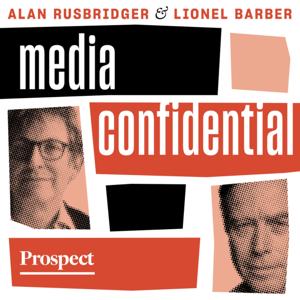
Alan Rusbridger and Lionel Barber—two of the world’s greatest editors—dive into the hugely important world of media. What—and who—drives it? What do they get right... And what do they get…
Lionel, former editor of the Financial Times, and Alan, editor of Prospect and former editor of the Guardian, will bring you revealing, high profile interviews and in-depth discussion.
Media Confidential is produced by Prospect Magazine.
Subscribe to Prospect and enjoy our rigorously fact-checked, truly independent analysis and perspectives. Get one free issue of Prospect when you sign up today: https://subscription.prospectmagazine.co.uk/OCT1MFBG/prospect-magazine/OCT1MFG
Hosted on Acast. See acast.com/privacy for more information.

366 Listeners
34 Listeners
152 Listeners
122 Listeners
58 Listeners
186 Listeners
45 Listeners
21 Listeners
100 Listeners
23 Listeners

3,024 Listeners
1,127 Listeners
772 Listeners
2,249 Listeners
43 Listeners