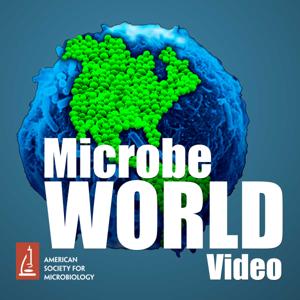
MicrobeWorld Video

MicrobeWorld Video

By American Society for MicrobiologyEducation
Download on the App Store

MicrobeWorld Video episodes

  • MWV Episode 31 - Tiny Conspiracies

    Bacteria communicate with chemical languages that allow them to synchronize their behavior and thereby act as multi-cellular organisms. This process, called quorum sensing, enables bacteria to do things they canât do as a single cell, like successfully infect and cause disease in humans. Bonnie Bassler, Ph.D., the Squibb Professor of Molecular Biology at Princeton University and President-elect for the American Society for Microbiology, has been researching strategies that can interfere with quorum sensing and will hopefully yield novel antibiotics to prevent disease. In this episode of MicrobeWorld Video we present the full presentation Dr. Bassler gave at the Marian Koshland Science Museum in Washington, D.C. on June 18, 2009. Not only does Dr. Bassler explain the mechanisms of bacterial communication, but she also puts forth her theories on how we can disrupt this communication for human benefit.

    1 hr 15 min
  • MWV Episode 30 - Biofuels in Puerto Rico
    Puerto Rico is widely known as the "La Isla del Encanto," which
    translated means "The Island of Enchantment." And while its beaches,
    tropical rain forest, and biolumescent bays are wonders of nature, the
    island is not without its problems. From energy needs to economics,
    Puerto Rico shares many issues facing the rest of the world.
    In this MicrobeWorld Video episode we talk with Nadathur S. Govind,
    Ph.D., Professor, Marine Sciences Department at the University of
    Puerto Rico, Mayaguez, and William Rosado, Marine Sciences Department
    at the University of Puerto Rico, Mayaguez, about the sustainable
    biofuel program they are launching in southwestern Puerto Rico.
    According to Govind, the island's successful sugarcane industry died in
    the 1990's. In fact, local rum manufacturers now import their molasses
    from as far away as Malaysia. As a result, approximately 70 percent of
    the population in southwestern Puerto Rico is on welfare.
    Govind believes he can rebuild the local economy by harnessing
    bacterial enzymes extracted from the guts of termites and shipworms
    (mollusks) found in the mangroves off the coast to break down the
    lignocellulose in sugarcane and hibiscus. The idea is that if he can
    bring agricultural production back to his community, he can use the
    crop waste to produce ethanol to supplement Puerto Rico's demand for
    fuel. And since the byproduct of ethanol is carbon dioxide, he also
    plans to use algae to capture the gas and produce biodiesel. The waste
    that he has left over can then be returned to the soil as fertilizer or
    given to livestock as feed, completing the cycle.
    For more information about Govind's program please read the article,
    "Combining Agriculture with Microbial Genomics to Make Fuels," found in
    the American Society for Microbiology's Microbe magazine.
    7 min
  • MWV Episode 29 - This Week in Virology Live in Philly
    MicrobeWorld Video presents episode 33 of This Week in Virology. Hosts Vincent Racaniello, Alan Dove, Dick Despommier and guest Raul Andino recorded TWiV live at the ASM General Meeting
    in Philadelphia, where they discussed increased arterial blood pressure
    caused by cytomegalovirus infection, restriction of influenza
    replication at low temperature by the avian viral glycoproteins, first
    isolation of West Nile virus in Pennsylvania, and current status of
    influenza.

    Links for this episode:

    Cytomegalovirus infection causes an increase of arterial blood pressure
    Avian influenza virus glycoproteins restrict virus replication at low temperature
    First West Nile virus isolation of the year in PA
    CDC press release of 18 May 2009
    Glaxoâs influenza vaccine with adjuvant
    NY Times article on Guillain-Barrà and a more scientific view

    Weekly Science Picks

    Dick - National Museum of the History of Science and Medicine, Leiden
    Alan - Beginning Mac OS X Programming
    Vincent - Vaccinated by Paul Offit
    Raul - HubbleSite

    Contact/Subscribe

    Please send your virology questions and comments to twiv [at] twiv [dot] tv. To listen, click the play button next to the title of this entry. You can subscribe for free to TWIV via iTunes, through the RSS feed with a podcast aggregator or feed reader, or by email.

    Thanks to Chris Condayan and ASM for making TWiV live possible. Recorded by Chris Condayan and Ray Ortega.

    Download

     TWiV #33 (Audio Only) (51 MB .mp3, 74 minutes)

    Sponsor

    Try GotoMyPC free for 30 days! For this special offer, visit www.gotomypc.com/podcast

    1 hr 9 min
  • MWV Episode 28 - Cheese and Microbes

    Fine cheeses are like fine wines. Producing and aging them properly is both an art and a science. From cave-aging to the use of raw milk, watch Dr. Catherine Donnelley, Co-director of the Vermont Institute for Artisan Cheeses, describe the microbial world of cheese.

    Listeria and Salmonella are just a couple of the pathogens that pose a

    risk to cheese consumers. In this episode of MicrobeWorld Video, Dr. Donnelly explains how these risks are mitigated through strict processing guidelines, why these safeguards make cheese one of the safest commodities today, and how beneficial organisms contribute to the cheese making process. In addition, Erica Sanford from Cowgirl Creamery with the help of Carolyn Wentz from Everona Dairy walk us

    through the steps of artisan cheese production.

    For more information about cheese making and cheese safety please visit the Vermont Institute for Artisan Cheeses. If you would like to try some of the cheeses featured in this episode order them online from www.cowgirlcreamery.com and www.everonadairy.com. Bon AppÃtit!

    7 min
  • MWV Episode 27 - ASMCUE

    The American Society for Microbiology Conference for Undergraduate Educators (ASMCUE) is an interactive four-day conference on scientific updates and effective teaching strategies. Now in its 16th year, the conference attracts over 300 microbiology and biology educators.

    Educators come from colleges, universities and international institutions to learn and share the latest information in the biological sciences and education research.

    The conference program includes plenary, concurrent, poster, and exhibit sessions. Participants engage in formal and informal small group discussions between colleagues all focused on the same goal: to improve teaching and learning in the biological sciences.

    In this episode, we talk with Erica Suchman, Associate Professor, Colorado State University, Ft. Collins, and Local Organizing Chair for the 2009 meeting. Erica talks about her attendance at the meeting for the past 12 years and the benefits of participating. Also featured are several participants at the ASMCUE 2008 held at Endicott College in Beverly, MA and ASM's Education Director, Amy Chang, a co-founder of the Conference.

    For more information about the conference or to view past proceedings, visit www.asmcue.org.

    5 min
  • MWV Episode 26 - Germ Proof Your Kids

    Parents are often presented with conflicting messages about germs and cleanliness. On the one hand, the news headlines warn us about dangerous "superbugs." On the other hand, there is growing concern that over-cleaning and excessive hygiene may weaken children's immune systems. Fortunately, there is real, vetted science available to help us understand how to best protect, without overprotecting, our kids.

    In episode 26 of MicrobeWorld Video, we talk with Dr. Harley Rotbart, author of Germ Proof Your Kids: The Complete Guide to Protecting (without Overprotecting) Your Family from Infections. Dr. Rotbart, a pediatric infectious diseases specialist at The University of Colorado and The Children's Hospital of Denver, has practiced, researched, and taught germ defense for the past 25 years. His new book serves as a resource for parents and health care providers to help put science back into the discussion of protecting kids from microscopic dangers. In addition to evaluating the traditional approaches to infection prevention (vaccines, antibiotics, etc.), Dr. Rotbart also analyzes the science behind Mom's advice about the effects of hygiene, nutrition, sleep, stress, exercise, and even wearing boots in the rain. It turns out Mom was right most of the time.

    This video was filmed live at the Marian Koshland Science Museum in Washington, D.C. and in various locations around the DC metro area.

    For more audio and video podcasts about microbiology, health and life science-related subjects, please visit www.microbeworld.org. If you would like to know more about Germ Proof Your Kids please visit www.germproofyourkids.com.
    6 min
  • MWV Episode 25 - Bacteria Lab
    What kinds of bacteria are growing in your sink or your refrigerator?
    How about on your keyboard at work? Does soap really reduce the
    amount of bacteria on your hands? Dr. Keith Lampel of the Food and Drug Administration helps citizen scientists discover the world of bacteria in and around us.
    Filmed at the Marian Koshland Science Museum in Washington,
    D.C., this two-part science lab kicked off with a hands-on activity in
    the museum to observe the invisible bacteria that are present all
    around us. Attendees were shown how to prepare samples in the museum
    and took lab supplies with them for further investigation in their
    homes, offices and schools. For the second part of program, participants
    shared their scientific endeavors from the previous week as Dr. Lampel
    answered their questions and discussed recent research at the FDA, new
    technologies, and new initiatives in food safety.
    Dr. Keith Lampel is the Director of the Division of
    Microbiology within the Center for Food Safety and Applied Nutrition at
    the Food and Drug Administration (FDA). His research interests include
    the development of rapid detection methods for food-borne pathogens
    using DNA-based technology, and identifying the genes in these bacteria
    that are involved in the development of disease.
    7 min
  • MWV Episode 24 - An Iconography of Contagion

    In this episode of MicrobeWorld Video we visit the National Academy of Sciences in Washington, D.C., for the opening of "An Iconography of Contagion," an art exhibition featuring more than 20 public health posters from the 1920s to the 1990s. Covering infectious diseases such as malaria, tuberculosis, AIDS, gonorrhea, and syphilis, the posters come from North America, Europe, Asia, and Africa.This video features interviews with J.D. Talasek, Director of  Cultural Programs of the National Academy of Sciences, and Michael Sappol, Ph.D., Curator-Historian for the National Library of Medicine, along with several of the opening's attendees, on their impressions and thoughts of how public health promotion and education have changed over the decades.The presentation of the posters along with comments provided by Talasek and Sappol provide insight into the interplay between the public's understanding of disease and society's values. The exhibit reflects the fears and concerns of the time and also the medical knowledge that was available. Considered an art form, many of the posters are beautiful and entertaining, but during their heyday, they sought to educate people on matters of life and death.The exhibition is free and open to the public weekdays from 9 a.m. to 5 p.m. until December 19, 2008. The National Academy of Sciences is located at 2101 Constitution Ave., NW, in Washington, D.C. Visitors enter at 2100 C St., N.W. The gallery is located upstairs. For those who can't make it to the Nation's Capitol, but would like more information, please feel free to download the exhibit's brochure.

    8 min
  • MWV Episode 23 - Antibiotics: Is a Strong Offense the Best Defense? (Part 3)
    In the final episode of this 3 part video series on how to optimize antibiotic use and how to minimize the emergence of drug resistant pathogens, Dr. Linda Tollefson, Assistant Commissioner for Science at the U.S. Food and Drug Administration, goes in depth on the use of antimicrobial drugs in agriculture, their efficacy, and adverse human health consequences. Dr. Stuart Levy, professor of Molecular Biology and Microbiology at Tufts University School of Medicine, discusses policy, regulatory and funding issues around antibiotic resistance. Both Dr. Tollefson and Dr. Levy take a handful of questions from the audience.The series, "Antibiotics: Is a Strong Offense the Best Defense?" was filmed on September 18, 2008 at the Koshland Science Museum in Washington, D.C. Parts 1 and 2 can be found at www.microbeworld.org.
    37 min
  • MWV Episode 22 - Antibiotics: Is a Strong Offense the Best Defense? (Part 2)
    On September 18, 2008 at the Koshland Science Museum in Washington, D.C., Dr. Stuart Levy, professor of Molecular Biology and Microbiology at Tufts University School of Medicine and Dr. Linda Tollefson, Assistant Commissioner for Science at the U.S. Food and Drug Administration, discussed how to optimize antibiotic use and how to minimize the emergence of drug resistant pathogens. In part 2 of this 3 part video series, Dr. Levy discusses how antibiotic resistance develops, the development practices drug companies employ when producing antimicrobials, and how this process may change in the future. Dr. Tollefson outlines how the FDA is encouraging the development of antibiotics in an industry that is mostly focused on manufacturing drugs for chronic illnesses. Dr. Levy is Professor of Molecular Biology and Microbiology at Tufts University School of Medicine where he is the Director of the Center for Adaptation Genetics and Drug Resistance. He directs research on mechanisms of bacterial antibiotic resistance. Stuart Levy is also Staff Physician at the Tufts Medical Center and he also serves as the president of The International Alliance for the Prudent Use of Antibiotics. Dr. Tollefson is Assistant Commissioner for Science at the U.S. Food and Drug Administration (FDA). She previously served as Deputy Director of the Center for Veterinary Medicine (CVM), where she led CVM's efforts to implement a risk-based approach to address antimicrobial resistance, fulfilling a 2001 Congressional mandate, and was instrumental in the founding of the National Antimicrobial Resistance Monitoring System for Enteric Bacteria. Tollefson also served as Chief of Epidemiology in the Center for Food Safety and Applied Nutrition where she successfully investigated numerous outbreaks of food borne disease and served as liaison to the Centers for Disease Control and Prevention. Part 3 will be published next week.
    28 min

About MicrobeWorld Video

From the publisher's feed

A video podcast by the American Society for Microbiology that highlights the latest in microbiology, life science and biotechnology news. ASM is composed of over 42,000 scientists and health…

More shows like MicrobeWorld Video

This Week in Virology by Vincent Racaniello

This Week in Virology

2,053 Listeners

This Week in Parasitism by Vincent Racaniello

This Week in Parasitism

456 Listeners

Meet the Microbiologist by Ashley Hagen, M.S.

Meet the Microbiologist

38 Listeners

This Week in Microbiology by Vincent Racaniello

This Week in Microbiology

522 Listeners

Microbios by Brendaliz Santiago-Narvaez

Microbios

12 Listeners

BacterioFiles by Jesse Noar

BacterioFiles

20 Listeners

MicrobeWorld Video (audio only) by American Society for Microbiology

MicrobeWorld Video (audio only)

4 Listeners

Editors in Conversation by American Society for Microbiology

Editors in Conversation

24 Listeners

MicrobeWorld Video HD by American Society for Microbiology

MicrobeWorld Video HD

4 Listeners