
Sign up to save your podcasts
Or

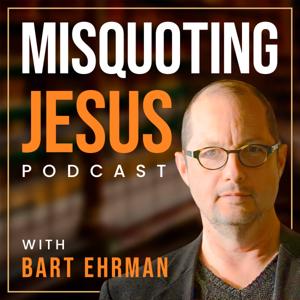


Based on Podcast App listening data
The Gospel of Luke and the Acts of the Apostles are widely understood to be a two-volume set, written by a single author.
Given that we've spoken before on Misquoting Jesus about how difficult it is to identify authors of ancient texts, why are scholars so sure that these two texts share the same author?
Who was that author, and why write two books when they could have written one?!
Pontius Pilate is a relatively minor figure in the gospels of the New Testament, but one who plays a vital role as the Roman official in charge of Jesus' sentencing.
Given that he's the face of Rome in the New Testament Gospels, he's presented in a surprisingly positive light! The same is true for his appearances in some other early Christian writings. To try and get to the bottom of exactly why the official representative of the big, bad Roman empire is presented as such a sympathetic figure, we're going to be taking a look at one of these non-canonical texts in a bit more detail.
The phrase "synoptic gospels" is thrown around a lot in Biblical scholarship, but what does it mean, and why are they important?
Are they as similar as people seem to think, and what do non-academics get wrong about them? Today, Megan is joined by Dr. Mark Goodacre, professor of Religious Studies and expert in all things synoptic, to answer these questions and to investigate some of his favorite differences between these fascinating texts.
Many people in the modern western world view reincarnation as a belief predominately from eastern religions - especially buddhism and hinduism.
Believe it or not, reincarnation was also a theological concept for some early Christians! How does what early Christians taught about reincarnation differ from what we understand it to be?
Was it a common idea, or did those who espoused it receive pushback and censorship from their fellow Christians?
Why isn't reincarnation still a widely held view in Christian circles?
Welcome everyone to a very special episode of Misquoting Jesus - our 100th episode!
In keeping with our centesimal celebration (hey, it's a word!), we're going to be exploring the world of Christianity 100 years after Jesus' death.
Was Christianity still a small, persecuted offshoot of apocalyptic Judaism, or had it spread far and wide? Was it still an apocalyptic religion, and what theological disagreements had occurred? Megan has the questions, and Bart, as always, has the answers.
The Bible is frequently invoked in the ongoing national debates about abortion, almost always to show that abortion is murder and strictly forbidden. Is that true?
This episode is not meant to resolve the issue about whether abortion should ever be considered a legitimate procedure or not.
The focus is on what the Bible actually says. Does it condemn abortion? Does it indicate that the fetus is to be considered a human with human rights, so that abortion constitutes murder? When, according to the Bible, does life begin. The overarching point of the episode is that those who cite the Bible in support of their social and political views should at least read what it says and be clear about what it means.
New manuscripts discoveries in Biblical studies are often outed as forgeries, But sometimes -- rarely -- they turn out to be authentic.
How do scholars distinguish between fact and fiction, especially when they only have access to photographs or copies? Is it possible for a text to pass all authenticity tests and still be a clever forgery?
Today we're back with Dr. Morton Smith and the Secret Gospel of Mark to discuss he discovered an actual ancient document with unknown information about Jesus, or turned up a forgery of some kind, or possibly even forged it himself.
When a scholar claims to have discovered a new text from early Christianity, it can send shockwaves through the academic community.
In the case of the "Secret Gospel of Mark," the shockwaves are still being felt today after over 65 years later. And scholars still can't agree on whether the text in question is authentically ancient, a modern forgery, or something else.
There are huge implications. The traces of this "secret Gospel" allegedly discovered in 1958 by Morton Smith, a professor of ancient history at Columbia University, have been interpreted (by Smith himself) to indicate that Jesus engaged in homosexual rituals with the followers he baptized in the nude. In this week's episode, we're discussing the discovery of this amazing text, what it actually says, and how scholars have interpreted the intriguing passages it contain
Why do so many Christians claim that other Christians are not really Christians? Is there a definition written in the sky somewhere?
Here we talk about the history of the problem, from its very beginning. Among other things we'll discuss why some biblical scholars today refuse to use the word "Christian" for the apostle Paul, the members of his churches, and for followers of Jesus in the first century altogether; and we'll ask whether there is something about "Christianity" in particular that leads to debates about what it actually means; and we'll try to work out if there's any satisfactory answer to the questions: "Is it possible to define the term to everyone's satisfaction?" and "Does it matter?"
The Antiquities of the Jews, written by the Jewish historian Flavius Josephus in 93 CE, is our most important resource for knowing about the history of Israel around the time of Jesus and his earliest followers.
This twenty-volume work contains two brief references to Jesus himself, and are in fact the only two mentions of Jesus in any non-Christian writing of the entire first century. But there are many questions surrounding these statements.
Are they authentic to Josephus? Were they added to his writings by later Christian scribes? Could the be authentic in part but altered by scribes. If they are authentic do they strengthen the case for the historicity of Jesus, or are they merely records of hearsay? Do they provide us with any valuable informatioin about Jesus that we otherwise would never know?
From the publisher's feed
Ranked by our users in the last 21 days
568 Listeners

5,526 Listeners

3,173 Listeners

26,213 Listeners
2,859 Listeners

3,287 Listeners
933 Listeners

4,288 Listeners

1,928 Listeners

1,623 Listeners
509 Listeners

3,332 Listeners

15,449 Listeners
223 Listeners
1,457 Listeners