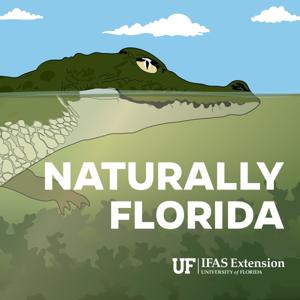
Naturally Florida

Naturally Florida

By Shannon Carnevale and Lara MilliganScienceNature
Download on the App Store

Naturally Florida episodes

  • Inland Flooding: Hurricane Series, Part 3

    In this episode, we explain how hurricanes cause inland flooding through extreme rainfall and connected watershed systems. We’ll discuss why Florida’s flat terrain and development patterns make inland flooding so persistent, how these events impact water quality and wildlife, and what practical steps Floridians can take to protect their homes and communities. 


    Learn More:

    • See the most up-to-date FEMA Flood Map for your community: https://msc.fema.gov/portal/home (FEMA)
    • Get a quote or learn more about the National Flood Insurance Program: https://www.floodsmart.gov
    • Florida Well Owners Network: https://programs.ifas.ufl.edu/well/  (UF/IFAS)
    • Benefits of Floodplains: https://www.fema.gov/floodplain-management/wildlife-conservation/benefits-natural (FEMA)


    Sources:


    • https://msc.fema.gov/portal/home  
    • https://www.archbold-station.org/projects/floodplains/ 
      • https://msc.fema.gov/msccontent/Flood_Hazard_Mapping_Updates_Overview_Fact_Sheet.pdf
      • https://www.floodsmart.gov
    26 min
  • Storm Surge: Hurricane Series, Part 2

    On today’s episode, we will do a deep dive into the topic ofstorm surge. What is storm surge? What are the impacts of storm surge to us and our natural systems? We will also help you understand the risk of stormsurge where you live.

    Episode script reviewed by Lauren Wolf, Holly Abeels, andArmando Ubeda.

    Episode recording reviewed by Stephen Mullens.

    Learn more:

    • National Weather Service – Storm Surge Overview &Hurricane Hazards https://www.weather.gov/phi/stormsurge& https://www.weather.gov/wrn/hurricane-hazards
    • National Ocean Service – What is storm surge? https://oceanservice.noaa.gov/facts/stormsurge-stormtide.html
    • National Hurricane Center and Central PacificHurricane Center – Storm Surge Overview - https://www.nhc.noaa.gov/surge/


    How you can help:

    • Learn your evacuation zone – https://www.floridadisaster.org/knowyourzone/Remember, evacuation zones are based on storm surge risk for low-lying, floodprone areas, mobile homes or unsafe structures.
    • Consider planting more salt-tolerant plants inyour landscape - https://ffl.ifas.ufl.edu/resources/apps/plant-guide/
    • Support nature-based solutions such as dunerestoration, mangrove plantings, and living shorelines.


    Sources for this Episode:

    • https://coast.noaa.gov/states/fast-facts/economics-and-demographics.html  
    • https://www.usgs.gov/centers/spcmsc/science/florida-coastal-mapping-program
    • https://agrilifetoday.tamu.edu/2023/06/15/sand-dunes/  
    • https://www.jstor.org/stable/26296452?mag=the-shifting-sands-of-hurricane-resilience&seq=1  
    • https://www.usgs.gov/centers/spcmsc/science/storm-induced-coastal-change 
    • https://daily.jstor.org/the-shifting-sands-of-hurricane-resilience/  
    27 min
  • Introduction to Hurricanes: Hurricane Series, Part 1

    This episode is part 1 of our summer hurricane series! Today, we're talking about how hurricanes form, why they spin, and what the "categories" mean when we talk about storms.


    Also, we would like to extend a huge THANK YOU to Stephen Mullens, a fellow faculty member at the University of Florida, for reviewing our episode content for accuracy. Stephan is an expert in forecasting and impacts related to hurricanes and thunderstorms.


    Learn More:

    • ​Coriolis Effect Video (Nat Geo): https://youtu.be/mPsLanVS1Q8?si=yokr3w1vUeVg6l9T
    • ​Saffir-Simpson Hurricane Wind Scale: Learn more about what each "category" storm means. https://www.nhc.noaa.gov/pdf/sshws_2012rev.pdf 
    • ​Make a plan! Get ready, now: https://www.floridadisaster.org/planprepare/preparing-for-hurricane-season/


    Sources:

    • ​https://climatecenter.fsu.edu/topics/hurricanes  
    • ​https://www.aoml.noaa.gov/wp-content/uploads/2020/12/How-Do-Hurricanes-Move_.pdf
    • ​https://www.nhc.noaa.gov/pdf/sshws_2012rev.pdf
    • ​https://www.npr.org/2018/09/14/647944033/september-is-peak-hurricane-season-why-is-that
    • ​https://weather.gov/media/mfl/TropicalEventSummary/PSHMFL_2024AL14_Milton_Tornadoes.pdf     
    • ​https://www.nhc.noaa.gov/data/tcr/AL092024_Helene.pdf 
    25 min
  • Throwback: Lara's Favorite Lizard

    Green anoles are some of Florida’s most familiar—and most overlooked—neighbors.

    In this episode of Naturally Florida, we revisit our very first show from 2020 to explore what makes these little lizards so unique, how they interact with the introduced Cuban brown anole, and what you can do to help them thrive in your own backyard.

    Learn more:

    • Cuban Brown Anole or Green Anole (video): https://youtu.be/KQhnzi9mkYI
    • Landscaping Solutions: Green Anoles: https://gardeningsolutions.ifas.ufl.edu/design/gardening-with-wildlife/anoles.html


    How You Can Help:

    • Help us document their populations! If you see a green anole in your yard or while out in one of Florida's many natural areas, snap a picture with your smartphone and upload it to ⁠iNaturalist.org.⁠ 
    • Add habitat to your yard or neighborhood. Consider adding native shrubs or small trees and changing part of your yard from lawn to Florida-Friendly Landscaping to provide habitat for a variety of small critters. Learn more here: ⁠https://ffl.ifas.ufl.edu/about-ffl/9-principles/principle-5-attract-wildlife/⁠

    Sources for this Episode:

    • Invader Updater: Cuban Brown Anole, UF Wildlife Department (2011) ⁠⁠https://ufwildlife.ifas.ufl.edu/InvaderUpdater/pdfs/InvaderUpdater_Winter2011.pdf⁠⁠
    • Green Anole (Anolis carolinensis), Savannah River Ecology Laboratory (n.d.) ⁠⁠https://srelherp.uga.edu/lizards/anocar.htm⁠⁠
    • Analysis of the effects of an exotic lizard on a native lizard in Florida ..., University of Tennessee (2000) ⁠⁠https://trace.tennessee.edu/utk_graddiss/4722/⁠⁠
    • Florida Lizards are Evolving, Fast, Science Connected (2014) ⁠⁠https://magazine.scienceconnected.org/2014/10/florida-lizards-evolving-rapidly/⁠⁠


    If you enjoyed this episode, please consider sharing it with a friend who might enjoy learning about Florida's natural areas and the wild things that live here!


    If you're active on iNaturalist, consider joining our iNaturalist project, Naturally Florida's Listener Observations, here: https://www.inaturalist.org/projects/naturally-florida-s-listener-observations

    19 min
  • Let's Talk About Lake Water Quality

    Happy Lakes Appreciation Month!

    This month, we dive into water quality and what it really means for freshwater systems. You'll hear a lot of scientific jargon this month, but we tried to define everything as we used it. This will help you talk to your local watershed, river, or lake managers!

    How You Can Help:

    • Participate in the Great Secchi Dip In! https://www.nalms.org/secchidipin/ OR, email Lara or Shannon to learn more about how to participate

    Learn More:

    • Florida Lakewatch: https://lakewatch.ifas.ufl.edu/extension/information-circulars/
    • Water Atlas (SW FL only): https://wateratlas.usf.edu


    24 min
  • The Scrub is Scrubbing

    In this episode, we explore the unique ecology of scrub habitat in Florida. What is a scrub? Where are they located?How are they different from similar ecosystems? How does fire play a role in scrub habitats? What threats do scrub habitats face? What can you do about it? We cover this and more in this episode of Naturally Florida.  

    Learn More:

    • Florida Natural Areas Inventory: Scrub - https://www.fnai.org/PDFs/NC/Scrub_Final_2010.pdf

    • Topographpic map, elevation, terrain - https://en-ca.topographic-map.com/map-x1rv5k/Polk-County/

    • Calamintha bee (Shannon mentioned in episode) - https://www.floridamuseum.ufl.edu/science/discover-nest-northern-range-blue-calamintha-bee/

    • Scrub and High Pine - https://programs.ifas.ufl.edu/florida-land-steward/forest-resources/upland-forest-ecosystems/scrub-and-high-pine/

    • Common Woody Plants of Florida Scrub Ecosystems- https://edis.ifas.ufl.edu/publication/FR373

    • Florida Scrub - https://crocdoc.ifas.ufl.edu/publications/msrpmap/floridascrub/

    How You Can Help:

    • Florida scrub is globally rare and incredibly unique, supporting plants and animals found nowhere else. Speak up and advocate for the preservation of the special natural lands. Needs some inspiration, check out the GladysE. Douglas Preserve story.

    • Fire is essential in scrub habitats —without it, the ecosystem collapses and species disappear. Be sure to support and advocate for prescribed fires in your area.

    • Scrub may look barren, but it’s a biodiversity hotspot—an ecological gem hiding in plain sight. See if you can find a scrub habitat near you to visit!

    Sources for this Episode:

    • Florida Natural Areas Inventory: Scrub - https://www.fnai.org/PDFs/NC/Scrub_Final_2010.pdf

    • Scrub and High Pine - https://programs.ifas.ufl.edu/florida-land-steward/forest-resources/upland-forest-ecosystems/scrub-and-high-pine/

    • Common Woody Plants of Florida Scrub Ecosystems- https://edis.ifas.ufl.edu/publication/FR373

    If you enjoyed this episode, please consider sharing it with a friend who might enjoy learning about Florida's natural areas and the wild things that live here!

    If you're active on iNaturalist, consider joining our iNaturalist project, Naturally Florida's Listener Observations, here: ⁠⁠https://www.inaturalist.org/projects/naturally-florida-s-listener-observations⁠


    25 min
  • Florida's Mighty Mangroves

    In this episode, we'll discuss the three different species of mangroves found in Florida, their northward migration, and the critical role they play in our coastal ecosystems. We'll also share practical actions you can take to help protect these vital habitats.


    Learn More: 

    • Florida's Mangroves - https://floridadep.gov/rcp/rcp/content/floridas-mangroves


    • Mangroves - https://gardeningsolutions.ifas.ufl.edu/plants/trees-and-shrubs/trees/mangroves/


    • Mangrove Species Profiles - https://www.floridamuseum.ufl.edu/southflorida/habitats/mangroves/species/


    • Mangrove propagule image - https://ocean.si.edu/ecosystems/coasts-shallow-water/floating-propagules


    • Video of fiddler crab - https://youtu.be/y4dWVCdsXQU?si=M5KI0XjM_KlBhB5d&t=13


    • Mangrove Ecosystem Services Field Lesson by Holly Abeels - https://www.youtube.com/watch?v=G2dsmo6W2do


    How You Can Help: 


    • Participate in local mangrove planting and restoration projects.


    • Avoid using harmful chemicals in your garden that can run off into coastal waters. Not sure where the water from your property flows, find out here: https://mywaterway.epa.gov/


    • If you have mangroves on your property that need trimming, please work with a certified mangrove trimmer - https://floridadep.gov/water/submerged-lands-environmental-resources-coordination/content/state-authorized-professional


    Sources for this Episode: 

    • Narayan, S. et al. (2019) Valuing the Flood Risk Reduction Benefits of Florida’s Mangroves, The Nature Conservancy.


    • Assessing the role of mangrove forest in reducing coastal inundation during major hurricanes: https://link.springer.com/article/10.1007/s10750-017-3201-8


    • The Global Flood Protection Benefits of Mangroves - https://www.nature.com/articles/s41598-020-61136-6
    24 min
  • Vulture Culture

    Vultures can be seen throughout Florida, whether soaring in the air or feeding on the ground, visitor or resident, we have all encountered vultures in Florida. We actually have two species of vultures in Florida, the black vulture and the turkey vulture. While they may seem clumsy and not the most attractive birds, they play a critical role in our ecosystem. Learn how to tell these two species apart and the importance of these birds to our natural world. 

    Learn More:  

    • Black Vulture - https://www.audubon.org/field-guide/bird/black-vulture
    • Turkey Vulture - https://www.audubon.org/field-guide/bird/turkey-vulture
    • Vultures: https://myfwc.com/wildlifehabitats/profiles/birds/raptors-and-vultures/vultures/
    • Black Vulture or Turkey Vulture? That Is the Question: https://youtu.be/S-XcSqcpBpI?si=4c1FObJAVCkpqzMb

    How You Can Help: 

    • Respect their space, they are doing a critically important job that none of us want to do. Let them do their work 😉
    • Share this episode with a family member, colleague, neighbor or friend. Help us share the love for this keystone species. 

    Sources: 

    • Do Vultures Find Dead Animals By Smell or By Tracking Predators Or Scavengers On The Ground? https://www.allaboutbirds.org/news/do-vultures-find-dead-animals-by-smell-or-by-tracking-predators-or-scavengers-on-the-ground/
    • Vulture-cattle interactions at a central Florida ranch - Vulture-cattle interactions at a central Florida ranch
    • Gamecock Scientists Say “Vultures Need Love” - Gamecock Scientists Say “Vultures Need Love” - Jax State News


    If you enjoyed this episode, share it with a friend who might enjoy learning about Florida's natural areas and the wild things that live here!

    If you're active on iNaturalist, join our iNaturalist project, Naturally Florida's Listener Observations, here: ⁠⁠⁠⁠https://www.inaturalist.org/projects/naturally-florida-s-listener-observations⁠⁠⁠

    24 min
  • Oh the Oaks
  • We just did an episode on trees two months ago, but they are such a critical part of our ecosystems, it’s hard not to talk about them. Today, we thought it would be fun to focus in on the oaks. Oaks are found throughout Florida and play a critical role providing ecosystem services and wildlife benefits.  Learn More:  
    • Florida’s Oaks - https://gardeningsolutions.ifas.ufl.edu/plants/trees-and-shrubs/trees/florida-oaks/  

    • The Little Oaks – Part I: https://blogs.ifas.ufl.edu/pinellasco/2019/07/11/the-little-oaks-part-i/  

    • The Little Oaks – Part II: https://blogs.ifas.ufl.edu/pinellasco/2019/08/12/the-little-oaks-part-ii/  

    Previous Episodes Referenced: 

    • Stormwater Episode: ⁠https://podcasts.apple.com/us/podcast/where-does-rain-go-after-it-falls/id1573268305?i=1000526291174 ⁠ 

    • Intro to Urban Forestry Episode: ⁠https://podcasts.apple.com/us/podcast/trees-and-people-an-intro-to-urban-forestry/id1573268305?i=1000533017933 ⁠ 

    How You Can Help: 

    • Take advantage of oak leaf fall by utilizing the leaves as mulch - https://blogs.ifas.ufl.edu/polkco/2021/03/06/fallen-oak-leaves-make-a-great-mulch/  

    • Get your tree checked out by a certified arborist and setup a pruning plan! ⁠https://www.treesaregood.org/findanarborist/findanarborist⁠ 

    • Consider planting an oak, but make sure you plant the right tree in the right place  - https://gardeningsolutions.ifas.ufl.edu/plants/trees-and-shrubs/trees/oak-trees/  

    Sources: 

    • Oak Forest Ecosystems: Ecology and Management for Wildlife - https://books.google.com/books?hl=en&lr=&id=tcH8EAAAQBAJ&oi=fnd&pg=PA182&dq=benefits+of+acorns&ots=WALVLyqyi5&sig=mhZ24zuxMYjsasR4GxUBTxpAuTA#v=onepage&q=benefits%20of%20acorns&f=false 

    • Abscission - https://www.sciencedirect.com/topics/agricultural-and-biological-sciences/abscission 

  • 25 min
  • Non-Native Lizards in Florida

    On today's episode, you'll hear about a few of our non-native lizards and learn about the complexity of when a species may or may not be called invasive.

    Learn more:

    • The Invasion Curve: A Tool for Understanding Invasive Species Management in South Florida - https://edis.ifas.ufl.edu/publication/UW392
    • "Ticks and Tickborne Illness in Florida" (a Naturally Florida podcast episode): https://podcasts.apple.com/us/podcast/ticks-and-tickborne-illness-in-florida/id1573268305?i=1000621364386
    • Naturally Florida Podcast Explains - Invasive Species: ⁠https://blogs.ifas.ufl.edu/pinellasco/2025/02/14/naturally-florida-podcast-explains-invasive-species/

    How you can help:

    • Report Sightings of Nonnative Species: https://myfwc.com/wildlifehabitats/nonnatives/report/
    • Nuisance Wildlife Control Operator Search: https://app.myfwc.com/hgm/nwt/nwtsearch.aspx
    23 min

About Naturally Florida

From the publisher's feed

Naturally Florida is a podcast about Florida's natural areas and the wild things that live here.

More shows like Naturally Florida

Wait Wait... Don't Tell Me! by NPR

Wait Wait... Don't Tell Me!

38,717 Listeners

99% Invisible by Roman Mars

99% Invisible

26,151 Listeners

Marketplace by Marketplace

Marketplace

8,731 Listeners

The Political Scene | The New Yorker by The New Yorker

The Political Scene | The New Yorker

4,065 Listeners

On Point with Meghna Chakrabarti by WBUR

On Point with Meghna Chakrabarti

4,028 Listeners

The Gray Area with Sean Illing by Vox

The Gray Area with Sean Illing

10,731 Listeners

Science Friday by Science Friday and WNYC Studios

Science Friday

6,431 Listeners

Nature Guys by Nature Guys

Nature Guys

566 Listeners

Ologies with Alie Ward by Alie Ward

Ologies with Alie Ward

24,539 Listeners

The Wild with Chris Morgan by KUOW News and Information

The Wild with Chris Morgan

3,415 Listeners

Cautionary Tales with Tim Harford by Pushkin Industries

Cautionary Tales with Tim Harford

5,079 Listeners

Welcome to Florida by Chadd Scott

Welcome to Florida

124 Listeners

Florida Spectacular by Cathy Salustri & Rick Kilby

Florida Spectacular

15 Listeners

History Daily by History Daily

History Daily

2,165 Listeners

Florida Uncut by Mason Gravley

Florida Uncut

29 Listeners