
Sign up to save your podcasts
Or

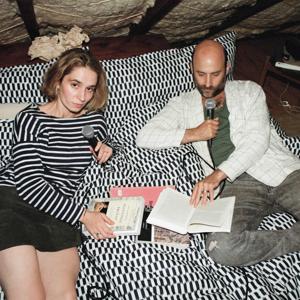


We continue our Immigrant Deprogramming series by talking to Andrey, a Russian immigrant who came to the United States in 1993 — brought over by his cool farsovshik/Soviet criminal underworld-adjacent dad.
We talk about the different sides of his extended Soviet family — vory types on one side, communists on the other. We also talk about him growing up in the Midwest and trying to fit into an American society that turned out to be more of a Beavis and Butthead than Home Alone world he imagined it to be as a Russian kid.
A couple of notes.
Andrey talked about Mark of Cain, a documentary on Russian prison tattoos. He also mentioned Ladoni, an art film on late Soviet poverty and mental illness, as well as a late Soviet TV program on farsovshiki. And we mentioned Brigada, a TV show about late Soviet and Russian organized crime — a kind of Russian Godfather.
—Yasha & Evgenia
PS: Check out Andrey’s music on SoundCloud.
Evgenia and I talk about TraumaZone, Adam Curtis’ latest doc series. It’s about seven hours long and tries to tell the story of the twin destructions that took place in Russia: the destruction of communism and the destruction of democracy.
Despite a lot of simplifications and its Anglo-Saxon misery porn fetish, Evgenia thinks it’s a valuable historical document and it could only have been made by an outsider, precisely because of how traumatic that decade was for ex-Soviets. Even today few people there want to think about happened, let alone alone to dig into the archives and construct a clear narrative about those times. The entire population suffers from PTSD.
—Yasha Levine
A couple of notes.
Evgenia mentions a documentary that Paweł Pawlikowski made about Vladimir Zhirinovsky. She wrote about the film a while back — check it out. Evgenia also mentions a couple of documentaries by Johnson & Johnson heir Jamie Johnson: Born Rich and the The One Percent. As Evgenia says, they stand out because documentaries are as a general rule made by the rich about the poor. But Johnson, fresh out college, made a couple of docs about his own oligarchic class — his family and friends, even Ivanka Trump is in there — and that’s very unusual.
San Francisco has a real bad rep in the national imagination these days. If you follow the news it can feel like this place is melting — nonstop crime, homelessness, hardened villains roaming the streets, Walgreens stores under siege, citizens cowering in fear. It’s like there’s a big media psyop being run to make it seem like even the tiniest decent left-leaning policy is leading to ruin and destruction. Even New Yorkers are afraid of San Francisco now.
Evgenia and I have wanted to focus more on local politics ever since we moved here a year ago. So to kick it off we decided talk with Misha Steier, a SF native who’s been involved with the DSA and the left scene. Misha and I first bonded over the Shahid Buttar fiasco, which the left in SF helped prop up and which I helped bring down — to everyone’s benefit but Shahid’s.
We talk about SF’s long-gone radical cred, people’s ignorance of local politics, ways to combat moneyed interests electorally, and the importance of journalism for democracy. Check it out.
—Yasha Levine
I talked to Mike Davis almost exactly 9 years ago on October 31, 2013. I wasn’t sure if I still had the audio from the interview. But turns out that I do. So I decided to publish it in honor of his passing.
I used to work as a contributor for the now-defunct Prime Russian Magazine, a vaguely left-wing cultural magazine published in Moscow. I talked Mike Davis for an issue the magazine was doing on the subject of poverty — and that’s where this interview is form. In it, Davis talks about the evils of micro-financing, praises Islam for banning usury, and laments the failure of the Occupy Wall Street movement (which was still fresh back then) due to lack of any strategic planning. As David said, “politics is depoliticizing people in this country on unimaginable scale."
The interview starts about at 40 minutes.
—Evgenia Kovda
P.S. I did this interview for print so the Skype audio recording isn’t the best quality. But it’s clear enough, so bear with it!
Want to know more? Check out previous episodes of The Russians.
Evgenia and I talk to Joe Costello about the politics of technology — nuclear energy, the internet, Wall Street, American democracy, the Romans, the need for new ways to organize society… As Joe points out, technology is not just gadgets but also social constructs: things like finance, debt, money, corporations, political institutions. The politics of these technologies are always hard to think about because “technology destroys history.” When a new one comes along it changes everything, yet it makes people think that this changed environment is how things have always been.
Joe Costello is a personal friend of ours. He’s been working in American politics and energy for decades — including on Jerry Brown and Howard Dean’s presidential campaigns. So he’s got firsthand knowledge about how rotten everything is here.
We highly recommend his new newsletter — Life in the 21st Century — where he writes about many of the things we talk about in this ep. Check it out and subscribe! Joe’s one of a kind.
—Yasha
PS: Forgot to mention that Joe’s also has a book — Of, By, For: The New Politics of Money, Debt & Democracy. He also has a great standalone essay: The Politics of Technology.
In this ep we talk to Masha Surazhsky to get an update on her Ukrainian refugee saga.
Evgenia and I previously talked to Masha in April — when she was going through hell trying to get both her elderly aunt and a family friend, who is a minor, out of Poland and into America. Since then things have stabilized: Masha is helping her friend fit into a new life as a war refugee in Brighton Beach, while the rest of the family is stuck in Ukraine. Masha’s aunt, meanwhile, has decided to take the risk and return to her hometown of Kharkov. She’s not alone. Plenty of Ukrainians, faced with a precarious existence refugee in Europe and elsewhere, have been making the same choice.
—Yasha
Evgenia and I talk about “We Are As Gods,” the Stewart Brand hagiomentary that just came out. We were at the film’s theatrical premier in San Francisco — with Brand himself in attendance.
Stewart Brand turns up as a minor but important character in my book Surveillance Valley. His personal contribution to the development of the internet was in the “branding” department: He helped move the anti-establishment cultural capital of the hippie movement into the corporate-military world of early internet and computer development — effectively imbuing a counterinsurgency technology with the spirit of the counterculture. It’s a rebranding that we still live with today.
But that’s not something you’ll get in the film. Instead, you get the heroic selfless visionary Brand — a man who practically invented the counterculture and the environmental movement and who is now using his last years on earth trying to stop global warming by…doing Jurassic Park gene splicing with woolly mammoths out in Siberia, while actually living life dies out all around him. It’s absurd. But the film fits in well with the previous episode we recorded about our society’s terminal techno-utopianism.
—Yasha Levine
A couple of notes. In the first hour we talk about the myth of Stewart Brand. In the second hour we move on to talk about the documentary in greater detail.
Evgenia and I talk to our friend Anthony Galluzzo about his views on the politics of technology, degrowth, the left’s inability to imagine a way of life decoupled from industrial capitalism and consumerism, and how both the right, the left and the center are all in the thrall of techno-utopianism.
Anthony is a lecturer at the New School. His focus is on early American and Romantic literature. You can follow him on Twitter and read his some of his stuff here and here and here.
—Yasha Levine
PS: I wanted to start our talk with Anthony by discussing Biden’s pro-growth “climate” bill — which, among subsidies to electric car and solar panel corps and ghee-whiz green capitalist carbon reclamation projects, ties building wind farms to opening millions of acres of land for new onshore and offshore oil and gas drilling in the Gulf of Mexico and off the coast of Alaska. But I got caught up in the moment and forgot to mention it. So we never got around to discussing the issue. Maybe next time…
Evgenia and I talk to our friend Anthony Galluzzo about his views on the politics of technology, degrowth, the left’s inability to imagine a way of life decoupled from industrial capitalism and consumerism, and how both the right, the left and the center are all in the thrall of techno-utopianism.
Anthony is a lecturer at the New School. His focus is on early American and Romantic literature. You can follow him on Twitter and read his some of his stuff here and here and here.
—Yasha Levine
One note: I wanted to start our talk with Anthony by discussing Biden’s pro-growth “climate” bill — which, among subsidies to electric car and solar panel corps and ghee-whiz green capitalist carbon reclamation projects, ties building wind farms to opening millions of acres of land for new onshore and offshore oil and gas drilling in the Gulf of Mexico and off the coast of Alaska. But I got caught up in the moment and forgot to mention it. So we never got around to discussing the issue. Maybe next time…
In this ep Evgenia and I talk about our trip to Fort Ross — Russia’s old colonial outpost just north of San Francisco — and the ridiculous recent attempts here in America to cancel “Russian” authors and poets like Dostoevsky, Pushkin, Solzhenitsyn, Bulgakov, and Brodsky for spreading the cultural bacillus of Russian anti-Ukranianism. Yes, Bulgakov is Ukrainian. But that apparently doesn’t save him. Because, you know, being Russian is state of mind — a mind full of bad thoughts — it’s not about your ethnicity or where you were born.
Being Soviet Jews it’s funny for us to see people suddenly try to sideline Russian authors for their racism and chauvinism — in this case their supposed anti-Ukrainianism. If we had cancel them for, say, their hate of Jews, we’d have to get rid of not just most Russian literature but pretty much the whole western canon.
—Yasha Levine
This is a preview of a full episode that is only available to subscribers. To hear the rest, sign up and listen here. A subscription also gets you access to our full archives.
A couple of notes.
There has been a steady stream of articles on the same theme. Two of the best examples: “The Ally of Executioners: Pushkin, Brodsky, and the Deep Roots of Russian Chauvinism” and “Russia’s Long Disdain for Ukrainian Nationhood.” I wrote a bit about this topic a few months ago.
Want to know more? Check out previous episodes of The Russians.
From the publisher's feed

519 Listeners

1,583 Listeners

8,834 Listeners

1,942 Listeners

3,911 Listeners

3,343 Listeners

3,134 Listeners

476 Listeners

415 Listeners
284 Listeners

215 Listeners

278 Listeners

1,061 Listeners
967 Listeners

138 Listeners