
Sign up to save your podcasts
Or

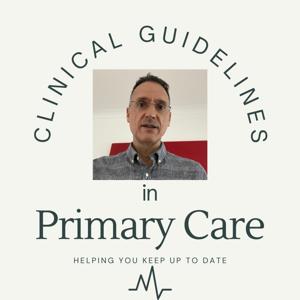

This video makes reference to guidelines produced by the "National Institute for Health and Care Excellence" in the UK, also referred to as "NICE". Please note that the content on this channel reflects my professional interpretation/summary of the guidance and that I am in no way affiliated with, employed by or funded/sponsored by NICE.
My name is Fernando Florido and I am a General Practitioner in the United Kingdom. In this video I will go through new and updated guidelines published in August 2023 by the National Institute for Health and Care Excellence (NICE), focusing on those that are relevant to Primary Care only.
By way of disclaimer, I am not giving medical advice; this video is intended for health care professionals, it is only my interpretation of the guidelines and you must use your clinical judgement.
There is a YouTube version of this and other videos that you can access here:
https://youtube.com/@practicalgp?si=ecJGF5QCuMLQ6hrk
The link to the PDF version of this video can be downloaded here:
· https://1drv.ms/b/s!AiVFJ_Uoigq0mEMuxr60pkhK-T5g?e=n81cOC
The Full NICE News bulleting for August 2023 can be found at:
· https://www.nice.org.uk/guidance/published?from=2023-08-01&to=2023-08-31
The links to the update guidance covered can be found here:
Otitis media with effusion in under 12s
· https://www.nice.org.uk/guidance/ng233
Quantitative faecal immunochemical testing to guide colorectal cancer pathway referral in primary care
· https://www.nice.org.uk/guidance/dg56
Venous thromboembolic diseases: diagnosis, management and thrombophilia testing
· https://www.nice.org.uk/guidance/ng158
Intro / outro music: Track: Halfway Through — Broke In Summer [Audio Library Release]
Transcript
Hello and welcome, I am Fernando, a GP in the UK. Today, we are looking at the NICE guidance and advice published in August 2023, focusing on what is relevant in Primary Care only.
It’s a fairly short and straightforward episode today so let’s jump into it.
The first clinical area is an update on the management of otitis media with effusion, also known as 'glue ear', in under 12s. Please don’t confuse the term otitis media with effusion with acute or chronic otitis media, which we are not covering today.
The updated paragraphs of the guideline refer to giving information about the fluctuating nature of the condition and its impact on hearing, language development, behaviour, and emotional wellbeing. We should also explain that exposure to smoking increases the risk of developing glue ear in children.
OME often present with one or more of the following: hearing difficulties, delayed speech and language development, ear discomfort and tinnitus. Also, behavioural problems, poor educational progress, and balance difficulties (for example, clumsiness).
NICE now also says that we should consider snoring as a reason to suspect glue ear.
If OME is clinically suspected based on the history and examination, we will make a referral for a formal assessment which will include a hearing test.
I will not cover all the various recommendations following referral as this is outside the scope of primary care. But it is worthwhile mentioning that we should not offer any of the following for OME or its related hearing loss: antibiotics, oral or nasal steroids, antihistamines, leukotriene receptor antagonists, mucolytics, anti-reflux medications, PPIs or decongestants
Equally, we will advise against homeopathy, cranial osteopathy, acupuncture, massage, and dietary modification, including probiotics
And finally, we will treat children with otorrhoea after grommet insertion with non-ototoxic topical antibiotic ear drops (such as ciprofloxacin) for 5 to 7 days.
The next clinical area refers to Venous thromboembolic diseases. There is not much to say as it does not really affect primary care too much, other than making you aware that there are updated recommendations for PEs and DVTs for people with COVID-19 and we are advised not to stop short-term interim anticoagulation for these patients following negative tests and to follow the COVID-19 rapid guideline instead.
The last clinical area refers to the recognition and referral of suspected colorectal cancer, in particular the use of quantitative faecal immunochemical testing, commonly referred to as a FIT test.
I found this extremely interesting and I will dedicate a separate video to the subject. For now, I will just say that the updated guidance recommends FIT tests in some clinical situations where before a two-week rule cancer referral pathway would have been recommended. FIT tests are now recommended in adults:
· with an abdominal mass,
· with a change in bowel habit,
· with iron-deficiency anaemia,
· aged 40 and over with unexplained weight loss and abdominal pain,
· aged under 50 with rectal bleeding and either:
o abdominal pain or
o weight loss,
· aged 50 and over with either:
o rectal bleeding
o abdominal pain or
o weight loss,
· and lastly, those aged 60 and over with anaemia even in the absence of iron deficiency
But I think that this issue deserves more reflection so watch out for my next episode, which will look into it in more detail, including the rationale for changing and other considerations.
We have come to the end of this episode. Remember that this is not medical advice and it is only my summary and my interpretation of the guidelines. You must always use your clinical judgement.
Thank you for listening and goodbye.
 View all episodes
 By Juan Fernando Florido Santana

4
22 ratings
This video makes reference to guidelines produced by the "National Institute for Health and Care Excellence" in the UK, also referred to as "NICE". Please note that the content on this channel reflects my professional interpretation/summary of the guidance and that I am in no way affiliated with, employed by or funded/sponsored by NICE.
My name is Fernando Florido and I am a General Practitioner in the United Kingdom. In this video I will go through new and updated guidelines published in August 2023 by the National Institute for Health and Care Excellence (NICE), focusing on those that are relevant to Primary Care only.
By way of disclaimer, I am not giving medical advice; this video is intended for health care professionals, it is only my interpretation of the guidelines and you must use your clinical judgement.
There is a YouTube version of this and other videos that you can access here:
https://youtube.com/@practicalgp?si=ecJGF5QCuMLQ6hrk
The link to the PDF version of this video can be downloaded here:
· https://1drv.ms/b/s!AiVFJ_Uoigq0mEMuxr60pkhK-T5g?e=n81cOC
The Full NICE News bulleting for August 2023 can be found at:
· https://www.nice.org.uk/guidance/published?from=2023-08-01&to=2023-08-31
The links to the update guidance covered can be found here:
Otitis media with effusion in under 12s
· https://www.nice.org.uk/guidance/ng233
Quantitative faecal immunochemical testing to guide colorectal cancer pathway referral in primary care
· https://www.nice.org.uk/guidance/dg56
Venous thromboembolic diseases: diagnosis, management and thrombophilia testing
· https://www.nice.org.uk/guidance/ng158
Intro / outro music: Track: Halfway Through — Broke In Summer [Audio Library Release]
Transcript
Hello and welcome, I am Fernando, a GP in the UK. Today, we are looking at the NICE guidance and advice published in August 2023, focusing on what is relevant in Primary Care only.
It’s a fairly short and straightforward episode today so let’s jump into it.
The first clinical area is an update on the management of otitis media with effusion, also known as 'glue ear', in under 12s. Please don’t confuse the term otitis media with effusion with acute or chronic otitis media, which we are not covering today.
The updated paragraphs of the guideline refer to giving information about the fluctuating nature of the condition and its impact on hearing, language development, behaviour, and emotional wellbeing. We should also explain that exposure to smoking increases the risk of developing glue ear in children.
OME often present with one or more of the following: hearing difficulties, delayed speech and language development, ear discomfort and tinnitus. Also, behavioural problems, poor educational progress, and balance difficulties (for example, clumsiness).
NICE now also says that we should consider snoring as a reason to suspect glue ear.
If OME is clinically suspected based on the history and examination, we will make a referral for a formal assessment which will include a hearing test.
I will not cover all the various recommendations following referral as this is outside the scope of primary care. But it is worthwhile mentioning that we should not offer any of the following for OME or its related hearing loss: antibiotics, oral or nasal steroids, antihistamines, leukotriene receptor antagonists, mucolytics, anti-reflux medications, PPIs or decongestants
Equally, we will advise against homeopathy, cranial osteopathy, acupuncture, massage, and dietary modification, including probiotics
And finally, we will treat children with otorrhoea after grommet insertion with non-ototoxic topical antibiotic ear drops (such as ciprofloxacin) for 5 to 7 days.
The next clinical area refers to Venous thromboembolic diseases. There is not much to say as it does not really affect primary care too much, other than making you aware that there are updated recommendations for PEs and DVTs for people with COVID-19 and we are advised not to stop short-term interim anticoagulation for these patients following negative tests and to follow the COVID-19 rapid guideline instead.
The last clinical area refers to the recognition and referral of suspected colorectal cancer, in particular the use of quantitative faecal immunochemical testing, commonly referred to as a FIT test.
I found this extremely interesting and I will dedicate a separate video to the subject. For now, I will just say that the updated guidance recommends FIT tests in some clinical situations where before a two-week rule cancer referral pathway would have been recommended. FIT tests are now recommended in adults:
· with an abdominal mass,
· with a change in bowel habit,
· with iron-deficiency anaemia,
· aged 40 and over with unexplained weight loss and abdominal pain,
· aged under 50 with rectal bleeding and either:
o abdominal pain or
o weight loss,
· aged 50 and over with either:
o rectal bleeding
o abdominal pain or
o weight loss,
· and lastly, those aged 60 and over with anaemia even in the absence of iron deficiency
But I think that this issue deserves more reflection so watch out for my next episode, which will look into it in more detail, including the rationale for changing and other considerations.
We have come to the end of this episode. Remember that this is not medical advice and it is only my summary and my interpretation of the guidelines. You must always use your clinical judgement.
Thank you for listening and goodbye.

703 Listeners

504 Listeners
304 Listeners

25 Listeners

1,152 Listeners
376 Listeners

254 Listeners

7 Listeners

16 Listeners

440 Listeners
377 Listeners

8,440 Listeners

327 Listeners

3,255 Listeners

6 Listeners