
Sign up to save your podcasts
Or



Being falsely accused of something, like sexually abusing your children, is one of the scariest things that can happen during divorce or custody battles. I’m telling you the horror story of one of my clients that this happened to recently. These allegations are scary. But it’s worth fighting them; hire an attorney that can take a stand and hold your false accuser accountable and reunite you with your children.
One of my clients’ ex accused my client of marital rape and sexually abusing their daughter. The police were called this first time. When a police officer talks to you to investigate an allegation, you are not under arrest so you’re not protected under Miranda rights, but anything you say or do can still be used against you. So you can plead the 5th, even if they don’t say that’s an option for you. You do not have to talk to them and you can say that you want to talk to an attorney first. Your attorney can advise you whether to give the police a statement or stay silent.
A second time with the same client, my client’s ex called DCFS (Division of Child and Family Services) on my client, again saying there was sexual abuse happening to their daughter by my client. If a DCFS case worker tries to talk to you, again anything you admit to will be used in their report and can be used against you in court. Don’t admit to anything without first talking to an attorney to decide whether it’s best to tell them your story or not.
After that, my client’s ex started going to doctors. Their daughter was getting a lot of UTIs and the ex kept telling the doctor she thought it was because her daughter’s father was molesting her. Doctors also have to report this sort of information. So it’s important as a parent to be really involved in your child’s life so not just the other parent can try to manipulate these professionals. If the doctor knows you, they are able to have a better understanding of both sides of the story and are going to want to be more investigative before they report anything, and can share information with you.
There were about 12 accusations from this ex, all of which had to be investigated. There was no evidence that there was any abuse or that any of the claims from his ex were true. My client started recording all conversations with his ex, which helped show his ex’s duplicity and mal intent. Make sure you know the legalities of recording conversations before you do that though. Utah is a 1-party consent state, so you can record any conversations as long as you’re a part of the conversation. But California, for example, is a 2-party consent state, so both parties have to know and approve being recorded for it to be legal. You can also take notes (especially if you can’t record conversations) after conversations with your ex or after you talk to the doctor. Make sure you don’t change your story. That leads to credibility issues.
The court was able to see that my client’s ex was using these allegations as a strategic advantage over him to get custody of their daughter. They were able to rule that she was not willing to facilitate a relationship with Dad, which led to a complete custody transfer to my client.
These allegations are scary. You have to protect yourself. Go find an attorney that’s willing to take a stand and disprove false allegations. You need to be able to hold the person accountable that is falsely accusing you, and you should be reunited with your children! It’s worth fighting for.
Summary: Dr. Celeste Holbrook and I are breaking down the topic of sex and redefining it in an equitable, shame-free way. Join us as we discuss the taboo: arousal, masturbation, consent, and more—especially in relation to divorce and parenting.
Dr. Celeste Holbrook is a sexologist and speaker who helps her clients embrace and understand their sexual self. She speaks on a variety of topics from sex drive and sexual shame to painful intercourse and purity culture. Her mission is to provide safe spaces for people to talk about sex. You can find her teaching classes for The Velvet Box or at her website at www.drcelesteholbrook.com. Sign up for a 30 min discovery call with Dr. Celeste on her website.
Sex is the only thing in our lives that we only seem performed. It’s not something that people we trust can model for us. So we compare our own sex lives to what we’ve seen in media. Media makes it look easy and like you have to have a partner.
If we don’t know about our own body, how can we give informed consent to a partner? It is your ethical responsibility to know about yourself.
If you can garner confidence in your sex life, where you’re the most vulnerable, it can give you confidence in all other places of your life, like asking for a raise at work.
Figure out the root cause of the issues in your previous marriage/relationship so you can improve or fix that in future relationships.
The biggest issue Celeste hears about regarding sex in relationships: Mismatched arousals/sex drives—but this is partially just human experience—we’re never going to be exactly matched. Sex is always a negotiation. Need to stop the conditioning from the male perspective and saying females have “low libido.”
Intimacy is a big umbrella; sex falls under that umbrella, but it’s just one piece.
Arousal frameworks: “these are the doorways I need to walk through in order for my arousal shows up.” What are some things that you need and that your spouse needs to prepare for arousal? “Chore play”; if responsibility is the biggest killer of arousal for a person, then if your partner is helping remove some of that dread or mindspace by helping with that task, then arousal is easier to access.
When you’re single is actually a great time to understand and process your sex life and needs. Deconstruct past messaging about sex. Unload your backpack and re-pack it in a more organized, intuitive way.
The very definition of sexual intercourse (heteronormative penis-vaginal penetration) is centered on penis owners.
You can’t show up as a parent and break the generational shame surrounding sex until you unpack and address your personal feelings about sex. You need to provide accurate and honest information for your kids. “The talk” with your kids is not a one-time talk. It should start really early and is a constant discussion that you build on. Model intimacy and also boundaries and consent around bodies.
What do you want emotionally out of sex? Ask yourself, “In my dream sexual scenario, what do I want to feel?” Then you can build behaviors around that to help you feel those feelings.
Sometimes it takes months or years before divorces get finalized, so what do you do in the interim if you have immediate financial needs or battles over current custody or living situations? Meet with a local, competent family attorney to see how they can help you file a motion with the court for temporary orders or emergency orders.
Summary:
My guest, Jessica Frew, hosts the “Husband in Law” podcast with her husband and her ex-husband. Today she’s sharing with me how she maintained a healthy and communicative relationship with her ex—even through when her ex came out as gay and had an affair, the divorce, a re-marriage, step-parenting, co-parenting, and being in business together.
Show notes:
Jessica Frew is a wife, ex-wife, mom, stepmom, and BOLD action taker. She has a successful podcast called “Husband in Law” that she records with her husband, Matt, and her ex-husband, Steve. Together they are sharing their stories of love, marriage, coming out, divorce, remarriage, and co-parenting to help others know they are not alone.
Her first husband, Steve, was married to Jessica for a year before he came to terms with the fact that he was gay. He wasn’t ready to embrace that or leave the marriage at that point, so they stayed married for another 6 years until he had an affair and they tried to work through it but it was a mess so they ended up divorcing. They had a 2-year-old daughter at the time of divorce. They didn’t want to have the typical resentment and issues that they had seen often in divorced couples so they took the time to figure out what they wanted their relationship and coparenting structure to look like for them. They hang out more than most ex couples and have a fairly unconventional co-parenting system. They spend all holidays together, work together, etc. Jessica married her second husband, Matt, 8 years ago and Steve actually now works for Matt. She has step kids through her second marriage.
Lessons learned:
When your partner shares something so vulnerable with you, take time to understand what it means to you. When your partner is already carrying personal shame with them, you don’t need to add to that in a negative way; they are likely already hard on themselves internally. Help them remember everything that’s good about them. Don’t judge them or create more shame; be there to love and support them.
Summary:
In this divorce tip episode, I explain the difference between legal and physical custody, including the relationship of custody to child support. I also define parenting plans and the dispute resolution clause, and I outline the differences between major and minor decision making for co-parenting.
Show notes:
What is the difference between legal custody and physical custody? It depends on the state if this applies to you since this isn’t a distinction in some states. But for the states this does apply in, I want to explain the difference between the two.
Legal custody is the decision making regarding your children. In Utah, the presumption for legal custody in most divorces is joint legal custody. This assumes that you and your spouse are going to work together regarding the major decisions of your children. Major decisions are defined as decisions involved with religion, education, extracurricular, and medical. Anything not in those categories is considered a minor decision, and the parent with the physical custody of the kids that day can make that decision. In joint legal custody, the court requires you to create a parenting plan, which is a legal roadmap for how you and your spouse are going to co-parent your children after the divorce. It includes a dispute resolution clause so that when you and your spouse are unable to come to these major decisions regarding your children together, there is a set up process for what to do. It will outline 3–4 steps for what to do in those instances, such as talking with experts or going through mediation. Most major decisions are able to be made between co-parents without resorting to the dispute resolution steps, as long as the parents remember that they both share the same goal of wanting the best for their kids.
Physical custody is defined by how many overnights a parent has per year. To have joint physical custody, you only have to have 111 overnights (out of 365) per year to be considered a joint physical custodian of your kids. It could be 50-50 or 70-30 split or anything in between, according to the percentage each parent has within joint physical custody. So the terms like sole or joint physical custody don’t matter as much as how many overnights you actually have with your kids.
In Utah, the number of overnights you have directly correlates to the amount of child support you’ll pay or receive. In Texas, child support amount doesn’t correlate with the parent time, it’s only about income, so you’ll need to check in your state.
Summary:
One of the biggest fears parents have going into a divorce is how it will negatively affect their children. Today I’m talking to Matt Ames, whose parents got divorced when he was in high school. Listen in as we lay out some tips to help kids and their parents get through the process positively.
Some tips to make the transition easier for your kids during divorce:
Tips for teens whose parents are going through divorce:
Be there for your other siblings, especially younger siblings.
Today I’m talking to fellow divorce attorney, Gabi Jones, about some interesting factors regarding the divorce of Bill and Melinda Gates. We discuss the increasing frequency of grey divorce, how a person’s net worth is determined, the difference between “fault” and “no fault” divorce grounds, and the impact of focused philanthropy.
Show notes:
The Gateses’ divorce was just finalized on August 2, 2021. They didn’t have a pre-nup or separation agreement, and they’d been married for 27 years, so we expected it to take longer, but it all went through in just 3 months. They announced the divorce May 3, 2021, on Twitter. Their youngest had just turned 18.
There’s been an uptick in “grey divorce,” or divorce for couples who are over 50, who’ve often been married for 20+ years. These often seem to be initiated by the wife. Researchers think it may be linked to feminism and more education and opportunities for women.
Bill Gates started Microsoft in the early 80s. He started dating Melinda in 1987, and they didn’t get married until 1994. By then, MS was already a billion dollar company and Bill was one of the richest men in the U.S., so it is surprising they didn’t do a pre-nup. Stupid, or romantic?
When they announced their divorce, The NY Times reported that Bill Gates had met with Jeffrey Epstein many times since 2011, even though he’s always denied a business relationship with Epstein. It’s really unclear what ties were there, but seems possible that whatever connection may have solidified Melinda’s decision to go forward with the divorce.
Several news outlets ran stories mid May about employees of the Gates Foundation that mentioned questionable behavior--that Bill may have pursued women that worked for Microsoft and the Gates Foundation.
It seems Melinda had been meeting with lawyers for a while before the announcement, and Bill had just retired from Microsoft. They have a great PR team; hard to find much credible info online. They are worth about $124 billion, but a lot of that is part of the foundation. They are still co-members of the board of trustees. Warren Buffet stepped down (who was also on the board).
Currently, their joint will only commits $10 million per kid. The rest would go to the foundation, but the wills may change now post separation. They are adding more trustees to the board and doing a two-year trial period for how it works to still run the foundation together. Part of the settlement of the divorce outlines that if they can’t make it work to run the foundation together, Bill will still give Melinda money for her philanthropic initiatives. Even since the divorce announcement, they’ve added another $15 million to the endowment. It seems like things will keep moving forward with the foundation.
It seems clear Melinda happily took a smaller personal amount of money so that she could focus on her priority of the foundation. Grounds of divorce is listed as “no fault” on their decree. It usually just means you don’t want to be married anymore; nothing specific happened or was blamed on one party.
They should be given a lot of credit for prioritizing their foundation of equal or fair splitting of assets and getting over whatever personal hurt or wanting to punish the other. Their foundation literally makes such big differences in the world.
It seems that everyone has advice to give you once they find out you are getting divorced. Though they likely have good intentions, your specific case will be unlike any other divorce, which also means that Google and Internet resources are only minimally helpful. In this quick tip, I explain why, and where TO get a realistic idea of what to expect in your divorce.
Show notes:
Just like how when you are pregnant with a baby and everyone around you all of a sudden is a parenting expert and feels the need to take it upon themselves to give you their personal experiences and advice, when people find out you’re getting divorced, it’s much the same way. Many people have been divorced or know someone closely who has been divorced, and they often want to try to help you by sharing those divorce stories.
But the truth is that divorces are like snowflakes. There isn’t one divorce that looks exactly like another divorce. If you listen literally to people’s divorce experiences, stories, and advice, and try to apply it to your situation, you will likely be setting unrealistic expectations for yourself in your own divorce.
Your case will be very specific to you. You want to protect yourself and your family. Case law is subjective. Your judge compared to another judge can have a completely different understanding of the law or issue at hand, and you can get very different results.
Not to even mention that you, your spouse, and the relationship and personalities you have will change the outcome and experience and facts of your case as compared to anyone else’s divorce.
Also, be careful in trusting google. Family law statues are specific to state, and even county sometimes. So the internet may be giving you info that isn’t even true in your state, or may be very outdated, or just completely inaccurate, since it’s not legally fact-checked.
To get the best information, you’re going to want to look for an attorney that is specifically a family law attorney and practices in your area. They will be able to give you up-to-date, relevant advice that is specific to your case. This is the best way to protect yourself, your future, and your family and have an understanding of the trajectory of your divorce case
When you’re in the midst of a high-conflict divorce, it’s hard to see the rainbow at the end. Today’s guest, Josh Hall, shares his experience going through a 5+ year battle with his NPD ex, bringing to light the despair and self-doubt that he felt at the time. He shares advice for how to get through it, and how he went from 40% custody of his daughter to full custody, and how he’s now living his career and life dreams in color.
Show notes:
When you’re going through the divorce, you’re on equal footing. But if you decide to settle with the amount of parent-time you’re offered at the time, just to get the divorce done, and think you’ll come back later when you have more money or whatever, you may be setting yourself up for an impossibility or a really expensive fight in the long run. It’s a really high burden to prove change of circumstance.
Tips for divorcing a high-conflict personality:
Summary:
Plenty of divorces are amicable, and you don’t need to spend thousands of dollars on legal fees. In this 10-minute tips episode, I map out when you can DIY and when you probably need a lawyer, and how to hire one if so. Either way, I always recommend at least meeting with an attorney once for an initial consultation.
Show notes:
A lot of times when people write their own divorce decrees or try to use an online form or service, it can lead to issues. When you don’t use legalese or understand the state law, oftentimes it makes the decree unenforceable by law.
You should always at least meet with an attorney. This means having an initial consultation with an attorney in your state (even better if in your same county). Then you know you have the most updated and specific information you need. You can do free consultations, but know that the attorney is mostly going to spend that time on a sales pitch to you, whereas paid consultations don’t waste your time and they are just going to give you legal advice specific to you. You don’t have to hire the attorney if you don’t need to. But if you do want to hire an attorney, it’s important to find an attorney you mesh well with. You need to make sure you trust them to represent you.
If the facts of your case are really complicated, you probably want to hire a lawyer. But if you and your spouse have already had plenty of discussions about how to divide things and you are still amicably communicating, and if you haven’t been married long or there aren’t a lot of assets to split, and if you don’t have children, you probably don’t need to hire an attorney beyond having that initial consultation.
It’s much harder to redo divorce decrees later on, so it’s best to take the time to get it done right in the first place. If you are trying to modify it with the court, it will be your burden to show substantial change of circumstance and it’s much harder. You should never settle your divorce just because you’re trying to get it over with or over-negotiating because you don’t have the emotional energy to fight right then. These are decisions that will affect you and your family for years to come
From the publisher's feed
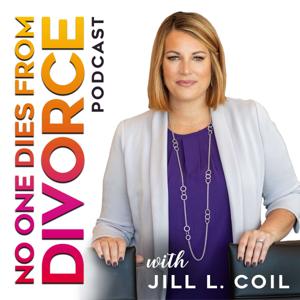
I'm Jill Coil — divorce attorney, family law expert, and author of "No One Dies from Divorce." I've helped hundreds of clients navigate separation and divorce, and I've faced it personally in my…
Each episode covers the topics that matter most during and after divorce: divorce recovery, co-parenting, child custody, dividing finances, healing emotionally, and rebuilding your life. I'm joined by fellow divorce attorneys, therapists, financial advisors, health coaches, and everyday people sharing their divorce journeys.
Whether you're considering separation, fighting for custody, protecting your finances, or just trying to survive the process — this podcast is your support system.
Note: Jill Coil is an attorney, but not your attorney. Nothing here constitutes legal advice.
You can do more than survive this. You can thrive after divorce. Let's get through it together.