
Sign up to save your podcasts
Or

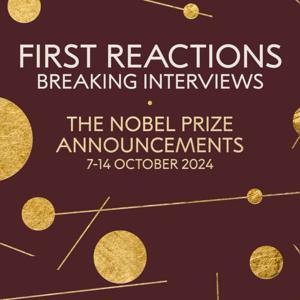


”I wasn't interested in learning stuff. I was just interested in understanding, because I could see what a fabulous shortcut it always was.” – Meet 2005 medicine laureate Barry Marshall in a dynamic talk with the Nobel Prize’s Adam Smith. Marshall tells us about his blog (something very few laureates had in 2005), his status as a yo-yo expert and his research that paved the way to a Nobel Prize. Self-experimentation is another topic that is up for discussion. Marshall takes us back to the moment he drank a bacterial culture of Helicobacter pylori to prove that gastric ulcers were caused by bacterial infections - it's a story you don't want to miss!
This conversation was originally presented in February 2014.
Hosted on Acast. See acast.com/privacy for more information.
”It's the insight, the work, the way you give yourself to the story that matters.” – We present a heartwarming chat with Canadian ’master of short stories’ and literature laureate Alice Munro.
This conversation between the Nobel Prize’s Adam Smith and Munro took place soon after she was awarded the 2013 Nobel Prize in Literature. In the episode, she reflects on how she creates short stories, what these stories have meant to her and her readers and why she started writing. Munro also tells Smith what she hopes to achieve with her writing: conveying stories that resonate, as well as surprise, her readers.
Hosted on Acast. See acast.com/privacy for more information.
“I have always thought of myself as a detective,” 2023 economic sciences laureate Claudia Goldin tells the Nobel Prize's Adam Smith when speaking about her research: “The detective always believes there is a way of finding the answer!” Recorded shortly after the public announcement of her prize, this conversation begins with Goldin praising Professor Randi Hjalmarsson of the University of Gothenburg, who fielded questions at the prize press conference after Goldin was disconnected. Now an economic history detective, Goldin explains how she was first switched onto detecting by Paul de Kruif’s book ‘Microbe Hunters’, published in 1926, cited by many Nobel Prize laureates across the generations as an inspirational read.
Hosted on Acast. See acast.com/privacy for more information.
After the 2023 Nobel Prize in Literature was announced, new laureate Jon Fosse was inundated with messages congratulating him on the award. In this call with the Nobel Prize’s Manisha Lalloo he speaks about one particular reader who told him that his work was “the reason she was still alive.” He also shares what writing means to him and his advice for aspiring writers.
© Nobel Prize Outreach.
First reactions terms of use: https://www.nobelprize.org/ceremonies/streams-terms-of-use
Hosted on Acast. See acast.com/privacy for more information.
“This is a collaborative effort,” says Louis E. Brus when asked for his first reaction to the award of the 2023 Nobel Prize in Chemistry, “partly physics, partly chemistry, partly material science.” In this conversation with the Nobel Prize’s Adam Smith he pays tribute to the many contributors to the field and discusses his own motivations for exploring the nature of nanoparticles in the productive environment of Bell Labs, 40 years ago. “It’s a surprise, at this point, after all these years,” he says, “I’m just lucky, I guess, that the Nobel Prize has chosen to honour this particular areas of research at this time.”
© Nobel Prize Outreach.
First reactions terms of use: https://www.nobelprize.org/ceremonies/streams-terms-of-use
Hosted on Acast. See acast.com/privacy for more information.
“It’s the middle of the night here!” Alexei Ekimov’s first reaction to hearing the news of his 2023 Nobel Prize in Chemistry was reasonable enough: “I woke up,” he says! In this call with the Nobel Prize’s Adam Smith, made not long afterwards, Ekimov goes on to discuss the experiments he performed over forty years ago producing quantum effects in coloured glass. He explains how his experiments confirmed theories he had read about back in his student textbooks: “I still remember that picture,” he recalls, “where there is a quantum well, and the levels of electrons, confined in that quantum well.”
© Nobel Prize Outreach.
First reactions terms of use: https://www.nobelprize.org/ceremonies/streams-terms-of-use
Hosted on Acast. See acast.com/privacy for more information.
“I’m supposed to teach at 9 this morning,” say Moungi Bawendi in this call recorded in the early morning, just after the news of his 2023 Nobel Prize in Chemistry had reached him, “and I’m not sure what’s going to happen!” Bawendi tells the Nobel Prize’s Adam Smith how he received the call, speaks about his co-laureate and mentor Louis E. Brus, and discusses what he tries to teach his students.
© Nobel Prize Outreach.
First reactions terms of use: https://www.nobelprize.org/ceremonies/streams-terms-of-use
Hosted on Acast. See acast.com/privacy for more information.
“My daughter called me asking, ‘Is that true, I see it on Google?’” That was how Pierre Agostini found out he had been awarded the 2023 Nobel Prize in Physics. In this conversation with the Nobel Prize’s Adam Smith, kindly facilitated by Dawn Larzelere of The Ohio State University (whose voice is heard at the start and end), Agostini talks of his surprise at receiving the prize now, his initial thoughts on hearing the news and recalls his pleasure at being the first to produce a train of attosecond light pulses back in 2001.
© Nobel Prize Outreach.
First reactions terms of use: https://www.nobelprize.org/ceremonies/streams-terms-of-use
Hosted on Acast. See acast.com/privacy for more information.
In what was surely understatement, 2023 physics laureate Anne L’Huillier described herself as “A little bit busy” when the Nobel Prize’s Adam Smith reached her a couple of hours after she had received the news. In this brief call she describes how special it feels to receive the prize and how her research into the overtones of light, which she revealed in the 1980s, continues to excite her: “Even now, 30 years afterwards, we are still learning new things.”
© Nobel Prize Outreach.
First reactions terms of use: https://www.nobelprize.org/ceremonies/streams-terms-of-use
Hosted on Acast. See acast.com/privacy for more information.
Ferenc Krausz was preparing to give lab tours at his Institute when a call from Stockholm reached him at home. “I was not sure whether I was dreaming, or whether it’s reality,” he tells the Nobel Prize’s Adam Smith in this call recorded just after the physics prize was announced. “It’s always exciting to see something that no-one could see before,” he says, recalling the thrilling morning in Vienna in 2001 when he first saw that they were able to reveal electron motions with their attosecond pulse technology: “This was just an unbelievable moment which I will never forget!”
© Nobel Prize Outreach.
First reactions terms of use: https://www.nobelprize.org/ceremonies/streams-terms-of-use
Hosted on Acast. See acast.com/privacy for more information.
From the publisher's feed
Through their lives and work, failures and successes – get to know the individuals who have been awarded the Nobel Prize. The host for this podcast is Adam Smith, who has the happy task of…
Sit in on our conversations as we delve into how these personalities found their fields of interest — often by coincidence — how they view collaboration, curiosity and failure, and what keeps them going. The laureates share what they have learned from their career and what they like to do outside of their work – from music to fly-fishing. We let the discussions flow freely, resulting in richly varied stories on topics ranging from poverty prevention to the science of black holes and the importance of being a role model.
Don't miss the First Reactions from our 2025 Nobel Prize laureates coming up in October.
Hosted on Acast. See acast.com/privacy for more information.

6,766 Listeners

43,361 Listeners
772 Listeners
298 Listeners
373 Listeners
270 Listeners
766 Listeners

542 Listeners
820 Listeners
1,540 Listeners
726 Listeners
4,163 Listeners
204 Listeners
262 Listeners

521 Listeners