
Sign up to save your podcasts
Or

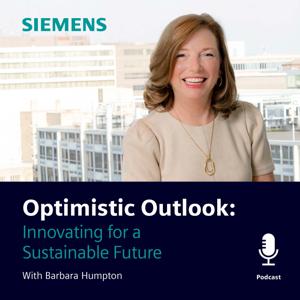


Most conversations about the circular economy stay at altitude. Materials in use, value retained, waste designed out. All true, and none of it tells you what actually has to change on a Tuesday morning at a working facility.
The idea itself is straightforward: instead of continually extracting resources, using them, and throwing them away, what if we could keep more of those materials in use?
In this episode of the Optimistic Outlook, Eryn Devola, Global Head of Sustainability for Siemens Digital Industries, sits down with Paul Coyne, CCO of Envetec to bring that idea down to earth. One company. One waste stream. What it cost before, what it costs now, and whoinside the customer organization had to sign off on doing it differently.
The conversation gets at a claim that sounds simple and turns out not to be: waste is a design flaw. If a material leaving a facility has no value, that is not necessarily inevitable. It is the result of decisions made earlier, usually by people who were never asked to think about the end of the line.
Changing that requires more than better waste disposal. It means designing processes differently, understanding where materials go, and using technology to identify opportunities to keep them in circulation. The payoff can be both environmental and economic: reducing waste while getting more value from the resources industry already uses.
The conversation covers:
This is a practical look at what the circular economy actually means on the factory floor—and how changing the way industry designs, uses, and reuses materials can turn less waste into greater value.
Show notes
Home/ Clean Change Through Biohazardous Waste Recycling / Envetec
GENERATIONS Case Study - Scottish Water - Envetec
Video - Envetec GENERATIONS: https://youtu.be/r5-PzEabqgo
The future of AI isn’t just about smarter models—it’s about putting AI to work in the real world.
In this episode of Optimistic Outlook In Five, Lauren Espin explores how Industrial AI could help manufacturers tackle one of the industry’s biggest challenges: a shortage of skilled engineering talent. As the United States works to expand and modernize its manufacturing capacity, AI is emerging as a powerful tool for helping engineers, operators and technicians become more productive.
The episode takes a closer look at programmable logic controllers (PLCs), the technology that controls countless machines and production processes, and the automation engineers who program them. Because every factory has its own equipment, configurations and engineering data, applying AI to industrial automation requires more than a general-purpose AI model—it requires deep industrial context.
That’s where Eigen Engineering Agent, developed at Siemens’ AI hub in Seattle, comes in. Integrated into the engineering software automation engineers already use, Eigen can use plant-specific engineering information to understand a task, write code, configure systems and work toward a defined performance goal. In pilot deployments across more than 100 companies in 19 countries, Eigen has delivered up to 50% greater engineering efficiency and can execute engineering tasks at two to five times human speed.
The episode also explores why human oversight, simulation and validation remain essential for deploying AI safely and reliably in industrial environments—and why the next chapter of AI may be defined less by what AI can do in theory and more by what it can accomplish inside real factories.
As Siemens invests $1 billion in AI capabilities and offerings over the next three years, Industrial AI is becoming an increasingly important part of the future of manufacturing, engineering and industrial automation.
What happens when AI stops answering questions and starts doing the work? In manufacturing, that future is already taking shape.
Press Release: Siemens launches the Eigen Engineering Agent, bringing purpose-built AI to industrial automation engineering
Eigen Engineering Agent
Every year, approximately 200,000 U.S. service members transition from military service to civilian careers. Employers say they want to hire veterans, yet highly qualified military talent is still too often overlooked. The problem isn’t a lack of skills—it’s the challenge of translating military experience into language civilian employers and hiring managers understand.
In this episode of the Optimistic Outlook, Kristine Irwin, who leads military talent strategy and partnerships at Siemens, is joined by Charlie Martinez, national lead for the Siemens SkillBridge program, and Cathy Miclat, Director of Career Services at Vets2PM. Together, they explore how employers can better recognize transferable military skills, improve veteran hiring, and build stronger pathways from military service to civilian careers.
Charlie knows the transition firsthand. After serving seven years in the U.S. Air Force, he transitioned to the civilian workforce through SkillBridge before joining Siemens. Today, he leads the same program that helped launch his civilian career. He shares how he learned to translate his military experience into civilian terms, and why veterans shouldn’t have to make their experience sound like something it wasn’t for employers to recognize its value.
The conversation explores:
Whether you’re a hiring manager, HR or talent acquisition leader, workforce development professional, veteran, or transitioning service member, this conversation offers practical insights into veteran employment and what it takes to turn military experience into opportunity.
Because the goal isn’t to make military experience fit a civilian job description. It’s to help employers recognize the skills, experience, leadership, and potential veterans already bring to the workforce.
The future of American manufacturing is being shaped by more than technology. It’s being built by the people who are bringing new ideas, processes and capabilities to the factory floor.
In this episode of the Optimistic Outlook, Lauren Curran, an industrial engineer and advanced manufacturing manager at Siemens’ Fort Worth facility, gives us a firsthand look at how modern manufacturing is evolving. In a conversation with Siemens USA President and CEO Ann Fairchild, Lauren shares how advanced manufacturing, data, AI and continuous improvement are creating new possibilities for both the industry and the people who work in it.
Siemens has invested $1 billion in U.S. manufacturing over the past five years, including a $190 million facility in Fort Worth producing switchgear and other electrical equipment that supports critical infrastructure across the country. Growing demand from industries including data centers and AI is accelerating the need for this equipment — and for the skilled workforce behind it.
But technology and investment are only part of the equation. America also needs people with the skills to build, operate and continuously improve the factories of the future. Lauren shares her own rapid career journey, from industrial engineer to advanced manufacturing manager, and explains how curiosity, problem-solving and a willingness to embrace challenges have helped shape her career.
She also offers a look inside the modern factory — from piloting new products and processes to working directly with assemblers to turn engineering designs into real-world products. Her experience challenges outdated perceptions of manufacturing and highlights the opportunities available to people considering careers in engineering, advanced manufacturing and skilled trades.
In this episode, discover:
As the United States works to strengthen its manufacturing workforce, stories like Lauren’s demonstrate what’s possible when people are given the tools, training and freedom to innovate.
Show notes
Siemens manufacturing plant in Fort Worth, TX
Siemens Opens $190M Fort Worth Manufacturing Hub to Support AI Infrastructure Boom
Earlier this year, Siemens surpassed $1 billion in U.S. manufacturing investments over five years—and announced there was more to come.
Show notes:
Siemens invests $200M in U.S. electrical manufacturing
America's manufacturing future depends on more than advanced technology—it depends on a skilled workforce prepared to build, program, and operate it.
In this episode of the Optimistic Outlook, Amanda Beaton, who leads Siemens Cooperates with Education, sits down with Jim Devaprasad, robotics professor at Lake Superior State University and recipient of the 2026 A3 Educator of the Year Award, to discuss how educators are helping solve America's manufacturing skilled labor shortage by preparing the next generation of engineers, technicians, robotics specialists, and automation professionals.
After more than 40 years in the classroom, Jim has witnessed the evolution of manufacturing technology firsthand—from hand-drawn robotics diagrams to today's highly automated, AI-enabled industrial environments. Along the way, he has inspired generations of students and launched countless careers, including former students who now lead automation companies of their own.
Amanda and Jim explore why hands-on STEM education, career and technical education (CTE), and strong partnerships between industry and education are essential to closing workforce gaps and strengthening U.S. manufacturing competitiveness. They also discuss how robotics, automation, and experiential learning are preparing students for high-demand careers and why investing in educators is one of the smartest investments America can make for its industrial future.
Topics covered:
Listen to hear why the future of American manufacturing starts in today's classrooms, and how educators like Jim Devaprasad are inspiring the next generation of innovators, engineers, and manufacturing leaders.
Show notes
Lake Superior State University (LSSU) School of Engineering and Technology: LSSU in Sault Sainte Marie, Michigan is one of only 10 nationally accredited robotics engineering programs in the nation.
America is investing in the future of shipbuilding — but modern shipyards require more than docks and cranes. They require digital technologies that help engineers, planners and production teams build smarter, faster and more efficiently. This episode of In 5 explores Siemens' new partnership with HD Hyundai and how AI-powered digital shipyards could help strengthen U.S. maritime competitiveness, improve productivity and create a blueprint for the next generation of American shipbuilding.
Show notes
Press Release: Siemens, HD Hyundai Modernize U.S. Shipbuilding
Blog post:
How will artificial intelligence impact jobs, workforce development, and the future of American manufacturing?
In this episode of the Optimistic Outlook, Siemens USA CEO Ann Fairchild sits down with U.S. Senator Ted Budd of North Carolina to discuss the future of work in the age of AI. Building on insights from a recent U.S. Senate hearing focused on artificial intelligence and workforce transformation, they explore how AI is reshaping industries, creating new opportunities for workers, and driving innovation across the U.S. economy.
Senator Budd shares why concerns about widespread job displacement are increasingly being replaced by conversations about productivity, workforce augmentation, and the growing demand for AI skills. Together, he and Ann examine the role of industrial AI, workforce training, public-private partnerships, and education in preparing Americans for the jobs of the future.
The conversation also explores how AI can help strengthen U.S. manufacturing, accelerate reshoring efforts, improve competitiveness, and support responsible innovation. Rather than replacing people, they argue that AI has the potential to empower workers, enhance human capabilities, and unlock new economic opportunities.
Whether you're interested in artificial intelligence, workforce development, manufacturing, economic policy, or the future of jobs, this episode offers an optimistic perspective on how technology can help build a stronger future for American industry and the people who power it.
Topics discussed:
Show Notes:
Siemens VP Addresses Congress on Industrial AI: https://www.siemens.com/en-us/company/insights/us-stories/siemens-vp-addresses-congress-on-industrial-ai/
Before the internet, there was the transatlantic cable. It transformed global communication, shrinking the distance between continents from weeks to minutes. But in its earliest days, that connection came at a steep price: one company controlled the only reliable cable across the Atlantic, and sending a twenty-word telegram could cost more than $100.
In this special America 250 episode of The Optimistic Outlook, guest host Lauren Espin tells the remarkable true story of the engineers and entrepreneurs who challenged that monopoly and helped usher in a new era of global communications. Drawing on original letters and archival research from the Siemens Historical Institute, the episode follows Werner, William, and Carl von Siemens as they designed and built the Faraday—the world's first purpose-built cable-laying ship—and embarked on a mission that nearly failed in the middle of the Atlantic.
Through firsthand correspondence between the brothers, you'll experience the technical setbacks, fierce competition, and determination that ultimately led to one of the greatest engineering achievements of the 19th century—and helped expand access to international communication at a pivotal moment in history.
In this episode, you'll learn:
How the first transatlantic telegraph cables changed communication, and why access remained limited
Why the Siemens brothers built the Faraday, the world's first purpose-built cable-laying ship
What happened when the cable snapped twice in the middle of the Atlantic
How rivals attempted to derail the project with false reports that the Faraday had sunk
Why September 15, 1875, marked a turning point in transatlantic communications when the Siemens cable opened for traffic and outperformed the existing route on its very first day
Whether you're interested in the history of technology, engineering, telecommunications, global infrastructure, entrepreneurship, or the stories behind the innovations that shaped modern life, this episode offers a fascinating look at one of the most consequential—and least-known—chapters in communications history.
Show notes:
Siemens in the United States - https://www.siemens.com/en-us/company/about/siemens-usa/
Siemens' History and Heritage - https://www.siemens.com/en-us/company/history-heritage/
Corporate sustainability strategy is becoming a profit driver as AI, decarbonization, and resilience converge.
Drawing on examples from industry, infrastructure, and mobility, Eva and Ann discuss why the cost of inaction is no longer theoretical. They explore how a modern corporate sustainability strategy can cut emissions, support circular operations, and strengthen systems, while still delivering measurable business value.
Key takeaways:
For CEOs, operators, and sustainability leaders, this episode offers a clear
Show notes
Sustainability at Siemens
From the publisher's feed

43,361 Listeners

36,175 Listeners

26,245 Listeners

9,619 Listeners

111,766 Listeners

56,424 Listeners

5,759 Listeners
9,069 Listeners

27,677 Listeners

14,341 Listeners
6 Listeners

5,390 Listeners

3,452 Listeners
1,450 Listeners

1,566 Listeners