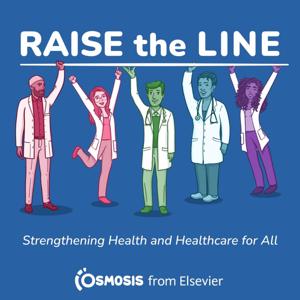
Raise the Line

Raise the Line

Download on the App Store

Raise the Line episodes

  • Deciding to Do Good - Dr. Abdul El-Sayed, Author of "Medicare for All: A Citizen's Guide"
    When Dr. Abdul El-Sayed realized that he could travel 15 hours to visit family in Egypt or drive 15 minutes away in Detroit and traverse the same 10-year life expectancy gap, the deeply political aspects of medicine and public health really hit home for him. In a broadly-spanning career with roles in medicine, activism, education, and politics, Dr. El-Sayed has endeavored to fix the problems in the U.S. healthcare system that contribute to this gap. In this important interview, Dr. El-Sayed speaks with host Dr. Rishi Desai about the power of storytelling, the immoral foundation of our healthcare system, and the need to step beyond institutional measurements to decide what matters. Tune in to discover the powerful influence his grandmother has had on his life's work, why Dr. El-Sayed believes that Medicare for all is not only the ethical way to go, but also “extremely technically possible,” and what he sees as the next step toward removing corporate dominance from our healthcare system. If you like this podcast, please share it on your social channels. You
    can also subscribe to the series and check out all of our episodes at
    www.osmosis.org/podcast
    22 min
  • Can Learning Medicine Actually Be Fun? - Andrew Berg and Saud Siddiqui of SketchyMedical
    You might say Osmosis and SketchyMedical share some DNA. Both learning platforms were started by medical students seeking a better way to manage the avalanche of information they had to memorize; both companies use animated videos with an approachable style; and both root their content in learning science. Sketchy’s key approach borrows from a method developed by the ancient Greeks that relies on visual-spatial memory to acquire and retain knowledge. They also keep fun front and center. “That fun aspect is harder to be objective about and to judge,” says co-founder Andrew Berg, “but we found that the more fun we're having when we're creating content, that translates into more fun the students are having and very likely makes it more effective as a learning tool.” Check out this fascinating (and fun!) discussion about the power of visual lessons to increase speed of learning and retention, the myth of learning preferences, and plans to apply the approach to non-medical subject areas. If you like this podcast, please share it on your social channels. You
    can also subscribe to the series and check out all of our episodes at
    www.osmosis.org/podcast
    23 min
  • Nursing’s Role in Advancing Health Equity - Suzanne Miyamoto, CEO of the American Academy of Nursing
    Suzanne Miyamoto's appreciation for healing and personal connection started while volunteering at a hospital in high school, and has been central to her life ever since. She has spent most of her career working in policy, and now leads the American Academy of Nursing, which endeavors to improve health equity by impacting policy through nursing leadership, innovation, and science. Join Miyamoto and host Jannah Amiel in this episode of Raise the Line to learn how nurses can be—and in Miyamoto's view, should be—front and center in the struggle to improve health equity. Tune in to soak up Miyamoto's valuable advice on forming partnerships, using good evidence, and seeking out opportunities outside of healthcare. Plus, learn about the need for better representation at the decision-making tables and the importance of educators encouraging and nurturing student ideas early and often. If you like this podcast, please share it on your social channels. You
    can also subscribe to the series and check out all of our episodes at
    www.osmosis.org/podcast
    27 min
  • Medical Schools Must Champion Health Equity - Dr. Valerie Weber, Dean of Wright State University Boonshoft School of Medicine
    “It has always really been about making things better for people,” says Dr. Valerie Weber of the various roles she has held in her distinguished career. “As somebody who is fortunate, you must use your role to help others and to make the system better.” In this episode of Raise the Line, Dr. Weber joins host Shiv Gaglani to discuss current challenges and new models in medical education, the impact of COVID, and pandemic silver linings. Tune in to discover how Dr. Weber's mother's passion for caring for community elders inspired her daughter's journey to leadership in healthcare, a field that Dr. Weber considers “the best career in the world.” Learn why Dr. Weber is a staunch advocate of community-based medicine and believes it is essential for medical schools to lead the way in championing health equity. Plus, find out what she thinks may prove to be the “discovery of the century.” If you like this podcast, please share it on your social channels. You
    can also subscribe to the series and check out all of our episodes at
    www.osmosis.org/podcast
    24 min
  • Reinventing Healthcare After the Pandemic: Dr. Shantanu Nundy, Chief Medical Officer at Accolade
    "Healthcare needs to become distributed, digitally enabled, and decentralized.” That’s the core message in the new book Care After Covid: What the Pandemic Revealed Is Broken in Healthcare and How to Reinvent It, by Dr. Shantanu Nundy. Between his work as a primary care physician, lecturer in health policy at George Washington University Milken Institute for Public Health, advisor to the World Bank on digital health and innovation and role as chief medical officer at Accolade, Nundy brings a lot to the national conversation about improving healthcare. Although plenty needs to be done by regulators, policymakers and other stakeholders, Nundy is also looking to his fellow providers to drive change. Taking the trajectory of telemedicine as an example he says, “we could have moved to virtual care sooner. Part of it was regulation, but part of it was us. We could have been giving our patients' blood pressure cuffs to take home with them. Part of it was regulation, but part of it was us. I think the pandemic has shown that you don't have to wait for someone in DC to solve a problem for you. There's so much that we all know because we're in exam rooms every day and there are things we can do to make care better.” Tune in for a trenchant discussion with host Rishi Desai on removing barriers to change, patient empowerment, changing medical education, training doctors to be mass communicators and much more. If you like this podcast, please share it on your social channels. You
    can also subscribe to the series and check out all of our episodes at
    www.osmosis.org/podcast
    26 min

About Raise the Line

From the publisher's feed

Join host Lindsey Smith and other Elsevier team members for a global conversation about improving health and healthcare with prominent figures in education and healthcare innovation as well as senior…

More shows like Raise the Line

Freakonomics Radio by Freakonomics Radio + Stitcher

Freakonomics Radio

32,046 Listeners

Planet Money by NPR

Planet Money

30,701 Listeners

The Daily by The New York Times

The Daily

111,799 Listeners

Hard Fork by The New York Times

Hard Fork

5,557 Listeners

The Megyn Kelly Show by SiriusXM

The Megyn Kelly Show

39,387 Listeners

Huberman Lab by Scicomm Media

Huberman Lab

29,204 Listeners

The Ezra Klein Show by New York Times Opinion

The Ezra Klein Show

15,882 Listeners

The Mel Robbins Podcast by Mel Robbins

The Mel Robbins Podcast

19,254 Listeners

Good Hang with Amy Poehler by The Ringer

Good Hang with Amy Poehler

12,486 Listeners