
Sign up to save your podcasts
Or



Mike and Brent pick up the discussion from Episode 25 with some further thoughts on the proposed revenue-sharing arrangement between the U.S. government and certain exporters, including what should be anticipated from the U.S. government in terms of increased transparency (01:36), give their take on the Maintaining American Superiority by Improving Export Controls Transparency Act signed into law by the President, including both what it does do and what it doesn’t do (10:27), and provide their takes on the long-running media speculation about a so-called “50% rule” that would extend the Entity List maintained by the U.S. Bureau of Industry & Security (BIS) automatically to subsidiaries or affiliates owned 50% or more by a listed entity (18:53), including questions that the debate raises about what due diligence is being done now on subsidiaries and affiliates of listed entities, and important distinctions between U.S. economic sanctions—from where the 50% rule concept is being borrowed—and U.S. export controls that suggest the rule is better suited for the former than the latter.
They conclude with another installment of Brent Carlson’s “Managing Up” (26:25).
More about Brent: https://www.linkedin.com/in/brent-carlson-41ba692/
More about Mike: https://www.linkedin.com/in/mhuneke/
Everything you ever wanted to know about the “high probability” standard: https://www.hugheshubbard.com/fresh-looks
Mike & Brent dive into the latest geopolitical developments surrounding technology exports and the interplay between leading tech companies and the U.S. Administration.
Specifically, they discuss the latest news regarding U.S. conditions for licensing the export of Nvidia’s H20 chip to China (00:38), the impact of the deal on trade negotiations between the U.S. and the People’s Republic of China (and vice-versa) (04:59), the difficult position companies generally are in regarding export controls due diligence and the multiple potential meanings and consequences regarding public officials’ statements around export controls (16:01), the latest news regarding Intel’s CEO’s interactions with the U.S. Administration and how they illustrate vividly the “whipsaw” effect companies and executives face as geopolitical winds swirl (20:09), the relevance of the “pretend mistake” tactic in dealmaking—or, as Mike referred to it in the context of U.S. export controls, the “revoked forgiveness” tactic (22:40), and, practically speaking, how companies can best anchor themselves amidst the geopolitical storm by designing and implementing a “high probability protocol” to best anticipate core trends in U.S. export controls enforcement and serve as an important compliance backstop (25:36).
They then conclude with another installment of Brent Carlson’s “Managing Up” (26:59).
More about Brent: https://www.linkedin.com/in/brent-carlson-41ba692/
More about Mike: https://www.linkedin.com/in/mhuneke/
Everything you ever wanted to know about the “high probability” standard: www.hugheshubbard.com/fresh-looks
Mike and Brent break down the key takeaways from an affidavit by a Bureau of Industry & Security Special Agent in Los Angeles, which was unsealed on August 5, 2025, and is a masterclass in how BIS is identifying and analyzing “red flags” indicating potential export controls violations.
Mike and Brent discuss the basics of the case (00:58), the value of the detailed affidavit prepared by the BIS Special Agent in support of the arrests (02:19), the value of the case to those making broader strategic decisions for companies in illustrating the competitive advantages—and ability to maximize the benefits of America’s AI Action Plan—through effective export controls compliance (03:00), the most-relevant details of the allegations (04:20), the dangers of doing business with “fly-by-night” operations of any type (05:45), how these allegations underscore the importance of dynamic risk assessments, i.e., those that focus on changes in customers or orders around significant changes to U.S. export controls (06:14), what the affidavit signals for corporate enforcement (07:21), what we can learn about diversion risks from Brent’s studies of the Qing dynasty and frozen meats (07:40), what seized text messages revealed about the smugglers’ view of the current U.S. Administration (08:57), what the affidavit indicates that trade compliance teams realistically, at the front end, could or should have known (10:31), how to respond to BIS requests for information or outreach visits (13:58), Mike’s leaky dishwasher analogy for diversion (and why you need to fix both) (14:15), how the affidavit shows that BIS agents are applying a high probability mindset in their investigations (18:27), how not to “kick the hornet’s nest” when BIS visits or requests information (20:29), the expectations of U.S. regulators generally that companies that become aware of potential violations, whether or not they voluntarily disclose anything, at least do a “root cause” analysis and consider whether compliance program enhancements are necessary (22:17), and the relevance of General Prohibition 10 and the several inchoate provisions under 15 C.F.R. § 764.2 (23:10).
They then conclude with the ever-popular segment, Brent Carlson’s “Managing Up” (26:03).
Edvard Pettersson’s article, with a link to the BIS Special Agent’s affidavit, “Chinese nationals charged with illegal exports of Nvidia chips” (Courthouse News, Aug. 5, 2025): https://www.courthousenews.com/chinese-nationals-charged-with-illegal-exports-of-nvidia-chips/
The DOJ press release: https://www.justice.gov/opa/pr/two-chinese-nationals-arrested-complaint-alleging-they-illegally-shipped-china-sensitive
More about Brent: https://www.linkedin.com/in/brent-carlson-41ba692/
More about Mike: https://www.linkedin.com/in/mhuneke/
Everything you ever wanted to know about the “high probability” standard: www.hugheshubbard.com/fresh-looks
Mike and Brent breakdown the $140 million corporate resolution announced on Monday, July 28, 2025, by the U.S. Department of Commerce’s Bureau of Industry & Security (BIS) and the U.S. Department of Justice’s National Security Division (NSD). Of this amount, $95 million was imposed by BIS alone, which is the largest stand-alone BIS penalty since April 2023.
Mike and Brent discuss the geopolitical context (00:39), how the resolution responds to December 2024 criticism from the then-majority staff of the U.S. Senate’s Permanent Subcommittee on Investigations (01:58), why this is “where the juice is” for future BIS and NSD enforcement (03:05), how the settlement underscores that sustained compliance with national security-driven regulations requires a substance-over-form approach (04:45), the relevant facts related to the resolving company’s China subsidiary and customers (06:36), the relevant facts related to the parent company (08:59), why a letter of assurance and end-use/end-user certifications were not sufficient to respond to the “red flags” identified (10:38), how U.S. parent companies should be thinking holistically about export controls risk and strategies for mitigating that risk, including in responding to BIS outreach visits or queries to hopefully avoid administrative subpoenas or, worse, referrals to criminal authorities (12:37), the signals BIS and NSD expect companies subject to U.S. export controls to perceive from the public documents (16:37), the significance of BIS’s reference to General Prohibition 10 and to attempted violations of U.S. export controls (16:37), and the key takeaways for legal and trade compliance professionals (19:09).
Mike and Brent then conclude with the still-back-by-popular-demand segment, Brent Carlson’s “Managing Up” (19:52).
The BIS Press Release, with links to the settlement documents: https://www.bis.gov/press-release/cadence-design-systems-pay-95-million-penalty-bis-unauthorized-exports-chinese-entities-tied-development
The NSD Press Release, with links to the corporate guilty plea and criminal information: https://www.justice.gov/opa/pr/cadence-design-systems-agrees-plead-guilty-and-pay-over-140-million-unlawfully-exporting
For everything you ever wanted to know about the “high probability” standard, check out Mike & Brent’s “Fresh Looks” series at www.hugheshubbard.com/fresh-looks
More about Brent: https://www.linkedin.com/in/brent-carlson-41ba692/
More about Mike: https://www.linkedin.com/in/mhuneke/
Mike and Brent go All-In regarding America’s AI Action Plan, unveiled by the White House on Wednesday, July 23, 2025, and discussed in detail at a forum the same day co-sponsored by the All-In Podcast and the Hill & Valley Forum.
Mike and Brent discuss how these developments relate to the “Moment of Truth” discussed in Episode 20 (00:31), the Three Pillars of America’s AI Action Plan (01:07), how the Three Pillars relate to their recent BRG ThinkSet magazine article (01:45), the commercial opportunity presented by full-stack AI export privileges under the AI Action Plan and how the “stack sweeps” previewed on Episode 19 are the compliance corollary to this commercial opportunity (02:32), Secretary of Commerce Howard Lutnick’s remarks about where to draw the line between sensitive and non-sensitive exports from a national security perspective and how this relates back to their recent ThinkSet article (05:00), how Pillar Three—Lead in International AI Diplomacy & Security—relates to many ongoing bilateral trade negotiations (07:23), the importance of not making anyone look like a sucker or a fool (08:34), the AI Action Plan’s reference to secondary tariffs as a means to make sure other countries don’t “backfill” where U.S. export controls create opportunities (08:53), the potential impact of the Maintaining American Superiority by Improving Export Control Transparency Act that is on the President’s desk for signature into law (11:20), the continuing relevance of end-user and end-use controls and the “high probability” standard (14:10), how Pillar Three also focuses on strengthening AI compute export controls enforcement by the Department of Commerce with support from the U.S. intelligence community (15:23), updates on Department of Commerce political employees’ confirmation process and reference therein to the Bureau of Industry & Security's “red flag” guidance to industry (16:21), and the fundamental “deal” between the U.S. government and the U.S. tech sector evident in the AI Action Plan (18:42). Mike and Brent then conclude with an “all-in” version of Brent Carlson’s “Managing Up” segment (24:46).
America’s AI Action Plan: https://www.whitehouse.gov/wp-content/uploads/2025/07/Americas-AI-Action-Plan.pdf
The White House’s Announcement of America’s AI Action Plan: https://www.whitehouse.gov/articles/2025/07/white-house-unveils-americas-ai-action-plan/
The All-In Podcast: https://allin.com/
The Hill & Valley Forum: https://www.thehillandvalleyforum.com/
More about Brent: https://www.linkedin.com/in/brent-carlson-41ba692/
More about Mike: https://www.linkedin.com/in/mhuneke/
Mike & Brent’s “Fresh Looks” series: https://www.hugheshubbard.com/fresh-looks
Mike and Brent were honored guests on the FCPA Compliance Report podcast with their podfather, Tom Fox, the Voice of Compliance and founder of the Compliance Podcast Network. They discuss the concept of “secondary tariffs” recently threatened by the U.S. as to Russia’s trading partners (00:44), what would such secondary tariffs as to Russia really mean, and for whom (03:21), how multinational companies should start thinking through the impact of these potential tariffs (04:37), the need to be very, very, very careful about schemes that seem too good to be true (because they are) (06:03), how risk-based compliance can help multinationals evaluate proposed reconfigurations of procurement flows (09:36), where self-certifications by suppliers might not be sufficient (10:22), and then conclude with a deep dive into what False Claims Act enforcement for tariff evasion might look like and how to mitigate enforcement risks by understanding and leveraging the False Claims Act’s “knowledge” element (13:52).
The Compliance Podcast Network: https://compliancepodcastnetwork.net/
The FCPA Compliance Report podcast: https://compliancepodcastnetwork.net/category/fcpa-compliance-report/
More about Tom Fox: https://compliancepodcastnetwork.net/about/
Tom Fox on LinkedIn: https://www.linkedin.com/in/thomasfox13/
More about Brent: https://www.linkedin.com/in/brent-carlson-41ba692/
More about Mike: https://www.linkedin.com/in/mhuneke/
Mike and Brent follow-up on Episode 19’s discussion of “stack sweeps” with a discussion of the current “moment of truth” facing trade compliance teams dealing with high-probability, catch-all enforcement risks as explained in their recent WorldECR (Issue No. 141, July/August 2025) and Dow Jones Risk Journal article, “Anticipating the moment of truth: how to prepare for ‘high probability’ catch-all enforcement.” Specifically, they discuss the recent decision by the U.S. to allow (licensed) sales of certain advanced integrated circuits to China (00:42), their WorldECR/DJRJ article and how the Bureau of Industry & Security (BIS) guidance of May 13, 2025, which emphasized the “high probability” standard and catch-all provisions of the U.S. Export Administration Regulations (EAR), inspired the article (or at least inspired Tom Blass of WorldECR to ask us for an article) (07:10), how the underlying catch-all provisions are not “new” as of May 13, 2025 (10:26), how compliance teams can’t “zero-risk” export controls risk and need to adopt risk-based approaches (12:17), the relevance of the “inchoate” offenses under the EAR, i.e., aiding, abetting, conspiracy, evasion, acting with knowledge, and misrepresentations (13:21), the limitations of end-use and end-user certificates under the May 13, 2025 policy and guidance documents (14:47), their thoughts on the reportedly pending “50% rule” for the Entity List (18:32), the impact of the ability of malign actors, political parties, and military-intelligence actors to exercise influence even without shareholdings (19:25), why the most risky counterparties are those not on the Entity List (20:49), and the three key takeaways in their WorldECR/DJRJ article (24:09). They conclude with another installment of Brent Carlson’s “Managing Up” segment (30:28).
WorldECR: https://www.worldecr.com/
More about Brent: https://www.linkedin.com/in/brent-carlson-41ba692/
More about Mike: https://www.linkedin.com/in/mhuneke/
Mike & Brent’s “Fresh Looks” series: https://www.hugheshubbard.com/fresh-looks
Mike & Brent coin a new phrase in the context of white-collar corporate enforcement, “stack sweep,” to describe the potential enforcement risks--up and down the technology stack--that recent U.S. export controls settlements, policy statements, and guidance portend in focusing on broad end-use or end-user “catch-all” provisions that turn on “knowledge” defined to include “an awareness of a high probability.” Specifically, they discuss how two recent cases are short on facts but long on lessons (or, as Brent says, appear at first glance to be “dogs”) (01:07), discuss the Alpha & Omega Semiconductor (AOS) settlement announced July 2, 2025 (03:19), how reliance on the advice of counsel is as useful as the extent of facts disclosed to counsel (06:09), discuss the Unicat Catalyst Technologies settlement announced by the Bureau of Industry & Security (BIS) on June 24, 2025 and parallel settlements announced by the Department of the Treasury’s Office of Foreign Assets Control (OFAC) and the Department of Justice’s (DOJ’s) National Security Division (NSD) on June 16, 2025 (08:34), the lessons for pre-acquisition due diligence (11:03) including the importance to buyers of testing whether a target’s trade compliance program incorporates risks driving by the full definition of knowledge to include “high probability” awareness (for example, by specifically addressing risks under the catch-all provisions) (15:33), convergence across DOJ, Treasury, and Commerce regarding expectations for corporate compliance programs (17:50), and then Mike & Brent coin the phrase “stack sweep” to describe what would be the equivalent in corporate export controls enforcement to prior “industry sweeps” in corporate FCPA enforcement, in that catch-all, knowledge-driven end-use and end-user enforcement “sweeps” within the tech industry would be “sweeps” up and down the relevant technology stack (20:01). They then conclude with Brent’s back-by-popular-demand segment, “Managing Up” (25:52).
The July 2, 2025 BIS settlement with Alpha & Omega Semiconductor: https://bis.gov/media/documents/e2995-alpha-omega
The June 24, 2025 BIS settlement with Unicat Catalyst Technologies: https://www.bis.gov/media/documents/e2994-unicat-catalyst-technologies-final-order-12-20-2024
The June 16, 2025 OFAC settlement with Unicat Catalyst Technologies: https://ofac.treasury.gov/recent-actions/20250616
The June 16, 2025 DOJ NSD press release with the relevant declination letter (buyer), non-prosecution agreement (target) and criminal guilty plea (former CEO): https://www.justice.gov/opa/pr/justice-department-declines-prosecution-private-equity-firm-following-voluntary-disclosure
For everything you ever wanted to know about the “high probability” standard: www.hugheshubbard.com/fresh-looks
More about Brent: https://www.thinkbrg.com/people/brent-carlson/
More about Mike: https://www.linkedin.com/in/mhuneke/
Mike and Brent propose a new framework for post-resolution third-party independent consultants imposed under corporate resolutions with the U.S. Bureau of Industry & Security (BIS) or monitors imposed under resolutions with the U.S. Department of Justice’s (DOJ’s) National Security Division (NSD) that best promotes underlying national security objectives while also minimizing the impact on the resolving company’s business. Their proposal is based on their prior “Fresh Looks” article with the NYU Law School’s Program on Corporate Compliance & Enforcement (PCCE), “Monitoring What Matters: A Fresh Look Proposal to Government and Industry for How Post-Resolution Oversight Can Best Deny Hostile Actors the Means to Cause Deadly Harm,” from March 28, 2024.
Mike and Brent introduce their prior “Monitoring What Matters” article (00:37), contrast the needs of post-resolution oversight under U.S. export controls with those under the U.S. Foreign Corrupt Practices Act (FCPA) (01:52), and then explain why traditional concepts of what a post-resolution independent monitor or consultant should do miss the mark (02:38), how the compelling need to move quickly could justify imposing key milestones at just 3 and 6 months, with completion in one year (04:56), that this shortened timeframe can be achieved by leveraging the “awareness of a high probability” standard of knowledge under the U.S. Export Administration Regulations (EAR) (05:56), how battlefield risks should drive prioritization (09:28), how third-part independent consultants should be leveraging what is likely, for many companies already on the front lines of U.S. export controls (e.g., by being part of the leading-edge AI ecosystem), a robust compliance program that was likely further enhanced during the preceding government investigation (11:11), how companies and any post-resolution independent consultant or monitor should think about where and how to draw due diligence lines regarding multi-tier distributor and reseller networks (12:57), the importance in the national security context of thinking about third-party consultant and monitor independence not just in terms of independence from direct client relationships with the subject company but also in terms of independence from the relevant foreign country’s military or intelligence agencies, including prior engagements to lobby the U.S. government (16:38), and the three key takeaways from their prior article (22:04). They conclude with Brent’s ever-popular segment, “Managing Up” (28:08).
The prior “Monitoring What Matters” article: https://wp.nyu.edu/compliance_enforcement/2024/03/28/monitoring-what-matters-a-fresh-look-proposal-to-government-and-industry-for-how-post-resolution-oversight-can-best-deny-hostile-actors-the-means-to-cause-deadly-harm/
The rest of the “Fresh Looks” series with NYU: www.hugheshubbard.com/fresh-looks
More about Brent: https://www.linkedin.com/in/brent-carlson-41ba692/
More about Mike: https://www.linkedin.com/in/mhuneke/
Mike & Brent welcome Erika Trujillo, Managing Director of SEIA (“say-a”), who with her company brings advanced data analytics solutions to solving trade compliance problems. Mike and Brent discuss Erika’s background and the services SEIA provides (00:14); how advanced data analytics can help with export controls risk assessments by, among other things, bringing to bear data from across multiple departments (which is particularly important under U.S. law’s collective knowledge doctrine and the “high probability” standard) (02:10); the importance of differentiating between your company’s “internal data” and the “external data” and of identifying and leveraging what internal data might be sitting within reach (05:03); the importance of contextualization, i.e., taking a holistic perspective at potentially interesting data points that only become informative in the context of other data points, for example data suggesting that EAR99 items that otherwise would not require an export license might be exported for prohibited end-uses or to prohibited end-users (06:53); the need for companies to have the courage to engage with their own data, especially since they are making statements to various governments in any case about their trade flows (09:21); how small- and medium-sized companies can start, step-by-step, to get a handle on their internal data (10:53); how to respond to reports or allegations (i.e., “red flags”) of potential export control violations (12:18); common data pitfalls to avoid (13:51); the importance of prioritization not just in terms of data cleanup projects (14:28); why praying to the accounting platform gods and hoping everything is OK is not sufficient (16:00); the full definition of knowledge (including an awareness of a high probability) and what opportunities that presents for risk-based approaches to trade compliance (16:35); how a data-driven approach to trade compliance can help improve relationships with colleagues in sales and operational functions (18:39); how to overcome the fear of what you might find by taking a deeper dive into your company’s data (19:28); and how a data-driven approach can help with c-suites and boards of directors (20:13). We conclude with a surprise twist in the ever-popular segment, Brent Carlson’s “Managing Up” in exploring Erika’s mission and purpose in co-founding SEIA.
More about SEIA: https://www.seiatech.com/aboutseia
Contact or Book a Demo with SEIA: https://www.seiatech.com/contact
Contact Erika: [email protected]
More about Brent: https://www.linkedin.com/in/brent-carlson-41ba692/
More about Mike: https://www.linkedin.com/in/mhuneke/
Mike & Brent’s “Fresh Looks” series: www.hugheshubbard.com/fresh-looks
From the publisher's feed
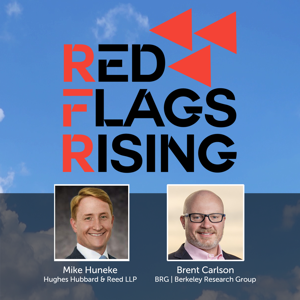
Welcome to Red Flags Rising, where we examine how geopolitics and national security are reshaping corporate enforcement and compliance.
In an era where “economic security” drives government…
Under the “high probability” standard driving this new enforcement playbook, spotting and effectively mitigating “red flags” has a new urgency.
We will help you identify and understand the trends, key insights, and practical solutions that are essential to companies, boards of directors, c-suite management, and compliance professionals in these turbulent times.
30,210 Listeners

9,625 Listeners
143 Listeners

111,865 Listeners

6,224 Listeners

6,178 Listeners
153 Listeners
140 Listeners
13 Listeners

4,494 Listeners
470 Listeners
47 Listeners