
Sign up to save your podcasts
Or



Based on Podcast App listening data
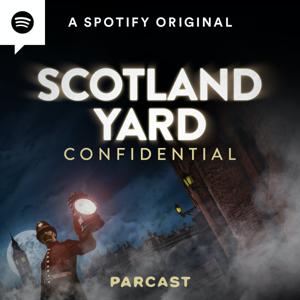
February 1947 is one of the snowiest months on UK record. As roads and rail are forced to close, in London, a six-man criminal gang organized a robbery targeting the Midland Bank of Kentish Town. Their mark was the unsuspecting bank manager, Mr. Snell. But all good plans are bound to go awry. Before they could act, word reached Scotland Yard's mysterious undercover intelligence unit - the Ghost Squad. Detective Inspector Len Crawford quickly came up with a cunning but dangerous play to snare the robbers - but it's a high-risk game that could prove fatal to his men.
Learn more about your ad choices. Visit podcastchoices.com/adchoices
Amid the heatwave of July 1948, a gang of London's top thieves came up with an audacious plot to steal half a million pounds worth of gold bullion and other valuables from the customs warehouse at the newly opened London Airport. The Head of Security at the airport - which later became known as Heathrow - was former Scotland Yard Detective, Donald Fish. He wasted no time in alerting his old pals on the force. The heist, and the resulting royal rumble between cops and robbers became known as The Battle of Heathrow. It went down in Scotland Yard folklore as the most bloody, but most successful sting operation in Flying Squad history.
Learn more about your ad choices. Visit podcastchoices.com/adchoices
On September 6th, 1988, 28-year-old British photographer, Julie Ward disappeared while driving through the Masai Mara Game Reserve in Kenya. Four days later, her father, John Ward, began a search for the truth, which would cost several million pounds and span three decades. Accident? Animal attack? Or murder? The case saw both police in Kenya and detectives from Scotland Yard plagued by conspiracies and cover-ups, secrets and lies. The investigation reached the highest levels of Kenyan politics, but the only true constant was a distraught father, determined to find the truth.
Learn more about your ad choices. Visit podcastchoices.com/adchoices
This is the story of a legendary figure of the Wild West… The man widely believed to have inspired the Lone Ranger… Who was born into slavery — and became one of America’s most revered lawmen. His name was Bass Reeves. Follow Solved Murders to catch the four-part miniseries, Bass Reeves: No Master But Duty. Listen free, only on Spotify.
Learn more about your ad choices. Visit podcastchoices.com/adchoices
1854. A shipwreck was found off the coast of Brazil. On board was a young English aristocrat, 25-year-old Sir Roger Tichborne. But his mother, a wealthy dowager, could not accept his death. When, years later, rumors circled that the survivors were taken to Australia, she placed ads in the papers, but heard nothing. Then, over a decade after the shipwreck, an impoverished man emerged from the Australian outback, making the sensational claim that he was in fact the long-lost Sir Roger. It led to scandal, sensation, and one of the most infamous legal battles in 19th-century Britain. So, just who was the claimant? Jack Whicher, legendary Scotland Yard inspector, was determined to find out.
Learn more about your ad choices. Visit podcastchoices.com/adchoices
2006. On a quiet street in Wembley, London, special constable Nisha Patel-Nasri, was found bleeding to death on her driveway. With no obvious enemies, police initially struggled to find any suspects. But the investigation led them through a twisted, shocking tale of lust, deceit and greed. Detectives from Scotland Yard tackled a crime born of age-old motives with 21st century technology. Using CCTV footage and mobile phone data, they pieced together a trail of evidence that blew the case wide open.
Learn more about your ad choices. Visit podcastchoices.com/adchoices
On February 14th, 1945, 75-year-old farm worker, Charles Walton, was brutally murdered while working in some fields. His body had been pinned to the ground with his own pitchfork, his throat cut with his hedging blade, and the sign of a cross carved into his chest. As superstitious villagers shared rumors of witchcraft and ritual sacrifice, local police realised they were out of their depth and called for help from Scotland Yard. Detective Superintendent Robert Fabian was assigned to the case. The most famous detective of his time, Fabian found himself leading an investigation so frustrating and exasperating that it would remain one of the very few unsolved murders on his record — despite being confident he knew who killed Charles Walton.
Learn more about your ad choices. Visit podcastchoices.com/adchoices
1935. Up in the picturesque hills of Moffat, Scotland, a gruesome discovery is made. Beneath an old bridge, a humble country police constable stands amid human body parts. The public will soon be as mystified as they are shocked, and the case will be dubbed The Jigsaw Murders. Those body parts will form the building blocks of 'the first modern murder investigation', going on to define criminal forensics itself. But under that bridge, horror strewn around his feet, the constable asks himself the question: Who could do something like this?
Learn more about your ad choices. Visit podcastchoices.com/adchoices
On December 29th, 1969, Muriel McKay disappeared from her home in London's affluent suburb of Wimbledon. Her husband, the newspaper executive Alick McKay, was convinced she'd been abducted. When the call came demanding one million pounds in ransom for her safe return, he was proved right. The problem was, the kidnappers had taken the wrong woman. They had meant to abduct Anna Murdoch, wife of media mogul Rupert Murdoch, who was McKay's boss at the time. In fact, the first-time kidnappers bungled every step of their ridiculous plan, and yet managed to evade the clutches of Scotland Yard for nearly two months. The investigation, dogged by a media frenzy, was the largest of its kind, taking over 250 officers some 40 days to solve.
Learn more about your ad choices. Visit podcastchoices.com/adchoices
On June 8th, 1946, London was in a party mood. A Victory Parade to celebrate the end of World War II saw the city consumed with pomp and fanfare. However, in the lull between the parade ending and the evening fireworks, a brutal murder took place. In the affluent suburb of Belgravia, in a house owned by the exiled King of Greece — George II — Elizabeth McLindon was shot in the back of the head. Finding her killer would take a combination of inspired detective work from one of Scotland Yard's finest, coupled with ground-breaking forensic science in a case that set the standard for ballistic analysis.
Learn more about your ad choices. Visit podcastchoices.com/adchoices
From the publisher's feed
Ranked by our users in the last 21 days

4,778 Listeners

1,871 Listeners
805 Listeners

5,244 Listeners

15,622 Listeners

2,516 Listeners

2,833 Listeners
247 Listeners
462 Listeners

1,329 Listeners
1,144 Listeners
41 Listeners

1,114 Listeners
265 Listeners

979 Listeners