
Sign up to save your podcasts
Or

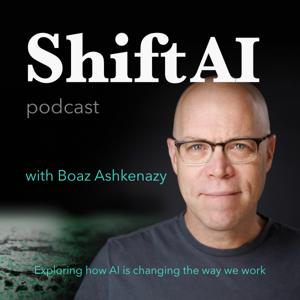

In this episode of the Shift AI Podcast, Scott Roberts, CISO at UiPath, joins host Boaz Ashkenazy for a deep dive into how agentic AI is reshaping enterprise security and automation—both for customers and inside UiPath itself.Scott shares his 25-year security journey spanning Microsoft’s early Security Response Center days (including the era that produced Patch Tuesday and the Security Development Lifecycle), product security work across Windows and Xbox, time at AWS, and leadership roles at Google where he helped build the Android Security Assurance and Pixel Security teams and the Android Monthly Security Update process. He also discusses his work in security standards across IPsec, HTML5 encrypted media, GSMA device security, and most recently, contributions to emerging agentic AI security standards.The conversation then explores UiPath’s evolution from traditional RPA into a unified platform that combines deterministic automation with agentic workflows. Scott walks through a real-world healthcare billing example where agentic automation increased deduplication accuracy dramatically by handling complex, variable inputs that classic RPA struggled with—while still keeping humans in the loop and feeding outcomes back into the system to improve over time.Boaz and Scott go deep on what’s changed for CISOs in the post-LLM world: the need for guardrails, identity and entitlements for AI agents, and the challenge of end users copying sensitive information into consumer AI tools. Scott explains UiPath’s approach: enable adoption while using nudges and policy controls to redirect sensitive workflows into enterprise-safe environments rather than relying solely on blocks.The episode closes with an eye-opening look at UiPath’s internal “agentic threat analyst” system—an orchestration of 60+ agents that can investigate SIEM alerts end-to-end, generate structured incident writeups, and compress hours of analyst work into roughly a minute and a half. Scott’s future-looking takeaway: as AI models evolve beyond “read-only” into potentially “read-write” systems that can update their foundational knowledge, the acceleration could be truly mind-blowing.This episode is essential listening for security leaders, enterprise operators, and automation teams trying to understand how agentic systems change not just productivity, but the entire security operating model.Chapters[00:01] Scott’s Security Journey: Microsoft, Google, Coinbase, UiPath[01:33] Security Standards Work: From IPsec to Agentic AI Standards[04:08] What UiPath Does: Process Orchestration, RPA, and Enterprise Automation[06:28] RPA vs Agentic Automation: A Healthcare Billing Deduplication Example[09:17] The Agentic Stack: Canvas, Guardrails, and the AI Trust Layer[10:31] How LLMs Change Security: Data Controls, Access, and Governance[12:14] Internal Adoption at UiPath: AI Tooling by Persona (Legal, Finance, Engineering)[13:13] Code Velocity and Security: Agents Generating Code, Agents Verifying It[15:53] Two AI Security Worlds: Orchestration Platforms vs End-User Chat Interfaces[17:11] Securing End Users: Enterprise LLMs, Nudges, and Browser-Based Controls[19:07] Sovereign AI and Data Boundaries: Keeping Data in the Right Region[21:00] Over-Permissioning Meets Agents: Why AI Makes Old Problems Obvious Fast[22:21] The Next Wave: AI Transforming the Entire SDLC End-to-End[24:53] Security Pitfalls in Agentic SDLC: Misaligned Incentives and Permissions[26:02] UiPath’s Agentic Threat Analyst: 60+ Agents, SIEM to Writeup Automation[30:07] What Changes for Humans: Faster “Time to Truth” and Higher-Leverage Work[32:09] Two-Word Future: “Mind Blowing” and Read/Write ModelsConnect with Scott RobertsLinkedIn: https://www.linkedin.com/in/scottroberts6/Connect with Boaz AshkenazyLinkedIn: https://www.linkedin.com/in/boazashkenazy/Email: [email protected]
 View all episodes
 By Boaz Ashkenazy
5
55 ratings
In this episode of the Shift AI Podcast, Scott Roberts, CISO at UiPath, joins host Boaz Ashkenazy for a deep dive into how agentic AI is reshaping enterprise security and automation—both for customers and inside UiPath itself.Scott shares his 25-year security journey spanning Microsoft’s early Security Response Center days (including the era that produced Patch Tuesday and the Security Development Lifecycle), product security work across Windows and Xbox, time at AWS, and leadership roles at Google where he helped build the Android Security Assurance and Pixel Security teams and the Android Monthly Security Update process. He also discusses his work in security standards across IPsec, HTML5 encrypted media, GSMA device security, and most recently, contributions to emerging agentic AI security standards.The conversation then explores UiPath’s evolution from traditional RPA into a unified platform that combines deterministic automation with agentic workflows. Scott walks through a real-world healthcare billing example where agentic automation increased deduplication accuracy dramatically by handling complex, variable inputs that classic RPA struggled with—while still keeping humans in the loop and feeding outcomes back into the system to improve over time.Boaz and Scott go deep on what’s changed for CISOs in the post-LLM world: the need for guardrails, identity and entitlements for AI agents, and the challenge of end users copying sensitive information into consumer AI tools. Scott explains UiPath’s approach: enable adoption while using nudges and policy controls to redirect sensitive workflows into enterprise-safe environments rather than relying solely on blocks.The episode closes with an eye-opening look at UiPath’s internal “agentic threat analyst” system—an orchestration of 60+ agents that can investigate SIEM alerts end-to-end, generate structured incident writeups, and compress hours of analyst work into roughly a minute and a half. Scott’s future-looking takeaway: as AI models evolve beyond “read-only” into potentially “read-write” systems that can update their foundational knowledge, the acceleration could be truly mind-blowing.This episode is essential listening for security leaders, enterprise operators, and automation teams trying to understand how agentic systems change not just productivity, but the entire security operating model.Chapters[00:01] Scott’s Security Journey: Microsoft, Google, Coinbase, UiPath[01:33] Security Standards Work: From IPsec to Agentic AI Standards[04:08] What UiPath Does: Process Orchestration, RPA, and Enterprise Automation[06:28] RPA vs Agentic Automation: A Healthcare Billing Deduplication Example[09:17] The Agentic Stack: Canvas, Guardrails, and the AI Trust Layer[10:31] How LLMs Change Security: Data Controls, Access, and Governance[12:14] Internal Adoption at UiPath: AI Tooling by Persona (Legal, Finance, Engineering)[13:13] Code Velocity and Security: Agents Generating Code, Agents Verifying It[15:53] Two AI Security Worlds: Orchestration Platforms vs End-User Chat Interfaces[17:11] Securing End Users: Enterprise LLMs, Nudges, and Browser-Based Controls[19:07] Sovereign AI and Data Boundaries: Keeping Data in the Right Region[21:00] Over-Permissioning Meets Agents: Why AI Makes Old Problems Obvious Fast[22:21] The Next Wave: AI Transforming the Entire SDLC End-to-End[24:53] Security Pitfalls in Agentic SDLC: Misaligned Incentives and Permissions[26:02] UiPath’s Agentic Threat Analyst: 60+ Agents, SIEM to Writeup Automation[30:07] What Changes for Humans: Faster “Time to Truth” and Higher-Leverage Work[32:09] Two-Word Future: “Mind Blowing” and Read/Write ModelsConnect with Scott RobertsLinkedIn: https://www.linkedin.com/in/scottroberts6/Connect with Boaz AshkenazyLinkedIn: https://www.linkedin.com/in/boazashkenazy/Email: [email protected]

32,100 Listeners

30,666 Listeners

43,528 Listeners

8,776 Listeners
9,622 Listeners
3,150 Listeners
506 Listeners
169 Listeners

87,529 Listeners

111,948 Listeners
5,485 Listeners

29,207 Listeners

15,950 Listeners

10,121 Listeners

3,483 Listeners