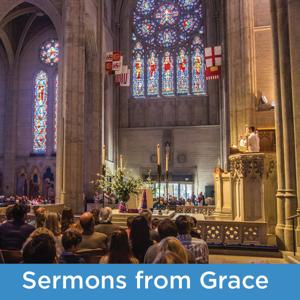
“And Jesus came and touched them, saying, ‘Get up and do not be afraid…” (Mt. 17).
Grace Cathedral, San Francisco, CA 2D12
Last Epiphany (Year A) 11:00 a.m.
Sunday 19 February 2023
Exodus 24:12-18
Psalm 99:1-8
2 Peter 1:16-21
Matthew 17:1-9
Last week in an email my friend Hugh Morgan observed that when it comes to social justice the Old Testament prophets sound strikingly modern to him. He wonders if the Old Testament has a stronger social justice message than the New Testament. [1] Today we consider this question.
But first let’s define social justice as equality in wealth, political influence, cultural impact, respect… in opportunities to make a difference, to love and serve others. It involves creating a society in which every person is treated with dignity as a child of God, as bearing God’s image. Jesus calls this the realm of God. Martin Luther King calls it “the beloved community.”
Today we celebrate the Last Sunday of Epiphany. Epiphany means a shining forth. You might call it a realization that utterly transforms us. The culminating story of this season occurs on a mountain top when Jesus’ friends experience a mystical encounter with God.
In a recent conversation the law professor Patricia Williams spoke about two epiphanies that she had had. [2] For her whole life she had taken at face value family stories she had heard about her great-great-grandmother. These described her as a lazy person who was constantly fishing, as someone that no one liked. Then when Williams was in her twenties her sister discovered the bill of sale for their great-great-grandmother.
In an instant she realized the truth. At the age of eleven her great-great-grandmother had been sold away from all that she had ever known. Two years later she was pregnant with the child of the dissatisfied thirty-five year old man who had bought her. She was traumatized so alienated from his children, who were taught to look down on her, that the only thing they chose to tell her descendants was that she was unpopular. To get to the truth Patricia Williams had to interpret those two stories together and to have empathy for someone’s suffering. We have to do the same thing in order to understand the Bible.
Getting back to our question, Hugh makes a wise observation about the importance of social justice in the Old Testament. The deceased Berkeley sociologist Robert Bellah (1927-2013) wrote a book called Religion in Human Evolution: From the Paleolithic to the Axial Age. He asks about how religious belief makes large human societies possible. He notes that Israel first appears in Egyptian records in the year 1208 BCE, long before anything written in the Bible.
He points out two notable features about the social world that produced the Old Testament. First, that this it attempts to establish a society not on the role of one man as a divine king (like most Egyptian pharaohs) but rather on a covenant between God and the people. Moses is a prophet not a divine king.
The second thing he notices is that the prophets, for instance, Amos does not just condemn failures of religious ritual but the mistreatment of the weak and poor. Amos criticizes both foreigners and his own people. He writes, “Thus says the Lord: For three transgressions of Israel, and for four I will not revoke the punishment; because they sell the righteous for silver and the needy for a pair of shoes” (Amos 2). [3]
At this point I feel compelled to tell you more about the Old Testament. It will be a long time before Chat GPT can write an accurate sermon. I am totally astonished by how incorrect search engine results are when it comes to some of the most basic issues in religion. This includes how we determine when these books were written. There was no journalist taking notes in the Garden of Eden or the court of David. The books of the Bible were not written in the order in which the events they record happened, or in the order in which they are presented.
One way to look at it is to see them growing up around the two ideas I just mentioned from the prophet Amos – that there is one God for all people and that God cares how the poor are treated. Scholars believe that the words of the prophet Amos were among the first in the entire Bible. So it is not as if the world was created, Noah built an ark, Abraham met God, God chose the Tribes of Israel, David’s kingdom was established, many other kings reigned and then social justice became important. Social justice, this idea of God’s universality and the dignity of every person, comes first. The other stories are ancient but put together by writers with this conviction in mind.
So the twentieth century rabbi Abraham Joshua Heschel calls the prophets, “the most disturbing people who ever lived” and “the [ones] who brought the Bible into being.” They “ceaseless[ly] shatter our indifference.” They interpret our existence from the perspective of God. Heschel writes that the prophets have assimilated their emotional life to that of the Divine so that the prophet, “lives not only his personal life but also the life of God. The prophet hears God’s voice and feels His heart.” [4]
The Old Testament was written mostly in Hebrew with three main types of literature the Torah (instruction or) the law, the Nevi’im or prophets, and the Ketuvim or the writings. The New Testament was written in Greek under Roman occupation and includes totally different genres: gospels, epistles or letters, and John’s apocalyptic conclusion the Book of Revelation.
As Jesus alludes to in the Book of Matthew, the New Testament is built on the foundation of the old – that there is one God for all the nations who cares about human dignity. It has a different feeling because it is composed at a different time, under different social circumstances for a different audience. But for me it is not less focused on social justice. Christians do not worship the Bible, but the person of Jesus. Jesus is how we understand our lives and our connection to God.
We see this in today’s gospel. The story of the Transfiguration is not so much about a private mystical experience, but a meditation on Christ’s passion. It exists to shape our response to Jesus’ death on the cross. Imagine the Book of Matthew. We climb up one side through Jesus’ teaching and healing until we finally hear Jesus describe how his death will be. The disciples cannot take it in. We go down the other side to Jerusalem where Jesus will be killed. And for a reassuring moment we linger at the mountaintop.
Let me briefly tell you three things about the Greek text. Matthew uses the emphatic word idou or “Behold! Look!” three times. First, before the appearance of Moses who represents the law, and Elijah who stands for the prophets. Then again when a shining cloud appears and yet again when God says, “This is my Son, the Beloved; with him I am well pleased” (Mt. 17).
Jesus’ friends feel so afraid they fall down like dead people. Jesus tells his friends to rise up and uses the same word he does when he says that the Son of Man will be raised from the dead. Jesus touches them in a reassuring way. The Greek word hapsamenos means to touch, hold or grasp. But it also can be translated as to light or ignite a flame.
What does it mean for social justice, to have at the heart of our religion a man who gives up his life and is executed? It is not just what Jesus says that matters. He gives his life to help make real this idea that God loves every human being, that each life has innate dignity. This includes the truth that death is not the end.
Although Christians often get lost in the belief that faith is about an isolated individual’s personal salvation, there is a deep tradition of meditating on the way Jesus’ death reverses the overwhelming evil all around us. I do not have time for more examples but I would like to mention Basil of Caesarea (330-379).
In the Gospel of Luke Jesus tells the story about a rich man who has so much property that he decides to build a bigger barn to hold it all so that he can “eat, drink and be merry” (Lk. 12). That night the foolish man dies. So the fourth century Basil wrote a sermon about this. He says that what we think we need constantly changes. We are metaphorically building smaller and bigger barns all the time. When we think we need too much we cannot be generous to others.
Basil says, “How can I bring the sufferings of the poverty-stricken to your attention? When they look around inside their hovels… [and] find clothes and furnishings so miserable… worth only a few cents. What then? They turn their gaze to their own children, thinking that perhaps by bringing them to the slave-market they might find some respite from death. Consider now the violent struggle that takes place between the desperation arising from famine and a parent’s fundamental instincts. Starvation on the one side threatens horrible death, while nature resists, convincing the parents rather to die with their children. Time and again they vacillate, but in the end they succumb, driven by want and cruel necessity.” [5] The Christian tradition in every generation is filled with appeals like this. They beg us to recognize the full humanity of every person.
Let me tell you the second of Patricia Williams’ two epiphanies. When she was a child there were very few women or Black people who were judges, law professors, law partners, attorney generals, etc. Virtually all law had been written by white men. Because of this there were blind spots, basic failures to understand society that had crucial legal ramifications. [6]
Professor Williams and other intellectuals invented Critical Race Theory to address this, to help the law work for all people, not just those in power. These debates were largely for people in universities until about ten years ago. In our conversation Professor Williams expressed her surprise when she heard a powerful political consultant talk about how he had made millions of Americans fear and hate this social justice project. He had successfully convinced them to regard Critical Race Theory as divisive and dangerous to white people. He explicitly stated that increasing their anger was a means of getting their votes. [7]
The great twentieth century Jewish expert in building healthy religious congregations Edwin Friedman frequently repeats this warning. “Expect sabotage.” [8] When we are working for good, to change how things are, we will be opposed. Those who care about social justice need to understand that there will be people who actively seek to thwart it.
Patricia Williams is a prophet for me, shattering my indifference. Many here this morning are prophets to me also. Behold. Be ignited. Shine forth. Let the realization of Jesus’ love utterly transform us.
[1] Hugh Morgan, 9 February 2023. “In reading Isaiah and the minor prophets, I am struck by how modern they sound, when calling out issues of social justice. Of course, our thinking has been influenced by the enlightenment and all that came after it, so my brain may be predisposed to see these threads in the text. But they are there.
You do not see the same strength of views on social justice in the New Testament, certainly little about upsetting the then current order. And I do not think you see similar messages supporting the oppressed in Greek or Roman writings (I have a super limited sense of what these are.)
And, you do not see "social justice thought" - a very modern thing - called out, developed, emphasized from the OT texts in the early church, nor through the reformation, not even in the revivals in America and England in the late 1800s.
Two questions to ponder
1. Where did the social justice message in the OT come from?
2. Are there strains of this message in church history that I / we are not aware of?”
[2] Patricia J. Williams on the Grace Cathedral Forum, 1 February 2023. https://youtu.be/8h-xHY7OIuY . Also see Patricia J. Williams, The Alchemy of Race and Rights: Diary of a Law Professor (Cambridge, MA: Harvard University Press, 1991) 17-19.
[3] Robert Bellay, Religion in Human Evolution: From the Paleolithic to the Axial Age (Cambridge, MA: Harvard University Press, 2011). Quoting Michael Walzer and David Malo on a covenant between the people and God (310f). Amos’ ethical statements (302).
[4] Abraham Joshua Heschel, The Prophets: An Introduction, Volume One (NY: Harper, 1962) ix-26.
[5] “How can I bring the sufferings of the poverty-stricken to your attention? When they look around inside their hovels… [and] find clothes and furnishings so miserable… worth only a few cents. What then? They turn their gaze to their own children, thinking that perhaps by bringing them to the slave-market they might find some respite from death. Consider now the violent struggle that takes place between the desperation arising from famine and a parent’s fundamental instincts. Starvation on the one side threatens horrible death, while nature resists, convincing the parents rather to die with their children. Time and again they vacillate, but in the end they succumb, driven by want and cruel necessity.” Basil of Caesarea, “I Will Tear Down My Barns.” Tr. Paul Shroeder. Cited in Logismoi. http://logismoitouaaron.blogspot.com/2010/03/on-social-justice-by-st-basil-great.html
[6] Professor Patricia J. Williams and I talked about “stand your ground” laws that result in much higher rates of death among Black men, because white people are more likely to be afraid of them.
[7] In an online interaction I heard from someone who is monomaniacally focused on the idea that Critical Race Theory must necessarily involve government forced discrimination against white people. He did not have the time to see the Patricia Williams interview. He had already made up his mind.
[8] “Sabotage is part and parcel of the systemic process of leadership.” Edwin Friedman, A Failure of Nerve: Leadership in the Age of the Quick Fix (NY: Church Publishing, 2017 revised).