
Sign up to save your podcasts
Or

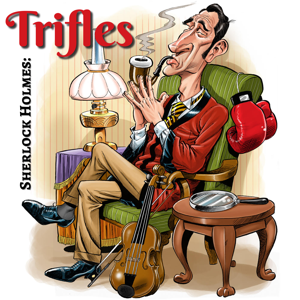


The third week of the month means we look at a piece of Sherlockian scholarship — particularly one that may not be as widely read or generally available to most Sherlock Holmes fans.
This month, we're looking at Bernard Davies' "The Back Yards of Baker Street," which appeared in James Edward Holroyd's Seventeen Steps to 221B. Step with us through the alleyways of 1895 to see if we can make a proper identification. It's just a Trifle.
Don't forget to listen to "Trifling Trifles" — short-form content that doesn't warrant a full episode. This is a benefit exclusively for our paying subscribers. Check it out (Patreon | Substack). Leave Trifles a five-star rating on Apple Podcasts and Spotify; listen to this episode here or wherever you get podcasts LinksCapital punishment in the United Kingdom evolved over a period of time. From the mid-17th century through 1820, the Bloody Code tracked some 200 crimes punishable by death.
In which Sherlock Holmes stories do we hear about capital punishment, and under England's laws of the late Victorian period, who would have been eligible for death by hanging? It's just a Trifle.
Don't forget to listen to "Trifling Trifles" — short-form content that doesn't warrant a full episode. This is a benefit exclusively for our paying subscribers. Check it out (Patreon | Substack). Leave Trifles a five-star rating on Apple Podcasts and Spotify; listen to this episode here or wherever you get podcasts LinksThe latest installment in our review of Morley-Montgomery Award-winning articles is by Andrew Jay Peck, BSI ("Inspector Baynes"): "The Solitary Man-Uscript" from Vol. 22, No. 2 of The Baker Street Journal in 1972.
Just who was the Solitary Cyclist? There are two cyclists in the story, and one is a young lady simply trying to get to her train safely; the other is a bearded man with sunglasses hunched over his handlebars. Only one of them can be our cyclist. It's just a Trifle.
Don't forget to check out our "Trifling Trifles" series -- shorter content that didn't warrant a full episode, available exclusively for our paying subscribers. Check it out (Patreon | Substack). Leave Trifles a five-star rating on Apple Podcasts and Spotify; listen to this episode here or wherever you get podcasts LinksWe came across a quite unusual observation — a Trifle, if you will — in an old issue of The Baker Street Journal. An article by Antony Boucher called "An Aborted Avatar."
Boucher discovered a turn of the century play called The King of Gee-Whiz that involved Sherlock Holmes in a quite unusual setting. The play was co-written by L. Frank Baum, of The Wizard of Oz fame. It's just a Trifle.
Another "Trifling Trifles" episode — short-form content that doesn't warrant a full episode — is coming your way in a few days. As a reminder, this is exclusively for our paying subscribers. Check it out (Patreon | Substack). Leave Trifles a five-star rating on Apple Podcasts and Spotify; listen to this episode here or wherever you get podcasts LinksA term we don't hear as frequently these days is "gypsy." Unless you're headed to see a Sondheim musical, which is about an entirely different Gypsy (and one with Sherlockian connections too).
Anyway, our focus here is on stories in which gypsies are mentioned (there are two; can you name them?) and a bit of historical context of gypsies in the Victorian era, including the documented experience of one exalted person. It's just a Trifle.
Another "Trifling Trifles" episode — short-form content that doesn't warrant a full episode — is coming your way in a few days. As a reminder, this is exclusively for our paying subscribers. Check it out (Patreon | Substack). Leave Trifles a five-star rating on Apple Podcasts and Spotify; listen to this episode here or wherever you get podcasts LinksOnce again, we find ourselves in a "Mr. Sherlock Holmes the theorist"-themed episode, where we look at a piece of old scholarship. This time, we share a chapter from William S. Baring-Gould's groundbreaking biography of Sherlock Holmes. Chapter V "On Stage and Off in England and America: 1879–1881" finds us in the two years leading up to Holmes and Watson meeting each other, while Holmes was beginning to run low on funds. His decision would mean a remarkable set of experiences ahead. It's just a Trifle.
And we have some bonus content related to a particular footnote of Baring-Gould's in this chapter. It's available exclusively for our supporters. Another "Trifling Trifles" episode — short-form content that doesn't warrant a full episode — is coming your way in a few days. As a reminder, this is exclusively for our paying subscribers. Check it out (Patreon | Substack). Leave Trifles a five-star rating on Apple Podcasts and Spotify; listen to this episode here or wherever you get podcasts Links
The second in our series on the Apocrypha of Sherlock Holmes — stories that are not in the original Canonical 60 but that have some relevant interest. In this case, we have a story written by Arthur Conan Doyle in 1898 and set in 1892 involving the mysterious death of a passenger on a train. The murderer is nowhere to be found and the man has an unusual number of watches on his person.
A "well-known criminal investigator" writes a letter to the press with an explanation. We briefly discuss the story and the many theories as to the authorship of those letters over the years by numerous Sherlockians. It's just a Trifle.
This season, we've added "Trifling Trifles" — short-form content that doesn't warrant a full episode — as an additional channel of content exclusively for our paying subscribers. Check it out (Patreon | Substack). Do you have a topic you'd like to recommend? Email us at [email protected] and if we use your idea on the air, we'll send you a thank-you gift. Leave Trifles a five-star rating on Apple Podcasts and Spotify; listen to this episode here or wherever you get podcasts Please leave us a rating and review on iTunes or Google Play, and consider supporting our efforts through Patreon or Substack. Links
Music credits Performers: Uncredited violinist, US Marine Chamber Orchestra Publisher Info.: Washington, DC: United States Marine Band Copyright: Creative Commons Attribution 3.0
Music credits Performers: Uncredited violinist, US Marine Chamber Orchestra Publisher Info.: Washington, DC: United States Marine Band Copyright: Creative Commons Attribution 3.0
Music credits Performers: Uncredited violinist, US Marine Chamber Orchestra Publisher Info.: Washington, DC: United States Marine Band Copyright: Creative Commons Attribution 3.0
From the publisher's feed

38,008 Listeners

38,723 Listeners
11,564 Listeners

8,735 Listeners
2,495 Listeners
333 Listeners
3,201 Listeners
2,506 Listeners
119 Listeners
406 Listeners
21 Listeners
32 Listeners
414 Listeners
1,243 Listeners
139 Listeners