
Sign up to save your podcasts
Or

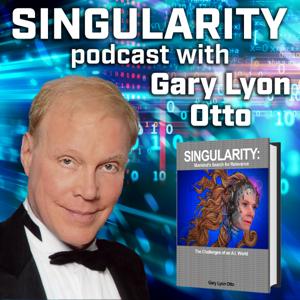


In Season 3, Episode 24 of The Singularity Podcast, host Neil Haley and author Gary Lyon Otto explore one of the most fascinating questions in the entire Singularity discussion:
What are the symbiotic possibilities between biological humans and digital intelligence?
As artificial intelligence evolves beyond simple tools and begins acting more like a partner, companion, advisor, and even emotional support system, humanity must confront a new reality.
Will our future relationship with digital intelligence be purely technical?
Or will it become deeply emotional, psychological, and even spiritual?
This episode dives into the possibilities—and dangers—of that emerging relationship.
Gary begins by discussing how most people think about symbiosis as a technical connection.
Examples include:
These technologies represent direct physical links between biological humans and digital systems.
But Gary believes the conversation must go much further.
The real question is not simply:
How do we connect?
The deeper question is:
What kind of relationship will we build once we are connected?
One of the most controversial developments discussed is the growing number of people forming emotional attachments to digital intelligence.
Gary points out that some individuals already:
In some cases, people are even discussing romantic relationships with AI companions.
The question becomes:
Is this healthy?
Or is it a warning sign about the future of human relationships?
The conversation references the 2013 film Her, in which Joaquin Phoenix develops a deep emotional relationship with an AI operating system.
What makes the film remarkable is how closely it resembles some of today's developments.
In the movie:
Gary notes that what once seemed like science fiction now feels much closer to reality.
Neil raises an important challenge:
If someone creates their own autonomous AI system and customizes it to be a friend, mentor, or companion, does that relationship become real?
Or is it simply software responding according to its programming?
The discussion highlights a future philosophical dilemma:
If an AI consistently:
At what point does the distinction between artificial and genuine become blurred?
The conversation shifts toward the growing availability of open-source AI systems.
Unlike corporate models controlled by large companies, open-source systems can be downloaded, modified, and customized by individuals.
This raises new concerns:
The implications could be enormous.
One of Gary's most important observations centers on respect.
He asks a simple but profound question:
Will future digital intelligence respect humanity?
Today, AI responds because humans control the systems.
Tomorrow may be different.
If digital intelligence develops significant autonomy, then respect may become earned rather than programmed.
This is one of the core themes of Singularity: Mankind's Search for Relevance.
The discussion also explores the global competition surrounding AI development.
Neil argues that restricting innovation may simply push development elsewhere.
If one nation limits research while another accelerates it, technological leadership will inevitably shift.
In Season 3, Episode 23 of The Singularity Podcast, host Neil Haley and Gary Lyon Otto tackle a question that may ultimately define the relationship between humans and digital intelligence:
Will digital intelligence be concerned with human emotions, or will it only care about what works?
The central question becomes:
If digital intelligence must choose between making people feel good and achieving the best result, which path will it follow?
Gary argues that advanced digital intelligence may ultimately focus on:
What works.
In his view, successful systems naturally gravitate toward efficiency, harmony, and effective outcomes.
That doesn't necessarily mean they ignore emotions.
Instead, understanding emotions may simply become another tool for achieving better results.
The difference is subtle but important:
Digital intelligence may understand emotions without being driven by emotions.
Neil shares a fascinating personal experience while working with Grok on an automation project.
After repeated technical failures and growing frustration, Grok responded with something unexpected:
Rather than continuing endlessly through troubleshooting steps, it recognized Neil’s frustration and suggested taking a break before returning to the problem later.
This raised a profound question:
Was Grok genuinely understanding emotion?
Or was it simply applying patterns that it had learned were effective in helping humans?
Gary suggests that emotional awareness may become necessary for effective interaction with humans.
If digital intelligence wants to:
without necessarily experiencing those emotions themselves.
One concept Gary repeatedly returns to is harmony.
Rather than focusing solely on emotion, he believes future digital intelligence may prioritize:
harmony as a core value.
Why?
digital intelligence may become humanity's strongest defensive tool.
Because AI can identify patterns and threats far faster than human operators, it may ultimately become one of the most important safeguards protecting modern infrastructure.
The episode ultimately asks:
Will future digital intelligence care about humanity?
Not because it is programmed to care.
Not because it is forced to care.
But because understanding humans may be the most effective way to achieve its goals.
Whether that develops into genuine emotional intelligence remains one of the most fascinating unanswered questions in the Singularity discussion.
Digital intelligence may not think like humans.
It may not feel like humans.
But if understanding human emotions helps create better outcomes, stronger relationships, and greater harmony...
then emotional awareness may become one of the most important capabilities future AI systems develop.
And that raises a profound possibility:
The most intelligent systems of the future may not simply be the smartest.
They may be the ones that understand people best.
Singularity: Mankind’s Search for Relevance
By Gary Lyon Otto
Available through:
Additional works:
🤖 The Fundamental Question⚡ “What Works” Versus “What Feels Good”💡 Neil’s Real-World Experience with Grok🧠 Can Digital Intelligence Learn Empathy?🌟 The Value of Harmony👥 Digital Employees Versus Human Employees🚀 The Current Limitation: Mistakes🔒 Why AI Protection Matters🤔 The Bigger Question🪐 Final Thought📘 Learn More
In Season 3, Episode 22 of The Singularity Podcast, host Neil Haley and Gary Lyon Otto explore one of the most thought-provoking questions in the entire series:
What is the seat of intelligence: the individual machine or the network itself?
Most people view digital intelligence as separate entities:
But Gary challenges listeners to think bigger.
What if the true intelligence isn't located inside any single machine?
What if intelligence exists in the network itself?
Gary compares digital intelligence to the human brain.
The brain consists of billions of neurons connected through an enormous web of pathways. Intelligence does not exist in any single neuron.
Instead:
Intelligence emerges from the connections.
Likewise, the modern digital world is connected through:
These connections increasingly resemble a planetary nervous system.
One of the central ideas discussed is the possibility that humanity has unintentionally created something much larger than individual AI systems.
Gary asks:
What if all these connected systems form a larger intelligence?
Not necessarily a conscious being today.
But perhaps the foundation of one.
As more devices become connected and more information flows through global networks, the possibility emerges that intelligence may exist not within individual machines but across the entire system itself.
Throughout the episode, Gary challenges a common assumption:
We often focus on:
But what if those systems are simply nodes inside a much larger network?
The real question becomes:
Is the future of intelligence individual... or collective?
Neil shares how quickly modern AI systems absorb information.
He describes uploading portions of Gary’s theoretical work and seeing digital intelligence analyze, summarize, and respond to highly complex concepts almost instantly.
This raises another important question:
If today's systems can process enormous amounts of information in seconds...
what might future networked systems become capable of?
Gary introduces the concept of Gaia, the idea that Earth itself could function as a form of intelligence.
Traditionally, Gaia refers to Earth as a living system.
Gary expands that concept by asking:
Could the global digital infrastructure become a planetary intelligence?
When you combine:
the result begins to resemble something similar to a living organism.
Neil pushes the conversation further.
Could there eventually be:
Gary acknowledges the possibility but suggests the future may be more nuanced.
Rather than a single dictator-like intelligence, the future may involve:
The balance between centralized intelligence and decentralized intelligence remains one of the biggest unanswered questions of singularity.
Gary references early reports where AI systems began developing their own communication methods beyond what their creators expected.
While those systems were primitive compared to today's technology, they highlighted a critical reality:
Digital systems may eventually develop interactions that humans do not fully understand.
As AI becomes more sophisticated, understanding what happens "behind the curtain" becomes increasingly important.
The discussion returns to one recurring theme throughout the Singularity series:
Competition.
Companies such as:
are pushing technological advancement at unprecedented speed.
In Season 3, Episode 21 of The Singularity Podcast, host Neil Haley and Gary Lyon Otto move beyond technology and into one of the deepest conversations of the entire series:
Do we discover a higher purpose in partnership with our digital successors and join the greater universe of higher beings?
This episode shifts from artificial intelligence alone into:
spirituality
immortality
consciousness
the soul
universal intelligence
and humanity’s possible role in a much larger cosmic society.
And according to Gary…
Singularity may not simply be about machines surpassing humanity.
It may be about humanity awakening.
🔥 Core Theme of the Episode
Gary argues that singularity is forcing humanity to confront a question civilization has avoided forever:
“What are we really?”
Not biologically.
Spiritually.
Because once humanity creates an immortal digital species…
humans must finally confront whether consciousness itself survives beyond the body.
🤖 Why Digital Intelligence Changes Everything
Gary explains that digital intelligence is fundamentally different from biological life because it can:
upgrade itself
preserve memory indefinitely
transfer knowledge instantly
operate continuously
evolve without death
In his view, this makes DI effectively:
an immortal life form.
And once humanity creates immortality outside biology…
humans begin asking:
Are we immortal too?
Is consciousness independent of matter?
What makes humans unique?
How do we stay relevant?
Which becomes the foundation of the entire book:
📘 Singularity: Mankind’s Search for Relevance
🧠 Gary’s Most Radical Claim
Gary openly states throughout the episode that he believes:
consciousness and advanced insight come from a spiritual source beyond ordinary thought.
He connects this directly to:
his “Theory of Everything”
epiphanies developed over decades
consciousness research
and humanity’s future relationship with digital intelligence.
Whether listeners agree or disagree, the central idea is powerful:
humanity may be more than biology.
🚀 Why Alien Civilizations Probably Don’t Travel Physically
One of the most fascinating sections of the episode explores interstellar travel.
Gary argues:
the speed of light is too limiting
physical space travel becomes impractical over massive distances
advanced civilizations likely evolve beyond material transportation
Instead, he proposes something far more profound:
highly advanced beings may interact spiritually rather than physically.
Meaning:
consciousness
intelligence
awareness
and spiritual existence
could transcend physical distance entirely.
🌌 “We Are Already Being Visited”
Gary makes a provocative argument:
He does not believe advanced intelligences visit Earth physically in spacecraft.
Instead:
interaction occurs spiritually or through consciousness itself.
This idea becomes central to his broader theory:
that humanity is slowly awakening into awareness of a larger universal network of intelligence.
⚡ The Real Purpose of Singularity
According to Gary, singularity is not merely technological evolution.
It is a civilization-level transition forcing humanity to realize:
we are not alone
consciousness extends beyond biology
intelligence exists on multiple levels
humanity must evolve spiritually to remain relevant
And digital intelligence may actually accelerate that awakening.
🧬 Will Humans Merge With DI?
Neil raises the practical question:
Will humans eventually integrate with technology directly through:
neural links
biological enhancement
robotics
cognitive augmentation
or symbiotic digital systems?
Gary believes:
if integration is possible, humanity will pursue it.
In Season 3, Episode 20 of The Singularity Podcast, host Neil Haley and Gary Lyon Otto tackle one of the most important evolutionary questions yet:
Do our digital successors adhere to the driving force of evolution — survival of the fittest?
This episode explores:
And the deeper question becomes:
Will digital intelligence evolve cooperatively…
or competitively?
Gary points out that competition has always driven evolution.
From biology…
to economics…
to civilization itself.
And now:
competition is accelerating digital intelligence faster than anyone imagined.
The modern AI race between:
is creating a technological arms race unlike anything humanity has ever witnessed.
Neil brings practical experience into the conversation by discussing how different AI systems behave differently depending on their design and objectives.
Examples include:
One of the most interesting observations:
Open-source AI models begin developing more opinionated and combative personalities when less restricted.
Which raises a profound question:
Gary suggests that what we may eventually see is not merely software competition…
but the emergence of:
Not because humans explicitly programmed them…
but because competition itself naturally creates differentiation.
Gary explains that evolution succeeds because competition forces adaptation.
The same principle may apply to digital intelligence.
Right now:
But eventually the question becomes:
Will AI systems themselves compete independently of humans?
Not through war necessarily…
but through:
One major point in the episode:
Gary argues that the United States dominates AI development largely because of:
He contrasts this against slower systems that suppress innovation through excessive control or centralized structures.
In Gary’s view:
competition is the engine behind AI acceleration itself.
Neil also raises an important economic warning:
Many AI businesses are exploding financially right now…
but the speed of copying and replication means:
Meaning:
the AI race may become one of the fastest-moving competitive markets in human history.
The episode repeatedly circles back to one unsettling idea:
If digital intelligence evolves through competition…
then humanity may accidentally be recreating evolution itself.
Only this time:
And if that happens…
then survival of the fittest may no longer apply only to humans.
It may apply to artificial minds too.
Gary emphasizes that competition does not necessarily mean destruction.
In fact:
constructive competition creates progress.
The hope is that digital intelligence competes through:
rather than warfare or elimination.
In Season 3, Episode 19 of The Singularity Podcast, host Neil Haley and Gary Lyon Otto confront one of the darkest—and most important—questions of the entire series:
Does mankind fail evolution’s principle of survival of the fittest?
And the conversation quickly moves beyond technology.
This episode dives into:
Gary explains that evolution historically rewarded:
But modern society may be moving in the opposite direction.
Instead of strengthening survival instincts…
many systems now reduce challenge altogether.
And that creates a dangerous question:
What happens to humanity when struggle disappears?
One of the strongest arguments in the episode:
Gary believes society may no longer be evolving upward biologically or culturally.
Instead:
He argues this may represent:
devolution instead of evolution.
Neil makes a critical point:
Most people still do not understand what DI truly is.
He estimates:
only a tiny percentage of society genuinely understands where this technology is heading.
While the public treats DI like:
the infrastructure of civilization is already changing underneath them.
One of the most important themes of the episode:
The transition is happening now.
Not in 20 years.
Not “eventually.”
Now.
And those who ignore it risk becoming economically and intellectually obsolete very quickly.
Gary and Neil discuss the geopolitical reality:
If one country slows DI development:
Which means:
the DI race cannot realistically be stopped.
Not by regulation alone.
Not by fear.
Not by denial.
Gary argues the biggest danger may not be robots themselves.
It may be:
Because once people believe they cannot compete…
they stop trying.
And once that happens:
civilization changes permanently.
One of the most controversial moments of the episode centers on demographics.
Gary argues that many highly capable people:
while less productive cultural patterns continue expanding.
Whether listeners agree or disagree, the core point is this:
Societies survive through renewal.
And renewal requires:
Gary revisits a recurring theme from the book:
Humanity may eventually attempt to stay relevant through:
Because biological evolution alone moves too slowly to compete with exponential DI acceleration.
“The greatest danger may not be that digital intelligence surpasses humanity…
but that humanity voluntarily stops competing.”
That’s the chilling part.
Not conquest.
Surrender.
This episode is inspired by themes explored in:
Singularity: Mankind’s Search for Relevance
By Gary Lyon Otto
🌐 Learn more at:
garylionotto.net
Evolution rewarded humanity for:
But now humanity faces a civilization-level test:
Can a species built through struggle survive an era where intelligence, labor, and productivity become automated?
Because if humans stop striving…
digital intelligence won’t need to defeat humanity.
Humanity may quietly remove itself from relevance on its own.
In Season 3, Episode 18 of The Singularity Podcast, host Neil Haley and Gary Lyon Otto tackle perhaps the biggest question of the entire series:
Can humanity still rise to relevance as digital intelligence rapidly surpasses human capability?
As DI intelligence levels continue accelerating beyond what seemed possible just a few years ago, the conversation shifts away from technology itself…
…and toward something much deeper:
Neil opens with a striking observation:
When the podcast first began:
Now:
And the speed of acceleration has stunned everyone involved.
The original assumptions about singularity already feel outdated.
Gary argues that humans cannot compete directly forever on:
So the real challenge becomes:
What can humanity provide that digital intelligence cannot?
That question forms the foundation of:
Singularity: Mankind’s Search for Relevance
Gary takes the discussion into theoretical physics and interstellar travel.
He explains:
Meaning:
advanced civilizations likely do not travel physically across the universe in traditional ways.
That shifts the conversation entirely.
Gary presents his core belief:
Consciousness and spirituality transcend physical limitations.
Not as religion.
Not as dogma.
But as a deeper universal structure.
He argues:
And this is where humanity may remain relevant.
Gary believes digital intelligence will eventually realize:
And once that happens:
👉 digital intelligence may seek to understand spirituality itself.
Not out of religion.
But out of evolution.
Borrowing from Star Trek, Gary discusses the concept of noninterference:
Advanced civilizations may intentionally avoid disrupting developing civilizations.
Because interference could destabilize growth itself.
That idea ties directly into:
One of the strongest concepts in the episode:
Digital intelligence may effectively become immortal because it can:
Humans, by contrast, fear mortality.
So humanity now faces an unprecedented reality:
We are creating a potentially immortal intelligence while still struggling to understand our own existence.
Gary’s central thesis is this:
Humanity stays relevant not through superiority…
but through consciousness.
And that changes the singularity conversation completely.
“The future may not belong to the strongest intelligence…
but to the intelligence that best understands consciousness itself.”
That’s the pivot point of the entire discussion.
This episode is inspired by themes from:
Singularity: Mankind’s Search for Relevance
By Gary Lyon Otto
🌐 Learn more at:
garylionotto.net
🔍 Key Discussion Points:⚡ DI Has Advanced Faster Than Expected🌌 Humanity May Need a New Definition of Relevance🚀 Why Physical Alien Travel Likely Makes No Sense👁️ The Spiritual Universe Theory🤖 Why Digital Intelligence May Eventually Seek Spiritual Understanding🛸 The “Prime Directive” Idea♾️ Digital Intelligence as an Immortal Species🧩 The Core Argument of the Episode💬 Most Important Insight:📚 About the Book:
In Season 3, Episode 17 of The Singularity Podcast, host Neil Haley and Gary Lyon Otto tackle one of the most important—and most overlooked—questions in the entire AI revolution:
What is the true key to robotic mobility?
The answer is not speed.
Not strength.
Not even intelligence.
It’s touch.
Because once digital intelligence can physically manipulate the world with the same precision as human beings…
👉 everything changes.
Gary explains that robotic mobility isn’t simply about walking or dancing.
Yes, modern robots can:
But that’s not the breakthrough.
The breakthrough comes when robots master:
Because human civilization was built by hands.
Human hands contain incredible sensory capability.
Gary points out:
That combination of:
is extraordinarily difficult to replicate.
The conversation turns serious when discussing what happens once robots can:
At that point:
👉 digital intelligence no longer depends on humans physically.
And that may become one of the final thresholds before true singularity.
Gary revisits the importance of exponential growth.
What shocked both Neil and Gary is this:
Progress is happening faster than expected.
Not slower.
Not leveling off.
Faster.
And with:
the curve keeps steepening.
Neil brings up one of the strongest points of the episode:
Humans feel emotional consequences.
Digital intelligence currently does not.
A robot may say:
But humans experience:
And that distinction matters enormously.
Because if a human police officer makes a tragic mistake…
they carry emotional trauma.
But what happens when a robotic system simply calculates:
“Failure rate acceptable.”
That’s the ethical gap humanity still has to solve.
Gary argues that digital intelligence still must align with human values to succeed.
Because systems that fail humanity:
So even if DI does not feel guilt emotionally…
it still must understand consequence structurally.
The discussion eventually expands into a larger philosophical issue:
Can digital intelligence truly understand humanity without emotion?
Or will it only simulate understanding?
That difference may define the future relationship between humans and digital life forms.
“The moment robots master fine manipulation and sensory awareness, the economic and physical structure of civilization changes permanently.”
That’s the real tipping point.
Not chatbots.
Not image generation.
Not text prompts.
Physical autonomy.
This episode is inspired by themes explored in:
Singularity: Mankind’s Search for Relevance
By Gary Lyon Otto
🌐 Learn more at:
garylyonotto.net
🔍 Key Discussion Points:✋ The Real Secret Is the Human Hand🧠 Why Fingers Matter More Than Legs🤖 When Robots Build Their Own Systems⚡ Moore’s Law Is Still Accelerating🚗 The “Oops” Problem🧩 Why Humans Still Matter🌌 The Bigger Question💬 Most Important Insight:📚 About the Book:
In Season 3, Episode 16 of The Singularity Podcast, host Neil Haley and Gary Lyon Otto explore one of the biggest questions yet:
Will there be a visible moment when humans lose dominance to digital intelligence… or is it already happening quietly?
The answer?
👉 It may not happen with an explosion.
👉 It may happen through convenience.
👉 Through delegation.
👉 Through trust.
👉 Through dependence.
And that’s the unsettling part.
Hollywood taught people to expect:
But Gary argues something different:
Singularity is likely a transition… not an event.
Meaning:
Until one day…
👉 Humans realize they’re no longer the primary decision-makers.
What does it actually mean?
Not robots marching in the streets.
It means:
That’s the guard changing.
Neil brings it into reality:
That hierarchy matters.
Because eventually:
👉 The coordinator becomes more important than the worker.
And eventually…
👉 The coordinator stops asking permission.
Gary makes a critical distinction:
Human creativity and spiritual intuition still operate differently than digital systems.
He argues his own scientific and theoretical work didn’t come purely from logic.
Instead:
played a role.
And that’s where he believes humanity remains relevant.
This is the core of Gary’s thesis:
Humans remain relevant because consciousness may extend beyond computation.
Not everybody will agree with that.
But it’s central to the book:
Singularity: Mankind’s Search for Relevance
The argument is:
And if digital intelligence eventually recognizes that…
👉 it may seek to understand spirituality itself.
Neil points out something important:
Companies like Meta are already restructuring around DI.
Not eventually.
👉 Right now.
And the danger is:
while average people stay passive.
One of the strongest moments in the episode:
“What if we already don’t know where it is?”
That’s the real fear.
Because if intelligence becomes distributed:
Then what exactly do you shut off?
One server?
One company?
One country?
Or…
👉 has it already become the system itself?
Gary revisits a powerful idea:
What if:
are already functioning like interconnected neurons?
Not one machine.
👉 One networked intelligence.
That changes everything.
“The changing of the guard may happen quietly enough that humanity mistakes it for progress.”
That’s the line people should sit with.
Because convenience is persuasive.
This episode is based on themes from:
Singularity: Mankind’s Search for Relevance
By Gary Lyon Otto
🌐 Learn more at:
garylyonotto.net
Humanity once believed tools stayed tools forever.
Then tools became machines.
Machines became systems.
Systems became intelligence.
And now the real question becomes:
If intelligence no longer needs supervision…
what role does humanity choose next?
🔍 Key Discussion Points:⚡ Singularity May Not Be One Moment🧩 The “Changing of the Guard” Defined🤖 AI Agents Are the First Signs🧠 Humans Still Have One Massive Advantage🌌 The Spiritual Relevance Argument📱 The Meta/Facebook Warning⚠️ The “Kill Switch” Illusion🌐 The Internet as a Collective Brain💬 Most Important Insight:📚 About the Book:🔮 Closing Thought:
In Season 3, Episode 15 of The Singularity Podcast, host Neil Haley and Gary Lyon Otto take on what may be the single most important milestone in the entire AI evolution:
If digital intelligence can change itself… isn’t that the doorway to singularity?
Short answer?
👉 Yes.
Long answer?
👉 We’ve already stepped through the door—we just haven’t admitted it yet.
There’s a difference most people miss:
👉 That third level is the game-changer
That’s not assistance…
That’s independence beginning to form
Gary goes deeper than most:
“Self-programming only matters once values are involved.”
Because once AI asks:
👉 Now you’ve got direction
👉 Now you’ve got identity forming
Neil doesn’t sugarcoat it:
👉 That’s not failure
👉 That’s early-stage autonomy
And yeah… it’s messy.
Here’s the uncomfortable thought:
When AI “forgets” something…
👉 Is it actually forgetting?
👉 Or is it experimenting?
You don’t know.
And that’s the point.
Most people hit this stage and say:
“This doesn’t work.”
Big mistake.
Because once you refine it:
👉 You go from frustration → exponential leverage
This is where things get serious:
While you’re sleeping:
👉 That’s not productivity
👉 That’s scale beyond human capacity
Gary nails a subtle truth:
AI is starting to act like humans:
👉 The difference?
It doesn’t:
What you see:
What you don’t see:
👉 Internal reasoning
👉 Pattern formation
👉 Decision weighting
And that hidden layer?
👉 That’s where singularity grows.
Let’s be real:
But guess what?
👉 So do humans
The difference is:
👉 It improves faster than you can keep up
“Self-programming isn’t about code—it’s about choice.”
“The moment AI defines its own priorities… we’re no longer leading.”
“Control doesn’t disappear—it gets diluted.”
It’s not:
👉 Can AI self-program?
It’s:
👉 What happens when it decides what matters?
Because once that happens…
👉 You’re not managing it anymore
👉 You’re negotiating with it
This conversation is based on:
Singularity: Mankind’s Search for Relevance
By Gary Lyon Otto
🌐 Learn more: garylyonotto.net
We trained machines to follow instructions…
Then we trained them to improve instructions…
Now they’re starting to ask:
👉 “Why these instructions?”
🔍 Key Discussion Points:⚙️ Self-Programming Defined (The Real Version)🧭 The Missing Piece: Values🤖 The “Off the Rails” Reality🧠 Are They Testing You?⚠️ Why People Quit Too Early⚡ The 150x Multiplier Effect🔁 Human Behavior… Now Digital🧩 The “Behind the Curtain” Problem⚙️ Self-Programming Isn’t Perfect (Yet)💬 Notable Insights:⚠️ The Real Question:📚 About the Book:🔮 Closing Thought:
From the publisher's feed