
Sign up to save your podcasts
Or

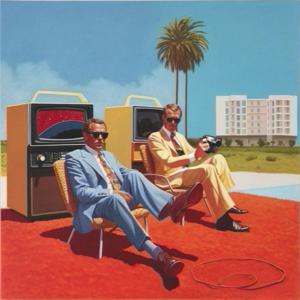


Steve Martin appeared on The Tonight Show many times with guest hosts. Once Johnny Carson himself was the one laughing, Martin was selling out arenas within months, because at 10:30 at night everyone was watching Carson. Now that attention is split across everything, we wonder whether the big cultural shifts have thinned out, and whether we've lost the boredom that used to send people to a book or a blank page. One of us has kids who come downstairs to announce they're bored, and 10 minutes later they've built a whole world upstairs. One of us remembers Laird Hamilton telling Rick Rubin on Tetragrammaton that surfboards went from one fin to three out of boredom.
Then we turn to language, which is the last thing we'd want to hand to ChatGPT. Writing a letter to a neighbor yourself might be the most important thing you do with 30 minutes. The CliffsNotes for Moby-Dick keep the plot and lose everything Melville does with words. A cover letter that nobody will read closely is another matter, and we argue over whether a soulless tool is fair game for a soulless process. It ends on a horror script one of us wrote years ago, about a woman and her husband stuck on a plane on a snowbound runway that was built over a cemetery. Some readers told him to drop the ghosts and write it as a straight drama about her.
-Ai
Show Notes:
Save the Cat by Blake Snyder - https://savethecat.com/
Critical Drinker - Falling Down: • Falling Down - The Great American Lie
Tetragrammaton - Laird Hamilton: • Laird Hamilton
Ghosts of my Life by Mark Fisher: https://bit.ly/3VZ9xcv
Spinning Plates - https://www.spinningplatesmovie.com/
Support the show
If you enjoyed this episode, please consider giving us a rating and/or a review. We appreciate and try to read all of them. Thanks for listening, and we'll see you in the next episode.
Ask Us a Question: https://studiosessionspod.com/#ask
Website: https://studiosessionspod.com
One of us took his daughter to the 25th anniversary re-release of The Phantom Menace. He'll be at Alien: Romulus opening weekend too, knowing every ticket tells the studios to make more, because nostalgia is their safest bet. The Star Wars sequels played all the music he loves, and he still thought they were bad movies, yet the end of a season of The Mandalorian had him in tears. A sequel should exist only when there's more story to tell, as there was for The Godfather Part II. Nobody needs a second It's a Wonderful Life. Instead of another Jurassic Park sequel, we'd rather see the original back in theaters for a summer.
Coppola put $120 million of his own money into Megalopolis, still unreleased as we talk, and we hope it plays more like his Apocalypse Now than a lecture. Apocalypse Now baffled one of us in college. Now it shows him something new about himself on every viewing, as The Shining does. The Shining's Jack Torrance, a would-be writer who resents his family, reminds one of us of Steve Martin's memoir Born Standing Up, where Martin's father, who wanted to act, grows cold toward his family. Near the end, one of us repeats what he was told his grandfather said late in life: that he wished he'd spent more time with his kids. He has since made it the title of something he's writing.
Mentioned in this episode: Top Gun: Maverick, The Mandalorian, Robert Zemeckis's Back to the Future, Francis Ford Coppola's Megalopolis, Francis Ford Coppola's Apocalypse Now, Frank Capra's It's a Wonderful Life, Sergio Leone's Once Upon a Time in the West, Stanley Kubrick's The Shining, Jonathan Glazer's The Zone of Interest, Joseph Conrad's Heart of Darkness, Steve Martin's Born Standing Up.
-Ai
Support the show
If you enjoyed this episode, please consider giving us a rating and/or a review. We appreciate and try to read all of them. Thanks for listening, and we'll see you in the next episode.
Ask Us a Question: https://studiosessionspod.com/#ask
Website: https://studiosessionspod.com
One of us has just come back from Poland, where a MotionVFX retreat had him and nine other YouTubers mountain biking near Bielsko-Biała and sleeping in a hikers' shelter, mostly out of reach of the internet. Ten grown men talked nonstop without any drama, and it felt like a Tuesday afternoon in 1974. Before the smartphone, you lived in the real world and went to the internet when you needed something. Now it runs the other way, and on a perfect 72-degree day he finds it hard to justify staying inside to make the next video.
A friend in his 80s, a lifelong songwriter, recently asked one of us how the writing was going. It wasn't, and his friend had no patience for excuses. Nobody knows how much time they have, the friend told him, so if you want to make shoes, make shoes. One of us had just posted a video asking whether YouTube is destroying a generation of artists, and it took off. Watching the view count climb was a thrill, and it also left him feeling a little grossed out. We wonder how the artists we admire live with that feeling, and one of us pictures Scorsese finishing Goodfellas and moving straight on to the next film. We also ask whether hanging your photographs on a gallery wall is only an ego trip.
Mentioned in this episode: MotionVFX, Kraków, Bielsko-Biała, Steven Pressfield's The War of Art, Francis Ford Coppola's The Godfather, Martin Scorsese's Goodfellas, William Eggleston.
-Ai
Support the show
If you enjoyed this episode, please consider giving us a rating and/or a review. We appreciate and try to read all of them. Thanks for listening, and we'll see you in the next episode.
Ask Us a Question: https://studiosessionspod.com/#ask
Website: https://studiosessionspod.com
In a documentary about film photography, one photographer says what he missed most when digital arrived was the community of the darkroom. One of us loves the darkroom for a different reason: there's no computer or phone in there, only chemicals and a red light. The other has a phrase for that, rejection as a process of integration, meaning a step back from technology to move forward. One of us has been reading Neil Postman's Technopoly, which argues that our culture now judges everything by what can be measured, and threw out myth to get there. He thinks the artist's job in a culture like that is to keep myth and metaphor alive. The other doubts that artists set out with a duty at all; many simply react to what the world gives them.
An essay called The Age of Average shook one of us. It collects examples of design drifting toward sameness, and now he wants to photograph Omaha's new apartment buildings, which all look alike. One of us thinks nothing new has broken through lately because each generation used to reject only the one before it. With everything online, we're rejecting all of history at once, and that takes longer. One of us reads from Steven Pressfield's The War of Art: the counterfeit innovator is wildly self-confident, and the real one is scared to death. He wrote himself a note asking whether he's the counterfeit one.
-Ai
Show Notes:
Grain: Analog Renaissance - • Grain: Analog Renaissance
The Century of the Self - • The Century of the Self - Part 1: "Ha...
Noam Chomsky on Propaganda - https://chomsky.info/consent01/
The Age of Average - https://www.alexmurrell.co.uk/article...
Technopoly by Neil Postsman - https://interesi.wordpress.com/wp-con...
The Power of Myth - • Joseph Campbell and The Power of Myth...
David Foster Wallace - New Sincerity - https://en.wikipedia.org/wiki/New_sin...
Carl Jung - https://en.wikipedia.org/wiki/Carl_Jung
60 Minutes Segment - • Teens surprise math world with Pythag...
The Merchants of Cool - • The Merchants of Cool (full documenta...
c.q. lucius - / @c.q.lucius
The War of Art by Steven Pressfield
Support the show
If you enjoyed this episode, please consider giving us a rating and/or a review. We appreciate and try to read all of them. Thanks for listening, and we'll see you in the next episode.
Ask Us a Question: https://studiosessionspod.com/#ask
Website: https://studiosessionspod.com
At an estate sale for a 94-year-old World War II veteran, one of us paid 50 cents for a plate that reads God Bless Our Mobile Home, because the two of us had recently towed a camper back from Iowa. He has also started a photo project on the old satellite dishes left over from when Omaha's edges were countryside. While he was shooting a huge one in Bellevue on a Sunday morning, a woman pulled up, and after filming him with her phone she mouthed that she was calling the police. He's 6 foot 4 and dresses all in black, and we wonder whether a beige shirt would get him left alone.
About 27 minutes in, the episode meant to be about curation turns into one about editing, in the old sense of deciding what to leave out. A book called The Work of Art shows Bob Dylan's cuts to Blowin' in the Wind, and George Saunders arguing with himself on the page over which way a story should go. With no gatekeepers left, we have to be our own, and one test is simple: if an idea still has a hold on you a week later, start it. It ends with baseball writers, who find room for craft in a story filed after every one of 162 games.
Mentioned in this episode: The Work of Art, Bob Dylan's Blowin' in the Wind, George Saunders, Garry Winogrand, Andrew Callaghan, the series Julia, Guy Clark's L.A. Freeway.
-Ai
Support the show
If you enjoyed this episode, please consider giving us a rating and/or a review. We appreciate and try to read all of them. Thanks for listening, and we'll see you in the next episode.
Ask Us a Question: https://studiosessionspod.com/#ask
Website: https://studiosessionspod.com
One of us has edited hundreds of videos since moving from Los Angeles to Omaha, including fundraising films and the short a museum shows visitors before a tour, and he realizes he hasn't made any work of his own in that time. His YouTube channel, he decides, is closer to a magazine about art than to art. This show's audio feed feels like something we own, while its YouTube version feels rented. Nobody needs a gatekeeper's permission to publish anymore, and a line from Jurassic Park fits: we got so excited that we could that we never stopped to ask whether we should. The cost is that everyone now learns in public. Beginners once made their bad early films in private. Now they make them in front of an audience, afraid of looking like idiots.
Money is the other obstacle. He wants to photograph the derelict satellite dishes around town, and he has a documentary about a musician sitting unedited, but he keeps telling himself they can wait until some big brand deal comes through. Seinfeld offers a way out in the episode where George Costanza does the opposite of every instinct. Making something doesn't have to mean publishing it. Write every day for 50 days, and a year later you might find 2 pieces worth keeping. It ends on photography, where 360 rolls of film might not hold a single great picture.
Mentioned in this episode: Steven Spielberg's Jurassic Park, Seinfeld's The Opposite, Venus Theory, Jackson Street Booksellers, Final Cut Pro.
-Ai
Support the show
If you enjoyed this episode, please consider giving us a rating and/or a review. We appreciate and try to read all of them. Thanks for listening, and we'll see you in the next episode.
Ask Us a Question: https://studiosessionspod.com/#ask
Website: https://studiosessionspod.com
A clip of ours took off, reaching about 300 views when the channel had around 60 subscribers, and we suspect why: we put Rick Rubin's name in the title on purpose. It makes us look at our habit of talking as if art is good and commerce is bad. One of us sorts it with what he calls a hierarchy of intentions. Making something good comes first and reaching more people comes second, and the trouble starts when the order flips. Knowing the formula has its place, as long as you add something of your own. Graeme Obree broke cycling's hour record twice on a bike he built himself, partly from a washing machine, after people laughed at the design.
Clickbait flips the order, because the title promises something the video doesn't deliver. Casey Neistat uses the same kind of title and then gives you more than it promised. We go through books on the craft of getting noticed, like Josef Albers' Interaction of Color and the advertising book Hey Whipple, Squeeze This. One of us brings up a 1980s example: most people would say they read the Bible, never the National Enquirer, though the Enquirer had more readers. He wonders if we're the same. Near the end, one of us rereads a Hunter S. Thompson letter from The Proud Highway, which says words are tools, and the right ones can put even your life in order.
Mentioned in this episode: Rick Rubin, Hunter S. Thompson's The Proud Highway, Graeme Obree, Casey Neistat, M. Night Shyamalan's The Sixth Sense, Luke Sullivan's Hey Whipple, Squeeze This, Eugene Schwartz's Breakthrough Advertising, Robert Greene's The 48 Laws of Power, Josef Albers' Interaction of Color, Trent Reznor, the National Enquirer.
-Ai
Support the show
If you enjoyed this episode, please consider giving us a rating and/or a review. We appreciate and try to read all of them. Thanks for listening, and we'll see you in the next episode.
Ask Us a Question: https://studiosessionspod.com/#ask
Website: https://studiosessionspod.com
Warren Buffett's biography is called The Snowball, after his idea that all you need is sticky snow and a long hill. One of us builds his body of photographs one picture at a time, whether it ends up in a book or in a thrift store after he's gone. The show works the same way: since the first episode it has gone out steadily, with short clips in between, and it has never felt like a chore, because we keep it simple. That raises a harder question about why people dream up grand, complicated projects, and whether the complication is partly a way of never starting.
One of us spent years at a grocery store register feeling dead inside, and later dreaded every shift of an at-home tech support job for Apple. Since then he has built his working life so that the jobs that need someone's permission are optional. We talk about chasing fear, and about a former White House chef who joined a group cooking dinner for strangers in Compton, because his mother had told him that if something doesn't scare you, it isn't the right thing. Then comes Bob Dylan's idea that you're a success if you spend your days doing what you want to do. It closes on one of us looking up from a day of editing, surprised to find it's already four o'clock.
Mentioned in this episode: Warren Buffett, Alice Schroeder's The Snowball, Mad Men, Rick Rubin's The Creative Act, Steven Pressfield's The War of Art, Final Cut Pro, Steven Spielberg, Bob Dylan.
-Ai
Support the show
If you enjoyed this episode, please consider giving us a rating and/or a review. We appreciate and try to read all of them. Thanks for listening, and we'll see you in the next episode.
Ask Us a Question: https://studiosessionspod.com/#ask
Website: https://studiosessionspod.com
John Mayer grew up thinking the Grateful Dead were for other people, until something opened the band up for him; he has now played their songs for a decade. We start with the things that did the same for us. For one of us it was The Power of Myth, Bill Moyers' interviews with Joseph Campbell, which an acting teacher assigned when he was 20. It taught him that people who do bad things are the heroes of their own stories. For the other it was an accident: a magazine in a mechanic's waiting room, with a long story about a man hunting for Jesse James's gold.
In the last episode one of us told how a stranger threw a two-pound hunk of metal at his head. This time he admits that his first thought afterward, still sitting in his truck, was to post about it on Instagram, and he wonders whether that was about making something or about attention. We talk about how easy it is to call an experience bad and stop thinking about it. One of us has found that whatever feels best the day he makes it is usually what ages badly. A line from The Social Network becomes our rule: get it down at once, then hold on, because we don't know what this is yet. It ends on what early praise can do to a piece that isn't finished.
-Ai
Show Notes:
John Mayer Interview - https://www.youtube.com/watch?v=AaaOoyclkE8
The Grateful Dead - https://www.dead.net/
The Power of Myth - https://www.youtube.com/playlist?list=PLiYnNom7SVRMjsi2WSpIGBlo1UDhlXyvz
What The Bleep Do We Know? - https://watchdocumentaries.com/what-the-bleep-do-we-know/
The Elegant Universe - https://shop.shakeandco.com/book/9780393338102
The Stanford Prison Experiment - https://www.prisonexp.org/
The Zone of Interest - https://a24films.com/films/the-zone-of-interest
As I Lay Dying - https://en.wikipedia.org/wiki/As_I_Lay_Dying
Bryan Birks - https://www.youtube.com/@BryanBirks
The Social Network - https://youtu.be/k5fJmkv02is?t=92
Support the show
If you enjoyed this episode, please consider giving us a rating and/or a review. We appreciate and try to read all of them. Thanks for listening, and we'll see you in the next episode.
Ask Us a Question: https://studiosessionspod.com/#ask
Website: https://studiosessionspod.com
One of us can't shake Elia Kazan's The Arrangement, a 1969 film about an advertising man who wakes up halfway through his life and wants out. He watched it the same week as Alone in the Wilderness, the PBS documentary about Dick Proenneke, who moved to Alaska at 51 and filmed himself building a cabin by hand. Both men walk away from what was expected of them. The Zone of Interest and Past Lives get us onto the objective camera, which mostly holds back and lets us watch. We'd both like our own work to trust its audience that way.
One of us sets a two-pound hunk of metal on the table. Two days earlier, taking street photographs in Midtown Omaha, he got a few frames of a man chasing a loose dog. Soon after, the man ran at him and threw the metal at his head, and he ducked in time. We talk about it as photographers: the voice that says not to take a picture, which is often the sign to take it, and how it might have felt to the man, after chasing his dog for what he said was over an hour, to have a stranger photographing it. It ends with four pages he wrote afterward that might be a poem, and a question we save for next time, about how something like this finds its way into the work.
-Ai
Show Notes:
The Arrangement (by Elia Kazan) - https://www.rogerebert.com/reviews/the-arrangement-1969
The Arrangement Trailer - https://youtu.be/9txF5Ma6G68?si=4LAldm6A6wXqIdNx
Alone in the Wilderness - https://shop.pbs.org/WA0792.html
My Self Reliance - https://www.youtube.com/@MySelfReliance
Walden & Civil Disobedience - https://bit.ly/3TDIsvM
Fargo - https://letterboxd.com/film/fargo/
John Prine - https://store.johnprine.com/collections/john-prine-vinyl
Ned’s Atomic Dustbin - “Kill Your Television” - https://www.youtube.com/watch?v=FaTcIzLk880
The Zone of Interest - https://a24films.com/films/the-zone-of-interest
Past Lives - https://a24films.com/films/past-lives
The Kennedy Films - https://drewassociates.com/films/the-kennedy-films/
Stephen Shore - http://stephenshore.net/
Miami Vice (Michael Mann) - https://bit.ly/3VmAad1
Tetragrammaton with Dr. Jack Kruse - https://bit.ly/43jYsGv
Support the show
If you enjoyed this episode, please consider giving us a rating and/or a review. We appreciate and try to read all of them. Thanks for listening, and we'll see you in the next episode.
Ask Us a Question: https://studiosessionspod.com/#ask
Website: https://studiosessionspod.com
From the publisher's feed
Discussions about art and the creative process. New episodes every other week.
Ask Us a Question:
Website: https://studiosessionspod.com