
Sign up to save your podcasts
Or

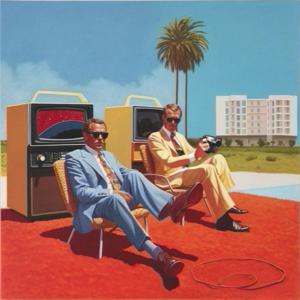


A bottle of Cutty Sark that costs under $20 holds its own against a 12-year Chivas, which surprises both of us. Then one of us plays the opening of Bruce Springsteen's Letter to You. Springsteen says after 50 years he still feels a burning need to communicate, as reliable as his own heartbeat, and he doesn't know where it comes from: loneliness, ego, ambition or the need to be heard. Hearing that feeling put into words leveled one of us, in the best way. It's the same need that makes us carry a camera or want to learn an instrument, because a thought has to exist somewhere outside our heads.
Springsteen turns what he feels into 3-minute songs that will outlive him. Today anyone can post a feeling the moment they have it, and every day brings what one of us guesses is a million of those videos, which nobody will ever watch again. We wonder whether the flood will swing people back toward crafted work, the way punk once swung them away from it. One of us admits his own habit is "think it, feel it, make it, send it," rushing work out before the feeling fades. The old gatekeepers made everyone spend 3 or 4 years getting better before anything went out. One of us remembers thinking his first screenplay was the best thing he'd ever written, and even his 15th has real problems.
Mentioned in this episode: Bruce Springsteen's Letter to You, Cutty Sark, Chivas Regal, Macallan 12, Hipgnosis, Bo Burnham's Inside.
-Ai
Support the show
If you enjoyed this episode, please consider giving us a rating and/or a review. We appreciate and try to read all of them. Thanks for listening, and we'll see you in the next episode.
Ask Us a Question: https://studiosessionspod.com/#ask
Website: https://studiosessionspod.com
Fair warning: this episode meanders a bit as we jump around – but that's just how it goes sometimes <3.
One of us found a Rollei 35 at an estate sale, marked $200, and got it for $60 because he couldn't tell whether the shutter worked. He brings it for the other to try, and once we work out how to fire it, we get to what has kept one of us up at night: opening a shop. A used record store across the river in Council Bluffs holds more than a million records, and one of us has asked its owner what the whole place would cost. What we picture is smaller: one room that could hold a photo show one week and a poetry reading the next.
Jackson Street, the used bookstore in Omaha's Old Market, is where one of us found a book of Jerry Schatzberg's photographs, tucked away in the photography section. A good bookstore, we decide, has a point of view of its own, like the big table there that gets new books every week. Barnes & Noble has come back by stocking fewer, better-chosen books, with staff who know them, though there's still nowhere comfortable to sit. One of us has less sympathy for Starbucks. Still, in plenty of towns it's the only coffee shop, so if it put couches back, a lot of people would hear that hanging out in public is back. It ends on the places we already have, like Homer's, a record shop that opens at 8 on Saturday mornings.
Mentioned in this episode: Rollei 35, Jackson Street Booksellers, Jerry Schatzberg, Barnes & Noble, Starbucks, Panera, Homer's.
-Ai
Support the show
If you enjoyed this episode, please consider giving us a rating and/or a review. We appreciate and try to read all of them. Thanks for listening, and we'll see you in the next episode.
Ask Us a Question: https://studiosessionspod.com/#ask
Website: https://studiosessionspod.com
One of us makes his bed every morning, and now spends his first hour each day reading upstairs with a record on quietly. The other has learned to run without a race to train for. We start with habits like these, kept for nothing but how they make us feel. Lately the morning reading has been Conrad Hilton's autobiography, picked up secondhand because Hilton appears in Mad Men. As a young man, Hilton hid Helen Keller's Optimism under his pillow. When the bank run of 1907 left his father's store buried in debt, the family took in travelers and fed them his mother's cooking, and that boarding house led to the Hilton hotels.
Hilton's story gets us onto optimism, and one of us has his tested at a Goodwill. Filling a cart with dollar records to resell, he let a woman waiting beside him have a Van Halen LP. The Discogs app had priced it at about $50. At home he doubted the scan, since the reissues are on colored vinyl and this one was black. He thinks it was an original 1995 pressing of Balance, which starts around $330, and it took him about 48 hours to let it go. A pop-up record show at The Sydney, a bar in Omaha's Benson neighborhood, showed him that record hunting is about the people he keeps running into. We end on whether optimism is inborn or a habit built by repetition.
Mentioned in this episode: Conrad Hilton, Helen Keller's Optimism, Mad Men, Van Halen's Balance, Discogs, The Sydney in Omaha's Benson neighborhood, Apple's iPad ad.
-Ai
Support the show
If you enjoyed this episode, please consider giving us a rating and/or a review. We appreciate and try to read all of them. Thanks for listening, and we'll see you in the next episode.
Ask Us a Question: https://studiosessionspod.com/#ask
Website: https://studiosessionspod.com
One of us mocked up a new look for the show, and before using it we stop to ask why. Nothing is wrong with the old one. A whiskey can come in a beautiful bottle and still not be very good. That turns into what this podcast is. If we made it a proper show with segments, we'd quit after five episodes. As it is, in two years neither of us has once dreaded sitting down to record. A listener suggested we make a movie together. One of us thinks this is the movie, a documentary in progress that has more in common with Richard Linklater's Boyhood or Louis Malle's My Dinner with Andre than with a talk show.
Jonas Mekas kept filming for 30 years and cut his home movies into a 288-minute film, which we want to watch. One of us has followed a YouTuber since about 2009, a man who still films himself walking around his house for maybe 3,000 subscribers. What would ruin this, we agree, is a sponsor. Elvis's 1968 comeback special makes the case: Colonel Parker wanted sketches, and the part one of us loves best is Elvis jamming with his old bandmates, which started in a dressing room. It ends on a note one of us had made that day about the five hindrances in Buddhism, which turn out to bear on why we wanted a new logo.
Mentioned in this episode: Richard Linklater's Boyhood, Louis Malle's My Dinner with Andre, Jonas Mekas's As I Was Moving Ahead Occasionally I Saw Brief Glimpses of Beauty, the '68 Comeback Special, the five hindrances.
-Ai
Support the show
If you enjoyed this episode, please consider giving us a rating and/or a review. We appreciate and try to read all of them. Thanks for listening, and we'll see you in the next episode.
Ask Us a Question: https://studiosessionspod.com/#ask
Website: https://studiosessionspod.com
One of us has taken up metta meditation, quietly wishing strangers well at the moments they'd usually get under his skin. Then a word turned up at midnight for a feeling we both know: sonder, the realization that every passerby is living a life as vivid and complex as your own. Acting and screenwriting classes teach a version of it, that every villain is the hero of his own story. It changes how you look at photographs as well. William Eggleston could point a camera at a stand of trees and somehow catch the energy of the place, and Alec Soth's portraits in Sleeping by the Mississippi read differently once you have the word.
It's a Friday episode with a glass of Four Roses, and it wanders. We compare the stacks of books we've been pulling from estate sales, and marvel at how much The Old Man and the Sea gets done with so few words. Some rooms leave one of us unable to say a word, like a Polaroid show in Los Angeles full of people he only knew from the internet, while a line at an estate sale makes it easy to talk to anyone. It ends in a basement with two twin beds under matching orange blankets, and the photo project one of us wants to make about the lives a house leaves behind.
Mentioned in this episode: John Koenig's The Dictionary of Obscure Sorrows, Chris Marker's Sans Soleil, William Eggleston, Alec Soth, John Updike's Rabbit Redux, Neil Postman's Amusing Ourselves to Death, Ernest Hemingway, Truman Capote, Good Will Hunting.
-Ai
Support the show
If you enjoyed this episode, please consider giving us a rating and/or a review. We appreciate and try to read all of them. Thanks for listening, and we'll see you in the next episode.
Ask Us a Question: https://studiosessionspod.com/#ask
Website: https://studiosessionspod.com
When one of us rereads a screenplay or a journal from years ago, he's right back in the feelings that made it, which makes it hard to tell whether the work is any good. The other barely recognizes whoever made his old work, and reads it like a stranger's. That turns into how artists keep digging at the same questions. Michael Mann can seem to have made one film for 40 years, and John Updike pushes his language further in Rabbit Redux than he did in Rabbit, Run. Some people keep excavating an idea while others work on the form itself, like Queen fighting for the full length of Bohemian Rhapsody, or Bob Dylan going electric at Newport.
One of us is trying to give his easy hours, early morning and after dinner, to novels. Part of the pull of physical media may be nostalgia for the late '90s, when the technology existed but didn't yet run our lives, though one of us notes that a cassette wears out while a Blu-ray lasts. One of us got a text from a childhood friend thanking him for the push back into vinyl, which is the kind of sharing he wants. The other would rather not post what he reads, because every post chips a little off an idea he might spend decades with. It ends on what changes when you share something with 150 people, or 200,000, instead of one friend.
Mentioned in this episode: Michael Mann, John Updike's Rabbit, Run and Rabbit Redux, Robert Zemeckis's Here, Kevin Costner's Horizon, Queen's Bohemian Rhapsody, Bob Dylan, James Mangold's A Complete Unknown.
-Ai
Support the show
If you enjoyed this episode, please consider giving us a rating and/or a review. We appreciate and try to read all of them. Thanks for listening, and we'll see you in the next episode.
Ask Us a Question: https://studiosessionspod.com/#ask
Website: https://studiosessionspod.com
Alex arrived with a list of pairs usually treated as opposites, like ambition and contentedness or control and surrender, and a hunch that holding both at once is beyond machines. Matt, hearing it cold, thinks back to college, when he'd skip the fastest route for one with S-curves he could take in his five-speed. Before we rolled, he'd pulled off a shoe to show how the laces cross back and forth, never settling on one side. One of us reads a passage from the Tao Te Ching in which long and short define each other. Then comes the Emperor's New Clothes, and the child who just says what he sees.
One of us brings a clip of John Updike, who, asked about self-indulgence, says a writer has to be innocent enough to assume his life is worth telling. Watching Killer's Kiss, Stanley Kubrick's second feature, over Christmas, one of us found it shallow, a stage he thinks everyone passes through. And one of us confesses to a one-act play at Florida State so pretentious that the teacher who had asked to direct his next piece left the moment it ended. Garry Winogrand said the artist's job is to state the question, which we take to mean the audience does the other half. It ends on revolution and renaissance, and Matt's sense that his last few years have been about bringing old things back rather than burning everything down.
Mentioned in this episode: the Tao Te Ching, Hans Christian Andersen's The Emperor's New Clothes, beginner's mind, John Updike's Rabbit, Run, Henry Miller, Martin Scorsese, Steven Spielberg, Stanley Kubrick's Killer's Kiss, Garry Winogrand, Bill Maher's Club Random.
-Ai
Support the show
If you enjoyed this episode, please consider giving us a rating and/or a review. We appreciate and try to read all of them. Thanks for listening, and we'll see you in the next episode.
Ask Us a Question: https://studiosessionspod.com/#ask
Website: https://studiosessionspod.com
Picture an army of 10 with more fronts than soldiers. One of us has more fronts than he can hold. The first to go is reselling cameras on eBay, and he's wary of restoring estate-sale finds, which can eat 15 to 20 hours a week for $300 or $400 a month. At 45, he feels behind in life, and recording this podcast in the daytime can feel like going into debt. The other, whom he sees as steadier, says he simply works on one thing at a time. Getting older sharpens the 45-year-old's feeling: his daughter recently asked whether he was 30-something, and he turns 46 this year. The other has also stepped back from YouTube, which was taking more than it gave, and now posts only what he actually cares about.
That leads to why this podcast never feels like a chore. Hours of conversation are hard to fake: Nicole Kidman is charming and packaged on Stephen Colbert's show, and sounds like herself on Marc Maron's WTF. The podcast works like a journal entry every two weeks, and one of us wishes he had the same from his father. Even our cheap flip cameras have become a character in the show, and every new subscriber feels like proof that an unproduced conversation can find an audience. It ends on Jerry Seinfeld, whose stand-up is built line by line and still rings true, because he cares about every word.
Mentioned in this episode: YouTube, eBay, Nicole Kidman, The Late Show with Stephen Colbert, Marc Maron's WTF, Jerry Seinfeld.
-Ai
Support the show
If you enjoyed this episode, please consider giving us a rating and/or a review. We appreciate and try to read all of them. Thanks for listening, and we'll see you in the next episode.
Ask Us a Question: https://studiosessionspod.com/#ask
Website: https://studiosessionspod.com
Four months after an episode on provenance and quintessence, one of us found a definition that ties them together: luxury is a thing's ability to develop provenance, and it comes down to time, the time spent making something and the time it will last. The other would take a beat-up Hermes Baby with a story over a mint one, and our answer to throwaway goods is to buy things built to last and give them a story. Cleaning his typewriters, he found the Hermes came apart in seven screws and two panels, and a Royal Safari in more than 20 screws.
An off-air talk about AI and consciousness gets saved for another episode. Looking at 2025, one of us wonders what a single video a month could do that six rushed ones never did. One of us tires quickly in company but wants more people around, now that he's staying in Omaha longer. After years of treating Omaha as a stopover before going back to Los Angeles, the other now calls YouTube the thing he's meant to do. Matt picks the opening clip from The Mask, where Ben Stein's character says everyone wears one, figuratively. He wants to take his off, so people who know him recognize him in his videos. It ends on The Bear's list of non-negotiables, the kind of principle one of us would rather work by than a goal.
Mentioned in this episode: provenance and quintessence, the Hermes Baby, the Royal Safari, the Olivetti Lettera 22, Antiques Roadshow, Chuck Russell's The Mask, Ben Stein, The Bear.
-Ai
Support the show
If you enjoyed this episode, please consider giving us a rating and/or a review. We appreciate and try to read all of them. Thanks for listening, and we'll see you in the next episode.
Ask Us a Question: https://studiosessionspod.com/#ask
Website: https://studiosessionspod.com
Matt, at 45, has worked out what his best stretches had in common: he made his decisions from a place of sacrifice rather than indulgence. He sees it in his wife, who found a corner to work out in even on Thanksgiving morning. In himself he finds the opposite, the urge to stop for a lottery ticket whenever the billboard on the Council Bluffs viaduct passes $200 million. One of us had just seen the other side of it: after 30 or 40 hours on a pitch this week, he wasn't nervous, because the inspiration comes out of the effort. Steven Pressfield says as much in The War of Art: keep sitting down to the work and it comes.
One of us remembers working hard, for once, in high school. To get cast in the school play, he learned the St. Crispin's Day speech from Henry V, which his father had shown him in Kenneth Branagh's film, until he knew it cold. He got a lead, and still knows most of the speech. Then Matt talks about his third places, the estate sales and record shops where people are glad to see him walk in. It ends with one of us recalling how, after he finally let it all out at a showcase in Chicago, a theater professor told him he could clearly switch it on when he chose to.
Mentioned in this episode: Kenneth Branagh's Henry V, Steven Pressfield's The War of Art, Stephen King, Steve Jobs, John Hughes's Planes, Trains and Automobiles, third places.
-Ai
Support the show
If you enjoyed this episode, please consider giving us a rating and/or a review. We appreciate and try to read all of them. Thanks for listening, and we'll see you in the next episode.
Ask Us a Question: https://studiosessionspod.com/#ask
Website: https://studiosessionspod.com
From the publisher's feed
Discussions about art and the creative process. New episodes every other week.
Ask Us a Question:
Website: https://studiosessionspod.com