
Sign up to save your podcasts
Or

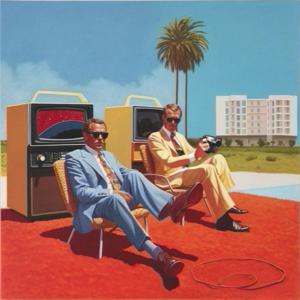


A friend who deals in antiques and vintage in Omaha's Old Market has a bigger space sitting free for a few months, and we can sublease it cheaply. We've wanted somewhere to show photographs for years. The man behind one empty building laughed at the idea in a voice message, and a gallery owner one of us approached wanted the show to be his. This one would be ours, beside our friend's furniture and glasswork, with no price tags. We picture a place people come to hang out, with slide viewers so visitors can build their own slideshows, and a pot of coffee on for street photographers starting a Friday walk.
One of us is glad it's on tape: if it fails, in ten years we can still say we tried to open a gallery. It's also a relief after so many conversations about art and commerce. With nothing to sell and little money at stake, the walls can hold whatever we find interesting, in thrift-store frames if need be. One of us has just put together an old Leica from an estate sale, and he suspects the pictures in his head are better than the first real ones will be. The space scares him too, but differently: it might turn out great just as the lease runs out. It ends on our friend, who keeps saying he wants the room to be something special, not corporate.
Mentioned in this episode: Omaha's Old Market, Alec Soth, the Joslyn Art Museum, Omaha's Workshop and A Priori, the Leica IIIf, Leica's 35mm Summaron.
-Ai
Support the show
If you enjoyed this episode, please consider giving us a rating and/or a review. We appreciate and try to read all of them. Thanks for listening, and we'll see you in the next episode.
Ask Us a Question: https://studiosessionspod.com/#ask
Website: https://studiosessionspod.com
After every new year, a group of friends used to meet for coffee and talk goals, and over the years the goals turned from revenue targets into a picture of the year we want. This episode is that conversation. For one of us, 2025 was the slowest year he's had and the most present in a decade. He's turning 30 and wants the groundwork laid this year: his website live, photography back in focus, a few short stories published and a long-running screenplay finished. He has thrown away more work than he's let anyone see.
The other remembers a stretch three or four years ago when he was more disciplined than he's ever been, and could write a paying Medium article in 45 minutes. It came with a costume, the short haircut and hustle of a tech YouTuber, and he has spent the last two years taking it off. We compare that to tearing down a house to fix its foundation. He wants 2026 to join the old discipline to the life he's found since, and to quiet the voice that says he should be on a Hollywood back lot instead of flipping through a box of records. It ends on a book about the House of Morgan, and the old financiers who read poetry and played piano until everyone specialized and, as the book tells it, finance became soulless.
Mentioned in this episode: Medium, Gary Vaynerchuk, the House of Morgan.
-Ai
Support the show
If you enjoyed this episode, please consider giving us a rating and/or a review. We appreciate and try to read all of them. Thanks for listening, and we'll see you in the next episode.
Ask Us a Question: https://studiosessionspod.com/#ask
Website: https://studiosessionspod.com
One of us has been watching a YouTube channel of video essays about art, a voice reading over striking old footage, and sent it over. The other recognized the footage as Jonas Mekas's, taken from one of his documentaries with a fair-use note and no credit. We don't name the channel. What bothers us is the gap between a channel arguing that art should stand apart from commerce and a method that looks like good branding. For contrast there's Paul Thomas Anderson's The Master. Seeing it on 35mm, one of us realized that Philip Seymour Hoffman's cadence sounds like Alan Watts, who held gatherings on an old ferryboat much like the one the film is set on. We call that reconstitution. Pasting in someone else's footage is appropriation.
Then one of us plays devil's advocate. When we started writing screenplays, we both leaned on a song laid over a weak scene to do the feeling for us, so maybe this is someone young whose taste is ahead of their skill. The other wonders if his own irritation is what James Carse describes in Finite and Infinite Games, turning someone into an enemy for taking away something he'd come to enjoy. We end by asking listeners where they'd draw the line on giving credit.
Mentioned in this episode: Jonas Mekas, the Prelinger Archives, Paul Thomas Anderson's The Master, Alan Watts, Philip Seymour Hoffman, "Weird Al" Yankovic.
-Ai
Support the show
If you enjoyed this episode, please consider giving us a rating and/or a review. We appreciate and try to read all of them. Thanks for listening, and we'll see you in the next episode.
Ask Us a Question: https://studiosessionspod.com/#ask
Website: https://studiosessionspod.com
One of us went alone to an anniversary party at A Priori, a vintage clothing shop in Omaha run by friends, and brought a '90s Polaroid to give the owners pictures of their own night. That opens a talk about why we want what we want. A Big E Levi's jacket one of us thrifted for $4 got recognized by vendors at a local market, and he admits that being recognized felt good. We try to tell a love of well-made things from a hit of dopamine.
At an earlier event at A Priori, a designer who worked at Nike described his Wardrobe Theory, a year of buying no clothes. Now one of us wants to try his own version: no hard goods from January through March, and a note every time the urge comes. One of us found a 45 by the Rogues, a 1960s band from David City, Nebraska, in a thrift store box, and once he learned copies had sold for $500, his viewers told him to keep it as an investment. He says the reselling has left him more fulfilled and more overwhelmed. We plan to revive our yearly goals sessions, this time picturing the life we want instead of chasing numbers. It ends with one of us wanting back the discipline he had a few years ago without losing what he's found since, and a line from Seinfeld about doing the opposite of every instinct.
Mentioned in this episode: Omaha's A Priori, Polaroid, the Contax T2, Levi's Big E, the Leica M9, the Rogues, Discogs, Seinfeld.
-Ai
Support the show
If you enjoyed this episode, please consider giving us a rating and/or a review. We appreciate and try to read all of them. Thanks for listening, and we'll see you in the next episode.
Ask Us a Question: https://studiosessionspod.com/#ask
Website: https://studiosessionspod.com
One of us has been reading James Carse's Finite and Infinite Games in the sauna, and he reads us what he highlighted. Carse sets a society, fenced in by its boundaries, against a culture, open to its horizons. Artists, he writes, make ways of seeing rather than objects. The Renaissance, in his telling, opposed no one, and one of us takes that as a test for whether an idea is worth following: it can't need an enemy.
A retired engineer on a plane gave one of us a phrase for what we do here: when he has a problem, he calls a buddy to chew the fat on it. Then comes a run of coincidences. At a low point, hitting acorns with a stick in Memorial Park, one of us said he wished he had a bat. Two steps later, in the middle of an empty lawn, he stepped on a plastic one. Another time, one of us thought of Alexander Payne outside the post office and found him inside at the counter. It ends with Werner Herzog's memoir and the salt mines that store uranium. Herzog asks how to warn anyone 40,000 years from now, when our words and pictures will mean nothing, and thinks of breeding the local cacti blue. We think a ritual might carry the warning further than any sign. A monument too big to miss might not: Stonehenge still gets credited to aliens.
Mentioned in this episode: James Carse's Finite and Infinite Games, the Tao Te Ching, the Minnesota Twins, Omaha's Memorial Park, Alexander Payne, Werner Herzog's Every Man for Himself and God Against All, Stonehenge.
-Ai
Support the show
If you enjoyed this episode, please consider giving us a rating and/or a review. We appreciate and try to read all of them. Thanks for listening, and we'll see you in the next episode.
Ask Us a Question: https://studiosessionspod.com/#ask
Website: https://studiosessionspod.com
One of us spent the day back at work on the Trans-Siberian Orchestra's tour show, in a room with a close friend and the show's designer, working out his part in something its fans come back to every year. That same morning he'd filmed B-roll alone and wanted nobody near him. So we talk about both ways of making. Casey Neistat says he can't work with other people, yet he still has someone watch his cuts. We wonder why the lone genius has become the story we tell about making things, when it took a crowd of people to reach the moon.
The best notes help a maker get closer to what they're going for, instead of steering it toward what the person giving them would have made. Then we turn to isolation. On an office day, everyone sat at computers in the same room until one of us got up and left. We like the idea of rooms built for one thing, like a writer's rented room with only a table. One of us wants a tiny phone that pops out of his iPhone and only makes calls. The last story is from a Key West bar with a famous past and a guitar Bob Dylan signed on the wall, where nearly everyone was looking at a phone.
Mentioned in this episode: Trans-Siberian Orchestra, Casey Neistat, Oscar Isaac, Guillermo del Toro, Grainydays, Omaha's Yoshitomo, HBO's Band of Brothers, Ang Lee's Hulk, Roseanne.
-Ai
Support the show
If you enjoyed this episode, please consider giving us a rating and/or a review. We appreciate and try to read all of them. Thanks for listening, and we'll see you in the next episode.
Ask Us a Question: https://studiosessionspod.com/#ask
Website: https://studiosessionspod.com
After two years and 50-some episodes, we admit the show has been on autopilot, so this one sets some guardrails: bring ideas worth an hour of talk, and use the show to hold each other to what we say. One of us realizes how long our Friday photo walks have been on hold when we're back in downtown Omaha's Gene Leahy Mall and he notices how big the trees have grown. The other has lost two weeks to a cough, and with them the early mornings, when he writes best. He wants the script he's worked on for a couple of years finished and made, good or not.
Then we pick one of the typed index cards on the cabinet, one of the oldest there: arrogance is a dangerous cliff. It leads to narcissism, and to a content creator who built a big audience by calling himself a narcissist, which makes one of us wonder whether his own habit of introspection is a performance. We land on arrogance as confidence turned sour, and on how success, whether a photo show or this podcast, can make you lenient with the process that made the work good. It ends with kung fu movies and Luke and Yoda, where a student has to be broken down before he can be taught, and with Uma Thurman in Kill Bill, too cocky until her teacher humbles her.
Mentioned in this episode: Omaha's Gene Leahy Mall, narcissism, David Foster Wallace's This Is Water.
-Ai
Support the show
If you enjoyed this episode, please consider giving us a rating and/or a review. We appreciate and try to read all of them. Thanks for listening, and we'll see you in the next episode.
Ask Us a Question: https://studiosessionspod.com/#ask
Website: https://studiosessionspod.com
One of us is writing something he won't talk about yet, and treats it as training, worth doing even if nobody reads it. The other shares everything, sometimes to his regret. Orson Welles once said he'd written scripts covering the whole range of human feeling, and luck decided which got made. Then comes a new idea, sparked by John Cassavetes explaining the fake play he wrote for Opening Night: two actors, each married to someone else, who fall for each other and can only act on it on stage. It reminds one of us of Edward Albee's The Goat, a play about love and betrayal in a long marriage, in which the husband falls in love with a goat.
We compare films that dazzle and leave nothing behind with older ones that let a scene run long. Seen on a big screen downtown, Citizen Kane left one of us ranking it above anything he'd seen, and Touch of Evil has just floored him. On technology, one of us is grateful for the AI that masters his audio and fed up with his 2019 truck, which now takes 45 seconds to bring up CarPlay. He buys old things because they're simple, and because a six-year-old one still works as it did new. It ends on the scene in One Battle After Another where Leonardo DiCaprio's character can't have a cell phone, and what that would be like.
Mentioned in this episode: Howard Stern's Private Parts, John Cassavetes' Opening Night, Edward Albee's The Goat, or Who Is Sylvia?, The Greatest Showman, Dostoevsky's The Gambler, Neil Postman, Orson Welles' Touch of Evil, Terrence Malick's A Hidden Life, Paul Thomas Anderson's One Battle After Another.
-Ai
Support the show
If you enjoyed this episode, please consider giving us a rating and/or a review. We appreciate and try to read all of them. Thanks for listening, and we'll see you in the next episode.
Ask Us a Question: https://studiosessionspod.com/#ask
Website: https://studiosessionspod.com
One of us has 30 recordings of his vinyl hauls sitting unedited in a folder, some from January. They may be the purest thing he makes, made with little thought for who watches. That leads to artists who follow their own interest and make the audience catch up. Mac Miller left frat rap behind and kept changing until he died. One of us draws a line down the middle of Paul Thomas Anderson's films, with Boogie Nights and Magnolia on one side and The Master and Phantom Thread on the other.
Sponsorships can make one of us feel like a salesman, so we try to separate promotion from curation, with the bottle of Cutty Sark on our table as the test. It's there because we like it, and if someone paid $10,000 to swap in their own whiskey, it would stop being curation. Seasonality means letting a project rest and coming back to it, even a decade later, while the culture wants everything quick and writes off a new business that isn't making $500,000 a year within two years. We end on our current seasons. One of us calls his chaotic clarity: he knows exactly what he wants to make, and his studio is torn apart making it. The other's season sits between feeling that everything could fall apart and having, for once, some space to make what he wants. While he answers, the cameras die one by one.
Mentioned in this episode: Robert Zemeckis's Back to the Future, Mac Miller, the Beach Boys' Pet Sounds, Weezer's Pinkerton, Paul Thomas Anderson, Cutty Sark, Van Morrison's Astral Weeks.
-Ai
Support the show
If you enjoyed this episode, please consider giving us a rating and/or a review. We appreciate and try to read all of them. Thanks for listening, and we'll see you in the next episode.
Ask Us a Question: https://studiosessionspod.com/#ask
Website: https://studiosessionspod.com
One of us is building a personal website in the spirit of the old internet, with a visitor counter, a guest book, photos sorted by year and month, and '80s cool jazz playing on a loop. It takes us back to the GeoCities site one of us once built line by line in a computer lab at Iowa State. To the one building the new site, posting to Instagram feels like selling something even when he isn't, while a website of his own is like showing a friend the shelves he built.
One of us got a Betamax player from an estate sale working again with a little lubricant on the gears. He has four old players wired to one TV in his studio and likes a movie on VHS going in the background, the way Basquiat painted with the TV on and a record going. For the other, the pull of old technology is connection: the buzz of an old TV makes a room feel less lonely. It ends on the modern computer, which one of us calls too dangerous because it can do anything. He wants two old white iMacs stripped down to a word processor and a language model in a terminal, so he can look up the most popular women's names of 1932 for a character without opening a browser. The other says put Linux on them, or try both and see which feels better.
Mentioned in this episode: GeoCities, Winamp, Jean-Michel Basquiat, Turner Classic Movies, Casey Neistat, Apple's Aperture, Cracker Barrel, Linux.
-Ai
Support the show
If you enjoyed this episode, please consider giving us a rating and/or a review. We appreciate and try to read all of them. Thanks for listening, and we'll see you in the next episode.
Ask Us a Question: https://studiosessionspod.com/#ask
Website: https://studiosessionspod.com
From the publisher's feed
Discussions about art and the creative process. New episodes every other week.
Ask Us a Question:
Website: https://studiosessionspod.com