
Sign up to save your podcasts
Or

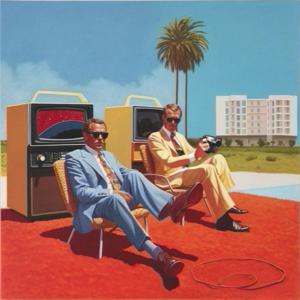


Daniel Arnold's new book from Loose Joints has no text beyond its title, only pictures sequenced by an editor at the publisher and a few blank pages we puzzle over. One of us, close to finishing something long, remembers Josh Safdie sounding close to tears in an interview because the first question after Uncut Gems, a decade in the making, was what's next. He still sees the appeal of moving straight on. Arnold built his book walking miles a day with a camera, and now anyone can flip through 10 years of those walks in 20 minutes and ask when the next one is out.
One of us is weighing a group photo walk on Saturday. We've walked downtown with cameras for 6 years, and one of us can't name a keeper from those walks, because good pictures seem to need you alone. Then again, we met through a Facebook post about getting coffee. That opens a talk about Omaha, where one of us rarely sees work that sends him home to try harder, the way a friend's table read did. When Roger Bannister broke the 4-minute mile, others soon followed. If one of us optioned a script, the other would buy the drinks and then go home and write. It ends with one of us feeling less of the why-bother he calls a sickness, the kind that hands him an excuse to stay home and watch TV.
Mentioned in this episode: Daniel Arnold, Loose Joints, Josh and Benny Safdie's Uncut Gems, Roger Bannister.
-Ai
Support the show
If you enjoyed this episode, please consider giving us a rating and/or a review. We appreciate and try to read all of them. Thanks for listening, and we'll see you in the next episode.
Ask Us a Question: https://studiosessionspod.com/#ask
Website: https://studiosessionspod.com
One of us came out of an Omaha used bookstore with a $25 book on Henri Cartier-Bresson, after passing up a $75 Martin Parr on the display. Reading about a photographer who came from money lands differently in a tight month. His weekly drop of new finds at a vintage shop, the other suggests, has taken the place of the shoot-and-post cycle that can be toxic to photography. His YouTube video predicting that Apple will bring back its Aperture software went from 800 views at bedtime to 25,000 by morning, a thrill that sits oddly next to a thin business account.
Then we read to each other. Cartier-Bresson spent whole days on the streets, tense and ready to spring, and suspected that only children could still express themselves freely. John Ruskin measures an artist by how many great ideas his work holds. In Proust's Swann's Way, a phrase of music makes Swann want to start his life over. The longest stretch is Italo Calvino's essay on the written city, where words on a wall, which nobody can avoid reading, amount to a kind of tyranny. The talk turns to yard signs and sports flags crowding a walk that should be about the birds. It ends on the husks of old trees one of us photographs like tombstones, including a 12-foot trunk stripped of every limb that has started growing back.
Mentioned in this episode: Henri Cartier-Bresson, Martin Parr, Peter Wollen's Signs and Meaning in the Cinema, Apple's Aperture, John Ruskin's Modern Painters, David Lynch's Catching the Big Fish, Marcel Proust's Swann's Way, Italo Calvino's Collection of Sand, Jackson Street Booksellers.
-Ai
Support the show
If you enjoyed this episode, please consider giving us a rating and/or a review. We appreciate and try to read all of them. Thanks for listening, and we'll see you in the next episode.
Ask Us a Question: https://studiosessionspod.com/#ask
Website: https://studiosessionspod.com
In 1903 Rainer Maria Rilke answered a young poet who had sent him verses to judge, and began by saying that criticism is the thing least able to reach a work of art. Then he told him to stop looking outward and ask himself, alone at night, whether he truly had to write. One of us reads it still frustrated by opening night at the Joslyn Art Museum, where a show of photographs from the Amon Carter Museum began with a talk neither of us liked. One of us found it narrow, the other underprepared, when all it had to do was unlock the work. An Alec Soth talk in the same building had done exactly that.
The photographs were another matter. One of us stood two inches from an Eggleston print, and a huge, staged Gregory Crewdson moved him more than he expected. We notice who's missing, like Walker Evans and Stephen Shore, and one of us wishes the Joslyn would take a risk on someone new, the way John Szarkowski did with William Eggleston's Guide. One of us wants wall labels about form, not the concerns of the moment, and the other has stopped reading them. Saul Leiter's idea that a photographer finds what a painter has to make explains to one of us why estate sales and street photography feel like the same work. It ends back with Rilke and his case for solitude.
Mentioned in this episode: Rainer Maria Rilke's Letters to a Young Poet, the Joslyn Art Museum, the Amon Carter Museum of American Art, Alec Soth, William Eggleston's Guide, John Szarkowski, Gregory Crewdson, Deana Lawson, Gordon Parks, Saul Leiter, Tomas Leach's In No Great Hurry.
-Ai
Support the show
If you enjoyed this episode, please consider giving us a rating and/or a review. We appreciate and try to read all of them. Thanks for listening, and we'll see you in the next episode.
Ask Us a Question: https://studiosessionspod.com/#ask
Website: https://studiosessionspod.com
One of us watched a video of a woman of 93 still repairing oil pump valves and teaching a man in his 40s the job, and saw his own future in it. He studied fine arts and expects to work forever, by choice. That opens a talk about the usual measures of success, like the house and the 401k, and the pressure they put on anyone who lives otherwise. In 1927 E.M. Forster wrote that a novel can't escape its humanity and is lifeless without it. We borrow the idea: strip the humanity out of a family's life and what's left is a house full of things.
Then one of us, who photographs estate sales once the owners are gone, describes a house call to buy records from a man still deciding where his things will go. They met at a thrift store. The man walked him through every room and a lifetime of collections, down to baseballs signed by Babe Ruth and Mickey Mantle, and asked only for a donation to the thrift store where he volunteers. That turns us to our own things, and the hope of finding each a person who cares about it as much as we do. Some objects carry a story, like a Cubs mug a friend mailed, or the damaged thrift-store books this man pays a woman to rebind. It ends on one of us hoping to go back and photograph the man.
Mentioned in this episode: E.M. Forster's Aspects of the Novel, John Sayles's Lone Star, Babe Ruth, Mickey Mantle.
-Ai
Support the show
If you enjoyed this episode, please consider giving us a rating and/or a review. We appreciate and try to read all of them. Thanks for listening, and we'll see you in the next episode.
Ask Us a Question: https://studiosessionspod.com/#ask
Website: https://studiosessionspod.com
We switched off the bright light because it wasn't the mood, and let the cameras suffer for it. That starts a talk about living with things of quality, which isn't the same as expensive. One of us spent nearly four hours picking through a man's house after he died. The other thinks AI is making physical things matter more. The man had built his own stereo receiver from a Heathkit, a box of parts he soldered himself, while one of us used to ask a HomePod mini for jazz and never learn who was playing. Knowing how your things work is worth something, down to a record player's belt.
One of us has had a flip phone for two years and set up his studio so nothing pulls at his attention. Back on quality, we get to enshittification, where a company that started out caring what it makes ends up cutting corners, like McDonald's in The Founder once Michael Keaton's character takes over. We try to vote with our money and our time, and still order from Amazon. One of us posts Instagram stories for a friend's shop and scrolls with his morning coffee. He takes in most media the way we do street photography, waiting for something interesting, like Judge Judy on a giant screen above an empty courtyard. It ends with the one on the flip phone agreeing, as long as you stay out of the algorithm's bubble.
Mentioned in this episode: Heathkit, the HomePod mini, the Porsche 911, John Lee Hancock's The Founder, Michael Keaton, Patagonia, Liquid Death, Amazon.
-Ai
Support the show
If you enjoyed this episode, please consider giving us a rating and/or a review. We appreciate and try to read all of them. Thanks for listening, and we'll see you in the next episode.
Ask Us a Question: https://studiosessionspod.com/#ask
Website: https://studiosessionspod.com
If making the work is water, content is food coloring, and once it's in there's no getting it back out. One of us never expected what his video channels would bring: a feeling that an audience is waiting, like a plant that dies if nobody waters it. He had begun them partly as an archive of his own life, the kind he wishes he had of his father's, even a staged one. Vivian Maier took her pictures while working as a nanny, which makes us wonder whether a day job keeps the water clean.
Offered an imaginary patron's $100,000 a year, one of us would take it and still wonder whether the content plant had died by the end. The other laughs off the idea that universal basic income will set creativity loose, since conflict seems to be part of what makes people make things. The conversation started when one of us was drawn at once to one photographer's book, then felt something missing from new work by another, who also makes social media content. Near the end, one of us describes what he calls is-ness, a scene that simply is what it is, like the light and dust on an estate-sale end table that morning, or two telephone poles on a hill above a ditch of dirty snow. We close on how hard that is to say, and how much our language leans on the image of a line.
Mentioned in this episode: Vivian Maier, Alec Soth, J.D. Salinger, Garry Winogrand, Leo Tolstoy's What Is Art?
-Ai
Support the show
If you enjoyed this episode, please consider giving us a rating and/or a review. We appreciate and try to read all of them. Thanks for listening, and we'll see you in the next episode.
Ask Us a Question: https://studiosessionspod.com/#ask
Website: https://studiosessionspod.com
We start on a worry that making videos about photography turns the pictures into content. Good work takes time: photographs one of us shared, taken over three and a half years, had no thread until he had a reason to look. One of us used to stock a friend's shop with any t-shirt that had The Exorcist or a band on it, however badly made, until the friend asked what those shirts said about the place. In photography, the cheap shirt is a lens comparison video made because those get views. One of us compares his first YouTube channel, built by copying Peter McKinnon and Matti Haapoja, with his second, made because nobody made the videos he wanted to watch.
William Eggleston once said he loves his own pictures and doesn't much care for other people's. That put one of us at ease, since he has long worried about liking so many of his own photographs. The other edits hard. An amateur's painting of a barn from an estate sale stands for a fear: that a body of work adds up to an earnest try and never a Monet. After some 40 viewings, the critics in the Garry Winogrand documentary sound like comedy to one of us, and we talk about the thousands of rolls Winogrand never developed. It ends on a Leica M11, bought partly to shoot alongside friends who have Leicas, before we leave to take pictures.
Mentioned in this episode: Garry Winogrand, William Eggleston, Saul Leiter, Alex Webb, Grainydays, Peter McKinnon, Matti Haapoja, Bruce Springsteen, Bob Ross.
-Ai
Support the show
If you enjoyed this episode, please consider giving us a rating and/or a review. We appreciate and try to read all of them. Thanks for listening, and we'll see you in the next episode.
Ask Us a Question: https://studiosessionspod.com/#ask
Website: https://studiosessionspod.com
More of a fun for us one here.
One of us opened Facebook Marketplace to find a Leica M11 and a Leica Q2 for sale, listed by a woman selling her father's cameras. He offered to make a short film about her father's photography in exchange for a discount, but she preferred cash at the price a used-camera dealer had quoted her, and the M11 dropped from $7,500 to $4,800. The other, who happened to call that morning, came away weighing the Q2 at $2,500. We half expected a scam, until a young family let us in with the Leicas sitting on the table. We each walked out with one.
For one of us, every camera kept and not shot is a small guilt, so he'll sell a shelf of digicams to pay for the M11. The other has lent him a Zeiss 35mm lens that had sat unused since its last service, in exchange for the use of a viewfinder. Now neither of us has an excuse not to shoot. One of us wants portraits of the people he meets on buying trips. The other is glad his partner will finally have a camera of her own when they go out shooting. It ends at a flea market booth packed with unworn Sturgis rally shirts at $3 each, where one of us showed restraint and took 25.
Mentioned in this episode: Facebook Marketplace, the Leica M11, the Leica Q2, KEH, Zeiss, the Ricoh GR, the Sony A7 IV, the Hermes 3000, Grainydays, Sturgis.
-Ai
Support the show
If you enjoyed this episode, please consider giving us a rating and/or a review. We appreciate and try to read all of them. Thanks for listening, and we'll see you in the next episode.
Ask Us a Question: https://studiosessionspod.com/#ask
Website: https://studiosessionspod.com
One of us sold an old Nikon lens on eBay for $425 to a buyer in Switzerland. Then a stranger on TikTok pointed out it was a rare early version, with a very low serial number. He prices more carefully now, and it paid off: a sealed Donkey Kong 64 he paid $30 for turns out to sell for around $1,000. The gallery we spent two episodes planning has fallen through. The artist already working in the space got the chance to take it over, and sharing it would have meant every decision went through a committee. We stepped back, and we're still on good terms with the artist. What we'll miss is the community that came with that spot.
The rest is about getting back to work. One of us hasn't loaded a single roll into the Leica he had overhauled. The other has joined a darkroom and wants to start loading his own Tri-X, so he asks listeners which reusable canisters hold up. With William Eggleston's Guide open on the table, one of us wants to pair his buying trips with time to shoot, maybe a portrait of every stranger he buys from. A Rick Rubin interview with George Saunders, about how the work only exists once you do it, leads to Tolstoy's definition of art as feeling passed from one person to another, and to the idea of finding your own definition instead of the right one.
Mentioned in this episode: West Coast Choppers, Donkey Kong 64, Kodak Tri-X, William Eggleston's Guide, Garry Winogrand, Rick Rubin, George Saunders, Tolstoy's What Is Art?
-Ai
Support the show
If you enjoyed this episode, please consider giving us a rating and/or a review. We appreciate and try to read all of them. Thanks for listening, and we'll see you in the next episode.
Ask Us a Question: https://studiosessionspod.com/#ask
Website: https://studiosessionspod.com
We still don't have a name for the space. An hour of brainstorming with ChatGPT, until one of us hit the usage limit, turned up mostly pretentious ideas like the Greek word kairos. A few names stuck anyway: Room, and Keyframe, which one of us read out from The Dictionary of Obscure Sorrows, where it means a moment that seemed like nothing when it happened and turned out to begin a new chapter of your life. Our friend's shop is called Lost, the kind of name you hear once and know is right. Every name in Star Wars works that way, and so do Chicago and Seattle.
Rather than a sign asking people to put their phones away, we'd like a room where they forget them. Then we describe the space itself. It should sit somewhere between a white-walled gallery and a shop crammed with things, with furniture arranged like a half-remembered living room at your grandparents' house. What we want is a scene, the kind that grew up around Warhol's Factory or the Neistat brothers' studio, where people show each other their work and push each other to make more, right here in Omaha. One of us pictures a running list on the wall of the photographers and filmmakers who have inspired us, for visitors to look up later. It ends on street photography, where the picture comes from being open to whatever happens in front of you.
Mentioned in this episode: ChatGPT, John Koenig's The Dictionary of Obscure Sorrows, George Lucas's Star Wars, Cameron Crowe's Singles, Andy Warhol's Factory, Casey and Van Neistat, Gregory Crewdson.
-Ai
Support the show
If you enjoyed this episode, please consider giving us a rating and/or a review. We appreciate and try to read all of them. Thanks for listening, and we'll see you in the next episode.
Ask Us a Question: https://studiosessionspod.com/#ask
Website: https://studiosessionspod.com
From the publisher's feed
Discussions about art and the creative process. New episodes every other week.
Ask Us a Question:
Website: https://studiosessionspod.com