
Sign up to save your podcasts
Or

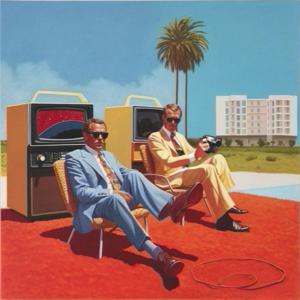


One of us spent $450 at an estate sale and came home with a Leica, two old press cameras, a Koni-Omega Rapid 200 that its owner used for crime scene photos, and a typewriter. We wonder where the vintage boom ends, and whether everything built before the '70s will just keep getting more expensive, now that one company gets up to $300 for a refurbished Walkman. His typewriters sell fast at a friend's shop. He owns about ten himself and types his record labels and eBay notes on them. Short letters to friends are his next thing. A letter teaches you to get it right as you go, since a mistake means typing the page over.
The other suggests a challenge: stop buying, and spend a month with one typewriter or two records, the way he and a friend have been smoking a single pipe tobacco for a month at a time. An object you commit to reveals itself slowly, like the $1 clock that has kept time on this table for 3 years. We wonder whether expecting perfection from our things has spilled into how we treat people. It ends on a barn painting from an estate sale, made by someone who had lived in the house. A friend with great taste found it unremarkable. One of us wanted it anyway, because he sees his own attempts at writing and making things in it.
Mentioned in this episode: Leica, Koni-Omega Rapid 200, Retrospekt, The Weather Channel's WeatherStar 4000, Raspberry Pi, the IndieWeb, Grand Prix Legends, Loess Hills Scenic Byway, Christopher Nolan, Werner Herzog.
-Ai
Support the show
If you enjoyed this episode, please consider giving us a rating and/or a review. We appreciate and try to read all of them. Thanks for listening, and we'll see you in the next episode.
Ask Us a Question: https://studiosessionspod.com/#ask
Website: https://studiosessionspod.com
We play David Foster Wallace's 2005 commencement speech, This Is Water, and one of us hears Groundhog Day in it: Phil Connors lives the same day until he stops believing he's the center of the universe. Wallace calls that self-centeredness our default setting, and says the real work is choosing what to pay attention to, even in a slow checkout line. One of us has been practicing it at home, where dirty dishes and a kid's questions can feel like obstacles to his work. It takes the edge off, he says. We talk about blind certainty, and how this show would be a different one, if it lasted at all, had either of us arrived with it.
Then we admit we're hypocrites. We complain about studios selling us nostalgia, yet one of us took his kids to the new Jurassic Park and saw Superman, while the other is about to watch Happy Gilmore 2. Since neither of us is moving to the middle of nowhere, the answer may be to watch where our money and time go. We get to criticism, too, and to Roger Ebert grading a movie about a dog named Beethoven for what it was. Near the end one of us explains why he photographs at all: to find beauty in ordinary places, a Midtown Omaha sidewalk or a small town in Iowa, instead of confirming what he already believes. That brings us back to Groundhog Day.
Mentioned in this episode: David Foster Wallace's This Is Water, Harold Ramis's Groundhog Day, Ralph Waldo Emerson's Self-Reliance, The Matrix, Letterboxd, Siskel and Ebert, David Mamet, Galaxy Quest, Stanley Kubrick's The Shining, Orson Welles's Citizen Kane.
-Ai
Support the show
If you enjoyed this episode, please consider giving us a rating and/or a review. We appreciate and try to read all of them. Thanks for listening, and we'll see you in the next episode.
Ask Us a Question: https://studiosessionspod.com/#ask
Website: https://studiosessionspod.com
Part two of two.
At the end of The Cable Guy, the satellite dish breaks and every TV goes dark, so people pick up books and go for walks. We start there, and with a worry about YouTube: if you pay people for views and hand them AI, the platform floods with slop. It's the cobra effect, named for a bounty on cobras that led people to breed more of them. Then one of us notices how much of what he loves is old, like the Jurassic Park shirt he just bought, or the 1978 Superman theme, which turned up in the new Superman and made him feel 14 again.
When the iPhone came out, the future felt like a meteor we were all riding. Now, one of us says, it feels like traffic. The other compares the moment to a video game level you can't beat. You go back to an earlier save point to play around where you know your way, and return with fresh eyes, which is how he sees his own turn toward old tech. One of us has been reading myths and Jung's Red Book, and thinks we'll need a new shared story to get past the meaninglessness. It ends with him reading from Emerson's Self-Reliance, that in every work of genius we recognize our own rejected thoughts, and handing over a copy as a possible opener for season 3.
Mentioned in this episode: Ben Stiller's The Cable Guy, the cobra effect, Bluesky, Jurassic Park, Superman, Carl Jung's The Red Book, David Foster Wallace, Ralph Waldo Emerson's Self-Reliance.
-Ai
Support the show
If you enjoyed this episode, please consider giving us a rating and/or a review. We appreciate and try to read all of them. Thanks for listening, and we'll see you in the next episode.
Ask Us a Question: https://studiosessionspod.com/#ask
Website: https://studiosessionspod.com
Part one of two.
One of us cleaned up an Apple iPod Hi-Fi he found at a thrift store, and the 3-minute video he made about it passed 780,000 views on TikTok in two weeks. Only a few thousand people followed him because of it. He could chase that number with a hyped-up voice and the right subtitle font, and he doesn't want to. A friend on Discord recently told him his story-driven videos about old tech feel like old YouTube, before what people call the MrBeastification of everything. We talk about platforms that reward the content over its maker, so everyone copies whatever works until it all sounds the same.
Then one of us explains "second screen," a term he has seen in quotes from Netflix executives who want films simple enough to follow while you're on your phone, with characters restating the plot for anyone who looked away. We both leave things on in the background too. But it's Apocalypse Now on VHS or a Seinfeld rerun, something we already love that might hand us a good scene when we look up. We admit Hallmark Christmas movies and The Price Is Right were always with us, and what's new is millions of creators making the same video. It ends on a hope: if the feeds get bad enough, people will put the phone down and go play with the dog.
Mentioned in this episode: MrBeast, Apple iPod Hi-Fi, TikTok, Netflix, Francis Ford Coppola's Apocalypse Now, Seinfeld, Hallmark Channel, Will Ferrell, The Price Is Right.
-Ai
Support the show
If you enjoyed this episode, please consider giving us a rating and/or a review. We appreciate and try to read all of them. Thanks for listening, and we'll see you in the next episode.
Ask Us a Question: https://studiosessionspod.com/#ask
Website: https://studiosessionspod.com
About seven friends, the two of us included, get together to watch movies, lately the original cut of Star Wars, and nobody has to work to keep an evening going. We take a minute to appreciate how rare that is. The show itself is about to start its third year. Then one of us describes the second Polaroid SX-70 he's been testing, all metal and leather, and we ask whether things built to last are coming back. Artifact Bag Co. makes leather bags meant to last a lifetime, and a documentary about the Hermès Birkin bag shows a company that won't rush a bag for anyone, billionaires included.
After time with a friend's younger siblings, who mostly talk in memes, one of us came away feeling old. We decide everyone is out of touch with something now, since each of us lives in a different sliver of culture. Then we argue over whether that fragmenting is real or only designed to look that way. Frank Capra's Meet John Doe, from 1941, helps: a newspaper invents a man, and once a movement grows around him, the paper's owner waits for the right moment to use it. It ends with kids home for the summer, and how strange it feels to have to think about paying someone to watch them so both parents can earn a living and still find time to make their own work.
Mentioned in this episode: Polaroid SX-70, Charles and Ray Eames, Artifact Bag Co., Hermès, Frank Capra's Meet John Doe.
-Ai
Support the show
If you enjoyed this episode, please consider giving us a rating and/or a review. We appreciate and try to read all of them. Thanks for listening, and we'll see you in the next episode.
Ask Us a Question: https://studiosessionspod.com/#ask
Website: https://studiosessionspod.com
OpenAI put out a video of Jony Ive and Sam Altman having espresso at Café Zoetrope in San Francisco, talking up a device built around what they call a magic intelligence in the cloud. One of us has seen it, and his question is what it will cost us, the way smartphones and social media cost us our data and our attention. The other calls himself pro AI, as long as it takes the bad problems and leaves the good ones to us. The worry is that people will hand it the good problems too, and it will do to thinking what GPS did to finding our way. We already use it to cut between this podcast's cameras. But if it handled the whole show, we'd stop caring about it.
One of us had to show someone close to him that a video she'd shared, of a veterinarian rescuing a baby moose, was made by AI, by circling the calf's three legs in a screenshot. Maybe a flood of fakes will kill that kind of video, the way nobody clicks banner ads anymore. We borrow Tolstoy's test, that art passes a feeling from one person to another, and admit plenty of human-made work fails it too. It ends with one of us tracking down a FireWire cable to shoot on DV tape again, where every slow step goes into what you make.
Mentioned in this episode: Jony Ive, Sam Altman, OpenAI, Café Zoetrope, ChatGPT, Neil Postman's Amusing Ourselves to Death, Leo Tolstoy's What Is Art?
-Ai
Support the show
If you enjoyed this episode, please consider giving us a rating and/or a review. We appreciate and try to read all of them. Thanks for listening, and we'll see you in the next episode.
Ask Us a Question: https://studiosessionspod.com/#ask
Website: https://studiosessionspod.com
Larry McMurtry wrote that people go to Los Angeles for the stars, and that the people at the top there have the job of creating desire for the whole world. We wonder whether it still holds, now that social media manufactures desire from anywhere. One of us, who used to live in LA, remembers weeks of 14-hour days in a windowless room in Burbank, and the nights when a show reached the theater and he drove home up the 101 feeling he was on his way. He also remembers a meeting at 20th Century Fox, where an executive asked what science fiction he liked, and all he could offer was The Walking Dead.
What we both miss is being surrounded by people who are chasing something. One of us points to footage of Josh and Benny Safdie helping the Neistat brothers tear down a wall in a New York studio, when everyone around them had something in the works. We argue over whether that energy belongs only to the young, and decide responsibility weighs more than age. One of us has found some of it in a Discord server of YouTubers who review each other's work. The other admits he has started waiting on other people, talking himself out of a run because his partner didn't want to go. It ends on Jiro Dreams of Sushi, where apprentices make the rice every day for years before they can move on.
Mentioned in this episode: Larry McMurtry's Roads, Amblin, 20th Century Fox, The Walking Dead, Josh and Benny Safdie, The Neistat Brothers, Jiro Dreams of Sushi.
-Ai
Support the show
If you enjoyed this episode, please consider giving us a rating and/or a review. We appreciate and try to read all of them. Thanks for listening, and we'll see you in the next episode.
Ask Us a Question: https://studiosessionspod.com/#ask
Website: https://studiosessionspod.com
One of us has been seeing what cheap, forgotten Leica compacts can do, like a 2005 D-Lux 2 that's a Panasonic underneath. He has also caught himself wanting a new Leica M11, so we try to work out why we want objects at all. A true luxury, we think, can wear and age without losing its function. The other once bought a Leica M9 that cost more than his car, and was too scared to take it out of the house. The one who wants the M11 calls the cheap finds filling his studio "ambition-based purchases." At the moment you buy one, your future looks boundless, with no sick kid at home and no budget in the way.
What we're both after is escape velocity: enough steady money that the work doesn't have to sell anything. The artists who got there, we decide, did it by chasing the work, and the money followed. One of us makes his living on YouTube, and has drifted toward old gear partly because nobody earns a commission on a decades-old camera. We compare an affiliate link with a book one of us gave the other for his birthday, which came with nothing attached. It ends on patronage and Kevin Kelly's idea of 1,000 true fans, and on how steep that climb looks for a channel with 33,000 subscribers.
Mentioned in this episode: Leica D-Lux 2, Leica M9, Leica M11, William Eggleston, Garry Winogrand, Saul Leiter, Kevin Kelly's 1,000 True Fans, The Critical Drinker.
-Ai
Support the show
If you enjoyed this episode, please consider giving us a rating and/or a review. We appreciate and try to read all of them. Thanks for listening, and we'll see you in the next episode.
Ask Us a Question: https://studiosessionspod.com/#ask
Website: https://studiosessionspod.com
One of us came back from Badlands National Park wearing a sterling silver bracelet he made himself. A silversmith in his late 60s, camping out of his truck, stopped to talk about bison and coyotes one evening. The next morning, Easter Sunday, the man offered to teach him, and they spent 6 hours on the back of the truck hammering a bar of silver into shape. Afterward the man showed them a video he'd been filming when they pulled in the day before, and said he had known he needed to teach them. It comes in a year when we're both reading road books, like Larry McMurtry's Roads. The other has started counting what 15 or 20 years at a desk cost him in days like that one.
Then one of us asks the other whether he has made anything that will outlast him. His answer is a photograph of four girls on top of a parking garage, one of them sitting on the edge, and a video he shot in Chicago of a man trying to revive a sick pigeon with water from a Coke can. We weigh craft against feeling, since a strong feeling can trick you into thinking the work is good. It ends on a debt. If you've taken 100 pennies from other people's work, you owe at least one back, and one of us says it feels less like a wish than an obligation.
Mentioned in this episode: Larry McMurtry's Roads, W.G. Sebald's The Rings of Saturn, Jack Kerouac's On the Road, Ky Dickens's The Telepathy Tapes, Carl Jung, John Szarkowski's The Photographer's Eye.
-Ai
Support the show
If you enjoyed this episode, please consider giving us a rating and/or a review. We appreciate and try to read all of them. Thanks for listening, and we'll see you in the next episode.
Ask Us a Question: https://studiosessionspod.com/#ask
Website: https://studiosessionspod.com
On every film set something goes wrong, and the job is to find the problems and solve them. We start there, and with Werner Herzog, who dragged a real boat over a real mountain to make a film. One of us has been thinking about comfort, partly because he had just spent 2 days on two eggs a morning and electrolyte water to prepare for a colonoscopy at 45. Afterward he caught himself wanting cereal and a cookie as a reward. We suspect a lot of people treat the small frictions of their work the same way, which may be why so much of it is dull.
Some of our best memories are uncomfortable ones. One of us walked Berlin at midnight looking for a room, with nothing booked. The other and his partner reached Highlands, North Carolina, to find the campsites closed and the hotels shut by frozen pipes, so they overpaid for a motel room and cooked dinner on their camp stove on its patio. Comfort also makes a handy excuse for waiting until conditions are right. Talking about work comes easily to us and doing it doesn't, so we agree to hold each other to the work for the next year. It ends with one of Basho's teachings, read aloud from a collection of his travel sketches: go to the pine to learn about the pine, and leave yourself out of it.
Mentioned in this episode: David Lynch, Werner Herzog's Grizzly Man, Film Streams, Michael Mann's Thief, Robert Rodriguez, Final Cut Pro, Jack Kerouac's On the Road, Basho's The Narrow Road to the Deep North and Other Travel Sketches.
-Ai
Support the show
If you enjoyed this episode, please consider giving us a rating and/or a review. We appreciate and try to read all of them. Thanks for listening, and we'll see you in the next episode.
Ask Us a Question: https://studiosessionspod.com/#ask
Website: https://studiosessionspod.com
From the publisher's feed
Discussions about art and the creative process. New episodes every other week.
Ask Us a Question:
Website: https://studiosessionspod.com