The Accessible Stall

The Accessible Stall

Download on the App Store

The Accessible Stall episodes

  • [26] Self Care and Silliness - The Accessible Stall
    With all that’s going on in the world, how the heck can we even begin to prioritize self care? And for that matter, what does self care really mean? In this episode, we answer those questions while keeping things light and a little silly. We discuss the struggles that come with taking care of the most important thing in your life: you. A transcript for this episode can be found here. This transcript is due to our generous supporters on Patreon. Thank you.

    So many people think: “But I’m too busy for self care.”
    We know. We feel you. It’s so easy to get wrapped up in the day-to-day and neglect basic things you should do to care for yourself. We’re not talking luxuries, though it’s definitely okay to treat yo’self.
     

    We mean remembering to eat regularly. Exercising. Taking time out for a shower or bath. Watching a funny TV show or playing a video game. Meeting your needs and unwinding are necessary.
    It’s pretty common to worry that if you pause to focus on yourself, you’re giving up valuable time for activism.
    Emily admits to struggling with this in this episode. But as Kyle points out, are you really being the best activist you can be if you’re not focusing on self care enough to function at your full capacity?
    Remember, it’s okay to disengage.
    And it’s also okay if it’s a learning process for you to do so. (Especially if you’re like Emily, who lives for consuming the news.) While it’s definitely important for you to stay updated on what’s going on around you, it’s equally important to take a break in the interest of self care. It’s the best way to avoid overloading yourself or burning out.
    Also remember we’re not here to be authorities.
    We’re just two people having some real talk and some fun along the way. Seriously though, chill out and take some time for yourself. Your body and your brain will thank you.
    29 min
  • [25] Accessibility vs. Inclusion - The Accessible Stall
    Is complete accessibility necessary for inclusion? Can anything be truly inclusive if it’s inaccessible? In this episode, we explore these questions and try to figure out where access and inclusivity intersect. A transcript for this episode can be found here. This transcript is due to our generous supporters on Patreon. Thank you.

    What prompted the conversation about accessibility and inclusion?
    Recently, the Washington Post published an article about an access “solution” developed for people with mobility disabilities. “Infinity Mirrors,” an exhibit at the Hirshhorn Museum and Sculpture Garden was not created in a way that’s accessible for wheelchair users. So, the Smithsonian’s Accessibility Program got to work with the Hirshhorn’s multimedia and technology team to recreate the experience of the exhibit using virtual reality (VR). The result? People unable to access the exhibit can take it in through a VR headset.
    Is that really a solution for inaccessibility?
    Not really. It’s an awesome use of VR, but it doesn’t solve the real issue. The exhibit itself is still not accessible for wheelchair users to experience in person. And if a wheelchair user goes to the museum with a group and has to hang back and see the exhibit with a VR headset while everyone else goes inside the actual exhibit, that’s pretty exclusionary.
    But aren’t there laws requiring public places like museums to be accessible?
    Yes. The Americans with Disabilities Act of 1990 (ADA) requires access to public places. Museums should be taking this into account when building new structures or installations. And the Smithsonian itself actually has Guidelines for Accessible Exhibition Design. It seems, in the case of “Infinity Mirrors,” they’re forsaking the law and their guidelines in favor of art.
    Does this one museum exhibition matter on a larger scale?
    It sure does. It’s an example of issues that come up over and over again. First, accessibility is still frequently an afterthought. Second, it’s often conflated with inclusion. People think that efforts to make something accessible also make it inclusive by default. But that’s definitely not the case. Access is only the first step toward inclusion. 
    Join us as we dive into why access and inclusion are not interchangeable and talk about the importance of making accessibility meaningful.
    Notes from this episode: Robot Visits White House
    30 min
  • [24] A Day Without a Woman - The Accessible Stall
    Today is International Women’s Day. Today is also “A Day Without a Woman,” a form of protest by the same people behind the Women’s March on Washington, which took place on January 21st, 2017. We like the idea of the Women’s Strike in theory. Women’s rights are human rights, after all. But is it a good idea in practice? Join us as we discuss in our first non-disability related episode of The Accessible Stall.
    What is A Day Without a Woman? How do I participate?
    Per their website,

    Anyone, anywhere, can join by making March 8th A Day Without a Woman, in one or all of the following ways:

    * Women take the day off, from paid and unpaid labor
    * Avoid shopping for one day (with exceptions for small, women- and minority-owned businesses).
    * Wear RED in solidarity with A Day Without A Woman


    That sounds fine. What’s your problem with it?
    It does sound fine. While there’s nothing inherently wrong with participating in the strike, we feel that it’s misguided. The goals are unclear, and the people who need to hear the message the most likely won’t. It’s a great idea in theory, but it’s exclusionary to those who can’t afford to take off from work or who can only shop at places like Walmart. To put it simply, it’s a gross display of socioeconomic privilege. And we feel it’s worth discussing, as we both are staunchly for women’s rights, but think there are other, more effective forms of grassroots activism.
    But you can just wear red, you don’t need money to participate!
    True. But we examine the effectiveness of “color wearing” activism in this episode. If, on the one hand, it’s the only way/most accessible way you can participate? Go for it! Otherwise, it’s just slacktivism at its finest.
    We went outside the box a little bit in our conversation during this episode. We hope you like it as much as we liked making it.
    Notes from this episode: A Day Without A Woman Letter to Employer.
    39 min
  • [23] Advocacy with The Uninitiated - The Accessible Stall
    All too often, we struggle with the question: how can we advocate successfully when the people that need to know better are the ones hardest to reach? comes up. We try to tackle this in our latest episode. There’s a ton to unpack here. A transcript for this episode can be found here. This transcript is due to our generous supporters on Patreon. Thank you.
    Where’s the line? Ignorance versus Willful Ignorance
    One of the issues we talk about in this episode is ignorance. More to the point, we talk about the difference between ignorance and willful ignorance. Recognizing the difference is fundamental to understanding this episode. However, they are often used interchangeably. While the difference between them should be somewhat obvious, the question that still remains is: When does ignorance become willful? Where is that line?
    How can we “initiate the uninitiated”?
    This is the crux of our conversation. When confronting someone ignorant of disability issues about disability issues, how much slack should we give the person? Too much and they may assume they’re always in the right with no room to improve; too little and we come across as mean-spirited and rude. Luckily, we’ve come up with a list to ensure everyone walks (or rolls!) away happy.
    Show me that list, yo.

    * Realize this is all subjective. Every disabled person has a different experience in their day-to-day life, so keep that in mind!
    * Ask a lot of questions and don’t worry about offending or how you’re coming across until you’re done asking. Use common sense, it’ll get you a long way!
    * Listen to the feedback about how you asked your question and how phrasing it better would have helped.
    * Most importantly, listen to the answers!

    That is the greatest list of all time. Is the episode this good?
    Probably not, but if you’ve listened or read this far you’ll enjoy it!
    Notes from this episode: “Almost Politically Correct Redneck” memes
    43 min
  • [22] Prioritizing Advocacy - The Accessible Stall
    Have you ever noticed clashes among disability advocates over which issues are most important to address? Have you ever felt overwhelmed when trying to decide what advocacy issues most urgently require your attention? You’re not alone. In this episode, we talk about prioritizing advocacy in light of current events.

    How do we even begin to figure out how we can go about prioritizing advocacy?
    Ponder this: advocates fought like hell to block the nomination of Betsy DeVos for Secretary of Education. She was nominated anyway. What’s the next cause disability advocates should take on? Where will we be heard?
    There’s another layer to this conundrum. We supposed to be a “disability community,” but more often than not, our advocacy priorities are at odds with other people who also count themselves as part of that community. We recognize that our overarching goals are the same: access and inclusion. Unfortunately, here’s where the similarities often hit a wall. The best ways to reach these goals will look different to everyone.
    Everyone wants a chance to grab the megaphone and speak their minds, but the resulting discord can create confusion among the people we want listening. And that gets us nowhere.
    But the reality is that there’s a lot happening in the world that does require advocacy. We’re not all going to agree on what’s most important.
    So, how can we decide where to direct our advocacy efforts? What can we do so our advocacy is more than just shouting into the void?
    Now, more than ever, prioritizing advocacy is a crucial strategy if we want our voices heard.
    47 min
  • [21] Disability and Depression - The Accessible Stall
    In this episode, we talk about disability and depression. We know it’s not the most pleasant topic. But, we wouldn’t be keeping it real if we acted like life is sunshine and roses all the time. And let’s be honest, depression is one of the realest parts of the human experience for so many. A transcript for this episode can be found here. This transcript is due to our generous supporters on Patreon. Thank you.

    Why is it important to be open about disability and depression?
    Here’s the problem: far too often, people assume that if a disabled person is depressed, the disability must be the direct cause. Even more problematic is that these kinds of assumptions aren’t just made by friends or family, but also by medical professionals.
    It’s true that there can be a strong correlation between disability and depression. But it’s important to remember that people can be depressed for any number of reasons.
    That said, it’s also important to recognize when disability is contributing to depression, and acknowledge that these feelings are valid. We’ve both encountered this. For instance, we’ve come face to face with physical limitations caused by our disabilities. We’ve had to grapple with things we can’t do. Experiences like this can definitely trigger or amplify emotions, especially for people who are already depressed.
    So, we decided to record this episode for three main reasons:
    1) To push back against the taboo of mental health disabilities;

    2) To explore the connections between being disabled and being depressed;

    3) And, most importantly, to let you know that you’re not alone.
    Disclaimer: We understand that not everyone considers mental health issues to be disabilities. And we know people use a range of terms to refer to mental health disabilities. For the purposes of this episode, we are defining mental health issues as a category under the umbrella of disability.
    44 min
  • Bodily Autonomy - The Accessible Stall

    We’re taking a break from our miniseries on building a better community and tackling the topic of bodily autonomy. What is bodily autonomy? For a simple definition, we consulted our good friend, Wikipedia, which defines bodily autonomy as: …the inviolability of the physical body and emphasiz[ing] the importance of personal autonomy and the self-determination of human beings over their own...

    The post Episode 20: Bodily Autonomy appeared first on The Accessible Stall.

    49 min
  • Building a Better Community: Carrie Wade - The Accessible Stall

    NB: There’s an audio glitch mid-episode that we couldn’t fix. We both thought the episode was more than good enough to publish despite that. Carrie Wade is a staff writer at Autostraddle and she’s someone that we both admire. So it seemed only natural that we’d have her on our show! This is the third episode in...

    The post Building a Better Community: Carrie Wade appeared first on The Accessible Stall.

    50 min
  • Building a Better Community: Defining Ourselves - The Accessible Stall

    The disability community is fickle on its best day. This is the second episode in our mini series called Building a Better Community. In this episode, Kyle and Emily discuss our community itself, all thanks to Anderson Cooper’s coverage on drive-by lawsuits specifically as they relate to the ADA. How can we achieve our goals if we don’t...

    The post Building a Better Community: Defining Ourselves appeared first on The Accessible Stall.

    51 min
  • Building a Better Community: Advertising - The Accessible Stall

    Emily and I struggle all the time with how we represent the “greater” disability community. We want to do the best we can when we produce this show. One theme that comes up constantly is the disability community itself and Emily and I agree: we need to be better.  But how can we do that? Building...

    The post Building a Better Community: Advertising appeared first on The Accessible Stall.

    49 min

About The Accessible Stall

From the publisher's feed

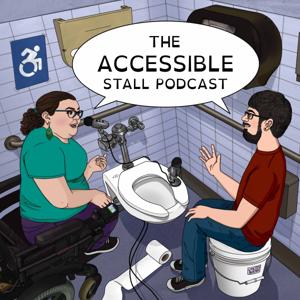
A disability podcast with Kyle and Emily

More shows like The Accessible Stall

Stuff You Should Know by iHeartPodcasts

Stuff You Should Know

78,398 Listeners

The Daily by The New York Times

The Daily

111,865 Listeners

5-4 by Prologue Projects

5-4

3,532 Listeners

Financial Feminist by Her First $100K

Financial Feminist

6,441 Listeners