
Sign up to save your podcasts
Or



Together, Sireesh Gururaja, Amanda Bertsch and Clara Na explain the paradigm shifts in Natural Language Processing that they've noticed themselves, observed in the community, and documented through a series of interviews with NLP researchers. They share their hopes for the NLP field -- as less focused on benchmarks, and as more self-reflexive and ethically-driven -- moving forward. Recorded Jan 19, 2024. Released March 25, 2024.
To Build Our Future, We Must Know Our Past: Contextualizing Paradigm Shifts in Natural Language Processing
by Sireesh Gururaja, Amanda Bertsch, Clara Na, David Gray Widder, Emma Strubell
https://arxiv.org/abs/2310.07715
Hosted on Acast. See acast.com/privacy for more information.
Steph Maj Swanson, aka Supercomposite and I discuss the spooky Loab phenomenon, generative adversarial network, negative prompts and the demons (maybe?) lurking in large datasets. Recorded Jan 19, 2024. Released March 11, 2024.
What I Learned from Loab: AI as a creative adversary
The artist behind the viral cryptid "Loab" reflects on her critical relationship to AI art tools
https://media.ccc.de/v/37c3-12052-what_i_learned_from_loab_ai_as_a_creative_adversary
Original Twitter thread:
https://twitter.com/supercomposite/status/1567162288087470081?lang=en
Insta
https://www.instagram.com/supercomposite/
Hosted on Acast. See acast.com/privacy for more information.
Kyriaki Goni - an artist with a background in social and cultural anthropology - and I start our conversation reflecting back on the lockdowns of April 2020 in Athens; what this signified, and how it shaped her art, which ultimately manifested as "The Portal or Let’s Stand Still for the Whales", which was a reflection on the tensions between the darkness of pandemic realities and the quiet restoration of natural things in her surroundings, and beyond. We also talk about "Perfect Love #couplegoals #AIgenerated, 2020,2022", as an exploration of intimacy, doomscrolling and isolation. We finish our conversation on "Not Allowed for Algorithmic Audiences, 2021" which focuses more specifically on 'audio assistant' tech, and the way algorithms pull audio from social media and various corners of the internet to then classify and reorganize the way we're listened to and heard. One of the (MANY) things I love about Kyriaki's work is that it is decidedly not preachy -- instead it holds a mirror to the audience to reflect gently, and in their own time, on the significance of technology in various contexts. Recorded Jan 12, 2024. Released Feb 26, 2024.
KYRIAKI GONI
https://kyriakigoni.com/
ANTHROPOCENE ON HOLD
https://www.pcai.gr/anthroposcene-on-hold
NOT ALLOWED FOR ALGORITHMIC AUDIENCES
March 23, 2023–April 29, 2023
The Breeder Feeder
https://thebreedersystem.com/uncategorized/kyriaki-goni_-not-allowed-for-algorithmic-audiences/
studio international: Kyriaki Goni – interview: ‘For me, technology is an existential discussion’
https://www.studiointernational.com/index.php/kyriaki-goni-interview-for-me-technology-is-existential-discussion-data-garden-blenheim-walk-gallery-leeds-arts-university
Hosted on Acast. See acast.com/privacy for more information.
Most of us researching data centers have come to rely on various figures and stats telling us how environmentally impactful the internet has become: how big is the footprint? how much energy is used? Anne Pasek and I discuss in this episode just how these things get tallied, and by whom, and to what ends. We also discuss what gets omitted in these calculations, and how a "relational footprinting" approach might help us situate our knowledge about this topic. We also briefly talk about open access publishing and the power of zines in particular. Recorded Dec 12, 2023. Released Feb 12, 2024.
Digital Energetics
https://meson.press/books/digital-energetics/
Getting Into Fights with Data Centers (zine)
https://emmlab.info/Resources_page/Data%20Center%20Fights_digital.pdf
Pasek, A., Vaughan, H., & Starosielski, N. (2023). The world wide web of carbon: Toward a relational footprinting of information and communications technology’s climate impacts. Big Data & Society, 10(1).
Hosted on Acast. See acast.com/privacy for more information.
Teaching in times of generative AI is weird, and sometimes wonderful. Tobias Williams and I discuss what it means to make art and teach art at this juncture and the conflicted feelings that emerge from resisting with the tools of creation. Recorded Oct 10, 2023. Released Dec 25, 2023.
Profile
http://tobiasjwilliams.com
https://www.instagram.com/getrichnever/
Hosted on Acast. See acast.com/privacy for more information.
Irene Niet and I have a conversation about how researchers might consider the environmental impacts of AI in relation to their social consequences, and in relation to their impacts on democracy. Recorded Oct 16, 2023. Released Dec 11, 2023.
Research profile
https://research.tue.nl/en/persons/irene-a-niet
Digital (Un)sustainability - Routledge
https://crowdusg.net/2022/06/06/digital-unsustainabilities-call-for-chapters/
Hosted on Acast. See acast.com/privacy for more information.
Ever wonder about the microchips in your car? MC Forelle and I talk about the “chipification” process of cars, since the 70s and 80s, and how these processes and logics see to increased corporate control and surveillance, while making opting out and DIY tinkering more difficult. We briefly touch on subscription model for automotive features — like BMW did for its heated seats not long ago — remember that? Recorded Oct 5, 2023. Released Nov 27, 2023.
The material consequences of “chipification”: The case of software-embedded cars
https://journals-sagepub-com.ezproxy.lib.ucalgary.ca/doi/full/10.1177/20539517221095429
Hosted on Acast. See acast.com/privacy for more information.
In this absolutely delightful hour, Steven Gonzalez, an anthropologist of data centers, walks us through various sites of ethnographic research — from places of abandonment post-climate disaster, the desert, to the suburbs. While much as been written and discussed about data centers in the last decade, nobody does it quite as thoughtfully as Steven — showing empathy and feeling in and through his writing. Recorded Oct 2, 2023. Released Nov 13, 2023.
Sordidez
https://egconde.com/books/sordidez/
Q&A: Steven Gonzalez on Indigenous futurist science fiction
https://news.mit.edu/2023/qa-steven-gonzalez-indigenous-futurist-science-fiction-sordidez-0821
The Staggering Ecological Impacts of Computation and the Cloud
https://thereader.mitpress.mit.edu/the-staggering-ecological-impacts-of-computation-and-the-cloud/
Steven Gonzalez Monserrate
https://www.stevengonzalezm.com/
The people of the cloud
https://aeon.co/essays/downtime-is-not-an-option-meet-the-stewards-of-the-cloud
La Nube sin Apagón
https://www.anthropology-news.org/articles/la-nube-sin-apagon/
Hosted on Acast. See acast.com/privacy for more information.
While efforts to make “AI” more “open” have gained momentum lately, it seems like both concepts are worth scrutinizing and historicizing so that we can better understand how these marketing terms become a focus (and distraction), as material conditions are downplayed. With David Gray Widder, we discuss where “ethics” are located and how “AI” workers of all kinds imagine responsibility to be someone else’s problem, or somewhere else down the chain. Recorded Sept 12, 2023. Released Oct 23, 2023.
The Myth of ‘Open Source’ AI
https://www.wired.com/story/the-myth-of-open-source-ai/
Open (For Business): Big Tech, Concentrated Power, and the Political Economy of Open AI
https://papers.ssrn.com/sol3/papers.cfm?abstract_id=4543807
Limits and Possibilities for “Ethical AI” in Open Source: A Study of Deepfakes
https://davidwidder.me/deepfakes.pdf
Dislocated accountabilities in the “AI supply chain”: Modularity and developers’ notions of responsibility
https://davidwidder.me/supply-chain.pdf
Computer scientists designing the future can’t agree on what privacy means
https://www.technologyreview.com/2023/04/03/1070665/cmu-university-privacy-battle-smart-building-sensors-mites/
Hosted on Acast. See acast.com/privacy for more information.
If you think you know anything about e-waste from what’s normally reported in the news, please have a listen to this episode with the brilliant Josh Lepawsky — it will really open up everything you thought you understood! We discuss global waste industries, shipping waste, the ideals of recycling, plastics and mining waste, and the need for collective action. And chemicals. Recorded Aug 3, 2023. Released Oct 9, 2023.
What E-Waste Journalism Gets Wrong
https://thereader.mitpress.mit.edu/what-e-waste-journalism-gets-wrong/
Sources and Streams of Electronic Waste
https://www.cell.com/one-earth/fulltext/S2590-3322(20)30307-9
Materials in Flux - A Symposium curated by Formafantasma Session 2: Contextualizing
https://youtu.be/ChKchFQGcyc?t=1506
Hosted on Acast. See acast.com/privacy for more information.
From the publisher's feed
Hi everyone, my name is Mél Hogan and I’m a critical media studies scholar based in Canada. I’m working on a project called The Data Fix through a series of conversations with scholars, thinkers,…
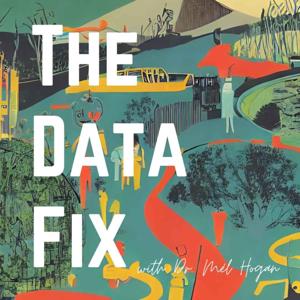
Cover art by Oona Ode.
Hosted on Acast. See acast.com/privacy for more information.

309 Listeners

1,620 Listeners

2,059 Listeners
2,228 Listeners
575 Listeners

286 Listeners

217 Listeners

5,574 Listeners

285 Listeners

16,291 Listeners

264 Listeners

353 Listeners

5,084 Listeners
395 Listeners
603 Listeners