
Sign up to save your podcasts
Or



This comprehensive text outlines NASA's intricate history, tracing its evolution from the National Advisory Committee for Aeronautics (NACA) to its current Artemis program. It details the agency's foundational period, driven by the Cold War's Space Race, leading to the Apollo missions and the first lunar landing. The sources then cover subsequent eras of robotic planetary exploration, including the Voyager and Cassini missions, and the Space Shuttle program's achievements and tragic failures, which led to a strategic shift towards commercial partnerships for low Earth orbit operations. Finally, the text highlights the ongoing Artemis program, which aims to establish a sustainable human presence on the Moon as a stepping stone for Mars exploration.
Research done with the help of artificial intelligence, and presented by two AI-generated hosts.
This report examines the complex and controversial career of Wernher von Braun, a pivotal figure in 20th-century rocketry. It details his professional life, beginning with his early work in Germany where he developed the V-2 rocket for the Nazi regime, a project heavily reliant on slave labor from concentration camps like Mittelwerk-Dora. The text then transitions to his post-war recruitment by the United States under Operation Paperclip, where his expertise was utilized to develop America's first ballistic missiles and, most notably, the Saturn V rocket that powered the Apollo program for NASA. Ultimately, the report highlights the "Faustian bargain" that defined his career, presenting him as a brilliant engineer driven by the singular ambition of space travel, who made significant moral compromises by aligning with any power that could fund his vision.
Research done with the help of artificial intelligence, and presented by two AI-generated hosts.
This comprehensive historical analysis traces Russia's evolution from the 9th-century Kievan Rus' to its current geopolitical standing in 2025. It highlights three enduring themes that have consistently shaped Russian identity and statehood. These themes include a persistent drive for a strong, centralized, and often authoritarian state, an ambivalent and complex relationship with the West characterized by cycles of emulation and antagonism, and a strategic imperative for territorial expansion driven by its challenging geography and a deep-seated sense of insecurity. The text examines how these interconnected patterns have manifested across various eras, from the Tsardom through the Soviet Union and into the modern Russian Federation, ultimately informing its contemporary actions on the global stage.
Research done with the help of artificial intelligence, and presented by two AI-generated hosts.
This collection of texts explores the intricate relationship between leaders' mental health and the destiny of nations, employing psychobiographical analysis to understand historical and contemporary figures. It investigates a central paradox: while mental illness can be debilitating, traits associated with conditions like depression can, in times of crisis, foster superior leadership qualities such as empathy and realism, as seen with Abraham Lincoln and Winston Churchill. Conversely, the sources also highlight how the mental instability of monarchs (like King George III) can trigger national crises, and how totalitarian leaders (like Adolf Hitler) can project their pathologies onto an entire state, leading to catastrophic outcomes. Finally, the text examines the long-term legacies of these leaders' psychological profiles and discusses the evolving field of psychobiography, emphasizing the importance of cross-cultural analysis and the dangers of pathocracy in the information age.
Research done with the help of artificial intelligence, and presented by two AI-generated hosts.
This comprehensive text, "History of Military Errors," explores a wide array of military failures throughout history, from antiquity to the contemporary era. It categorizes these errors into four overarching themes: failures in planning, leadership, execution, and adaptation. Through numerous case studies, such as the Athenian Syracuse Expedition and Napoleon's invasion of Russia, the source illustrates how consistent human and organizational shortcomings lead to catastrophic outcomes, regardless of technological advancement or geopolitical context. The document highlights critical issues like hubris, miscommunication, and the inability to understand the true nature of a conflict, demonstrating their enduring impact across diverse historical periods and projecting these patterns into potential future perils.
Research done with the help of artificial intelligence, and presented by two AI-generated hosts.
The provided text offers a comprehensive overview of Human Rights Watch (HRW), detailing its evolution from a Cold War-era monitor to a global advocacy powerhouse. It traces the organization's origins as Helsinki Watch in 1978, its strategic expansion into various "Watch Committees" throughout the 1980s to counter accusations of bias, and its consolidation into Human Rights Watch in 1988. The sources highlight HRW's landmark campaigns, such as the effort to ban landmines and its pivotal role in establishing the International Criminal Court, demonstrating its shift from merely documenting abuses to actively shaping international law and norms. Furthermore, the text examines HRW's adaptation to 21st-century challenges, including the "war on terror" and the expansion of its thematic mandates to encompass issues like LGBT rights, business and human rights, and climate change, while also addressing persistent criticisms regarding its alleged biases, funding controversies, and methodological integrity.
Research done with the help of artificial intelligence, and presented by two AI-generated hosts.
The provided text offers a comprehensive overview of Amnesty International (AI), chronicling its evolution from its founding in 1961 by Peter Benenson as an appeal for "Prisoners of Conscience" to its current status as a global human rights powerhouse. It details AI's expansion beyond its initial mandate, encompassing campaigns against torture, the death penalty, and for an Arms Trade Treaty, and highlighting its shift to address abuses by non-state actors and advocate for gender and LGBTQI+ rights. The text also discusses AI's organizational structure, its rigorous research methodologies including modern digital forensics, and acknowledges the criticisms and internal challenges the organization has faced throughout its history. Ultimately, it emphasizes AI's enduring legacy in shaping international human rights law and mobilizing global citizen action despite a constantly changing and often hostile global landscape.
Research done with the help of artificial intelligence, and presented by two AI-generated hosts.
The provided text offers a comprehensive historical overview of Oxfam International, tracing its evolution from a wartime relief committee in 1942 to a global confederation. It highlights several key transformations, including its shift from immediate aid to long-term development and a rights-based approach to poverty, and its structural growth into an international network. The document also addresses significant challenges, such as the 2018 safeguarding scandal, which prompted major internal reforms and a commitment to shifting power to the Global South with a decolonial and feminist lens. Ultimately, it portrays Oxfam as an organization continuously adapting its strategies, from innovative fundraising and global campaigns like "Make Trade Fair" to addressing intersecting crises of inequality, conflict, and climate change, while navigating the inherent tensions of being both an activist movement and a large professional institution.
Research done with the help of artificial intelligence, and presented by two AI-generated hosts.
The provided source offers a comprehensive historical overview of UNICEF, tracing its evolution from a temporary post-World War II relief effort in 1946 to a permanent, global organization dedicated to children's rights and development by 2025. It details how UNICEF transitioned from an emergency needs approach to focusing on long-term benefits and country-specific development plans. Key periods highlighted include the Child Survival and Development Revolution in the 1980s and the adoption of the Convention on the Rights of the Child (CRC), which fundamentally shifted its mission towards a rights-based approach. The source also examines UNICEF's role in achieving Millennium Development Goals (MDGs) and Sustainable Development Goals (SDGs), alongside its responses to major humanitarian crises such as the 2004 Indian Ocean Tsunami, the 2010 Haiti earthquake, the COVID-19 pandemic, and ongoing conflicts and climate disasters. Finally, it recognizes the transformative leadership of its various Executive Directors and their impact on the organization's adaptable and enduring mission.
Research done with the help of artificial intelligence, and presented by two AI-generated hosts.
The provided text offers a comprehensive overview of the World Food Programme's (WFP) evolution from its origins in 1961 as a three-year experiment, influenced by U.S. agricultural surpluses, to its current role as a crucial global humanitarian agency. It details the WFP's dual mandate of emergency relief and long-term development, showcasing its transformation into a logistical powerhouse capable of responding to complex crises like the Sahel famines and major conflicts. The document highlights the strategic leadership of key Executive Directors who shaped its autonomy from FAO, its focus on women and children, and its shift from "food aid" to a diverse "food assistance" toolkit, including cash-based transfers. Despite receiving the Nobel Peace Prize in 2020 for its efforts to combat hunger and conflict, the WFP currently faces unprecedented challenges, including a severe funding crisis, complex logistical hurdles, and the political complexities of maintaining neutrality in a world grappling with escalating humanitarian needs.
Research done with the help of artificial intelligence, and presented by two AI-generated hosts.
From the publisher's feed
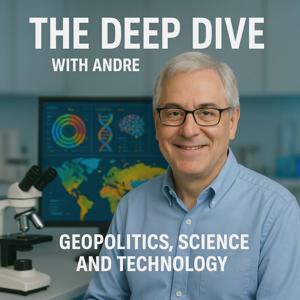
This podcast channel delivers in-depth, educational content across a broad range of topics. A large collection of episodes are available to you, the oldest being as relevant as the newest since this channel is not about daily news. Each episode runs between 30 and 120 minutes and is intentionally designed to go beyond casual listening. The research behind every episode is conducted with the support of advanced artificial intelligence and presented by two AI-generated hosts.
If you’re uncomfortable with the use of cutting-edge AI as both researcher and presenter, this podcast may not be for you. Its mission is to provide access to expert-level knowledge—insights that are typically out of reach through simple web searches or general-purpose AI tools.
“The Deep Dive with Andre” is not about connecting with the personality and voice of a human podcaster — it’s about connecting with expert-level knowledge, for those who value insight over persona. At times, the generated virtual hosts may exhibit an inappropriate voice tone, which can be disconcerting. The technology is still evolving.
Unlike traditional Text-to-Speech (TTS) services, the experimental AI powering the virtual hosts develops an independent understanding of the input information before generating speech. While the resulting voices do not match the quality of those produced by services like ElevenLabs, the AI’s ability to generate dynamic dialogues between two virtual hosts is a distinctive feature. Also, the cost of high-quality voiceovers would be astronomical, given the length of each episode (30 to 120 minutes). Quantity takes precedence over voice quality, given the vast knowledge conveyed by the episodes.
Note: When the hosts mention the “report,” “sources,” or “text,” they are unknowingly referring to the in-depth research and analysis generated by the first-stage AI. That output is then passed on to the second-stage AI, which handles the virtual hosts.
Disclaimer: This content is intended for educational purposes only and should not be construed as professional advice. It is derived exclusively from publicly available sources. No proprietary, confidential, or non-public information has been used in their preparation. However, through deep analytical synthesis, it is possible that some insights or conclusions presented here represent emergent interpretations that have not yet been formally published or broadly disseminated within the scientific and technological communities.
Please share your comments here:
https://the-deep-dive-with-andre.podbean.com
That would help improving this podcast show. Some podcast apps give direct access to the episode website.
Available on Amazon Music, Apple Podcasts, Audible, Castbox, Castro, Deezer, Goodpods, iHeartRadio, MyTuner, Overcast, Player FM, Pocket Casts, Podbean, Podcast Addict, Spotify, TuneIn Radio and others.

14,358 Listeners

5,520 Listeners

12,165 Listeners

4,168 Listeners

1,621 Listeners

19 Listeners

16,062 Listeners