
Sign up to save your podcasts
Or

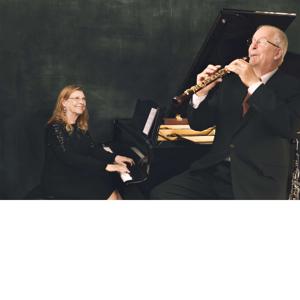


Sonata #3 for Oboe and Piano (2021) Bill Douglas (1944-)
Bill Douglas is a Canadian-born bassoonist, pianist and composer who lives in Boulder, Colorado. He has toured and recorded with the clarinetist Richard Stoltzman since they met in college (Yale, class of 1969). Douglas has written that “(his) basic philosophy of music is that it can be helpful to the world. It can evoke such positive emotions as compassion, tenderness, strength, nobility, upliftedness, and joy.”
Bill Douglas provided a performance note: “Do not swing any of this music. Always sing expressively with long, expansive phrasing. Feel free to change slurs, particularly awkward downward ones, in order to make passages easier.” Thanks, Bill. That helped.
This recording is unedited, including two squeaks from the oboe and Viva's satisfied chuckle at the end.
Scores and recordings of Bill Douglas’ work, including a wonderful CD of vocal rhythm exercises, are available at https://billdouglas.cc. His extensive output of compositions which feature oboe, English horn or bassoon is published by TrevcoMusic.com.
photo by Fran Hodes, 2023
Pierre Onfroy de Bréville (1861-1949) was a French composer, teacher and critic and a friend of Franck, Debussy and Ravel. His music was elegantly crafted but has not been performed much since his death. His Sonatine for Oboe and Piano (1927) could be the sound track for an imaginary Parisian art exhibit. It first paints a jaunty tapestry of interwoven colors and textures in the spirit of Georges Seurat’s Sunday Afternoon on the Island of La Grande Jatte*. The second movement seems like a serene interlude, perhaps contemplating one of Claude Monet’s paintings from his floating studio on the Seine. The final movement, Vite is a burst of kinetic exuberance in the spirit of a music hall poster by Henri de Toulouse-Lautrec.
*Property of The Art Institute of Chicago. Featured in Sundays in the Park with George, a musical by Stephen Sondheim
William Alwyn's Oboe Sonata
William Alwyn (1905-1985) was a respected English composer, teacher and conductor. He began his musical career as a virtuoso flutist, attended the Royal Academy of Music, and at the age of nineteen he was appointed professor of composition. Alwyn composed dozens of widely performed concert pieces and the musical scores of more than 70 films, including a classic Hollywood swashbuckler, “The Crimson Pirate,” starring Burt Lancaster.
Alwyn’s Oboe Sonata was published in 1934. It has three movements:
I. Moderato e grazioso
II. Andantino
III. Allegro (quasi waltz tempo)
The origami flower in the accompanying photo was created by Yukie Echizen.
Sue Yoast and Viva Knight became close friends in 2001 when both were newly widowed. Sue was diagnosed with scleroderma, a rare and incurable autoimmune disease, in 2008. She remained valiantly upbeat to the end, a dear friend and a loyal fan of Dolci. We will miss her. Her obituary is at Mykeeper.com.
Autumn Night is a new composition by Eric Ewazen , written in memory of oboist Judith Ricker and pianist Joseph Werner of the Eastman faculty, who both died this year.
Felix Mendelssohn, Song Without Words, opus 85 No. 40, arranged for piano and oboe d'amore by David Walter. Fiber art in photo is by Martha Mae Jones.
Concerto for Oboe (Piano reduction) by John Williams (b. 1932)
John Williams is a distinguished American composer, best known for his film scores. In 2005 the American Film Institute selected Williams's score for Star Wars as the greatest film score of all time. He has won 25 Grammy Awards and received 52 Academy Award nominations and 5 Academy Awards. He is also a composer and conductor of concert music. He wrote this concerto in 2011 for Keisuke Wakao, the principal oboist of the Boston Pops Orchestra, of which Williams was music director for many years.
Some composers try to create excitement by forcing the players to struggle with technical difficulties.* Not so John Williams, and certainly not his Oboe Concerto. Williams’ concerto requires practice and precision from the oboist, but mostly it demands fluency, energy and expressiveness in the moment. Its phrases fall naturally within a human breath. The oboe part is written in a range where it can produce a nuanced timbre, can start and end notes precisely, and has a speech-like potential to engage the listener’s emotions. The piano reduction is precisely notated to reproduce the complex ensemble playing and rich sonorities of the Boston strings without risking injury or public humiliation to the pianist. He lets both players’ hands move efficiently without straining for uncomfortably large intervals.
This generous gift to the oboists and pianists of the world shows how well Williams can cast spells, play games, evoke moods and tell stories. It is a genial piece, composed in a language of beautiful, logically connected sounds, and with the sweet smile of reason.
_________________________________
Essa-Pekka Salonen stated this in his comments to an audience at Hertz Hall, Berkeley, California, c. 2012. Fascination with virtuosic musical performance as a form of heroism has been part of Western music at least since the early nineteenth century when great soloists like Paganini and Liszt began to be idolized in the press along with popular heroes like Cook, Nelson and Napoleon. _________________________________
Photo by May Phan
Sonata for Oboe and Piano, 1938 Paul Hindemith (1895-1963)
During his frantic last year in Germany before escaping with his family to Switzerland, Paul Hindemith wrote several important works, including his Oboe Sonata. Its first movement is quick and frisky, using overlapping 2-4 and 3-8 meters like the combined gaits of a little girl and her big brother hurrying hand in hand into an unknown forest. Like any a good Gothic story, its sunny beginning and end contrast with darkly threatening episodes. The harmony progresses in disorienting twists from unfamiliar to scary to downright weird. The second movement starts very slowly as a dreamy lullaby in slow 3-4 time, accompanied by a fantastically ornate accompaniment in eighth, sixteenth, thirty-second and sixty-fourth note subdivisions. The lullaby melody breaks into headlong flight as a lively 3-8 fugue, then pauses to hide, dreams, and resumes its running-away (fugue). The second escape winds through a cadence, long-winded enough to rival a Beethoven symphony, and leads us at last to safety.
John Steinmetz (b. 1951) grew up in Oakland, California, attended the California Institute of the Arts and was swept into Los Angeles' freelance whirlpool as a bassoonist and composer. He now teaches at UCLA and lives in Altadena. He wrote about this composition: “Many operas start optimistically but this piece imagines the opposite trajectory, beginning in pessimism or depression and working toward a happy ending... The five movements of the Suite might be scenes or musical numbers drawn from a longer opera... Whether it’s a drama between people or a struggle within a single person are questions for the audience’s imagination.”
The movement titles are
photo © 2010 Charlotte Castro
Six Studies in English Folk-Song by Ralph Vaughan Williams
I Adagio, "Lovely on the Water"
II Andante sostenuto, "Spurn Point"
III Larghetto, "Van Diemen's Land"
IV Lento, "She Borrowed Some of her Mother's Gold"
V Andante tranquillo, "The Lady and the Dragoon"
VI Allegro vivace, "As I walked over London Bridge"
When Ralph Vaughan Williams (1872-1958) was a music student in London he became fascinated with rural English traditional songs, which then existed only in oral tradition and were gradually being forgotten. He visited rural churches and musicians, learned their songs by ear, wrote them out in music notation, and enlisted other musicians to help him save the music from extinction. He wrote this piece in 1926 for cello and piano, and later transcribed it for many other solo instruments, noting that his aim was that the songs be “treated with love.”
"Lovely on the Water" is a dialogue of a sailor with his love, before he is sent off to war.
"Spurn Point" is a dangerous spit at the entrance to the Humber estuary from the North Sea, where a vessel stranded and its captain refused help from the life station there, sinking on the next tide and losing all aboard.
"Van Diemen's Land" is a cautionary lament of poachers who have been transported to a penal colony on Tasmania.
The complete words for "She Borrowed Some of her Mother's Gold" have not been recovered, but the story does seem to have ended badly for her.
"The Lady and the Dragoon" tells of a poor but valiant soldier who marries above his station yet earns his honor by rescuing his new father-in-law from the king's soldiers.
"As I walked over London Bridge" is the overheard tale of a pretty maid whose lover, though of royal blood, is to be hanged with a golden chain for having stolen and sold sixteen of the King's deer.
Three Romances, opus 22 Clara Schumann (1819-1896)
Andante molto — Allegretto — Leidenschaftlich schnell
Clara Schumann probably wrote her Three Romances for Christmas, 1849, at the same time her husband Robert wrote his Three Romances for Oboe and Piano, but like many of her compositions they were not published immediately. As the sole family breadwinner after Robert became ill, Clara was obliged to devote most of her time and energy to her career as a virtuoso pianist. She performed the Romances for King George V of Hanover in 1853 (he loved them) with the violinist Joseph Joachim, and finally published them in 1856 with a dedication to Joachim. They mirror Robert’s Three Romances in form; though there is no published oboe version, they suit it beautifully, suggesting that they might have been originally intended for that instrument.
From the publisher's feed