
Sign up to save your podcasts
Or

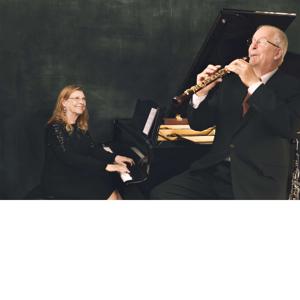


Concerto on Themes of Domenico Cimarosa Arthur Benjamin (1893-1960)
I. Introduzione
II. Allegro
III. Siciliana
IV. Allegro giusto
The Australian composer Arthur Benjamin compiled four of Domenico Cimarosa’s sonatas into this oboe concerto in 1942. Cimarosa, a Neapolitan contemporary of Mozart, was best known for his comic operas. He also wrote hundreds of witty single-movement harpsichord sonatas. But Cimarosa backed the losing side in a revolution against the monarchy of Naples. He was imprisoned and then exiled to Venice, where he died at the age of 51.
Italian Dance Madeleine Dring (1923-1977)
Madeleine Dring was an English actress, pianist and composer. She was fluent in the idioms of jazz, pop and musical theater. She received a privileged education and became a skilled classical composer as a student of Ralph Vaughan Williams. She was influenced by the work of Arthur Benjamin, George Gershwin, Cole Porter and Francis Poulenc. Her father, an amateur pianist, was a skilled improviser who encouraged her use of “wrong-note humour” in which she added unexpected notes to conventional chords. While still a student she met the soon-to-be-famous oboist Roger Lord to accompany him for an audition. They married, she wrote many pieces for him, and he in turn tirelessly promoted the publication and performance of her compositions after her early death.
Sonata in G Minor, BWV 1030b Johann Sebastian Bach (1685-1750)
Andante — Siciliano — Presto
Bach’s G-minor Sonata for Oboe and Keyboard was probably first performed in a coffee house for a weekly meeting around 1730 of the Leipzig Collegium Musicum, a music society which Bach directed at the time. His score gives distinct personalities, dignified, flirtatious or childlike, to each musical line, one at a time for the oboe and two or three at once for the keyboard player. The Andante movement is a trio sonata with increasingly intricate counterpoint. The Siciliano movement is a slow dance in 6/8 meter, with elaborate ornamentation around a swaying melody. The Presto has two sections. It starts as a quick fugue ("chase") in which an opening theme chases after its imitations through a thicket of counter-melodies in different keys. The finale is a hopping dance in 12/8, a gigue in (of course) jig time. The jig has a rollicking bass near the end that might well have inspired “The Teddy Bears’ Picnic:”
“If you go down in the woods today, you're sure of a big surprise
If you go down in the woods today, you'd better go in disguise
For every bear that ever there was
Will gather there for certain because
Today's the day the teddy bears have their picnic!”
(lyrics ©Henry Hall, 1932)
3 Gymnopédies (1888) Erik Satie (1866-1925)
3 Gnossiennes (1890)
Satie attended the Paris Conservatoire, was expelled twice for ignoring musical rules, and thereafter went out of his way to offend the musical establishment. Following the motto of Charles Baudelaire that art should “épater (scandalize) les bourgeois”, the Gymnopédies and Gnossiennes refer to dances of naked men and boys as depicted in ancient Greek pottery and the murals of the Palace of Knossos in Crete. The Gnossiennes are written without bar lines to suggest a continuous flow of sound.
Martha Graham, Diaghilev’s Ballets Russes, Merce Cunningham and others choreographed dances based on this music. Satie was friendly with Debussy, Ravel, and the founders of Cubism and Dadaism. Hoping to call attention to Satie, Debussy orchestrated Gymnopédies #1 and #3, and Poulenc orchestrated Gnossienne #3. In all three arrangements an oboe plays the principal melodies.
Photo by Soichi Sunami, 1927: Martha Graham Dancers performing Satie's Gnossienne. Source: Library of Congress
Ballade (1953) by Hendrik Andriessen (1892-1981)
This is our lament for our country and for the black lives we are losing. Ballade commemorates the experience of the Dutch people under German Fascist occupation in World War II, and by extension, all victims of Fascism everywhere. The Nazis murdered three quarters of all Dutch Jews, and hundreds of thousands of Dutch Gypsies, resistance fighters, journalists, artists and the ordinary citizens who tried to protect them. Ballade tells their story without words, first in a traditional Jewish lamentation, then in the sounds of marching troops, aircraft engines, falling bombs, and a funeral march. The Nazis were afraid of this music. They imprisoned its composer, Hendrik Andriessen, and prohibited performing his compositions.
We must not tolerate the drift of our country towards Fascism, for this is where it leads. Viva Knight and Ted Rust add our voices to the worldwide protest against the state-sanctioned murder of black people in the United States of America.
We say their names:
We deplore the loss of over 100,000 Americans, a disproportionate number of them black, due to our nation’s failure to contain the coronavirus pandemic and to tolerate peaceful protest.
For white people asking what they can do about racism in America, here is a response from Light Watkins: https://youtu.be/sjhz594Am6g
photo ©Christine Wu, 2020
Gabriel’s Oboe Ennio Morricone (1928 -)
Ennio Morricone is a prolific Italian composer of film scores and concert music. This piece is from a scene in The Mission (1968) in which the central character, a missionary priest, plays his Baroque oboe for a band of Indians who have captured him in the Amazonian forest. His music persuades them to spare his life. Some oboe playing can have the opposite effect.
Two Themes of Handel, opus 85a Ernst Krenek (1900-1991)
Andante -- Allegretto
Ernst Krenek was an Austrian avant-garde composer of radically atonal music for the first half of his career. His work was denounced as “degenerate” by the Gestapo, forcing him to leave Austria. He emigrated to the U.S. in 1938. Following Stravinski’s lead, he adopted an elegant neoclassical style for these settings of themes by George Frideric Handel.
Domenico Scarlatti, Keyboard Sonata in E Major
Domenico Scarlatti, Keyboard Sonata in E minor
Terry Riley, “Simone’s Lullaby”
Domenico Scarlatti (1685-1757) was born in Naples. His father was Alessandro Scarlatti, who had composed a series of successful operas in Naples and Rome. Domenico studied in Rome with the most respected musicians of his time and was considered a brilliant harpsichordist. He worked as a composer/musician in the courts of the Vatican, Lisbon and then, for the rest of his life, in Madrid, where he became harpsichord teacher to the future Queen of Spain. The vast majority of his compositions, over 500 short harpsichord sonatas, were written in Madrid towards the end of his life and were little known elsewhere in Europe until the early 20th century.
Terry Riley (1935- ) is an American composer whose works are performed worldwide. His piece “in C” (1964) launched what became known as the Minimalist movement. He is an acknowledged master in the disciplines of classical Western composition, Indian classical music, film scoring and jazz. Simone’s Lullaby, from Heaven’s Ladder Book 7, was written for his granddaughter. He was born in Colfax, CA in 1935, lives in a small town in the northern Sierra Nevada foothills and continues to perform internationally.
1. In beautiful May, when the buds opened, love opened up in my heart: when the birds all sang, I told you my desire and longing.
2. Many flowers spring up from my tears, and a nightingale choir from my sighs: If you love me, I'll pick them all for you, and a nightingale will sing at your window.
3. I used to love the rose, lily, dove and sun, joyfully: now I love only the little, the fine, the pure, the One: you are the source of them all.
4. When I look in your eyes all my pain and woe fades: when I kiss your mouth I become whole: when I recline on your breast I am filled with heavenly joy: and when you say, 'I love you', I weep bitterly.
5. I want to bathe my soul in the chalice of the lily, and the lily, ringing, will breathe a song of my beloved. The song will tremble and quiver, like the kiss of her mouth, which in a wondrous moment she gave me.
6. In the Rhine, in the sacred stream, Cologne with its great cathedral is reflected. In it there is a face painted on golden leather, which has shone into the confusion of my life. … the eyes, lips and cheeks are just like those of my beloved.
7. I hold no grudge, though my heart breaks, love ever lost to me … I saw the night in your heart, I saw the serpent that devours it: I saw, my love, how empty you are.
8. If the little flowers only knew how deeply my heart is wounded, they would weep with me to heal my suffering, but … only one knows, she that has torn my heart asunder.
9. There is a noise of flutes and fiddles and trumpets, for they are dancing the wedding-dance of my best-beloved. There is a thunder and booming of kettle-drums and shawms. In between, you can hear the good cupids sobbing and moaning.
10. When I hear that song which my love once sang, my breast bursts with wild affliction. Dark longing drives me to the forest hills, where my woe pours out in tears.
11. A youth loved a maiden who chose another: the other loved another girl, and married her. The maiden married, from spite, the first and best man she met. ... It's the old story, always new: the one whom she turns aside, she breaks his heart in two.
12. On a sunny summer morning I went out into the garden: the flowers were talking and whispering, but I was silent. They looked at me with pity, and said, 'Don't be cruel to our sister, you sad, death-pale man.'
13. I wept in my dream, for I dreamt you were in your grave: I woke, and tears ran down my cheeks. …
14. I see you every night in dreams, and see you greet me friendly, and crying out loudly I throw myself at your sweet feet. You look at me sorrowfully and shake your fair head ... You say a gentle word to me and give me a sprig of cypress: I awake, and there is no sprig, and I have forgotten what the word was.
15. The old fairy tales tell of a magic land where flowers shine in the golden evening light, where trees speak and sing like a choir, and songs of love are sung such as you have never heard, till wondrous sweet longing infatuates you! … Ah! I often see that land of joys in dreams: then comes the morning sun, and it vanishes like smoke.
16. The old wicked songs, and the angry, bitter dreams, let us now bury them … the coffin must be bigger than the Heidelburg Tun. ... And bring me twelve giants, who must be mightier than the St. Christopher in the cathedral at Cologne. They must carry the coffin and throw it in the sea. … Why must the coffin must be so big and heavy? I will also put my love and my suffering into it.
Isaac Albeniz (1860-1909) composed Aragón (Fantasia) in 1886 as one of a series of piano solo pieces depicting the musical styles of the Spanish provinces. It is based on a popular traditional dance called the Jota. This version of Aragón was adapted for oboe and piano by David Walter.
Alberto Guidobaldi (1967- ) is a professor at the Conservatorio de Musica de Puerto Rico in San Juan. He composed this Sonatina for Oboe and Piano in 2004. It has three movements:
Vivo has a catchy Latin rhythm that alternates between 6/8 and 3/4 like the one Leonard Bernstein used in the song “America” for West Side Story:
GIRLS
I like to be in Ame-ri-ca
Okay by me in Ame-ri-ca
Everything free in Ame-ri-ca
BERNARDO
For a small fee in Ame-ri-ca . . .
Wolfgang Amadeus Mozart (1756-1791) wrote his Violin Sonata in F major, KV 376, in 1781 as a showpiece for his student, the pianist and composer Josepha Barbara von Auernhammer (1758-1820). She performed its premiere in Vienna with Mozart playing the violin part, and later supervised its publication.
In Dolci’s adaptation, the oboe rolls through the double and triple-stopped chords of the violin part, transposes a few notes up or down an octave to fit the oboe’s range, and trades brief passages with the piano. Other departures from Mozart’s score can only be attributed to human error.
The three movements are marked:
I. Allegro
II. Andante
III. Rondo: Allegretto grazioso
Partia #2 of Die Kleine Kammermusik by Georg Philipp Telemann (1681-1767). It consists of a slow dance with six variations. The movements are
From the publisher's feed