
Sign up to save your podcasts
Or



April: On Nature
April 30
Today's reflection was inspired by the poem "The Gardener 85" by Rabindranath Tagore.
Buy a bag of bulbs and plant them in the ground and think of all the other dirt-covered, cracked hands that dug through the same dirt you’re kneeling in now. Smell the honeysuckles and lilacs in April, think of all the others who stuck their noses into the flowers of the ancestors of that plant, those flowers that were visited by the bees of a hundred years ago and were turned to seed where the cycle continued through time to you and will continue on after you.
Do this and know that you are never alone. That you and the plants and the gardens and fields are all threaded together in one massive tapestry of time.
April: On Nature
April 29
Today's reflection was inspired by a quote from my novel Dead World: A Post-Apocalyptic Tale.
According to National Geographic, about 571 species of plants have gone extinct in the wild since the 1750s. And since 1900, an average of eight plant species have gone extinct every three years.
I don’t know what the world will look like 10 years from now, let alone hundreds or thousands—what life, what plants will be left, but I can try now, while I’m here, to protect that which exists and add to it where I can. And who knows, maybe that future I dreamt up doesn’t have to be harsh and gray and lifeless or post-apocalyptic—maybe it doesn’t have to be at all—maybe if we do something now, it’ll be greener and brighter.
April: On Nature
April 28
Today's reflection was inspired by the poem "The Peace of Wild Things" by Wendell Berry.
We fear a future that does not exist, one that we created and then let control our lives in the present. This is a very human thing to do—anxiety has helped us survive for millions of years out in the plains or in the forests and mountains. And it’s easy to say, “Do not let it control you,” when you are not suffering from it. But when your mind has been apprehended by it? That is another matter. So best to prepare, and best to repair—find your places in nature, those ones that heal you and free you. Breathe the air, watch the swaying of the trees, the still water of a pond, the blue skies and bright stars. Do this every chance you get. When on vacation or out on a hike or stopping for a moment in the grocery store parking lot to look up at the clouds and imagine where they’ve been and where they have yet to go, watch the birds below them on their way south or north without forethought of grief—then breathe, and repeat.
April: On Nature
April 27
Today's reflection was inspired by a quote from the graphic novel A. Guardian by me (Eastin DeVerna).
You can try and retrace the steps you took, the paths you chose in your life that led you up to this moment here and now. You can ponder over the what ifs and what could have beens till the cows come home. And while reflection is good, dwelling can sink you into a dark pit. You are here now in your position, in your relationship or not, and all that you can do is decide how you will move forward in this moment and each thereafter.
You may wake up and wonder where your spark went, where the desire to bound through the woods and dance with the leaves went, and if you do, do not despair. It is a good thing. Because, after all, you can’t look for something until you know it’s missing, can you?
So find your peace, seek it out—out there in the world, in nature, in a book, in a prayer or meditation, or just in the silence of your mind. Find it, and keep it as a touchstone in your pocket.
April: On Nature
April 26
Today's reflection was inspired by a quote from the video game The Legend of Zelda: Ocarina of Time.
At what point does your life begin? At your birth? Or the moment your parents met? The moment an ancestor of yours who you’ll never know—one who will never know you—escaped death, fleeing a bear, wearing a helmet in a war, or stopping to pick up their scarf before crossing the street when a truck came barreling through the intersection?
Does it end with your death? Or does it live on in your ideas and actions? The river of time and life—trying to comprehend it is like trying to bail out the Mississippi with a tablespoon. It can’t be done. And you shouldn’t want to. Rather, look at yourself in its surface, dream of the past, live in the present, and contemplate the future. Dip your feet in once in a while, grab a canoe, and just drift.
April: On Nature
April 25
Today's reflection was inspired by a quote from Ursula K. Le Guin’s The Tombs of Atuan.
We speak often of nature’s serenity and tranquility—it’s ability to heal and comfort. But its darker side—its duality—should be no surprise, for we humans have inherited both edges of this sword. The capacity for love and kindness, and for hostility and indifference. The ability to wage war, throwing lives away as fodder, and then care for the orphans and hope and pray they never will have to live through another like it.
We learned from nature, we exist within nature—so some may say, then why should we be any different? The answer is simply because we can. The answer lies in our power to choose. We must never forget where we came from, but we also must never squander our gift of agency and turn a blind eye to where we can go.
April: On Nature
April 24
Today's reflection was inspired by the poem "There Will Come Soft Rains" by Sara Teasdale.
She wakes from the long sleep. One in which she dreamt of blossoms and wind and rivers and soil. The day’s first light falls upon her as she rises from her bed of moss and leaves and she steps forward into the world with nothing to separate her from the air or ground or sky.
She watches the sparrows flutter, listens to their song, watches them alight upon the antlers of deer, twitching their tails in an odd language, one that brings a smile to her face.
A great city stretches out before her. It was once a place where she was not welcome, where they would take blade and poison and wage war against her. But she does not recall that life—not since this place has been burned and hollowed out. The buildings and spires of cement and steel that rejected her touch have no choice now but to let her in and she gives it not a second thought as her children of vines and moss and lichen clamber over the structures, using them to reach such great heights as they have never reached before, and they do not offer their thanks to these spires and buildings because these spires and buildings exist solely for them and for them to climb.
Listen on for the rest . . .
April: On Nature
April 23
Today's reflection was inspired by a quote from Little House in the Big Woods by Laura Ingalls Wilder.
The mysterious beauty of winter is undeniable, and so too is the fact that it has hardened humans, building resilience and forcing innovation out of necessity.
The cyclical nature of the seasons offers a reminder that the difficult and sparse times will end, but also that they will return—and in those times, you can still find beauty and peace . . . but don’t get complacent.
You can do with that what you will—ignore it and bask in the warmth and abundance of summer, or build up your stores, strengthen your shelters and prepare. The choice is yours.
April: On Nature
April 22
Today's reflection was inspired by a quote from Monty Don's book My Roots: A Decade in the Garden.
When you are planting, you are facilitating life. When you are planting, you can forget your contracts to society for a moment or a few hours or a day. In this time, it is you and nature, you and the planet—you have no mortgage or rent or job, you do not have to eat or watch or buy—your task is simple and singular.
You’re neat and organized? Great—create your little world of plants in rows or by alphabetical order or species. Do you subscribe to the chaos variety of life? Also great—grab a handful of seed and throw it around and see what survives the birds. Plant whatever and wherever you want without a second thought and let nature do its thing.
April: On Nature
April 21
Today's reflection was inspired by a quote from Robert Frost's poem "Birches."
In modern times, it is the constant stream of news—of knowing every horrible event happening around the globe the moment it happens, coupled with the daily burdens of being overworked and underpaid, the stress of being responsible for the survival of others, all while battling anxiety, depression, and an ever-growing movement of oligarchs and extremism, that can make one weary of considerations and make life feel like a pathless wood at times.
Though, there is something beautiful about a pathless wood. It’s nature as she intended. There is opportunity in the ability to go in any direction, until you stumble upon a deer path, anyway. Sometimes, in following paths laid out by others, or even in carving one yourself, you may not like what you find at the end of it.
There is fun to be had as well in wandering the pathless. Climb that birch there, climb as high as you can until you’re off the ground and can see eye-to-eye with the birds, feel the winds fresh before they fall to the ground, and just get away from it all—before your weight becomes too much for the birch and it eventually lowers you down like a tired parent taking their child from atop their shoulders.
The people of Earth can and will make you weary, but they will also fill your cup. After all, it is the right place for love—where is it likely to go better? Yes, you could do worse than here and now, being a swinger of birches.
From the publisher's feed
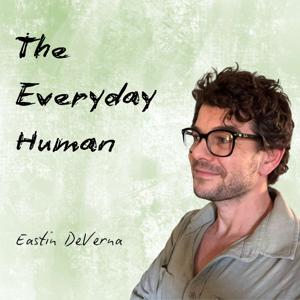
Welcome to the Everyday Human podcast.
My name is Eastin DeVerna. Each day, I'll share a reflection written by me and inspired by literature, poetry, music, movies, video…
Together, we'll explore what it means to be human. Every month we'll walk a new path, taking a look at life, death, the universe, and everything in between.
Thanks for coming along.
For more, visit eastindeverna.com or join me on Instagram @the_everydayhuman.