
Sign up to save your podcasts
Or



Based on Podcast App listening data
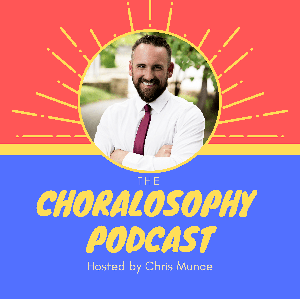
In this episode Maria Ellis and I discuss the practical aspects of recruiting across cultural lines for our choirs through the telling of her own story. Maria grew up not knowing that a career as a conductor was possible for her, but through a big dream and a big change of life direction, she began her music degree after 12 years in the business world. Now doing what she loves, she reflects back on the journey and offers us great advice in helping to make sure our students never grow up seeing themselves as limited.
Maria in her own words, “
Music Educator, Choral Conductor, with over 20 years of choral music experience. I have been called a Master Educator and a Force of Nature by Dr. Jim Henry, University of Missouri- St. Louis. I hold a B.M. in Music Education emphasis on Voice (K-12 Certified) Degree from the University of Missouri- St. Louis.
I have served as the Arts and Administrative Fellow for The St. Louis Symphony and I currently serve as the Community Engagement Manager for The St. Louis Children’s Choirs. I am the Founding Conductor of The Sheldon Concert Hall and Art Galleries’ newly formed City of Music All-Star Chorus.
http://www.girlconductor.com
Part 1: Why does representation in Choral Music matter?
In this first installment, I address the question “Why Does Representation in Classical Music matter?” (or choral music) My answer to this question, and subsequent defense of that answer got me kicked off of a Facebook page. So in this episode, I tell that story. It’s a doozy. My answer was, “Representation matters because music is for ALL. From all to all. It can and should transcend innate characteristics.” It turns out this put me at odds with the moderator who had a “music is not universal” perspective which I have noticed has become more prevalent in the last five years or so. I have a lot problems with this trend though I see it as well-meaning one.
So, I decided to line up a series of episodes and guests during Black History Month in order to advance the conversations around representation, equity, equality and inclusion of ALL in the most HUMAN of all art forms: Choral Music.
This is a FASCINATING discussion with Donald Brinegar, author of the recently published “Pitch Perfect: a Theory and Practice of Choral Intonation.” Donald and I discuss the sometimes misunderstood concepts related to intonation and what makes something “in tune” or “out of tune.” Is it possible that we our education related to this topic has been lacking? I think it has been lacking for many, which is why I think this episode is so important. The conversation runs mostly along two tracks. The common misconceptions surrounding the mathematics of intonation as well as practical ways to bring concepts of intonation into rehearsals with singers of all levels.
Find “Pitch Perfect” by Donald Brinegar on Amazon! or on his website.
Donald Brinegar is a conductor, tenor soloist, voice instructor, educator and master class clinician. Professor Emeritus of Music at Pasadena City College, Brinegar directed the Choral Studies program at PCC for 36 years. Brinegar also conducts the Donald Brinegar Singers, a community choral ensemble in Pasadena, California, Director of Choruses for the Pasadena Symphony and POPS, . During the summers he co-directs the Cal State Los Angeles masters program in choral conducting.
He has an extensive background as a performer both as a soloist and a conductor having performed throughout the United States, Japan, Europe, Australia, New Zealand, Mexico, and Canada. Brinegar has performed as a featured soloist with Robert Shaw, Helmuth Rilling, Roger Wagner, Gerard Swartz, Murray Sidlin, Howard Swan, Charles Hirt, Rod Eichenberger, William Hall, Marvin Hamlisch, Michael Feinstein, and with numerous music festivals, orchestras and opera associations. He has collaborated artistically with Henry Mancini, Barry Manilow, The Los Angeles Philharmonic, John Delancie, and the Chieftains. His choirs have given five performances for the American Choral Directors Association Conferences, California Music Educators (MENC), Choral Conductors Guild, and have performed in Carnegie Hall, the Los Angeles Music Center, and the Hollywood Bowl. In the Fall of 2017, Brinegar was recognized by the Pasadena Symphony as their Artist of the Year.
The Donald Brinegar Singers, choral ensemble, was founded in the Fall of 1997 as an ensemble of former students and colleagues of Professor Brinegar. Their first concert was given in November of 1997. Their second performance was the premiere of Lauridsen’s organ edition of Lux Aeterna, accompanied by organist James Buonemani. The ensemble presented music of the holiday season and was then invited to perform at The ACDA Western Division Convention in Los Angeles, 2000. Shortly following the convention appearance, the Singers recorded Ubi caritas et amor and Madrigali Six Fire-Songs: for Lauridsen’s compact disc, Northwest Journey. The Singers performed the Chansons des Roses with Lauridsen accompanying at the San Antonio, Texas, ACDA National Conference. The Singers followed with two more performances of Lauridsen’s music in Las Vegas, 2004 ACDA Western Division Conference, and the premiere of Nocturnes (The Brock Memorial Convention Commission) 2005, Los Angeles ACDA National Convention.
Sometimes we fall into ruts. Sometimes the singers do… Ultimately, both scenarios are bad and are OUR fault as the director. I have had wildly successful school years and seasons with churches and pro choir. And some that fell flat… In this episode I draw on that experience to come up with list of winning strategies synthesized from my best years on the podium. The list below is NOT ranked in any type of way.
In this episode I asked the expert, Dr. Amanda Quist to chat with me about teaching the concept of vowels, resonance and intonation. Is it possible to measure a vowel scientifically? Or is the purity of a vowel subject to the opinion of the conductor? We discuss what I believe to be a new frontier in choral classrooms by using technology to teach students how visualize and then hear their own resonant singing. One important topic we discuss is the unfortunate practice of “Choral Band-Aid” vowels. I define this as avoiding the teaching of proper anatomy of vowel structures in order to get to a blended sound more quickly.
Dr. Amanda Quist is the Director of Choral Activities for the Frost School of Music at the University of Miami. Dr. Quist was previously Chair of the Conducting, Organ, and Sacred Music Department, and Associate Professor of Conducting at Westminster Choir College. Dr. Quist is the recipient of Westminster Choir College of Rider University’s 2014 Distinguished Teaching Award, the 2018 Mazzotti Award for Women’s Leadership, and she is the Carol F. Spinelli Conducting Fellow. Dr. Quist was recently invited to be a conductor for the ACDA International Exchange Program, clinician for the 2019 ASPIRE International Youth Music Festival in Australia, juror for the Penabur International Choir Festival in Indonesia, and clinician for the Interkultur International Choral Festival. Westminster Kantorei, winner of the 2018 American Prize in College & University Choral Performance, has performed at the American Choral Directors Association’s (ACDA) Eastern Division Conference, Boston Early Music Festival, American Handel Festival, and Interkultur.
The choir recently released its first commercial recording, Lumina, distributed by Naxos, which was hailed by infodad.com as a recording “sung with great beauty of sound and excellent articulation … a CD to cherish” and by National Medal of Arts recipient Morten Lauridsen as “superb, a splendid recording, highly recommended.” During her work with the Westminster Symphonic Choir, Dr. Quist collaborated with the New York Philharmonic, Philadelphia Orchestra, and the Dresden Staatskapelle. She also serves as Chorus Master for the Philadelphia Orchestra Chorus. Dr. Quist’s role as Chorus Master for the premiere of Toshio Hosokawa’s opera Matsukaze at the Spoleto Festival USA and the Lincoln Center Festival garnered praise from The New York Times and Charleston City Paper, who described the chorus’ performance as “beautifully prepared, gripping,” a “gossamer web of voices” and “bridging the vocal and instrumental textures with perfect intonation.”
Dr. Quist was Director of the Westminster Vocal Institute, a highly regarded summer program for talented high school students, and Director of Choral Activities at San José State University. Her other honors include the James Mulholland National Choral Award and the Audrey Davidson Early Music Award. An active guest conductor and clinician, her recent and upcoming appearances include the NAfME All National Honor Choir, All State High School & Collegiate Honor Choirs throughout the country, and serving as a headliner for music conferences in the US and abroad. Dr. Quist is the National ACDA Repertoire & Resources Coordinator for Collegiate Activities, and her choral series is published through Walton Music.
https://choral.frost.miami.edu
Frost School Choral Studies on Facebook
The pink trombone. Try it!
In this episode, Beth and I chat with our mutual friend, Dr. Jaclyn Johnson about her choice to step away from the choral classroom and her University teaching post to go to Brazil to teach Yoga. We discuss her goals in embarking on this adventure, and how she is using this time away to reboot her focus as an educator and conductor. I think you will enjoy this chat and the fascinating story behind it! Other topics include mindfulness, and cultural norms dealing with physical touch and materialism.
Described as an energetic firecracker, Dr. Jaclyn Normandie-Johnson’s goal is to share her passion for life and music around the world. Her current areas of research include Latin American music, vocal pedagogy, and music-incorporated yogic philosophy. Johnson is a prolific lecturer, honor choir conductor, and clinician around the country. An avid Wellness Life Coach, she spent the last 6 months living in India and Brazil practicing and teaching yoga.
Johnson earned her doctoral degree from the University of Michigan, and has had a thriving career as a high school, university, and church choral educator. Ensembles under her direction received numerous honors, including performances at the American Choral Directors Association National Conference, Western Division Conference, and Central Division Conference.
“We live in a time where directing choirs for a living is possible. In the broad scope of human history, THAT alone is an amazing luxury.”
I believe that an underlying philosophy is a necessity for each successful professional. Some call this a “why statement.” Have you found your “why?” Is it the same as it was 10 years ago? In this episode, I share my thoughts about practicing gratitude as a life principle, as well as an exercise in class. In order to illustrate this, I enlisted the help of some friends. In addition to my thoughts on gratitude, you will hear “why” statements from Dr. Ryan Board of Pepperdine, Mark Lawley of Willard High School, Robert T. Gibson of Reed Academy, Dr. Giselle Wyers of U of Washington, Dr. Jennaya Robison of Luther College and Ryan Main, composer and director of the Kansas City Youth Choir program and Dr. Andrew Crane of BYU. Special thanks to each of them for sharing with us!
I am beyond excited to show you an amazing tool that I use to introduce my students to the concept of vowels, resonance and formants! And, by extension, the concept of blend. This is a passion for me in the classroom. I love watching the students eyes and ears come alive to the power of an overtone rich sound. To that end, we provide visual aid for them to understand if they are doing it correctly. One thing we know about good teaching is that not all students learn in the same way. What if the visual learners could SEE if their vowel is correct or if the choir is tune?!
No more arguing with kids about their “O” vowel! You don’t have to be the bad guy anymore!
When singers can SEE if they are in tune, if they can SEE that they are singing the right vowel, it creates an amazing path toward being able to HEAR it in context.
In this episode, I have the privilege of chatting with Charles Anthony Silvestri, noted lyricist, about the artistic magic that is possible when music and text are fused. He believes that this intersection is what makes our beloved art form special, and I whole heartedly agree. I pick his brain about his process from idea to final project for a new piece. We talk about his new endeavors as a composer of notes and not just lyrics, as well as some witty banter about Eric Whitacre’s early years and his role in bringing the choral art form into the 21st Century.
Poet, composer, and speaker Charles Anthony Silvestri has worked with composers from all over the world to create texts tailor-made for their commissions and specific artistic needs. He has provided custom poetry, opera libretti, program notes and other writing for composers including Eric Whitacre, Ola Gjeilo, Kim Arnesen, and Dan Forrest, and for ensembles ranging from high schools to the Houston Grand Opera, from the King’s Singers to the San Francisco Gay Men’s Chorus, from Westminster Choir College to Westminster Abbey. As a clinician Silvestri speaks to choirs, classes, and concert audiences about his works, the creative process, the marriage of words and music, and about his collaborative relationships with composers. He is the author of three books, including A Silver Thread (GIA 2019), a retrospective of almost 20 years of his lyric poetry. He teaches Ancient and Medieval History at Washburn University, and lives in Lawrence, Kansas.
Find more about Tony as well as links to his published poetry books mentioned on the website at:
www.charlesanthonysilvestri.com
Find Tony on Social media @CharlesAnthonySilvestri on Facebook @tony_silvestri on Instagram @TonySilvestri on Twitter
For this episode, I sat down (twice… long story) with Paul Smith, co-founder and CEO of VOCES8 and the VOCES8 Foundation while he was in Kansas City. We had a lot of great conversations about the state of music education in the U.K. and the U.S. and the role of VOCES8 and other performing ensembles in sparking a passion for choral music in young singers. The talk ranged from discussions of disparity of music education quality regionally all the way to the interesting differences between the preferred “British” choral sound vs. that preferred by most American Choral Directors.
Paul Smith is an innovative and creative performer, conductor, composer, an inspirational educator and an empowering public speaker. As co-founder of VOCES8, author of The VOCES8 Method and CEO of the VOCES8 Foundation, his annual programme sees him working globally in prestigious concert venues, festivals, schools and universities.
Paul is passionate about the impact singing and the arts can have in the widest possible context – from academic improvement to social skills and building more cohesive communities. He uses that passion to design and deliver unique, inclusive and uplifting performance projects.
In the 2019-20 season, highlights will include: leading the ‘Singing Brussels’ massed choir project with BOZAR in Brussels; touringhis new album and concert programme titled ‘Reflections’; a series of concerts and workshops at the VOCES8 Centre in the City of London; leading his family concert ‘The Winter House’ programme with the Curtis Institute in Philadelphia; conducting the Orchestra of Avignon in a series of concerts for families and young people; conducting the Orchestre D’Auvergne in a new concert for students; leading the Israeli Vocal Ensemble for a series of concerts in Israel; leading a series of concerts across France with VOCES8 and Apollo5, supported by Vivendi,and concerts and workshops in Germany, the USA, New Zealand and Japan. Paul will be continuing his work at the University of Cambridge in 2019.
The VOCES8 Method, written by Paul, is published by Edition Peters in four languages, and is now being used in thousands of schools in numerous countries around the world. The Method is designed to link specific music-making activities with academic improvement in numeracy, literacy and linguistics.
https://youtu.be/qwyqJoTmPCM – Paul’s new setting of the Nunc Dimittis. There’s a link to the sheet music on the video blurb.
https://youtu.be/kSZubXsjUmI – New arrangement of the Edo Lullaby, a Japanese traditional song. Again, sheet music links are in the video blurb.
Our new VOCES8 digital release:https://music.apple.com/us/album/after-silence-i-remembrance/1484535596
The full album referenced in podcast, Reflectionshttps://music.apple.com/us/album/reflections/1467740424
From the publisher's feed
Ranked by our users in the last 21 days

90,783 Listeners

78,288 Listeners

31,903 Listeners

38,651 Listeners

14,360 Listeners
30,074 Listeners

3,070 Listeners

87,153 Listeners

56,416 Listeners

69,490 Listeners

85,590 Listeners

1,621 Listeners

16 Listeners
0 Listeners
643 Listeners