
Sign up to save your podcasts
Or

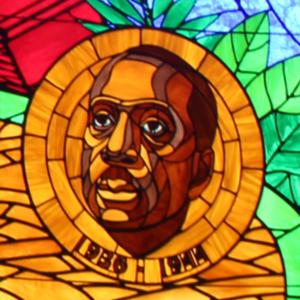


In this second lecture on "The Men Who've Walked with God," Thurman summarizes his teachings on mysticism and supplements it with a conversation on Laozi and the Dao. Laozi affirmed the Dao to be the creator of life that has no name or category. The Dao manifests itself in all of life. Thurman explains that experiencing the Dao requires detachment – not withdrawal from life, but rather finding the center of your being, a discipline we rarely make time for. Thurman says that we must parse through the noise of our lives to hear the God who lives at our center.
Part of the Collection, Men Who've Walked with God (1953)
Tags:
Description by Rodell Jefferson III.
Recorded in Fellowship Church, San Francisco, California
Citation: Thurman, Howard, “Men Who've Walked With God, Part 2, 1953 April 19,” The Howard Thurman Digital Archive, accessed July 9, 2024, https://thurman.pitts.emory.edu/items/show/946.
This final section in Thurman's series on the Divine Encounter examines the encounter with God in human need. Throughout this series, Thurman has spoken to dealing with crisis, not just on the surface, but at deeper levels. By relating to the person, rather than the person's sickness, we are able to restore them at the level of personality. This is a difficult task because we often deal with only aspects of each other, and not the whole. Nevertheless, when we deal with each other in whole, the God in us is administering to the needs of God in the other.
Part of the Collection, The Divine Encounter (1953, Fellowship Church, San Francisco, CA)
Tags:
Description by Rodell Jefferson III.
Recorded in Fellowship Church, San Francisco, California
Citation: Thurman, Howard, “The Divine Encounter, Part 4, 1953 March 30,” The Howard Thurman Digital Archive, accessed July 9, 2024, https://thurman.pitts.emory.edu/items/show/943.
In Part 3 of this series on the Divine Encounter, Thurman remarks that "life is more than any experience of life." No single event, circumstance, or experience is capable of totally defining our lives. Any event that convinces us otherwise becomes God in our lives, which is why worry and anxiety are so despairing. For Thurman, remaining connected to the inexhaustible quality of our personalities gives our lives meaning and resilience. With this connection maintained, even death becomes nothing more than an event of life, incapable of exhausting the whole of us.
Part of the Collection, The Divine Encounter (1953, Fellowship Church, San Francisco, CA)
Tags:
Description by Rodell Jefferson III.
Recorded in Fellowship Church, San Francisco, California
Citation: Thurman, Howard, “The Divine Encounter, Part 3, 1953 March 23,” The Howard Thurman Digital Archive, accessed July 9, 2024, https://thurman.pitts.emory.edu/items/show/942.
In Part 2 of this series on the Divine Encounter, Thurman continues to claim that all of life is supported by God's order, including life's crises. Thurman asserts that it is better to experience crisis than to have no crisis at all, for it is crisis that summons up the depth of the human spirit. For Thurman, all the universe shares the rationality of God with the human mind, and thus the mind is capable of finding revelation and understanding in any circumstance. By this connection, Thurman says that we should expect "highest revelation," even in our "littlest places."
Part of the Collection, The Divine Encounter (1953, Fellowship Church, San Francisco, CA)
Tags: suffering
Description by Rodell Jefferson III.
Recorded in Fellowship Church, San Francisco, California
Citation: Thurman, Howard, “The Divine Encounter, Part 2, 1953 March 16,” The Howard Thurman Digital Archive, accessed July 9, 2024, https://thurman.pitts.emory.edu/items/show/941.
In the first lecture of this series, Thurman discusses the Divine Encounter in the context of crisis. All living beings experience crisis in some form. These crises force us out of familiarity and comfort. Thurman suggests that, in the face of crisis, we have the option to retreat or move towards this challenge. Using examples ranging from biblical Jacob to Beethoven, Thurman offers that, even in seeming chaos and disorder, there is an "orderliness of rationality of God." Ultimately, Thurman invites us to demand revelation from crisis, as there is no crisis that is outside of God.
Part of the Collection, The Divine Encounter (1953, Fellowship Church, San Francisco, CA)
Tags: suffering
Description by Rodell Jefferson III.
Recorded in Fellowship Church, San Francisco, California
Citation: Thurman, Howard, “The Divine Encounter, Part 1, 1953 March 9,” The Howard Thurman Digital Archive, accessed July 9, 2024, https://thurman.pitts.emory.edu/items/show/940.
Do you “believe in democracy?” Thurman poignantly begins his sermon by asking the congregation to give serious thought to their commitments to the democratic process. Democracy, he claims, rests on a fundamentally metaphysical presupposition that the world is “grounded in creativity.” Human thought experiments with the raw material of life and of living that exist all around us, which is “shaped and reshaped” in accordance with “great aspiring and great hoping and great dreaming.” Human imagination is the fundamental pillar upon which the hope of democracy rests. More than the individual working alone, “collective imagining,” he says, yields wisdom and insight in their highest manifestations. Building consensus, however, takes time. People often feel that they do not have the time. In the fall of 1952, Thurman believed the proverbial clock was ticking. While the American experiment in democracy remained imperfect, Thurman was sure this “laboratory” for the democratic process could be instructive for societies across the globe. He calls upon the nation to resist dominating the world and rather, shed light on the divine path toward a more united human race.
Part of the Collection, A Faith to Live By (1952, Fellowship Church, San Francisco, CA)
Tags: America, creativity, democracy, democratic process, Great Depression, option, Reinhold Neibuhr
Description by ShaCarolyn Halyard
Recorded in Fellowship Church, San Francisco, California
Citation: Thurman, Howard, “A Faith to Live By, Part 6: Democracy, 1952 October 19,” The Howard Thurman Digital Archive, accessed July 9, 2024, https://thurman.pitts.emory.edu/items/show/935.
In the fifth sermon of this series, Thurman invites us into a reexamination of what it means to be human beings. "What am I? What are you?" he asks. Thurman suggests three answers to the question: 1.) We are dreamers, and our vitality is sustained by our dreaming. 2.) We are builders of worlds, and though our building never fulfills its blueprint, the greatness of our plans feed our dreams and hopes, and 3.) We are children of God, beings of infinite worth. Thurman ends saying that a culture, civilization, or institution that recognizes this dimension of humanity can survive – but one which refuses to do so is already bound towards death.
Part of the Collection, A Faith to Live By (1952, Fellowship Church, San Francisco, CA)
Tags:
Description by Rodell Jefferson III.
Recorded in Fellowship Church, San Francisco, California
Citation: Thurman, Howard, “A Faith to Live By, Part 5: Man (continued), 1952 October 12,” The Howard Thurman Digital Archive, accessed July 9, 2024, https://thurman.pitts.emory.edu/items/show/934.
In the first of two sermons entitled “Man,” Thurman considers what it means for the human to be a spirit-possessing being. The spirit is fundamental to understanding all things that a person thinks and feels. It is what enables the human to respond to one's experiences. Thurman imagines spiritual consciousness as an elevated level of awareness, whereby a person resists being imprisoned within moments and events so that possibilities beyond immediate experience become visible. Here, one can speak back to whatever is “total” in life and thus respond to life “totally.” Such acts are evidence, Thurman says, of what the psalmist means when declaring that humans have been made a “little lower than God.” He ends this message by asking all to consider what he or she will do with the inspiration of the spirit. Divine presence within the body, he avers, is what has the power to turn “the destiny of the race.”
Part of the Collection, A Faith to Live By (1952, Fellowship Church, San Francisco, CA)
Tags: alternative, freedom, harmony, imagination, man, order, spirit
Description by Unknown
Recorded in Fellowship Church, San Francisco, California
Citation: Thurman, Howard, “A Faith to Live By, Part 4: Man, 1952 October 5,” The Howard Thurman Digital Archive, accessed July 9, 2024, https://thurman.pitts.emory.edu/items/show/933.
In the third sermon of this series, Thurman offers commentary on Jesus as a resource for faithful living into the fact of God. Thurman says that Jesus offered to his disciples a vision of God – not a metaphysic, not a theology, not a dogma – but an embodied vision of God. This vision revealed that God is near, and God is love, two principles that cannot be separated. No degradation, no waywardness can rub out God's signature on us. We are redeemed, not by our own individual character, but by God's loving character. In the story of "adulterous woman," Jesus lives into this reality of God that sees us in the tragic state that we are, and yet believes us into greater possibility.
Part of the Collection, A Faith to Live By (1952, Fellowship Church, San Francisco, CA)
Tags:
Description by Rodell Jefferson III.
Recorded in Fellowship Church, San Francisco, California
Citation: Thurman, Howard, “A Faith to Live By, Part 3: Jesus Christ, 1952 September 28,” The Howard Thurman Digital Archive, accessed July 9, 2024, https://thurman.pitts.emory.edu/items/show/932.
In the second sermon of this series, Thurman extends his commentary on God as a centering force in human experience. For Thurman, the awareness of God always arises out of some present stirring, passion, concern, or, anxiety. The religious spirit, he says, emerges to “focus on the ultimate destiny” of the human race whenever there is “moral confusion” in the world. In these instances, God is the reference point enabling creative and dynamic faith. One must turn to the altar of the divine to spark the reflective process and confront evil and the tragedies of life.
Part of the Collection, A Faith to Live By (1952, Fellowship Church, San Francisco, CA)
Tags: aloneness, creator, devil, God, spiritual values, weariness
Description by ShaCarolyn Halyard
Recorded in Fellowship Church, San Francisco, California
Citation: Thurman, Howard, “A Faith to Live By, Part 2: God, 1952 September 21,” The Howard Thurman Digital Archive, accessed July 9, 2024, https://thurman.pitts.emory.edu/items/show/931.
From the publisher's feed
It is my goal to support the The Howard Thurman Digital Archive, at Pitts Theology at Emory University, with their…
I've set a personal goal of listening to all 290+ recordings in one year, and having these recordings available as a podcast will help tremendously. I am so grateful to have them. And I am hopeful that others will discover Dr. Thurman through this podcast.