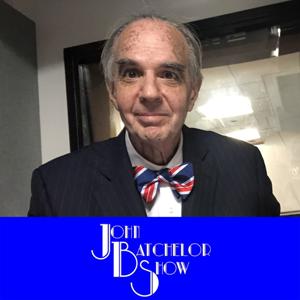
The John Batchelor Show

The John Batchelor Show

By John Batchelor Show.Society & CultureNewsArtsBooks
Download on the App Store
  • Ranking

    33rd

    on Books

  • Favorites

    578

    Followers

  • Typical duration

    18 min

    per episode

  • If it hooks

    62%

    finish an episode

Based on Podcast App listening data

The John Batchelor Show episodes

  • S8 Ep1120: The Rise of the "Available Man": Warren G. Harding Guest: David Pietrusza With Roosevelt dead and Wilson incapacitated, the Repub
    The Rise of the "Available Man": Warren G. Harding Guest: David Pietrusza With Roosevelt dead and Wilsonincapacitated, the Republican Party sought a candidate who could unify their ranks during what was perceived as "their year." Warren G. Harding emerged not as a frontrunner, but as the "available man" — a likable, non-alienating figure from the critical battleground state of Ohio. His campaign manager, Harry Daugherty, strategically positioned him as a middle-ground accommodator while other candidates, like Leonard Wood and Frank Lowden, were damaged by campaign spending scandals. Pietrusza highlights that both parties focused on Ohio as the ultimate prize, leading to the eventual nomination of two Ohio newspaper publishers. Though Harding's personal life involved numerous extramarital affairs and secret children, these did not become public issues in 1920. His wife, Florence Harding, acted as a political "rock," maintaining their partnership to pursue higher office despite her awareness of his conduct. (2)
    1920
    8 min
  • S8 Ep1120: The Tragedy of Woodrow Wilson and the League of Nations Guest: David Pietrusza The 1920 election cycle begins with a physical and
    The Tragedy of Woodrow Wilson and the League of Nations Guest: David Pietrusza The 1920 election cycle begins with a physical and political crisis as President Woodrow Wilson suffers a massive, debilitating stroke in October 1919. This event leaves him frail for the remainder of his life and turns the League of Nations into the central, polarizing issue of the upcoming campaign. Historian David Pietrusza notes that while Wilson viewed the League as his "crusade," the Republican Party was deeply divided between isolationists and those seeking specific "reservations" to protect American sovereignty. Amidst this, Theodore Roosevelt — who many believed would be an "unstoppable" candidate for 1920 — dies in January 1919. Wilson reportedly reacted to his rival's death with "hatefulness" and "vulgarity." As Wilson's inner circle masked his declining health, the political stage was set for a transition from his rigid internationalism to a new era of Republican leadership. (1)
    1920
    11 min
  • S8 Ep1119: The 1936 Landslide and Political Realignment Guest: David Pietrusza Book Title: Roosevelt Sweeps Nation: FDR's 1936 Landsli
    The 1936 Landslide and Political Realignment Guest: David Pietrusza Book Title: Roosevelt Sweeps Nation: FDR's 1936 Landslide and the Triumph of the Liberal Ideal Election night 1936 at Hyde Park began with nervous anticipation, as many — including the Literary Digest — still expected a close race. However, early returns from New Haven, Connecticut, showing a 15,000-vote victory for Roosevelt, signaled an impending "swamping" of the Electoral College. Roosevelt himself was shocked by the margins, initially believing the teletype machines were being read incorrectly. The final result was a massive landslide: Roosevelt carried 46 out of 48 states, losing only Maine and Vermont. The victory brought massive coattails, resulting in 74 Democratic Senators and 334 Democratic House members. This election marked the permanent realignment of American politics, creating the modern Democratic coalition. Roosevelt carried 104 of the nation's 106 largest cities, losing only Pasadena and Syracuse. This shift was driven largely by the children of immigrants who had come of age in the 1930s and "flopped down" for Roosevelt. The Literary Digest poll, which had been right for decades, was famously humiliated, having failed to account for the shifting demographics of the electorate. Roosevelt's victory was more than a mandate; it was a total triumph of the liberal ideal and the big-city machine. The President returned to Hyde Park not just as a reelected leader, but as the architect of a new political era that would dominate the American landscape for decades to come. (8)
    1936
    5 min
  • S8 Ep1119: Eleanor Roosevelt and the Campaign Climax Guest: David Pietrusza Book Title: Roosevelt Sweeps Nation: FDR's 1936 Landslide and th
    Eleanor Roosevelt and the Campaign Climax Guest: David Pietrusza Book Title: Roosevelt Sweeps Nation: FDR's 1936 Landslide and the Triumph of the Liberal Ideal The 1936 campaign saw the emergence of Eleanor Roosevelt as a political star. While Republicans hid Landon's wife and some Democrats feared Eleanor was "too much" for the public, she became an indispensable asset on the campaign trail. She was particularly vital in securing the African-American vote in Northern cities. While the President refused to support an anti-lynching law for fear of alienating Southern Democrats, Eleanor campaigned for it, effectively allowing the administration to "cover the bases" separately. This outreach was crucial, as African-Americans were the hardest-hit demographic and relied heavily on New Deal relief programs. The campaign reached a fever pitch in October 1936. Despite early polls showing Landon leading, the momentum swung heavily toward Roosevelt by late summer. At a massive rally at Madison Square Garden on Halloween night, Rooseveltdelivered a speech that "would peel paint today," declaring of the "economic royalists" that "I welcome their hatred." The speech was a masterpiece of class warfare; observers noted that the violence and "naked demagoguery" of his delivery were even more powerful than the written words. This aggressive stance countered the Republican argument that the public was tired of the New Deal. Despite an unemployment rate still hovering at 13.9%, Roosevelt's ability to frame himself as the protector of the working class against oppressive wealthy interests solidified his lead heading into election day. (7)
    16 min
  • S8 Ep1119: The Selection of Alf Landon and the Republican Field Guest: David Pietrusza Book Title: Roosevelt Sweeps Nation: FDR's 1936 Lands
    The Selection of Alf Landon and the Republican Field Guest: David Pietrusza Book Title: Roosevelt Sweeps Nation: FDR's 1936 Landslide and the Triumph of the Liberal Ideal The Republican Party in 1936 struggled to find a viable candidate to face Roosevelt's juggernaut. They rejected a return to Herbert Hoover, whose 1928 style was deemed too slow and associated with the initial collapse. Other potential nominees included William Borah, the "Lion of Idaho," a progressive maverick and isolationist whom the Republican Old Guard suspected of being a secret Roosevelt shill. Frank Knox, a former Rough Rider and newspaper man, was also considered, though he was seen as a political amateur. Arthur Vandenberg of Michigan was a more mainstream choice, credited with pushing the FDIC to stabilize banks, but he lacked national appeal. Ultimately, the party settled on Alf Landon, the Governor of Kansas, often called the "Kansas Coolidge." Landon was an unremarkable millionaire who had balanced the budget in Kansas, making him a "rock star" by depressed Republican standards. His path to the nomination was paved by Hearst's endorsement and the fact that he was "none of the above" in a limited talent pool. However, Landon was a terrible radio performer in an era dominated by charismatic speakers. Father Coughlin even advised the Republican chairman to get Landon off the campaign trail, suggesting they "say that he broke a leg" to explain his absence. This lack of charisma, combined with Landon's status as a "progressive Republican" who didn't plan to dismantle the New Deal, left him with a weak and uncompelling message. (6)

    10 min
  • S8 Ep1119: William Randolph Hearst and the "Soak the Rich" Tensions Guest: David Pietrusza Book Title: Roosevelt Sweeps Nation: FDR's 1936 L
    William Randolph Hearst and the "Soak the Rich" Tensions Guest: David Pietrusza Book Title: Roosevelt Sweeps Nation: FDR's 1936 Landslide and the Triumph of the Liberal Ideal One of the most formidable figures Roosevelt had to manage was media tycoon William Randolph Hearst, who controlled a vast empire of 28 newspapers and eight radio stations. Hearst's political allegiances were notoriously fickle; he had supported Roosevelt in 1932 only after caving to pressure to avoid a candidate he liked even less. However, as the New Deal moved leftward, Hearst became increasingly hostile. His power was so great that in 1934 he visited Adolf Hitler in Berlin. While Hearst claimed the meeting was brief, other accounts suggest a longer discussion where Hearst attempted to raise the issue of the persecution of Jews, though the visual of the meeting severely damaged his reputation. The final break between Hearst and Roosevelt came over the President's "Soak the Rich" tax program. Hearst, who earned over $100 million a year, was outraged by the proposal to raise taxes on the wealthy. In response, Roosevelt privately noted that it might be necessary to "throw 46 men who make a million dollars a year to the wolves," including Hearst. Hearst subsequently ordered his editors to promote Republican candidate Alf Landon, using his "column inches" to saturate the public with pro-Landon content. Despite this media onslaught, Hearst's popularity was in decline, and Roosevelt's willingness to confront the nation's wealthiest interests resonated with a public still struggling through the Great Depression. (5)
    10 min
  • S8 Ep1119: Splinter Parties and the Global Shadow Guest: David Pietrusza Book Title: Roosevelt Sweeps Nation: FDR's 1936 Landslide and the T
    Splinter Parties and the Global Shadow Guest: David Pietrusza Book Title: Roosevelt Sweeps Nation: FDR's 1936 Landslide and the Triumph of the Liberal Ideal Beyond populist insurgents, Roosevelt had to contend with the Socialistand Communist parties, which held significant sway in urban centers. The Socialists, led by Norman Thomas, appealed to the intellectual "proto-faction" in New York City, drawing hundreds of thousands of votes. More complex was the role of the Communist Party USA, led by Earl Browder, who was hand-picked by Stalin for his compliance. Under Stalin's"Popular Front" strategy to combat Hitler, the Communists shifted from attacking Roosevelt as a "tool of Wall Street" to offering a deceptive endorsement. Browder realized an open endorsement would be the "kiss of death," so the party ran its own campaign while focusing its firepower on Roosevelt's opponents. This radicalism extended to the Midwest with the Farmer-Labor Party, led by figures like Minnesota Governor Floyd Olson. Olson, a radical agrarian who also harbored presidential ambitions for 1940, presided over a volatile political climate where political violence was not uncommon. These movements reflected a "different political geography" where radical agrarianism and urban socialism threatened to peel away parts of the Democratic electorate. Roosevelt remained wary of these factions, particularly in New York and California, where they were most active. Internationally, the brewing Spanish Civil War and the rise of European dictators added urgency to the domestic political landscape, as the Communists sought to keep Roosevelt in power as a potential ally against fascism. (4)
    7 min
  • S8 Ep1119: The Townsend Plan and the Radio Priest Guest: David Pietrusza Book Title: Roosevelt Sweeps Nation: FDR's 1936 Landslide and the T
    The Townsend Plan and the Radio Priest Guest: David Pietrusza Book Title: Roosevelt Sweeps Nation: FDR's 1936 Landslide and the Triumph of the Liberal Ideal Two unconventional figures heavily influenced Roosevelt's 1936 strategy: Dr. Francis Townsend and Father Charles Coughlin. Townsend, a physician, gained a massive following with his plan to provide $200 a month to everyone over 60, provided they retired and spent the money within 30 days. Though Roosevelt initially disliked the idea of "government checks," the political pressure from Townsend Clubs forced his hand. Consequently, Social Security was introduced largely as a reactive measure to neutralize Townsend's momentum. Meanwhile, Father Coughlin, a Canadian-born Roman Catholic priest, became a radio sensation with a voice that rivaled Roosevelt's for intimacy and warmth. Initially a supporter who coined the phrase "Roosevelt or Ruin," Coughlin turned against the President when he felt his influence on monetary policy was ignored. In a surreal meeting arranged by Joseph P. Kennedy at Hyde Park in September 1935 — the morning after Huey Long's death — Coughlin and FDR spent six hours conferring. The meeting failed to reconcile them, and Coughlin soon teamed up with Townsend and Gerald L.K. Smith to form the Union Party. They nominated Congressman William Lemke to run for president, hoping to force the election into the House of Representatives. However, as political amateurs, they struggled to even get on the ballot in major states like New York or California, ultimately failing to derail the Roosevelt machine. (3)
    14 min
  • S8 Ep1119: Populist Threats and the "Share Our Wealth" Movement Guest: David Pietrusza Book Title: Roosevelt Sweeps Nation: FDR's 1936 Lands
    Populist Threats and the "Share Our Wealth" Movement Guest: David Pietrusza Book Title: Roosevelt Sweeps Nation: FDR's 1936 Landslide and the Triumph of the Liberal Ideal As Roosevelt prepared for the 1936 election, he faced significant pressure from the populist left, most notably embodied by Huey Long of Louisiana. Long's "Share Our Wealth" program proposed seizing assets from millionaires to provide every American family with a guaranteed income, car, and radio. Though Long was assassinated in September 1935, his legacy and the millions of members in his clubs remained a potent threat to Roosevelt's base. Long's strategy had been to siphon enough votes to elect a Republican in 1936, hoping the ensuing failure would lead the nation to turn to him as the "man on the white horse" in 1940. In the South, Eugene "Old Gene" Talmadge of Georgia represented a different brand of populism, blending race-baiting with Jeffersonian conservatism. Talmadge refused to fund New Deal welfare programs despite local need, accusing the administration of communist influence. In January 1936, he hosted a rally in Macon, Georgia, where supporters displayed Confederate flags and engaged in aggressive red-baiting. These challengers highlighted the fragile nature of Roosevelt's 1932 coalition, which relied on the "solid South" despite its crushing Jim Crow laws. The President had to neutralize these "crackpot ideas" while addressing the genuine suffering of the Great Depression. This internal party friction necessitated a strategy that could bridge the gap between radical populists and the traditional Democratic machine, all while the nation looked toward the growing needs of the elderly and the unemployed. (2)
    8 min
  • S8 Ep1119: The Passing of Louis Howe and the Challenge of the Right Guest: David Pietrusza Book Title: Roosevelt Sweeps Nation: FDR's 1936 L
    The Passing of Louis Howe and the Challenge of the Right Guest: David Pietrusza Book Title: Roosevelt Sweeps Nation: FDR's 1936 Landslide and the Triumph of the Liberal Ideal In April 1936, the Roosevelt administration faced the looming loss of Louis Howe, the President's most trusted political advisor and mastermind behind his rise from New York State Senator to the White House. Howe's death marked a critical transition, leaving Roosevelt to navigate a reelection campaign without his "acerbically cynical" mentor. Beyond his political utility, Howe was a vital link between the President and Eleanor Roosevelt, having encouraged her early political activism following the discovery of Franklin's1917 affair. With Howe's health failing due to heavy smoking and bronchitis, Eleanor took a lead role in his care, even arranging his funeral. Simultaneously, Roosevelt faced a growing challenge from the right wing of his own party, led by former mentor Al Smith. Smith, disaffected by Roosevelt's "forgotten man" rhetoric and viewing the New Deal as class warfare, joined wealthy interests like the DuPonts to form the American Liberty League. Smith famously lambasted the New Deal at the Mayflower Hotel, claiming New Dealers had "stolen the socialist program." Despite Smith's following among Catholics and the Northeastern conservative elite, his opposition provided Roosevelt with a convenient target. The President leaned into the conflict, framing his campaign against "rich guys in silk hats" whose capitalism he had saved, yet who remained ungrateful. This tension set the stage for a campaign defined by demographic shifts and a battle for the soul of the Democratic Party. (1)
    12 min

About The John Batchelor Show

From the publisher's feed

The John Batchelor Show is a hard news-analysis radio program on current events, world history, global politics and natural sciences. Based in New York City for two decades, the show has travelled…

Best of The John Batchelor Show

Ranked by our users in the last 21 days

More shows like The John Batchelor Show

Mark Levin Podcast by Cumulus Podcast Network

Mark Levin Podcast

22,889 Listeners

THE SAVAGE NATION by Michael Savage

THE SAVAGE NATION

11,892 Listeners

Hillsdale Dialogues by Hillsdale College

Hillsdale Dialogues

2,119 Listeners

Bill O’Reilly’s No Spin News and Analysis by Bill O'Reilly

Bill O’Reilly’s No Spin News and Analysis

12,598 Listeners

The Mark Simone Show by iHeartRadio and Mark Simone

The Mark Simone Show

731 Listeners

The Radio Free Hillsdale Hour by Hillsdale College

The Radio Free Hillsdale Hour

670 Listeners

Newt's World by Gingrich 360

Newt's World

6,552 Listeners

John Solomon Reports by John Solomon

John Solomon Reports

6,482 Listeners

The Hugh Hewitt Show: Highly Concentrated by Salem Podcast Network

The Hugh Hewitt Show: Highly Concentrated

716 Listeners

DINESH Podcast by Salem Podcast Network

DINESH Podcast

6,838 Listeners

The Big Ben Show by Fox News Podcasts

The Big Ben Show

557 Listeners

The Victor Davis Hanson Show by Victor Davis Hanson and Jack Fowler

The Victor Davis Hanson Show

8,407 Listeners

Kudlow by Fox News Podcasts

Kudlow

215 Listeners

Victor Davis Hanson: In His Own Words by Victor Davis Hanson | The Daily Signal

Victor Davis Hanson: In His Own Words

1,152 Listeners

Pod Force One by New York Post

Pod Force One

1,180 Listeners